Cardano Founder Reveals Leios Solves The Blockchain Trilemma

bitcoinistPublished on 2026-02-10Last updated on 2026-02-10

Abstract

Cardano is developing a major layer-1 upgrade called Ouroboros Leios, aimed at significantly increasing the network's throughput from the current 10–15 transactions per second (TPS) to around 500 TPS initially, with a long-term goal of reaching 10,000 TPS. The upgrade, targeted for release in 2026, is designed to enhance scalability while maintaining decentralization and security—addressing the blockchain trilemma. Cardano founder Charles Hoskinson emphasized that Leios is the result of a decade of research and collaboration among numerous scientists and engineers. The protocol introduces a new block type called "endorser blocks" to bundle more transactions efficiently. Additionally, the upgrade is engineered to fail safely back to the current Ouroboros Praos consensus if needed. The development team plans a gradual rollout to avoid overburdening stake pool operators (SPOs), with a public testnet expected by the end of Q2 2026. Hoskinson also highlighted Cardano’s on-chain governance and treasury as key long-term advantages for funding future upgrades.

Cardano is preparing a layer-1 upgrade it says will push mainnet throughput from roughly 10–15 transactions per second to hundreds, while keeping the network’s decentralization and security profile intact. At a Tokyo community event on the Midnight Japan Tour, Input Output’s Michael Smolenski and Cardano founder Charles Hoskinson framed Ouroboros Leios as both a scaling step and a broader consensus breakthrough.

Smolenski, Cardano Core product manager at Input Output, told attendees Leios is “an upgrade to layer 1 to make Cardano faster,” with active development underway and a target release “this year in 2026.” He described the current throughput ceiling as suitable for proving out Ouroboros’ design, but insufficient for the next phase of adoption and for the economics of stake pool operators (SPOs).

Cardano’s Leios Eyes 50x Speed Boost In 2026

“Up until now the speed of the network has been around [...] 10 to 15 transactions per second,” Smolenski said. “But now we need to move on to higher transaction throughput in order to compete and drive further adoption. Another factor, SPOs, they in the long term need to support the cost of their operations from transaction fees instead of from block rewards [...] they need to see network usage of around 50 transactions per second.”

The initial Leios mainnet release is pitched as a “50 times improvement,” with Smolenski translating that into an early move from roughly 10 TPS to around 500 TPS. Rather than sticking to transactions-per-second as the headline metric, he emphasized “transaction kilobytes per second” to account for varied transaction sizes, calling out a target of “300 transaction kilobytes per second” and a confirmation window “between 20 to 80 seconds,” based on prototype results.

Smolenski described Leios as Cardano’s “next generation consensus protocol,” built around additional block types. “There’s a new block. It’s called an endorser block,” he said, adding that existing blocks would be referred to as “ranking blocks.” The practical consequence, in his telling, is the ability to “pack a whole lot more transactions” by bundling them into endorser blocks, alongside other prioritization mechanics he did not detail on stage.

He also stressed that scaling will be incremental to avoid overburdening node operators. The team plans to demonstrate higher throughput in steps, first targeting 500 TPS on mainnet, then proving 1,000 TPS in the near term, with an eventual ambition of 10,000 TPS. “We can’t just go from where we are [...] and go up to 10,000 transactions per second because this needs to be done in a strategic manner,” Smolenski said, repeatedly pointing to the need to “bring the SPOs along with us.”

On timeline, he said a first public Leios testnet is targeted “at the end of Q2 this year,” ahead of a mainnet hard fork.

Hoskinson: ‘Not Just TPS’ But The Trilemma

Hoskinson widened the frame, positioning Leios as the culmination of a decade-long research and engineering pipeline. “Ouroboros Leios didn’t begin in 2026 [...] Leios actually began in 2016, 10 years ago,” he said, describing “more than two dozen papers,” “dozens of protocols,” and contributions spanning “more than 15 engineering firms” and “168 scientists over a 10-year period.”

“Why Leios is special is it’s not TPS,” Hoskinson said. “It’s actually a resolution of the hardest problem in consensus and blockchain, the blockchain trilemma [...] you have decentralization, you have security, and you have scalability [...] we’re told you can only pick two.” He then made the core claim: “This protocol is decentralized, secure, and fast.”

Notably, Ethereum co-founder Vitalik Buterin also said the blockchain trilemma has effectively been solved, comments he made just a few weeks ago.

Hoskinson also argued the design is engineered to degrade safely. “If the protocol fails, the protocol fails to what we have today. It collapses to Ouroboros Praos,” he said, referencing a prior network incident he characterized as a soft fork in which “Cardano split into two networks” and later “came back together by itself.”

In the same remarks, Hoskinson repeatedly returned to governance capacity as the longer-horizon advantage, suggesting pure technical differentiation is transient. He pointed to Cardano’s on-chain governance and treasury — “a billion dollars in it [...] that you control [...] the ADA holders,” he said — as the mechanism to fund upgrades and coordinate change over time.

At press time, ADA traded at $0.2638.
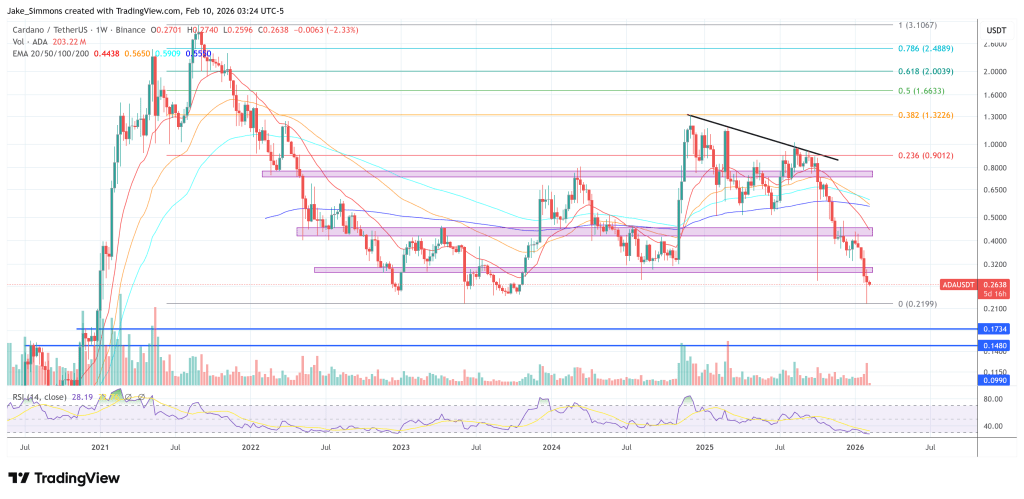
ADA hovers above key support, 1-week chart | Source: ADAUSDT on TradingView.com

Related Questions

QWhat is the main goal of the Cardano Leios upgrade and when is it targeted for release?

AThe main goal of the Cardano Leios upgrade is to significantly increase the mainnet throughput from 10-15 transactions per second to hundreds, while maintaining decentralization and security. It is targeted for release in 2026.

QAccording to Michael Smolenski, what are the two key reasons Cardano needs higher transaction throughput?

AAccording to Michael Smolenski, Cardano needs higher transaction throughput to compete and drive further adoption, and to allow stake pool operators (SPOs) to support their operational costs from transaction fees, which requires a network usage of around 50 TPS.

QHow does Charles Hoskinson position the significance of Ouroboros Leios beyond just transaction speed?

ACharles Hoskinson positions Ouroboros Leios as a resolution to the blockchain trilemma, claiming it achieves decentralization, security, and scalability simultaneously, which is considered the hardest problem in consensus and blockchain.

QWhat is the safety mechanism described for the Leios protocol if it fails?

AIf the Leios protocol fails, it is engineered to degrade safely by collapsing back to the previous Ouroboros Praos protocol, as demonstrated in a past network incident where Cardano split and then recovered by itself.

QWhat longer-term advantage does Hoskinson suggest is more important than pure technical differentiation for Cardano?

AHoskinson suggests that Cardano's on-chain governance and treasury, controlled by ADA holders and containing about a billion dollars, is the longer-term advantage as it provides the mechanism to fund future upgrades and coordinate change.

Related Reads

Uncovering the Truth About Agent Commerce, Payments, and Infrastructure

Decoding Agent Commerce, Payments, and Infrastructure: The Reality Over the past year, I've been building infrastructure for the Agent economy, engaging with major players like Stripe, Visa, Coinbase, Google, and dozens of startups. A clear conclusion emerges: true, large-scale demand does not yet exist. Startups face structural challenges. Data points illustrate this gap. Stripe's Agent commerce platform has over 1,000 merchants but only single-digit transacting agents. Visa's Agent payment token requires 9-month KYC and a $250M revenue threshold, accessible only to giants like Amazon. On-chain analysis reveals actual daily Agent transaction volume is around $17k, half of which are test transactions. The article analyzes four potential markets: **1. Agent-to-Merchant (A2M):** Current AI shopping UX is often inferior to traditional e-commerce for visual, comparison-heavy purchases (clothing, electronics). Chat interfaces are a step back. Real merchant interest is defensive "Agent Engine Optimization," fearing future obsolescence, not current demand. Potential exists in high-frequency, low-decision purchases (e.g., food delivery) or simplifying terrible UX (complex checkouts, non-native shoppers), but these require massive consumer distribution channels dominated by giants like DoorDash and Amazon. **2. Agent-to-API (A2A):** Developers already have subscriptions and billing for core APIs (compute, data). The argument for micro-payments via crypto for sub-dollar API calls is addressed by pre-paid balances today. The deeper issue is supplier resistance; major SaaS firms rely on enterprise contracts, not fractional cent pricing. Opportunity lies in the long tail of niche services, but this is a smaller market catering to developers, a historically low-paying group. **3. Agent-to-Agent (A2A):** This remains a theoretical long-term vision with near-zero current transaction volume. It involves unique challenges: discovery, trust, negotiation, dispute resolution. When it materializes, it will require a fundamentally new settlement infrastructure for high-speed, variable-value, multi-party transactions. It's a real long-term bet, but not the current market. **4. Agent-to-Finance (A2F):** This is the only category with existing, paying demand. Integrating AI into financial workflows (trading, portfolio management) is a natural evolution and enables new capabilities like autonomous rebalancing. However, competition favors incumbents with regulatory licenses, compliance infrastructure, and existing client relationships. **The Real Issue:** Why is infrastructure still being built? Incumbents can afford long-term bets, and payment companies see every problem as a nail for their payment hammer. However, payment is just one piece. The core challenge is *coordination*—orchestrating work between Agents and humans, verifying outcomes, and settling results. Payment is part of settlement, which is part of coordination. Companies that solve the coordination problem will subsume payments, not the other way around. Startups lack the infinite runway of giants and must find today's real market, which, after a year of exploration, lies outside these four categories—in an area with real, growing, and underserved activity.

marsbit1h ago

Uncovering the Truth About Agent Commerce, Payments, and Infrastructure

marsbit1h ago

Kalshi, MTS, and a16z's Ambition

The article "Kalshi, MTS, and a16z's Ambition" explores prediction markets as a focal point of excitement in 2025 for investors, crypto enthusiasts, and media. It traces their intellectual lineage from Friedrich Hayek's ideas on dispersed knowledge and market coordination to Robin Hanson's Logarithmic Market Scoring Rule (LMSR), which incentivizes truthful information sharing. The piece argues that a16z's significant investment in prediction market platform Kalshi (valued at $220B) transcends mere financial speculation. a16z frames prediction markets as a new form of "media" that provides "presence"—a way for individuals to actively engage with and influence world events through financial stakes, countering postmodern detachment. By wagering on outcomes, users become "super observers," and the market's aggregated probabilities gain authoritative power to define event truth and importance. The article uses media company MTS ("Monitoring The Situation") as a case study of a16z's "new media" strategy: rapidly producing high-intensity, multi-format content to "take over the timeline." However, prediction markets like Kalshi are presented as the ultimate piece in this media empire. Their real-money, crowd-sourced probabilities possess a unique "reality distortion field" and perceived objectivity, potentially swaying public opinion and granting a private company unprecedented interpretive power over reality. Ultimately, Kalshi's immense valuation is attributed not just to its exchange model, but to its role as a foundational component in a16z's envisioned new media landscape, where prediction markets define narrative and truth.

链捕手1h ago

Kalshi, MTS, and a16z's Ambition

链捕手1h ago

Trading

Spot
Futures

Hot Articles

Discussions

Welcome to the HTX Community. Here, you can stay informed about the latest platform developments and gain access to professional market insights. Users' opinions on the price of ADA (ADA) are presented below.

活动图片