‘Capital Is Moving, Not Leaving’: What Japan’s Crypto Market Stands To Gain

bitcoinistPublished on 2025-12-20Last updated on 2025-12-20

Abstract

The crypto market is facing uncertainty and selling pressure, with Bitcoin struggling above $90,000 and Ethereum showing volatility. However, analysis by XWIN Research Japan indicates capital isn't exiting but shifting form. The total supply of ERC20 stablecoins has reached near all-time highs at $160 billion, suggesting funds are moving into stablecoins as "waiting liquidity" within the ecosystem, poised for redeployment when market direction becomes clearer. This behavior has positive implications for Japan’s crypto market. Improving regulatory clarity and tax frameworks may attract cautious domestic capital back, boosting local market depth and Japan’s global role. The yen-denominated stablecoin JPYC is key, serving not only for trading but as infrastructure for real economic applications like Web3 services and payments. The overall crypto market cap is testing critical support at the $2.9-$3.0 trillion zone, having been rejected from the $4 trillion level. While the long-term trend remains intact above the 2022-2023 base, the market is in a corrective phase. Holding current support is crucial to avoid a deeper retracement.

The crypto market is entering a phase marked by rising uncertainty and persistent selling pressure, as major assets struggle to regain bullish momentum. Bitcoin remains capped below the $90,000 level, repeatedly failing to attract enough demand to flip resistance into support.

At the same time, Ethereum is experiencing heightened volatility and renewed selling pressure, reflecting broader risk aversion across the market. Sentiment has weakened, and price action suggests that investors are becoming increasingly selective rather than aggressively positioning for upside.

However, according to an analysis by XWIN Research Japan, the most important shift currently unfolding in crypto is not visible directly in price charts but in how and where capital is being positioned. On-chain data shows that global liquidity within the crypto ecosystem has not exited the market. Instead, it has changed form.

The total supply of ERC20-based stablecoins has expanded to approximately $160 billion, hovering near all-time highs. While this supply briefly contracted during the risk-off environment of 2022, it has since resumed a clear and sustained upward trend.
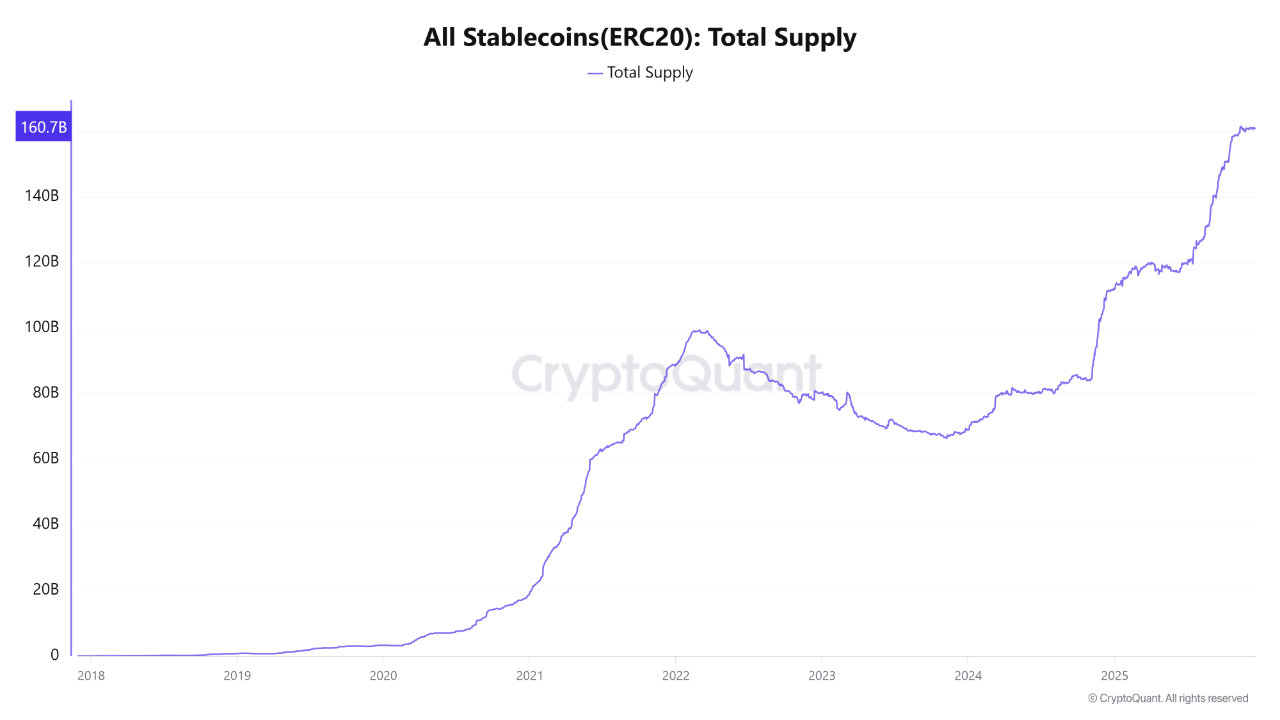
All Stablecoins (ERC20) Total Supply | Source: CryptoQuant

This behavior does not signal capital fleeing crypto. Rather, it reflects funds temporarily de-risking while remaining fully inside the ecosystem. Capital is accumulating in stablecoins as “waiting liquidity,” positioned on the sidelines and ready to be deployed once clearer directional signals emerge. Liquidity has not disappeared; it is simply paused, patient, and awaiting conviction.

The analysis also highlights that this shift in global capital behavior carries meaningful implications for Japan’s crypto market. As regulatory clarity improves and tax frameworks gradually become more accommodating, Japan is positioned to benefit from a return of domestic capital that has remained cautious in recent years.

Combined with renewed interest from individual investors, this re-entry of sidelined capital could deepen local liquidity, improve price discovery, and strengthen Japan’s role within the broader global crypto landscape.

A key element in this transition is the growing relevance of JPYC, Japan’s yen-denominated stablecoin. While US dollar–based stablecoins continue to dominate global crypto flows, a yen-native digital currency offers Japan a strategic differentiator.

JPYC is not limited to speculative trading use cases; it is increasingly viewed as an infrastructure layer capable of supporting real economic activity. This includes integration with Web3 services, as well as domestic and cross-border payment applications that align more closely with Japan’s existing financial systems.

Looking ahead, the report suggests Japan’s crypto market may gradually shift away from a narrow focus on short-term price speculation. Instead, it could evolve into an ecosystem where capital actively circulates and is deployed for practical use cases. Ultimately, how effectively Japan absorbs and channels this globally mobile liquidity will play a central role in defining the market’s next phase of growth.

Crypto Market Tests Structural Support Amid Broad Risk-Off Sentiment

The total cryptocurrency market capitalization is showing clear signs of structural stress after failing to sustain momentum above recent highs. As the weekly chart highlights, total market cap has retraced toward the $2.9–$3.0 trillion zone, an area that now acts as a critical inflection point for the broader market. This level coincides with the rising 100-week and 200-week moving averages, reinforcing its importance as medium- to long-term support.
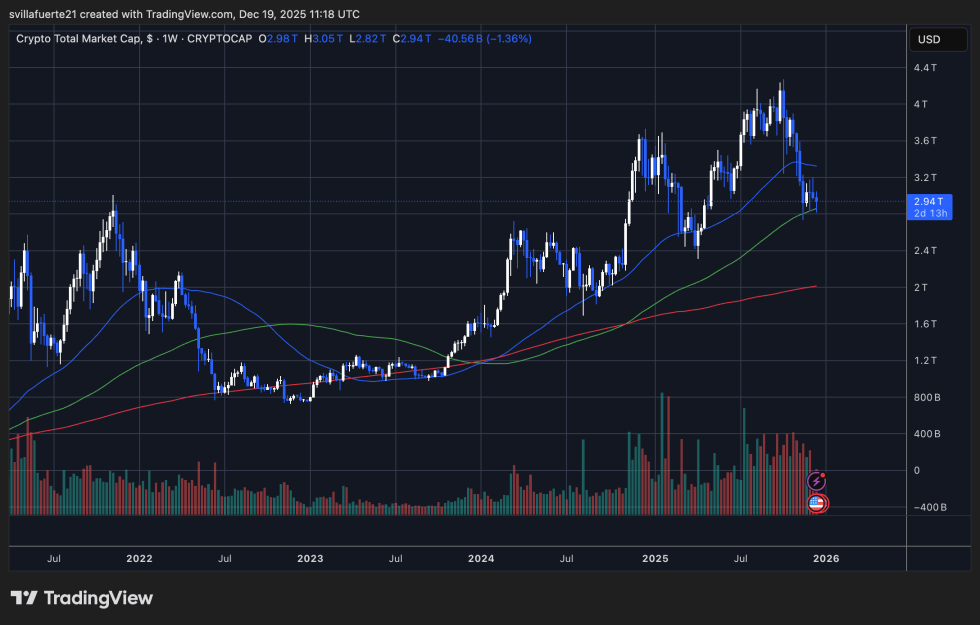
Total Crypto Market testing structural demand | Source: TOTAL chart on TradingView

The rejection from the $4 trillion region marks a decisive shift in market structure. After an extended expansion phase through 2024 and early 2025, the market has entered a corrective regime characterized by lower highs and weakening upside follow-through. Volume behavior supports this interpretation: selling pressure has increased during down weeks, while rebound attempts have been met with comparatively muted participation.

Despite the pullback, the long-term trend has not fully broken. The market remains well above the 2022–2023 base, suggesting this move resembles a consolidation or valuation reset rather than a full structural collapse. However, continued trading below the short-term moving averages indicates that risk appetite remains subdued.

For the bullish structure to reassert itself, the total market cap must stabilize above the $3 trillion threshold and reclaim the mid-range resistance near $3.3–$3.5 trillion. Failure to hold current support would expose the market to a deeper retracement toward the $2.4–$2.6 trillion region, where stronger historical demand previously emerged.

Featured image from ChatGPT, chart from TradingView.com

Trending Cryptos

Related Questions

QAccording to the analysis by XWIN Research Japan, what is the most important shift currently happening in the crypto market that is not directly visible on price charts?

AThe most important shift is not visible directly in price charts but in how and where capital is being positioned. Global liquidity has not exited the market; instead, it has changed form, with capital accumulating in stablecoins as 'waiting liquidity'.

QWhat does the expansion of the total supply of ERC20-based stablecoins to near all-time highs indicate about capital behavior?

AIt indicates that capital is not fleeing the crypto market. Instead, funds are temporarily de-risking while remaining inside the ecosystem, accumulating in stablecoins as liquidity that is waiting on the sidelines, ready to be deployed when clearer market signals emerge.

QHow is Japan's crypto market specifically positioned to benefit from the current global shift in capital?

AAs regulatory clarity improves and tax frameworks become more accommodating, Japan is positioned to benefit from a return of domestic capital that has been cautious. This, combined with renewed interest from individual investors, could deepen local liquidity and strengthen Japan's role in the global crypto landscape.

QWhat role does the yen-denominated stablecoin JPYC play in Japan's crypto market evolution?

AJPYC offers Japan a strategic differentiator. It is not just for speculative trading but is increasingly viewed as an infrastructure layer capable of supporting real economic activity, including integration with Web3 services and domestic and cross-border payment applications aligned with Japan's financial systems.

QWhat is the critical inflection point for the total cryptocurrency market capitalization mentioned in the article, and why is it significant?

AThe critical inflection point is the $2.9–$3.0 trillion zone. It is significant because it acts as medium- to long-term support, coinciding with the rising 100-week and 200-week moving averages. Holding this level is crucial for the bullish structure to reassert itself; failure could lead to a deeper retracement.

Related Reads

Jito Revives with New Exchange JTX Buyback: Self-Salvation or Lifeline?

Jito, a Solana-based MEV and liquid staking infrastructure protocol, has announced new governance proposal JIP-38 and the launch of a new self-custody trading platform, JTX. The proposal establishes a rigid value-capture mechanism, mandating that 100% of the DAO's share of revenue from JTX—80% of its platform fees—will be used for programmatic, on-chain verifiable open market buybacks and permanent burns of the JTO token. This commitment is set to last at least from JTX's launch until Q4 2027. The move comes as Jito faces significant challenges in its core liquid staking market, with protocol-staked SOL declining from 18 million to under 10 million. Intense competition from protocols like Sanctum and Jupiter, coupled with continuous monthly token unlocks (1.15% of max supply), has pressured JTO's price, which fell over 96% from its all-time high to a low of $0.21 earlier this year, before recovering to around $0.63. JIP-38 formalizes Jito Network as a "token-centric" network, where all major revenue streams flow to the DAO for governance by JTO holders. While the JTX buyback is a firm commitment using new revenue, decisions on other income streams and the post-2027 strategy will be determined by future governance votes. The proposal is seen as a strategic pivot to create a new revenue source and directly align token value with ecosystem growth, though its success depends heavily on JTX's ability to compete effectively in the crowded Solana trading landscape.

Foresight News1h ago

Jito Revives with New Exchange JTX Buyback: Self-Salvation or Lifeline?

Foresight News1h ago

Trading

Spot

Hot Articles

Discussions

Welcome to the HTX Community. Here, you can stay informed about the latest platform developments and gain access to professional market insights. Users' opinions on the price of S (S) are presented below.

活动图片