Trump Uses Senator's Death to Pressure Congress: Calls for Passing Cryptocurrency Market Structure Act in Graham's Name

marsbitPublished on 2026-07-14Last updated on 2026-07-14

Abstract

Former President Donald Trump is urging the Senate to pass the Crypto Asset Regulatory Transparency and Innovation (CLARITY) Act as a tribute to the late Senator Lindsey Graham, who passed away last weekend. In a Truth Social post, Trump claimed Graham was a "strong supporter" of the bill, which aims to shift primary regulatory oversight of digital assets from the SEC to the CFTC. However, Graham, who served since 2003, was not on relevant banking or agriculture committees and had no recorded votes or public statements directly advocating for the CLARITY Act, though he did vote for a stablecoin bill in 2025. The bill faces significant Democratic opposition, with several senators demanding the inclusion of conflict-of-interest provisions related to Trump's connections to various crypto projects. Furthermore, with Graham's death and Senator Mitch McConnell hospitalized, the Republican majority in the Senate has narrowed to 51-47. Passing the CLARITY Act requires 60 votes, meaning substantial Democratic support is needed. The Senate has only four weeks left before its August recess, creating a tight legislative window. Some Republican senators, like Cynthia Lummis, have echoed Trump's sentiment, but the path to 60 votes remains highly uncertain.

Author: Turner Wright

Compiled by: TechFlow

TechFlow Insights: U.S. Senator Lindsey Graham passed away last weekend. Shortly after, Trump took to social media to urge the Senate to pass the cryptocurrency market structure bill, the CLARITY Act, "in Graham's name." However, Graham had not directly championed this bill during his lifetime. Meanwhile, the Republican majority in the Senate has narrowed to 51-47, making it significantly harder for the bill to meet the 60-vote threshold required for passage.

U.S. President Trump is pressing the Senate to pass the "Clarity for Digital Assets Act" (CLARITY Act), citing the need to "honor" Senator Lindsey Graham, who passed away last weekend.

In a Truth Social post on Monday, Trump stated that Graham had been a "strong supporter" of the CLARITY Act and called on the Senate to pass it promptly. The Senate has only four weeks left before its August recess, leaving a very short legislative window. Graham died last Saturday at the age of 71.
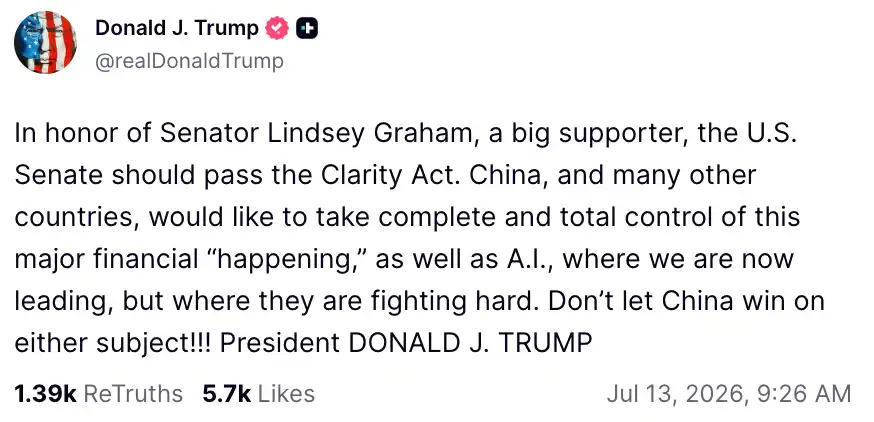
Caption: Screenshot of Trump's post on Truth Social

However, the reality is that Graham, who served as a senator from South Carolina since 2003, was not a member of either the Banking Committee or the Agriculture Committee in this Congress and had not voted on the CLARITY Act's advancement. He voted in favor of the stablecoin bill, the GENIUS Act, in 2025 but had not publicly expressed direct support for the CLARITY Act.

The Core Controversy of the CLARITY Act

The core of the CLARITY Act is to significantly shift regulatory and enforcement authority over digital assets from the SEC to the CFTC. This is a long-sought outcome by the crypto industry, which has viewed SEC enforcement as overly aggressive.

But resistance from Senate Democrats is strong. Several Democratic senators have explicitly stated they will not vote in favor of the bill unless it includes provisions addressing conflicts of interest between lawmakers and the crypto industry. Democrats are referring to Trump's connections to several crypto projects, including his memecoin and his family's World Liberty Financial.

The Vote Dilemma: How to Clear the 60-Vote Threshold?

With Graham's death and Senator Mitch McConnell hospitalized, the Republican majority in the Senate has shrunk to 51-47. To pass the CLARITY Act, 60 votes are needed, meaning Republicans must secure additional Democratic support.

Cointelegraph reached out to the offices of Senators Tim Scott, Kirsten Gillibrand, and Angela Alsobrooks for comment but did not receive an immediate response.

Senator Cynthia Lummis expressed support for Trump's statement on X on Monday, saying Graham "was passionate about ensuring America leads in all areas, including digital assets." Cointelegraph also contacted Lummis's office seeking clarification on Graham's specific stance on digital assets but likewise received no response.


Trending Cryptos

Related Questions

QAccording to the article, what specific legislative action did Trump urge the Senate to take in the wake of Senator Graham's death?

APresident Trump urged the Senate to pass the digital asset market clarity bill, the CLARITY Act, in order to "honor" or "in the name of" the late Senator Lindsey Graham.

QWhat is the main regulatory change proposed by the CLARITY Act as described in the article?

AThe core of the CLARITY Act is to shift the primary regulatory and enforcement authority over digital assets from the Securities and Exchange Commission (SEC) to the Commodity Futures Trading Commission (CFTC).

QWhat challenge does the Senate face in passing the CLARITY Act, specifically regarding the vote count?

AThe Senate faces the challenge of reaching a 60-vote threshold to pass the CLARITY Act. With the Republican majority reduced and Democratic resistance, Republicans must secure additional votes from Democratic senators to achieve this supermajority.

QWhy are some Democratic senators reportedly resisting the CLARITY Act, according to the article?

ASome Democratic senators are resisting the CLARITY Act because they demand the inclusion of provisions addressing potential conflicts of interest between lawmakers and the crypto industry, specifically citing connections between Trump and various crypto projects.

QWhat evidence does the article present to counter Trump's claim that Senator Graham was a strong supporter of the CLARITY Act?

AThe article counters Trump's claim by stating that Graham was not a member of the relevant Senate committees (Banking or Agriculture), never voted specifically on the CLARITY Act, and did not make any public statements directly supporting it, though he did vote for a related stablecoin bill (GENIUS Act) in 2025.

Related Reads

Jito Revives with New Exchange JTX Buyback: Self-Salvation or Lifeline?

Jito, a Solana-based MEV and liquid staking infrastructure protocol, has announced new governance proposal JIP-38 and the launch of a new self-custody trading platform, JTX. The proposal establishes a rigid value-capture mechanism, mandating that 100% of the DAO's share of revenue from JTX—80% of its platform fees—will be used for programmatic, on-chain verifiable open market buybacks and permanent burns of the JTO token. This commitment is set to last at least from JTX's launch until Q4 2027. The move comes as Jito faces significant challenges in its core liquid staking market, with protocol-staked SOL declining from 18 million to under 10 million. Intense competition from protocols like Sanctum and Jupiter, coupled with continuous monthly token unlocks (1.15% of max supply), has pressured JTO's price, which fell over 96% from its all-time high to a low of $0.21 earlier this year, before recovering to around $0.63. JIP-38 formalizes Jito Network as a "token-centric" network, where all major revenue streams flow to the DAO for governance by JTO holders. While the JTX buyback is a firm commitment using new revenue, decisions on other income streams and the post-2027 strategy will be determined by future governance votes. The proposal is seen as a strategic pivot to create a new revenue source and directly align token value with ecosystem growth, though its success depends heavily on JTX's ability to compete effectively in the crowded Solana trading landscape.

Foresight News1h ago

Jito Revives with New Exchange JTX Buyback: Self-Salvation or Lifeline?

Foresight News1h ago

The More Proficient AI Becomes at Answering, Why Do Humans Need Deep Thinking More? Fudan Releases the 2026 Blue Book on Intelligent Development in Humanities and Social Sciences

As AI capabilities rapidly expand, particularly in generating sophisticated text, analyzing data, and automating complex tasks, the need for human deep thinking becomes more critical, not less. The "2026 Blue Paper on Intelligent Development for Humanities and Social Sciences" from Fudan University argues that the relationship between AI and these fields is shifting from "one-way empowerment" to "bidirectional fusion." While AI transforms research methodologies, the humanities must guide its purpose, application, and governance. The core challenge is no longer processing vast information, but defining worthwhile problems, establishing genuine causal mechanisms, and constructing verifiable evidence chains. AI excels at producing coherent, fluent outputs but risks oversimplifying complex social realities into standardized formats it can easily process. For instance, in areas like climate-society systems, the difficulty lies not in handling more variables, but in understanding the fundamental mismatches between natural and social systems. Similarly, in automated research, AI can efficiently search for statistically significant results or generate papers quickly, potentially masking flawed assumptions or "packaging" statistical noise as discovery. The speed of paper production does not equate to the speed of genuine knowledge advancement. This underscores the non-transferable human responsibility for judgment. Deep thinking must be embedded into research workflows, governance systems, and organizational structures. Key principles include: * **Maintaining the Evidence Chain:** While AI can handle tasks like data processing, researchers must retain oversight over problem definition, conceptual translation into metrics, causal interpretation, and defining the scope of conclusions. Frameworks like STRIDES aim to document decisions and enable audit trails. * **Ensuring Meaningful Human Oversight:** In public governance, AI systems should operate in an "assistive" rather than an "agentic" mode. Human operators must retain genuine intervention, correction, and explanation rights to prevent "responsibility theater," where humans merely rubber-stamp algorithmic decisions. * **Translating Principles into Practice:** AI governance needs enforceable mechanisms across a system's lifecycle—pre-deployment risk assessment, runtime monitoring and human-in-the-loop controls, and post-hoc review and accountability—tailored to the level of risk involved. * **Defining Direction, Not Just Answers:** Humanities and social sciences provide the essential framework for navigating value conflicts (e.g., efficiency vs. fairness) and analyzing the social consequences of technology, questions AI alone cannot resolve. Building lasting capacity requires more than isolated projects. It demands integrated infrastructure—shared data standards, tools, interdisciplinary training, and collaborative mechanisms—as measured by initiatives like the "Chinese Universities AI4SSH Index." The ultimate imperative is clear: as AI becomes better at answering questions, humans must become more deliberate and responsible in deciding which questions are worth asking, critically evaluating the answers, and steering the technology's impact on society.

marsbit1h ago

The More Proficient AI Becomes at Answering, Why Do Humans Need Deep Thinking More? Fudan Releases the 2026 Blue Book on Intelligent Development in Humanities and Social Sciences

marsbit1h ago

Trading

Spot

Hot Articles

Discussions

Welcome to the HTX Community. Here, you can stay informed about the latest platform developments and gain access to professional market insights. Users' opinions on the price of S (S) are presented below.

活动图片