BTC Sees Largest Single-Day Short Liquidation in History: Overnight $1.1 Billion Short Positions Evaporate, But Calling a Bull Return is Premature

marsbitPublished on 2026-08-20Last updated on 2026-08-20

Abstract

Bitcoin experienced its largest single-day short liquidation in history, with approximately $1.191 billion in short positions being forcibly closed within 24 hours as the price surged nearly 7% to approach $70,000. This event, occurring on the evening of August 19, resulted in total liquidations of about $1.345 billion across the network. The massive short squeeze was attributed to a combination of catalysts: a White House meeting between former President Trump and crypto industry executives fueling regulatory optimism, and a more substantial signal from the U.S. Treasury doubling its liquidity support for long-term bond repurchases, hinting at looser macro liquidity for risk assets. Data showed strong institutional buying, with U.S. spot Bitcoin ETFs seeing significant inflows. The liquidation process itself created a feedback loop, accelerating the price rise as forced buy-backs pushed prices higher. This event surpassed the previous record for BTC perpetual short liquidations set during the volatile "5.19" period in 2021. While such extreme short liquidations have historically signaled a potential medium-term bottom formation, analysts caution that the market often undergoes weeks of consolidation and "cooling off" afterward. Current sentiment remains mixed, with the Fear & Greed Index still in "Fear" territory, and the key test for the rally being whether it can sustain momentum to challenge higher resistance levels like $75,000. The article concludes by warning against...

Author: Claude, Deep Tide TechFlow

Every miraculous escape requires short sellers as the sacrifice. Last night, Bitcoin surged with heavy volume intraday, briefly approaching the $70,000 mark. While investment communities were once again filled with the cry of 'the bull is back,' you might not know: last night witnessed the largest single-day short liquidation in crypto history, with over $1.1 billion in short positions liquidated across the network in a single day, shattering the historical record by a wide margin.

$1.1 Billion Shorts Liquidated Overnight, Setting a New Crypto Record

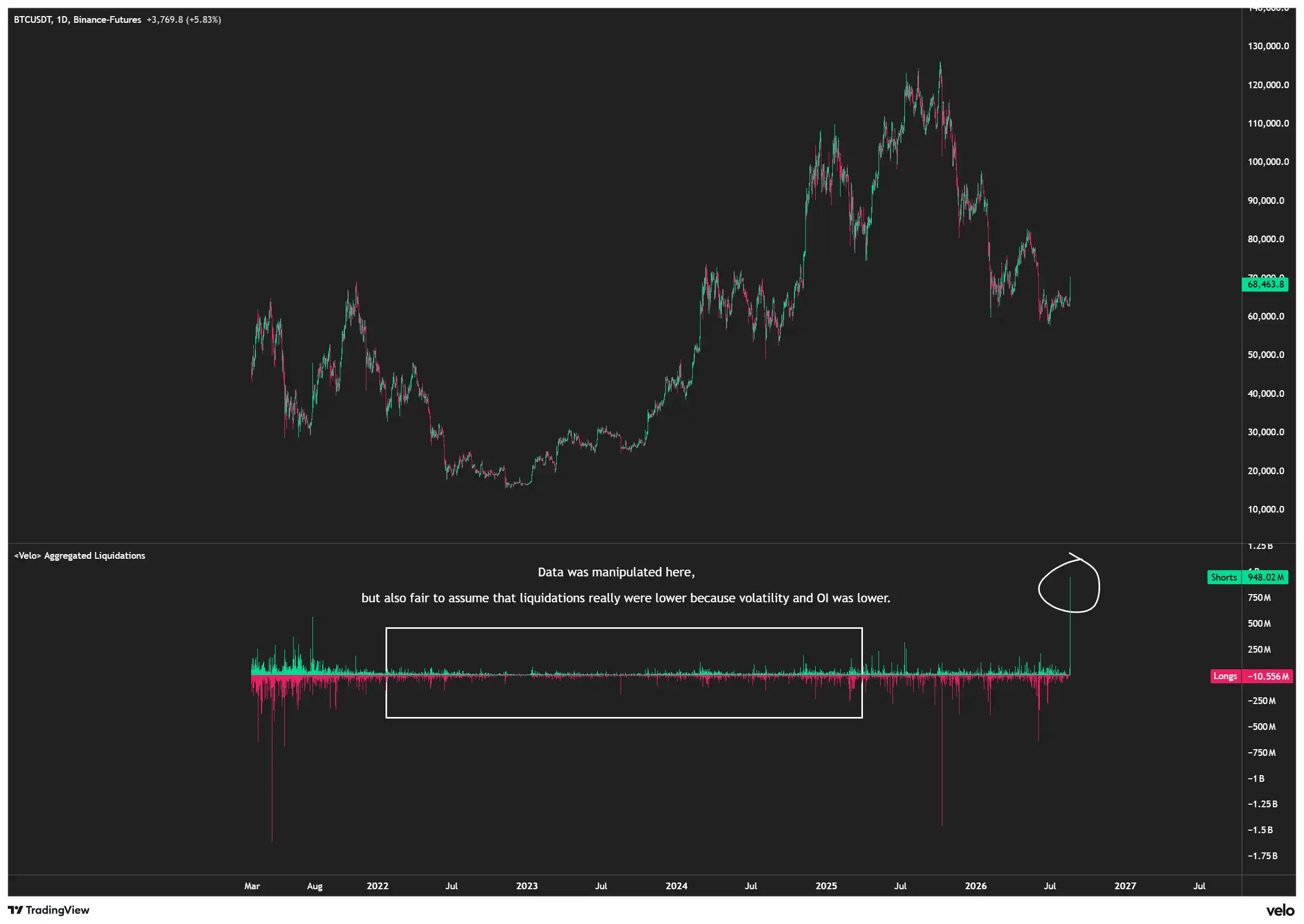
On the evening of August 19, BTC started its climb from around $64,000, gaining about 7% in one hour, with the intraday high touching $69,970, just a step away from the $70,000 threshold. This is the highest price since early June and the largest single-day gain since March.

Accompanying the surge was a bloodbath in the futures market. According to public futures data, liquidations across the network in the past 24 hours amounted to approximately $1.345 billion, involving 105,000 traders. Of this, short liquidations were about $1.191 billion, while long liquidations were only $153 million. In the most intense hour, the network saw $1.194 billion in liquidations, with short positions accounting for 93.5%.

By coin, Bitcoin short contracts were liquidated for roughly $662 million in 24 hours, and Ethereum shorts about $366 million. Leveraged positions betting on a decline were almost all wiped out at the same moment. Several whale positions on Hyperliquid, totaling nearly $200 million (high-leverage large holders), were also completely liquidated.

Liquidation itself accelerates price movement. Short liquidations mean forced buying to cover positions, creating a self-reinforcing feedback loop where higher prices trigger more liquidations, which in turn drive prices even higher.

Simultaneously, data from multiple sources indicates this is the single largest short liquidation day for Bitcoin.
White House Summit Just a Spark, the Catalyst Came from Bond Markets

The market attributed the sharp rise to two overlapping positive factors.

One was news-driven. On August 19, Trump met with executives from the crypto industry including Coinbase, Payward (Kraken's parent company), and Blockchain.com at the White House, raising market optimism about a regulatory shift.

The other was more fundamental.

On the same day, the U.S. Treasury Department announced a direct doubling of the liquidity support ceiling for long-term Treasury bond repurchases, increasing the per-operation limit from $2 billion to at least $4 billion, effective September 9.

From the crypto community's perspective, this is a more tangible signal than the summit: macro liquidity is loosening towards risk assets.

Data also confirms institutional buying. U.S. spot Bitcoin ETFs saw net inflows of $297.6 million on Monday and an additional $189 million on Tuesday; funding rates have climbed to a 20-month high. With longs crowded and shorts even more so, once the price starts moving, liquidation dominoes automatically take over.

The Last Major Short Liquidation Dates Back to 5.19

Old-timers surely remember '5.19' in May 2021: China explicitly banned financial and payment institutions from conducting virtual currency-related business. In the ensuing panic, Bitcoin plummeted from above $40,000 to near $30,000 within a day, with network-wide liquidations around $7 billion in 24 hours, setting a record at the time.

The 5.19 crash liquidated longs, washing away approximately $7.56 billion in leveraged long positions in an instant. However, in the following days, amidst the panic, a massive number of traders frantically added leveraged shorts at the bottom, only to encounter an extremely violent retaliatory rebound.

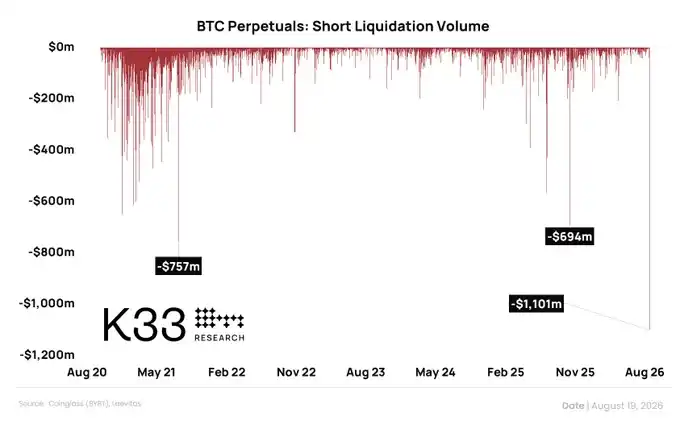
According to K33 Research citing Coinglass data, about $757 million in short positions were wiped out in a single day, becoming the largest single-day short liquidation for BTC perpetuals in history.

And it was this record that was broken yesterday.
After Major Short Liquidations, Prices Often Grind a Bottom for Weeks

If we must rely on historical parallels, major short liquidations often signal a mid-term consolidation bottom being thoroughly solidified. The deleveraging and position unwinding that follow, along with the time needed for macro liquidity to transmit to crypto, require several weeks of cold, hard consolidation and accumulation of strength.

Will this time be the same?

Currently, Bitcoin is around $69,200, with its 24-hour gain narrowing to 7.6% (as of the morning of August 20). Sentiment indicators remain hesitant: the Fear & Greed Index is at 46, still in the 'Fear' zone; on Polymarket, the probability of Bitcoin reaching $70,000 this month has jumped from before the surge to about 70%.

IG Chief Technical Analyst Axel Rudolph observed: Driven by short covering, Bitcoin is advancing towards $70,000, indicating buyer confidence is recovering. However, the key test for this rally is whether it can maintain momentum and challenge $75,000.

Times are different. History provides the script but does not guarantee the ending. Do not go all-in on 'the bull is back' in one shot.


Trending Cryptos

Related Questions

QWhat was the primary cause of the massive Bitcoin price surge on the night of August 19th according to the article?

AAccording to the article, the surge was caused by a combination of two factors. First, the market's optimistic expectations for a regulatory shift due to a White House summit meeting between industry executives and former President Trump. Second, and more fundamentally, the US Treasury's announcement to double the size of its long-term Treasury buyback operations, which was seen as a signal of easing macro liquidity flowing towards risk assets like cryptocurrencies.

QWhat historical record did Bitcoin's price action on August 19th break?

AThe article states that August 19th saw the largest single-day short liquidation in Bitcoin's history, with approximately $11.91 billion in short positions being liquidated across the entire crypto market in 24 hours, breaking the previous record.

QWhat was the previous historical record for Bitcoin's largest single-day short liquidation, and when did it occur?

AThe previous record for Bitcoin's largest single-day short liquidation was approximately $757 million. This event occurred in late May 2021, in the days following the "5.19" crash, during a violent rebound that wiped out many short positions that had been opened at the bottom.

QWhat is the potential market implication of a top-tier short liquidation event like this one, based on historical patterns mentioned in the article?

ABased on historical patterns mentioned, a top-tier short liquidation event often signals that a medium-term cyclical bottom has been firmly established. However, it is typically followed by several weeks of cold, consolidating price action and accumulation as leverage is purged from the market and macro liquidity conditions gradually translate into crypto price movements.

QAccording to market data cited in the article, what was the state of trader sentiment indicators (like the Fear & Greed Index) after the price surge?

ADespite the price surge, trader sentiment indicators remained cautious. The article notes that the Fear & Greed Index was at 46, still in the 'Fear' zone, indicating that market participants were not yet overwhelmingly bullish.

Related Reads

UBS Research Report Analysis: Murata's MLCC Factory Opens to the Public for the First Time in 20 Years, 20% Production Increase Potential from Optimization of Existing Assets

On August 18, UBS analysts visited Murata's Fukui Takefu factory, its first public opening in about 20 years. As the global MLCC leader with ~35% market share, this plant serves as the mother factory for advanced MLCCs used in AI servers and premium smartphones. UBS confirmed key findings: deep technical barriers remain, existing equipment holds ~20% latent production capacity, and physical expansion is nearing its limits. Murata's competitive edge lies in a closed-loop system encompassing proprietary ceramic material uniformity control, capacitance-maximizing self-developed technology, and self-built production equipment—a "black box" model difficult to replicate. Its flexible segmented production system efficiently manages over 50,000 product types. With new facility construction constrained and equipment lead times lengthening, optimizing existing lines becomes a crucial, lower-cost path to increase output. Murata's strategy involves shifting generic production to overseas sites like Thailand while focusing Japanese facilities on advanced, high-margin products. UBS projects significant operating margin expansion from 15.4% in FY2026 to 37.6% in FY2029, driven by this product mix upgrade toward high-capacitance, small-size MLCCs for AI and smartphones. Primary risks include U.S. economic slowdown, technology diffusion in Asia, and circuit integration trends. UBS maintains a positive industry outlook, noting potential for guidance upgrades, and sets a 13,200 yen target price based on a 30x FY2029 P/E, implying ~76% upside contingent on successful MLCC product structure advancement.

marsbit20m ago

UBS Research Report Analysis: Murata's MLCC Factory Opens to the Public for the First Time in 20 Years, 20% Production Increase Potential from Optimization of Existing Assets

marsbit20m ago

Arthur Hayes: Awaiting Fed Signal, Replenishing Ammo to Position for Crypto Bull Market

Arthur Hayes, co-founder of BitMEX, argues that the yen is significantly undervalued and analyzes three potential paths for its appreciation. He dismisses the first two options—the Bank of Japan raising interest rates or Japanese institutions selling foreign assets—as politically or economically unfeasible. Instead, he identifies the preferred method: Japan's Ministry of Finance (MOF) using the Federal Reserve's FIMA (Foreign and International Monetary Authorities) repo facility to borrow dollars against its U.S. Treasury holdings, then selling those dollars to buy yen in the forex market. Hayes explains that U.S. Treasury Secretary "Besant" has already called for removing the FIMA per-counterparty limit to enable this. The execution depends on Fed Chair "Warsh" convening a subcommittee to adjust the FIMA rules. Hayes is confident this will happen, signaling a major shift in USD/JPY dynamics and the end of the "cheap" yen era. He connects this potential massive dollar liquidity injection directly to a surge in asset prices, particularly Bitcoin, physical gold, and gold miners' stocks, drawing parallels to the Fed's balance sheet expansion during COVID-19. Within crypto, besides Bitcoin, he views Ethereum as undervalued and highlights Ethena (ENA) as a high-potential, speculative altcoin that could see 5-10x returns if liquidity increases and boosts Bitcoin basis trade yields. Hayes concludes he is waiting for the Fed's signal to fully deploy capital, anticipating a significant crypto bull market.

marsbit59m ago

Arthur Hayes: Awaiting Fed Signal, Replenishing Ammo to Position for Crypto Bull Market

marsbit59m ago

Websea Global RWA Summit Successfully Held: Focusing on New Opportunities in China-Kazakhstan Digital Economy, Releasing Signals of Cross-border Collaboration

Websea Global RWA Summit Successfully Held: Focusing on China-Kazakhstan Digital Economy Opportunities, Releasing Signals for Cross-Border Synergy When traditional industries seek new channels for globalization and digital technologies reshape capital, assets, and collaboration methods, an industrial dialogue connecting China, Kazakhstan, and global markets took place in Almaty. On August 18, 2026, the "2026 Global RWA Real-World Asset Tokenization Enterprise Globalization Resource Matching & China-Kazakhstan Industrial Investment Conference," co-hosted by Websea, concluded successfully in Almaty, Kazakhstan. Centered on RWA digitization, cross-border industrial synergy, and investment promotion, the summit gathered industry representatives, investors, digital economy practitioners, creators, and media from China and Kazakhstan to explore the future of a digital economy community. The event shifted focus from mere "project showcases" to fostering deeper "industrial synergy." It featured project roadshows and panel discussions on topics like "Mining Future·Digital Empowerment," "Real Estate Renewal·Urban Evolution," "Green Energy·RWA Opportunities," and "The Globalization Logic of Real Economy." Mr. Yerbol Kharbayev, Chairman of the Kazakhstan Association of Special Economic Zones, emphasized that RWA's significance lies not only in technology but in enhancing asset transparency, collaboration efficiency, and cross-border connectivity through digitization. The discussions highlighted a move towards a deeper "Digital Economy Community" between China and Kazakhstan. Key points included the need for an open, transparent, and stable business environment to attract long-term investment and the crucial role of synergy between governments, enterprises, platforms, and communities. The summit facilitated strategic cooperation signings and targeted B2G/B2B matching, providing a direct channel for Chinese enterprises exploring the Central Asian market. As an invited digital asset platform, Websea participated in brand presentations and the launch of initiatives like a Creator Alliance and a Web3 MCN agency. Herbert Sim, Global CMO of Websea, stated that platform development is fundamentally rooted in user trust and real experience. He expressed gratitude for user and partner trust, underscoring Websea's commitment to asset security, transaction experience, risk awareness, and user rights protection. Websea aims to contribute to the global digital economy through optimized services and open collaboration. The summit also launched the Web3 Beauty Alliance - Central Asia Chapter, a China-Kazakhstan Quality Creator Alliance, and Web3 MCN agencies, expanding the dialogue beyond industry and capital to include technology, content, community, and brand building. The event concluded by signaling that the future of the digital economy will be co-created by a broad range of participants. It requires institutional and infrastructural support, long-term commitment from enterprises, and the sustained trust of users, partners, and communities. With the summit's conclusion, a new chapter in China-Kazakhstan industrial synergy and digital economy cooperation has begun. Websea will use this as a starting point to continue exploring a secure, open, and sustainable digital future alongside global users and partners.

marsbit1h ago

Websea Global RWA Summit Successfully Held: Focusing on New Opportunities in China-Kazakhstan Digital Economy, Releasing Signals of Cross-border Collaboration

marsbit1h ago

Trading

Spot

Hot Articles

What is $BITCOIN

DIGITAL GOLD ($BITCOIN): A Comprehensive Analysis Introduction to DIGITAL GOLD ($BITCOIN) DIGITAL GOLD ($BITCOIN) is a blockchain-based project operating on the Solana network, which aims to combine the characteristics of traditional precious metals with the innovation of decentralized technologies. While it shares a name with Bitcoin, often referred to as “digital gold” due to its perception as a store of value, DIGITAL GOLD is a separate token designed to create a unique ecosystem within the Web3 landscape. Its goal is to position itself as a viable alternative digital asset, although specifics regarding its applications and functionalities are still developing. What is DIGITAL GOLD ($BITCOIN)? DIGITAL GOLD ($BITCOIN) is a cryptocurrency token explicitly designed for use on the Solana blockchain. In contrast to Bitcoin, which provides a widely recognized value storage role, this token appears to focus on broader applications and characteristics. Notable aspects include: Blockchain Infrastructure: The token is built on the Solana blockchain, known for its capacity to handle high-speed and low-cost transactions. Supply Dynamics: DIGITAL GOLD has a maximum supply capped at 100 quadrillion tokens (100P $BITCOIN), although details regarding its circulating supply are currently undisclosed. Utility: While precise functionalities are not explicitly outlined, there are indications that the token could be utilized for various applications, potentially involving decentralized applications (dApps) or asset tokenization strategies. Who is the Creator of DIGITAL GOLD ($BITCOIN)? At present, the identity of the creators and development team behind DIGITAL GOLD ($BITCOIN) remains unknown. This situation is typical among many innovative projects within the blockchain space, particularly those aligning with decentralized finance and meme coin phenomena. While such anonymity may foster a community-driven culture, it intensifies concerns about governance and accountability. Who are the Investors of DIGITAL GOLD ($BITCOIN)? The available information indicates that DIGITAL GOLD ($BITCOIN) does not have any known institutional backers or prominent venture capital investments. The project seems to operate on a peer-to-peer model focused on community support and adoption rather than traditional funding routes. Its activity and liquidity are primarily situated on decentralized exchanges (DEXs), such as PumpSwap, rather than established centralized trading platforms, further highlighting its grassroots approach. How DIGITAL GOLD ($BITCOIN) Works The operational mechanics of DIGITAL GOLD ($BITCOIN) can be elaborated on based on its blockchain design and network attributes: Consensus Mechanism: By leveraging Solana’s unique proof-of-history (PoH) combined with a proof-of-stake (PoS) model, the project ensures efficient transaction validation contributing to the network's high performance. Tokenomics: While specific deflationary mechanisms have not been extensively detailed, the vast maximum token supply implies that it may cater to microtransactions or niche use cases that are still to be defined. Interoperability: There exists the potential for integration with Solana’s broader ecosystem, including various decentralized finance (DeFi) platforms. However, the details regarding specific integrations remain unspecified. Timeline of Key Events Here is a timeline that highlights significant milestones concerning DIGITAL GOLD ($BITCOIN): 2023: The initial deployment of the token occurs on the Solana blockchain, marked by its contract address. 2024: DIGITAL GOLD gains visibility as it becomes available for trading on decentralized exchanges like PumpSwap, allowing users to trade it against SOL. 2025: The project witnesses sporadic trading activity and potential interest in community-led engagements, although no noteworthy partnerships or technical advancements have been documented as of yet. Critical Analysis Strengths Scalability: The underlying Solana infrastructure supports high transaction volumes, which could enhance the utility of $BITCOIN in various transaction scenarios. Accessibility: The potential low trading price per token could attract retail investors, facilitating wider participation due to fractional ownership opportunities. Risks Lack of Transparency: The absence of publicly known backers, developers, or an audit process may yield skepticism regarding the project's sustainability and trustworthiness. Market Volatility: The trading activity is heavily reliant on speculative behavior, which can result in significant price volatility and uncertainty for investors. Conclusion DIGITAL GOLD ($BITCOIN) emerges as an intriguing yet ambiguous project within the rapidly evolving Solana ecosystem. While it attempts to leverage the “digital gold” narrative, its departure from Bitcoin's established role as a store of value underscores the need for a clearer differentiation of its intended utility and governance structure. Future acceptance and adoption will likely depend on addressing the current opacity and defining its operational and economic strategies more explicitly. Note: This report encompasses synthesised information available as of October 2023, and developments may have transpired beyond the research period.

2.0k Total ViewsPublished 2025.05.13Updated 2025.05.13

What is $BITCOIN

Discussions

Welcome to the HTX Community. Here, you can stay informed about the latest platform developments and gain access to professional market insights. Users' opinions on the price of BTC (BTC) are presented below.

活动图片