BTC Falls Back to $10,000?! Bloomberg Senior Expert Gives the Most Pessimistic Prediction

比推Published on 2025-12-15Last updated on 2025-12-15

Abstract

Bitcoin has retreated below $90,000, extending a 30%+ decline from its October all-time high. The broader crypto market is under pressure, with most top assets in the red. Bloomberg Intelligence senior commodity strategist Mike McGlone issued a stark warning, predicting Bitcoin could fall to $10,000 by 2026. He argues that global markets are approaching an inflationary-to-deflationary inflection point, where risk assets like Bitcoin—viewed as highly speculative and dependent on liquidity—could face severe repricing. McGlone cites three factors: extreme wealth reversion to the mean, Bitcoin's high valuation relative to gold, and systemic oversupply of speculative crypto assets. While not all analysts agree, institutions like Standard Chartered have also lowered mid-term Bitcoin price targets. The market's direction is now tied to macro conditions, with key central bank decisions and economic data releases expected to shape the trajectory of risk assets in 2026.

Over the past weekend, the crypto market did not see a sentiment recovery. After several days of narrow-range fluctuations, Bitcoin came under significant pressure from Sunday evening to Monday U.S. stock market hours, falling below the $90,000 mark, with the intraday low once touching around $86,000. ETH dropped 3.4% to $2,980; BNB fell 2.1%; XRP declined 4%; SOL decreased 1.5%, retreating to around $126. Among the top ten cryptocurrencies by market cap, only TRX recorded a slight increase of less than 1%, while the rest were in a correction phase.
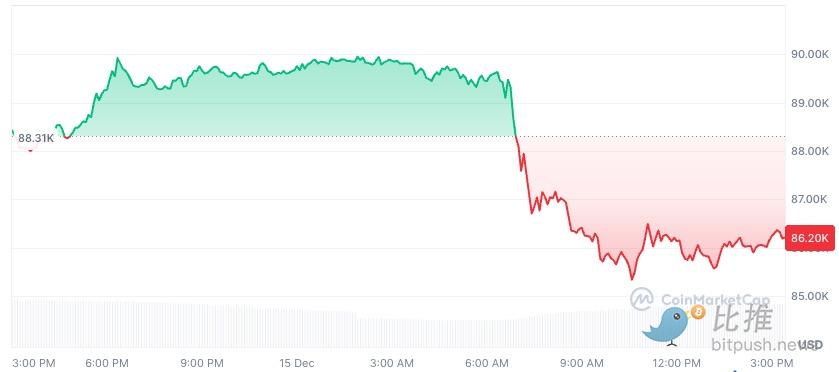
From a time perspective, this is not an isolated adjustment. Since hitting a new all-time high in mid-October, Bitcoin has accumulated a pullback of over 30%, with each rebound appearing brief and hesitant. Although ETF funds have not seen systematic outflows, marginal inflows have significantly slowed, making it difficult to provide the "sentiment foundation" for the market as before. The crypto market is transitioning from one-sided optimism to a more complex and patience-testing phase.

Against this backdrop, Mike McGlone, Senior Commodity Strategist at Bloomberg Intelligence, released a latest report, placing Bitcoin's current trend within a broader macro and cyclical framework and presenting a highly unsettling judgment: Bitcoin is very likely to fall back to $10,000 by 2026. This is not alarmist but a potential outcome under a deflationary cycle.
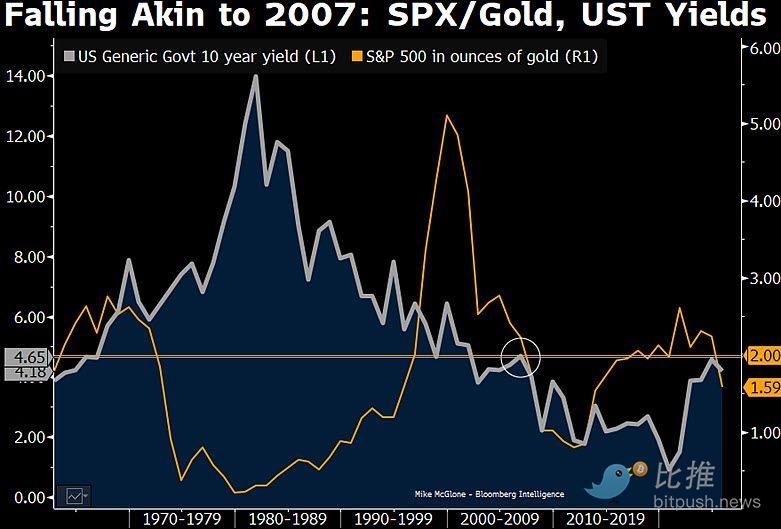
The reason this view has sparked significant controversy is not just because the number itself is "too low," but because McGlone does not treat Bitcoin as an independent crypto asset. Instead, he reexamines it within the long-term coordinate system of "global risk assets—liquidity—wealth regression."

What Comes After Inflation? McGlone Focuses Not on Crypto but on the Cycle Inflection Point

To understand McGlone's judgment, the key is not how he views the crypto industry but how he interprets the next phase of the macro environment.

In his latest views, McGlone repeatedly emphasizes a concept: Inflation/Deflation Inflection. In his view, global markets are near such a critical juncture. As inflation peaks in major economies and growth momentum slows, asset pricing logic is shifting from "fighting inflation" to "coping with deflationary pressures."
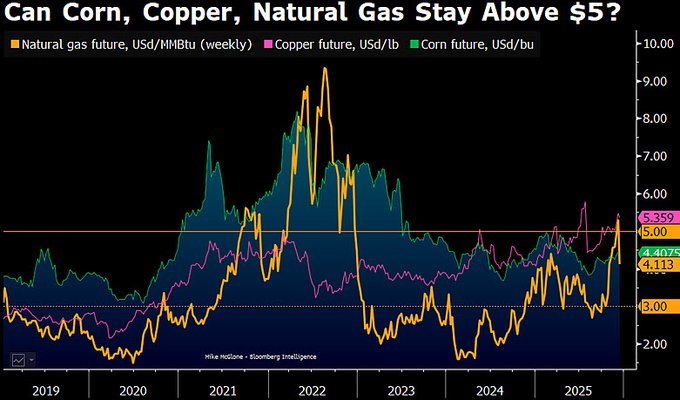
He points out that by around 2026, commodity prices may fluctuate around a key axis—the "inflation-deflation dividing line" for core commodities like natural gas, corn, and copper could settle near $5. Among these, only copper, which has real industrial demand support, might still stand above this axis by the end of 2025.

McGlone notes: When liquidity recedes, the market will重新区分 "real demand" and "financialization premium." In his framework, Bitcoin is not "digital gold" but an asset highly correlated with risk appetite and speculative cycles. When the inflation narrative recedes and macro liquidity tightens, Bitcoin tends to reflect this change earlier and more sharply.

In McGlone's view, his logic is not based on a single technical level but the叠加 of three long-term paths.

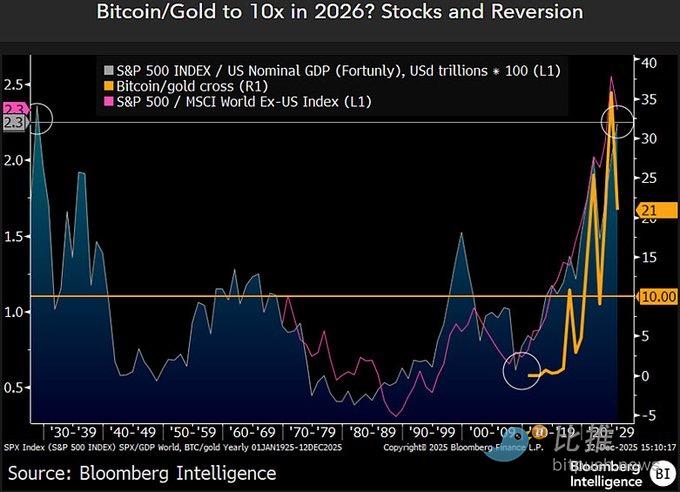
First, mean reversion after extreme wealth creation. McGlone has long emphasized that Bitcoin is one of the most extreme wealth amplifiers of the past decade-plus of loose global monetary conditions. When asset price growth long outstrips real economy and cash flow growth, the regression is not gentle but violent. Historically, whether it was the 1929 U.S. stock market or the 2000 tech bubble, the commonality of the top phase was: the market repeatedly sought a "new paradigm" at highs, and the eventual adjustment幅度, in hindsight, often far exceeded the most pessimistic expectations at the time.

Second, the relative pricing relationship between Bitcoin and gold. McGlone特别强调 the Bitcoin/Gold ratio. This ratio was about 10x at the end of 2022, then expanded rapidly driven by the bull market, reaching over 30x at one point in 2025. But this year, the ratio has fallen about 40%, dropping to around 21x. In his view, if deflationary pressures persist and gold remains firm due to safe-haven demand, it is not an激进假设 for the ratio to further return to historical ranges.
Third, systemic issues in the supply environment of speculative assets. Although Bitcoin itself has a clear total supply cap, McGlone has多次指出 that what the market is truly trading is not Bitcoin's "uniqueness" but the risk premium of the entire crypto ecosystem. When millions of tokens, projects, and narratives compete for the same risk budget, in a deflationary cycle, the entire sector tends to be uniformly discounted, and Bitcoin can hardly完全脱离 this revaluation process.

It should be noted that Mike McGlone is not a bull/bear spokesperson for the crypto market. As a senior commodity strategist at Bloomberg, he has long studied the cyclical relationships between crude oil, precious metals, agricultural products, interest rates, and risk assets. His predictions are not always precisely timed, but their value lies in: he often raises structural contrarian questions when market sentiment is most consensus-driven.

In his latest remarks, he also主动复盘 his "errors," including underestimating the timing of gold breaking through $2,000 and misjudging the节奏 of U.S. Treasury yields and U.S. stocks. But in his view, these deviations反复印证 one point: the market is most prone to illusions about trends before cycle inflection points.

Other Voices: Divergence Is Widening

Of course, McGlone's judgment is not market consensus. In fact, mainstream institutions' attitudes show clear分化.

Traditional financial institutions like Standard Chartered have recently significantly lowered their medium-to-long-term target prices for Bitcoin, reducing the 2025 expectation from $200,000 to about $100,000 and adjusting the 2026 imagination from $300,000 to around $150,000. In other words, institutions no longer assume that ETFs and corporate allocations will provide marginal buying at any price range持续.

Glassnode's research points out that Bitcoin's current consolidation range between $80,000 and $90,000 has put pressure on the market, with intensity comparable to the end of January 2022. The current market's relative unrealized losses have approached 10% of market cap. Analysts further explain that such market dynamics reflect a state of "liquidity-constrained, sensitive to macro shocks" but not yet reaching the level of a typical bear market彻底抛售 (panic selling).
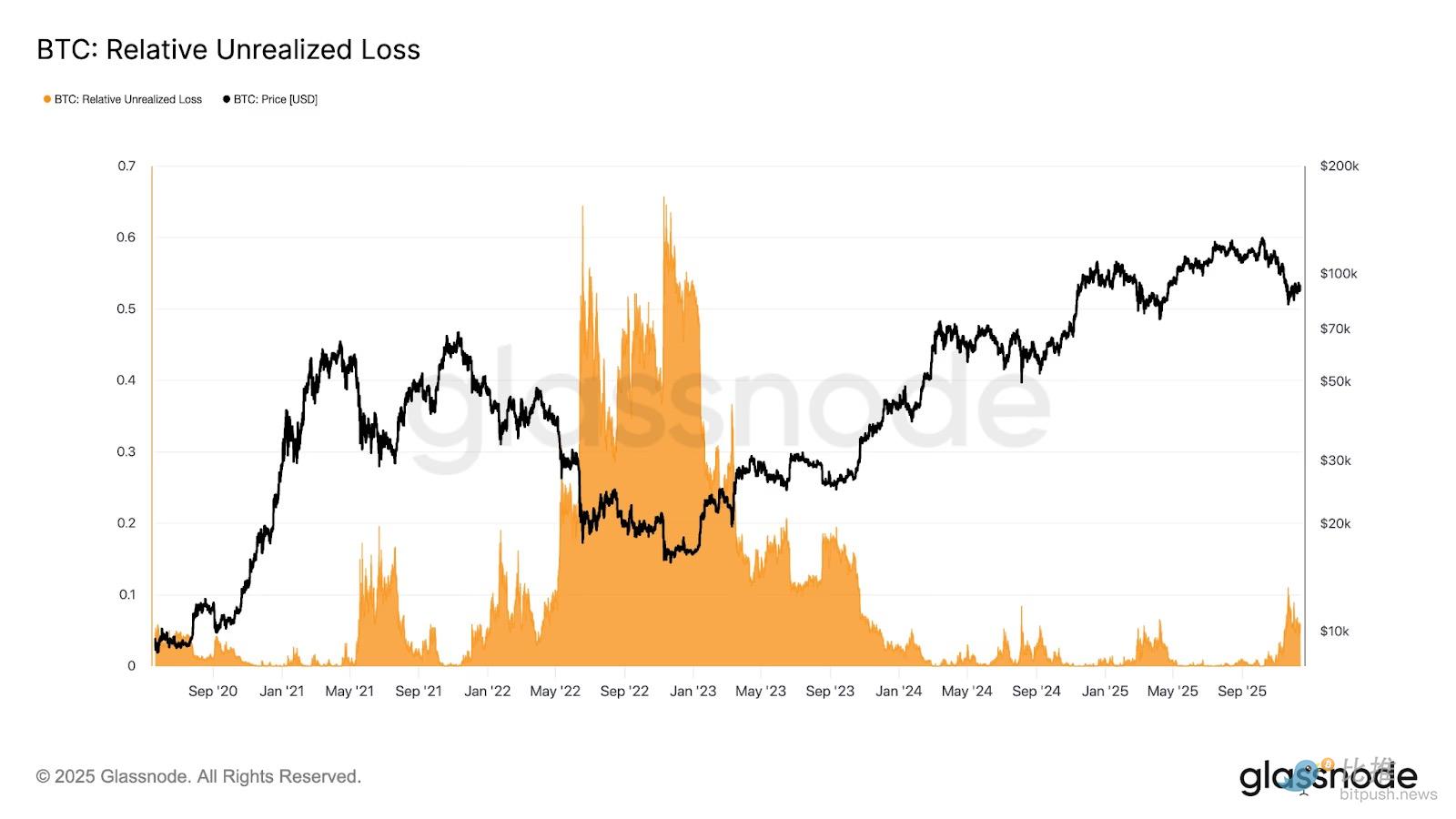
More quantitative and structure-focused 10x Research gives a more direct conclusion: they believe Bitcoin has entered the early stages of a bear market, with on-chain indicators, fund flows, and market structure all indicating that the downward cycle has not yet reached its end.

From a broader time dimension, the current uncertainty surrounding Bitcoin is no longer just an issue of the crypto market itself but is firmly embedded in the global macro cycle. The coming week is seen by many strategists as the most critical macro window of the year-end—the European Central Bank, Bank of England, and Bank of Japan will相继 announce interest rate decisions, while the U.S. will迎来 a series of delayed employment and inflation data, providing a belated "reality check" for the market.

The Fed's signal at the December 10 FOMC meeting was unusual: not only did it cut rates by 25 basis points, but there were also three dissenting votes, and Powell直言 that job growth in previous months might have been overestimated. This week's密集出炉 macro data will reshape the market's core expectations for 2026—whether the Fed can continue to cut rates or will have to press pause for a longer period. For risk assets, this answer may be more important than any single asset's bull-bear debate.

Author: Seed.eth


Twitter:https://twitter.com/BitpushNewsCN

Bitpush TG Discussion Group:https://t.me/BitPushCommunity

Bitpush TG Subscription: https://t.me/bitpush

Original link:https://www.bitpush.news/articles/7595927

Related Questions

QWhat is the most pessimistic price prediction for Bitcoin in 2026, as mentioned in the article, and who made it?

AThe most pessimistic prediction is that Bitcoin could fall back to $10,000 in 2026, made by Mike McGlone, a senior commodity strategist at Bloomberg Intelligence.

QAccording to Mike McGlone, what major macroeconomic shift is the global market approaching that could impact Bitcoin's price?

AMcGlone believes the global market is approaching an 'Inflation / Deflation Inflection' point, where the pricing logic for assets is shifting from 'fighting inflation' to 'dealing with deflationary pressures'.

QWhat key ratio does McGlone use to analyze Bitcoin's relative pricing, and what was its peak and current value?

AMcGlone uses the Bitcoin/Gold ratio. It peaked at over 30 times in 2025 and has since fallen approximately 40% to around 21 times.

QBesides McGlone prediction, which major financial institution significantly lowered its Bitcoin price target for 2025 and 2026?

AStandard Chartered significantly lowered its Bitcoin price target, reducing its 2025 forecast from $200,000 to around $100,000 and its 2026 forecast from $300,000 to about $150,000.

QWhat did the research firm 10x Research conclude about the current state of the Bitcoin market based on on-chain metrics and market structure?

A10x Research concluded that Bitcoin has entered the early stages of a bear market, with on-chain indicators, fund flows, and market structure all indicating that the downward cycle is not yet over.

Related Reads

Standard Chartered Bank Places a 40x 'Bet', Calls for UNI to Rise to $100

Standard Chartered Bank’s digital asset research head, Geoff Kendrick, initiated coverage on Uniswap with a highly bullish long-term price target of $100 for its UNI token by 2030—a roughly 40-fold increase from its ~$2.60 trading price at the time of the report. The bank’s thesis hinges on the exponential growth of tokenized real-world assets (RWA), projected to surge from ~$340 billion to $4 trillion by 2028. It expects the share of these assets deployed in DeFi to rise from 3.5% to 30%, driving total DeFi TVL to around $2.7 trillion. As the leading decentralized exchange (DEX), Uniswap is positioned to capture a significant portion of this liquidity influx. A key catalyst is Uniswap’s “fee switch,” activated in late 2024, which directs a portion of protocol fees to UNI token buybacks and burns. This transforms UNI from a pure governance token into a yield-generating, deflationary asset, narrowing its valuation gap with centralized exchanges like Coinbase. The report draws an analogy: Coinbase operates like Netflix (centralized, high-cost), while Uniswap functions like YouTube (open, user-generated, network-effect driven). Despite its dominant market share and recent institutional adoption—such as BlackRock’s BUIDL fund and Fidelity’s stablecoin using Uniswap for liquidity—the path faces challenges. Competition from Solana-based DEXs and aggregators threatens user mindshare, while regulatory delays or setbacks in RWA adoption could slow the projected growth. Furthermore, UNI remains down over 92% from its 2021 peak, reflecting persistent market skepticism. Ultimately, Standard Chartered’s report signals a shift in traditional finance’s perception of DeFi, valuing network effects and cash flow potential. However, realizing the $100 target depends on Uniswap successfully navigating intense competition, regulatory hurdles, and the multi-year timeline for massive tokenized asset adoption.

marsbit5m ago

Standard Chartered Bank Places a 40x 'Bet', Calls for UNI to Rise to $100

marsbit5m ago

For Those Still Obsessed with Altcoins, Just Go All-in on HOOD

Title: "For Those Still Fixated on Altcoins, Just Bet on HOOD" The article argues that Robinhood (HOOD) stock is a compelling alternative for investors still holding onto hopes for altcoin rallies. It highlights HOOD's recent strong performance, briefly touching $100, and expresses continued optimism. The bullish thesis is multi-faceted: HOOD's operational data for May showed record highs in key metrics like total assets and funded customers, though crypto volume was weaker. Positive catalysts include Robinhood launching its own prediction market (Rothera) to capture more revenue, gaining approval to act as an IPO underwriter for major upcoming listings, and being selected to manage the new "Trump Account" government savings program for millions of future US newborns. Insider and institutional buying, along with raised price targets, provide further confidence. The core argument is that HOOD is successfully decoupling from the crypto market's fortunes. While crypto-related revenue was once a major contributor, its share of total revenue has been declining, hitting 13% in Q1 2026. Although HOOD's price historically moved with Bitcoin, a recent divergence is noted. The author posits that Robinhood's growing equity trading, prediction markets, and IPO-related businesses can drive growth independently of a crypto bull market. Thus, HOOD offers asymmetric exposure: it stands to benefit if the crypto market recovers but is no longer wholly dependent on it. For those disillusioned with altcoins' risks, HOOD presents a potentially safer way to maintain exposure to the fintech and speculative trading space.

marsbit14m ago

For Those Still Obsessed with Altcoins, Just Go All-in on HOOD

marsbit14m ago

For Those Still Obsessed with Altcoins, Just Buy HOOD

The author expresses bullish sentiment on Robinhood (HOOD) stock, citing multiple positive catalysts. Recent monthly operational data shows record highs in key metrics like total assets, funded customers, and margin balances. On the news front, Robinhood launched its own prediction market (Rothera), received approval to act as an IPO underwriter, and was selected to manage the new "Trump Accounts" for U.S. newborns, ensuring a long-term user base. Insiders and institutions are also buying or raising price targets. The core investment thesis, however, focuses on HOOD's evolving valuation narrative. Historically viewed as a "crypto proxy," its stock price was highly correlated with Bitcoin and its revenue heavily dependent on cryptocurrency trading fees. Recent data indicates this dependence is waning: crypto-related revenue hit a multi-quarter low of 13% of total revenue in Q1 2026, and the stock price has recently decoupled from BTC's trend. The author argues HOOD is transforming into a more diversified platform. Its growth is now driven by equities, options, prediction markets, and IPO-related services. This reduces its cyclical vulnerability to crypto bear markets. Crucially, if the crypto market recovers, HOOD would still benefit from increased trading activity. Therefore, for investors still hoping for gains from altcoins but concerned about their risks and liquidity, the author suggests HOOD offers a compelling alternative with higher safety margins—it can rise with a crypto bull run but isn't reliant on one.

Odaily星球日报18m ago

For Those Still Obsessed with Altcoins, Just Buy HOOD

Odaily星球日报18m ago

Cryptocurrency & Stock Market Indicator丨SpaceX Discloses Holding 18,712 Bitcoins Worth $1.18 Billion; Strategy Spends $100 Million Two Weeks in a Row to Scoop Up BTC at Low Levels (June 16)

"Coin-Stock Barometer: SpaceX discloses holding 18,712 Bitcoin worth $1.18B; Strategy spends another $100M accumulating BTC (June 16) SpaceX has officially disclosed holding 18,712 Bitcoin in its S-1 filing, valued at ~$1.18B, becoming the 8th largest public company Bitcoin holder. Its average cost is ~$35,000 per BTC. In weekly BTC treasury news, Strategy (formerly MicroStrategy) purchased another 1,587 BTC (~$100M) last week, increasing its total to 846,842 BTC. Mara Holdings added 1,000 BTC. However, Metaplanet and others made no purchases. Nakamoto sold ~600 BTC to repay ~$45M in debt. Global public companies (excluding miners) now hold 1,121,341 BTC. In other crypto treasury developments: - Metaplanet acquired Siiibo Securities to build a Bitcoin-focused financial ecosystem in Japan. - Bitmine increased its ETH holdings by 76,881 last week. - SharpLink's cumulative ETH staking rewards surpassed 21,119 ETH. - Forward Industries' acquisition offers for two SOL treasury companies, including Brera Holdings (holding 2.1M SOL), were rejected. - Tron Inc.'s TRX holdings surpassed 700 million. - Avalanche Treasury Co. (AVAT) begins trading on Nasdaq. - AIFC detailed plans to use WLFI tokens for collateral/loans. Market perspectives on U.S. stocks vary. 'White-Haired Stock God' Serenity sees the current cycle as retail-to-institution transfers, where negative reports may signal institutional accumulation. Morgan Stanley suggests a rotation from tech to cyclical stocks could occur. Citrini believes the U.S. stock market hasn't peaked but expects frequent 10-15% pullbacks in the coming months."

marsbit24m ago

Cryptocurrency & Stock Market Indicator丨SpaceX Discloses Holding 18,712 Bitcoins Worth $1.18 Billion; Strategy Spends $100 Million Two Weeks in a Row to Scoop Up BTC at Low Levels (June 16)

marsbit24m ago

Trading

Spot
Futures

Hot Articles

What is $BITCOIN

DIGITAL GOLD ($BITCOIN): A Comprehensive Analysis Introduction to DIGITAL GOLD ($BITCOIN) DIGITAL GOLD ($BITCOIN) is a blockchain-based project operating on the Solana network, which aims to combine the characteristics of traditional precious metals with the innovation of decentralized technologies. While it shares a name with Bitcoin, often referred to as “digital gold” due to its perception as a store of value, DIGITAL GOLD is a separate token designed to create a unique ecosystem within the Web3 landscape. Its goal is to position itself as a viable alternative digital asset, although specifics regarding its applications and functionalities are still developing. What is DIGITAL GOLD ($BITCOIN)? DIGITAL GOLD ($BITCOIN) is a cryptocurrency token explicitly designed for use on the Solana blockchain. In contrast to Bitcoin, which provides a widely recognized value storage role, this token appears to focus on broader applications and characteristics. Notable aspects include: Blockchain Infrastructure: The token is built on the Solana blockchain, known for its capacity to handle high-speed and low-cost transactions. Supply Dynamics: DIGITAL GOLD has a maximum supply capped at 100 quadrillion tokens (100P $BITCOIN), although details regarding its circulating supply are currently undisclosed. Utility: While precise functionalities are not explicitly outlined, there are indications that the token could be utilized for various applications, potentially involving decentralized applications (dApps) or asset tokenization strategies. Who is the Creator of DIGITAL GOLD ($BITCOIN)? At present, the identity of the creators and development team behind DIGITAL GOLD ($BITCOIN) remains unknown. This situation is typical among many innovative projects within the blockchain space, particularly those aligning with decentralized finance and meme coin phenomena. While such anonymity may foster a community-driven culture, it intensifies concerns about governance and accountability. Who are the Investors of DIGITAL GOLD ($BITCOIN)? The available information indicates that DIGITAL GOLD ($BITCOIN) does not have any known institutional backers or prominent venture capital investments. The project seems to operate on a peer-to-peer model focused on community support and adoption rather than traditional funding routes. Its activity and liquidity are primarily situated on decentralized exchanges (DEXs), such as PumpSwap, rather than established centralized trading platforms, further highlighting its grassroots approach. How DIGITAL GOLD ($BITCOIN) Works The operational mechanics of DIGITAL GOLD ($BITCOIN) can be elaborated on based on its blockchain design and network attributes: Consensus Mechanism: By leveraging Solana’s unique proof-of-history (PoH) combined with a proof-of-stake (PoS) model, the project ensures efficient transaction validation contributing to the network's high performance. Tokenomics: While specific deflationary mechanisms have not been extensively detailed, the vast maximum token supply implies that it may cater to microtransactions or niche use cases that are still to be defined. Interoperability: There exists the potential for integration with Solana’s broader ecosystem, including various decentralized finance (DeFi) platforms. However, the details regarding specific integrations remain unspecified. Timeline of Key Events Here is a timeline that highlights significant milestones concerning DIGITAL GOLD ($BITCOIN): 2023: The initial deployment of the token occurs on the Solana blockchain, marked by its contract address. 2024: DIGITAL GOLD gains visibility as it becomes available for trading on decentralized exchanges like PumpSwap, allowing users to trade it against SOL. 2025: The project witnesses sporadic trading activity and potential interest in community-led engagements, although no noteworthy partnerships or technical advancements have been documented as of yet. Critical Analysis Strengths Scalability: The underlying Solana infrastructure supports high transaction volumes, which could enhance the utility of $BITCOIN in various transaction scenarios. Accessibility: The potential low trading price per token could attract retail investors, facilitating wider participation due to fractional ownership opportunities. Risks Lack of Transparency: The absence of publicly known backers, developers, or an audit process may yield skepticism regarding the project's sustainability and trustworthiness. Market Volatility: The trading activity is heavily reliant on speculative behavior, which can result in significant price volatility and uncertainty for investors. Conclusion DIGITAL GOLD ($BITCOIN) emerges as an intriguing yet ambiguous project within the rapidly evolving Solana ecosystem. While it attempts to leverage the “digital gold” narrative, its departure from Bitcoin's established role as a store of value underscores the need for a clearer differentiation of its intended utility and governance structure. Future acceptance and adoption will likely depend on addressing the current opacity and defining its operational and economic strategies more explicitly. Note: This report encompasses synthesised information available as of October 2023, and developments may have transpired beyond the research period.

371 Total ViewsPublished 2025.05.13Updated 2025.05.13

What is $BITCOIN

Discussions

Welcome to the HTX Community. Here, you can stay informed about the latest platform developments and gain access to professional market insights. Users' opinions on the price of BTC (BTC) are presented below.

活动图片















