BREAKING: Mastercard Just Opened Its Global Payment Network To Crypto — Which Altcoins Made The Cut?

bitcoinistPublished on 2026-06-03Last updated on 2026-06-03

Abstract

Mastercard announced the expansion of its global settlement infrastructure to support on-chain settlement using regulated stablecoins. This enables card transactions to settle 24/7, eliminating delays from traditional banking hours. The initial rollout supports six stablecoins—USDC, PYUSD, USDG, USDP, RLUSD, and SoFiUSD—across eight blockchains, including Ethereum, Solana, and the XRP Ledger. The service is launching with partners in the U.S. and Latin America. This is a back-end settlement upgrade, not a consumer-facing change, allowing network partners to optionally use blockchain rails while traditional fiat settlement remains available.

Mastercard announced on June 3 that it will expand its global settlement infrastructure to support on-chain settlement using crypto via regulated stablecoins — enabling card transactions to settle 24 hours a day, seven days a week, across weekends and holidays for the first time in the network’s history, per the company’s official press release.

Six regulated crypto and stable coins are supported in the initial rollout: Circle’s USDC, PayPal’s PYUSD, Paxos-issued USDG and USDP, Ripple’s RLUSD, and SoFi’s SoFiUSD. Settlement will operate across eight blockchain networks — Ethereum, Solana, Polygon, Base, Arbitrum, the XRP Ledger, Canton, and Tempo — per the official announcement.

ARQ (formerly DolarApp), CBW Bank, Cross River, Lead Bank, and Nuvei are among the first partners to support stablecoin settlement optionality, with the initial rollout targeting the United States and Latin America before broader expansion through 2026.
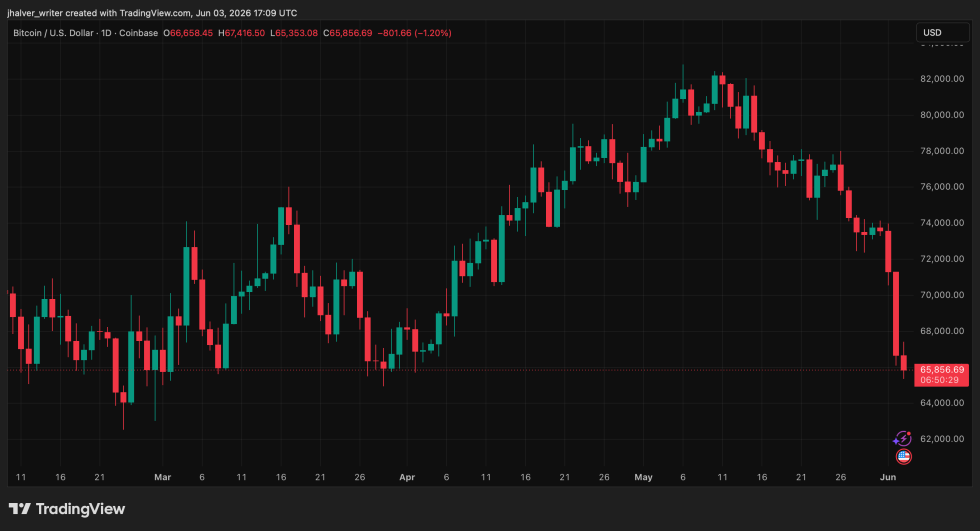
BTC's price trends to the downside on the daily chart. Source: BTCUSD on Tradingview

What Changes For Crypto — And What Doesn’t

The announcement is a settlement-layer development, not a consumer-facing product shift. Issuers and acquirers on Mastercard’s network can now choose to settle card-based transactions using regulated stablecoins on-chain rather than through traditional banking rails — or continue using existing fiat processes. Both options run in parallel. No cardholder needs to change how they pay.

What changes is the back-end infrastructure that clears and finalizes transactions between merchants, banks, and payment processors. That infrastructure can now operate on blockchain networks around the clock — removing the dead zones created by banking hours, weekend closures, and public holidays that have been a structural friction point in global payments for decades, per Mastercard’s press release.

Raj Dhamodharan, Mastercard’s Executive Vice President for Blockchain and Digital Assets, described the enhancement as expanding how partners manage liquidity while operating in an always-on digital economy, per the announcement. Ripple SVP Jack McDonald called it a landmark validation that blockchain technology is ready for the world’s most critical payment infrastructure, per Benzinga’s reporting of his statement.

This development marks a pivotal and historic moment for the nascent sector. The world’s second-largest card network opening its global settlement rails to six regulated stablecoins across eight blockchains — not as a pilot, not as a proof of concept, but as a live network-level enhancement — is the clearest institutional validation the stablecoin economy has received to date.

Cover image from Grok, BTCUSD chart from Tradingview

Related Questions

QWhat major announcement did Mastercard make on June 3 regarding its payment network?

AMastercard announced it is expanding its global settlement infrastructure to support on-chain settlement using regulated stablecoins, enabling card transactions to be settled 24/7 for the first time in the network's history.

QWhich six regulated stablecoins are supported in the initial rollout of Mastercard's new settlement system?

AThe six supported stablecoins are Circle's USDC, PayPal's PYUSD, Paxos-issued USDG and USDP, Ripple's RLUSD, and SoFi's SoFiUSD.

QHow many and which blockchain networks will this settlement system operate across according to the announcement?

ASettlement will operate across eight blockchain networks: Ethereum, Solana, Polygon, Base, Arbitrum, the XRP Ledger, Canton, and Tempo.

QWho are among the first partners to support stablecoin settlement optionality with Mastercard?

AThe first partners include ARQ (formerly DolarApp), CBW Bank, Cross River, Lead Bank, and Nuvei.

QWhat is the key difference this announcement makes for crypto transactions on Mastercard's network?

AThe announcement is a settlement-layer development, not a consumer-facing change. Issuers and acquirers can now choose to settle card transactions using regulated stablecoins on-chain, operating 24/7, instead of or alongside traditional banking rails. Cardholders' payment methods do not change.

Related Reads

What Are Some Good Paths for Chinese Web3 Entrepreneurship? (Part 5)

This article explores pathways for Chinese Web3 teams to pivot toward AI, building on a previous discussion. It focuses on two specific team profiles: **Security & Risk Control Teams:** These teams, skilled in smart contract auditing, wallet security, and on-chain monitoring, can transition to providing **Agent behavior auditing and AI security governance**. As AI Agents automate tasks, access data, and trigger payments, enterprises will need solutions to monitor permissions, audit logs, control data access, and prevent anomalies—creating a strong B2B demand. **Application & Community-Focused Teams:** Instead of completely rebranding as AI companies, these teams should use AI to **enhance their existing products**. For example, research platforms can use AI to summarize information and identify signals; community tools can automate user support and analysis; and educational products can create personalized learning paths. The key is integrating AI to solve existing user pain points, like information overload or high operational costs. The article also advises against certain AI directions for Chinese Web3 teams, such as building general-purpose large language models (too resource-intensive), creating overly broad Agent platforms (hard to monetize), developing AI traders/automated yield products (high regulatory and risk sensitivity), or simply adding superficial AI features without genuine value. The core conclusion: Successful migration depends not on chasing AI hype, but on **identifying how a team's existing Web3 capabilities—be it in data, payments, security, or user operations—can address real needs in new AI application scenarios.**

marsbit2h ago

What Are Some Good Paths for Chinese Web3 Entrepreneurship? (Part 5)

marsbit2h ago

Trading

Spot
Futures
活动图片