Breaking: Claude Introduces Mandatory Real-Name Verification, Requires Live Selfie with ID, Otherwise Immediate Account Ban

marsbitPublished on 2026-04-16Last updated on 2026-04-16

Abstract

Claude, the AI assistant by Anthropic, has introduced a mandatory real-name verification system, requiring users to submit a government-issued photo ID and a real-time selfie. This move aims to prevent misuse, enforce usage policies, and comply with legal obligations. The verification process, handled by third-party provider Persona, is triggered for certain use cases, platform integrity checks, or security measures. Users from unsupported regions, those under 18, or those violating terms of service risk account suspension—even after successful verification. The policy has sparked significant user backlash, with concerns over increased surveillance, loss of privacy, and potential disruption to workflows. Many fear the stricter controls will drive users to competitors like OpenAI’s ChatGPT, which is perceived as more stable and user-friendly. The announcement emphasizes data protection, stating that verification data is not used for model training or shared with third parties. However, users are advised to backup their data and avoid using personal subscriptions for unauthorized purposes like proxy services or multi-user setups to minimize risks.

Claude is literally putting a knife to users' throats this time!

Claude starts mandatory real-name verification: identity check activated, ID submitted, selfie taken, account ban risk immediately reaches new heights!
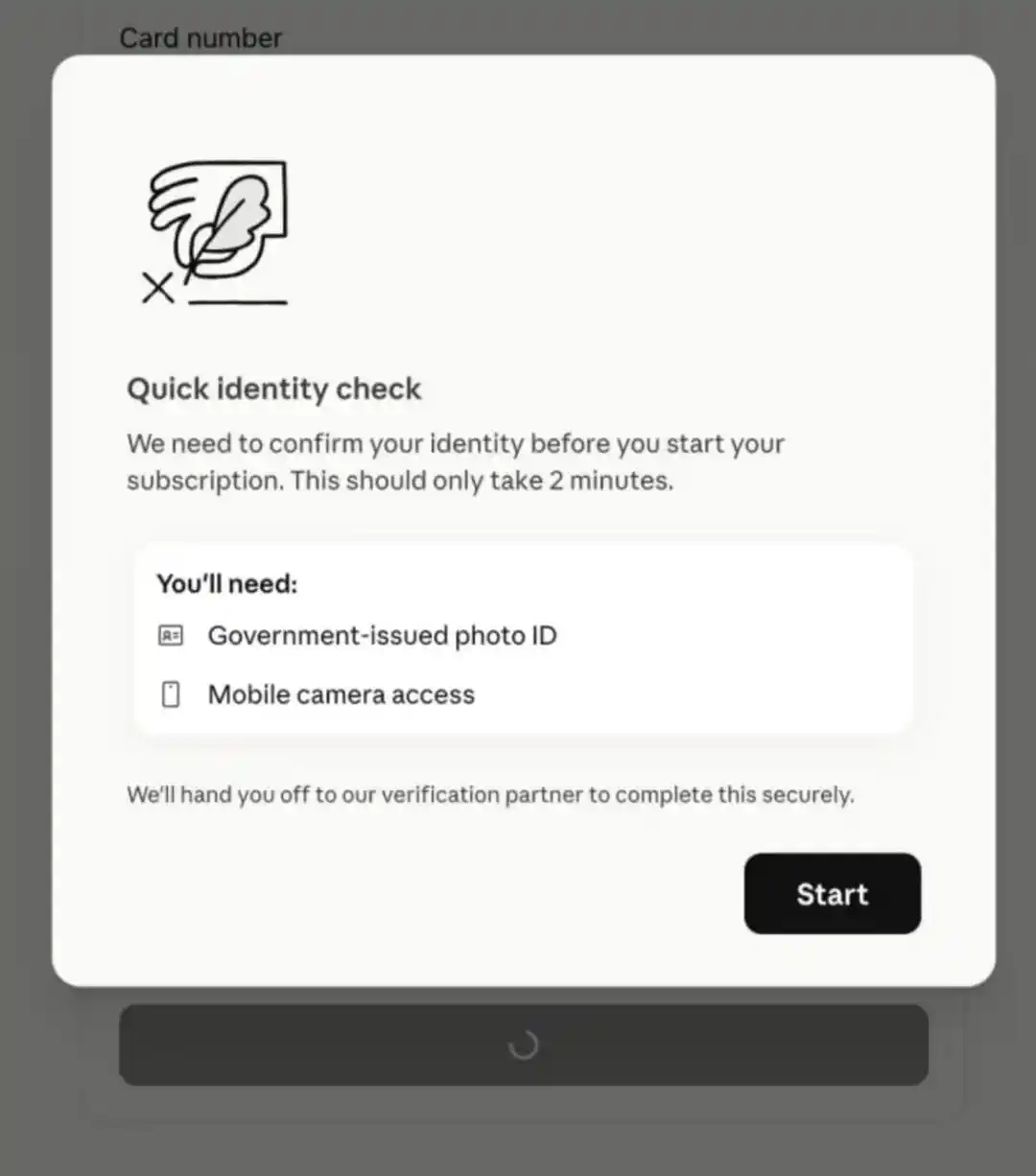
Many people originally held onto a sliver of hope, thinking the platform would leave some wiggle room, that there was still some cover.

No need to guess anymore, Anthropic has blocked the path for you to see!

For users, the most terrifying part of this wave isn't the hassle of the process or the extra few minutes spent.

The truly fatal part is that account risk has instantly shifted from a vague state to an open hand! The platform has put verification, review, and disposal all on the table!

In one sentence, they're not even pretending anymore!

The official announcement spells it all out

Every move targets 'high-risk users'

Anthropic's official announcement appears calm on the surface, even carrying a tone of standardized compliance.
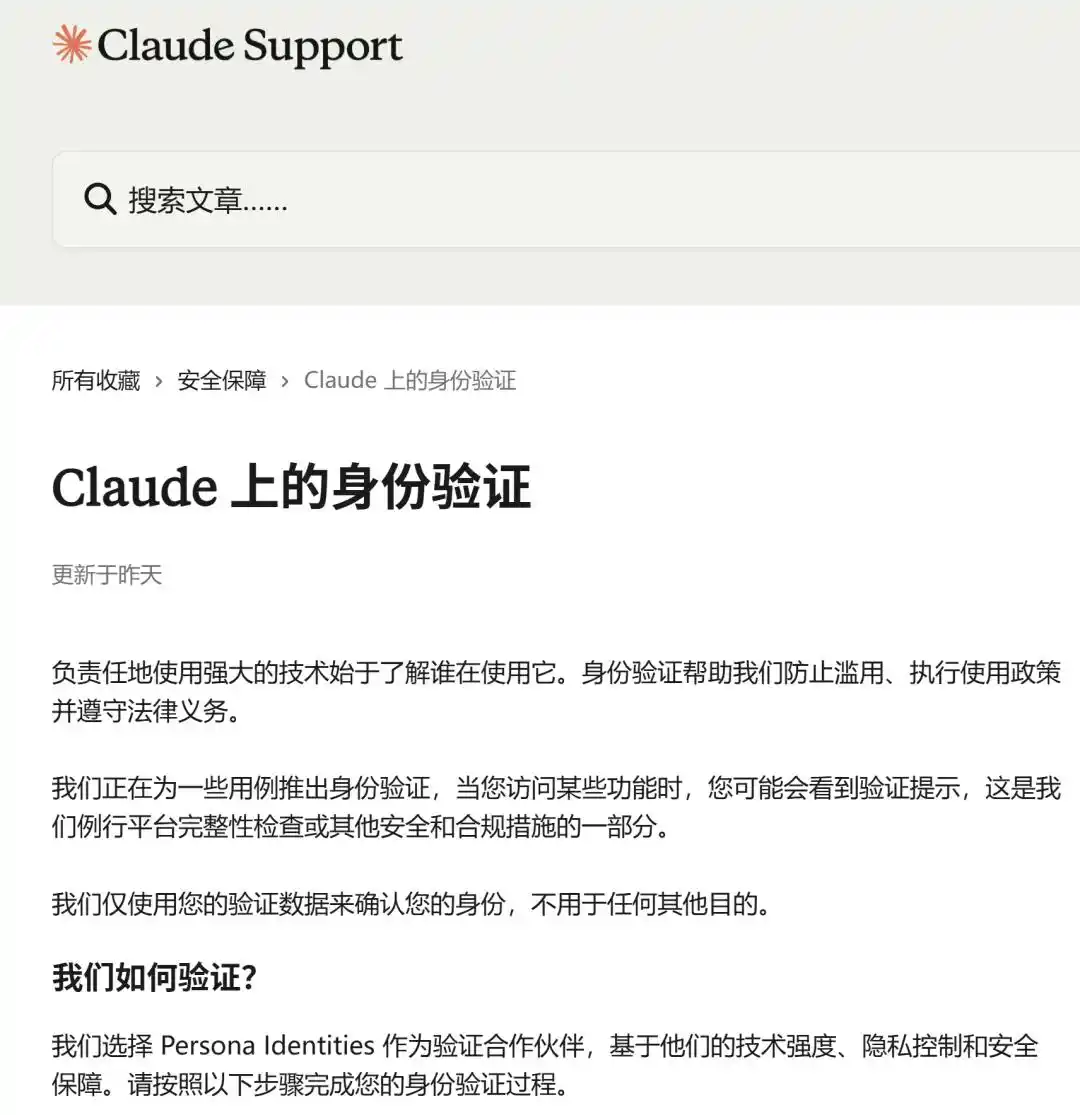
Things like preventing abuse, enforcing usage policies, fulfilling legal obligations – the wording seems fine.

But what users see isn't these nice words.

What they see is that the platform has publicly pushed its identity recognition capabilities a huge step forward!

The announcement clearly states that identity verification may be triggered for some use cases, certain features, platform integrity checks, and other safety and compliance measures.

The required materials are also stated without any ambiguity: a government-issued photo ID, plus a real-time selfie, and it must be the physical original.

Screenshots won't work, scans won't work, photos of photos won't work, digital IDs won't work either!

With these requirements laid out, many people's hearts have already sunk.

What's even harsher comes next.

Anthropic itself writes that accounts may still be disabled even after completing verification.

Reasons include repeated violations of usage policies, creating accounts from unsupported locations, violating Terms of Service, and use by those under 18.

The杀伤力 (lethality) of this passage is enormous!

First, they ask for your identity documents, then immediately lay out the reasons for banning accounts.

Everyone understands what this means.

The platform is no longer satisfied with simply identifying if you are a person; it wants stronger confirmation capabilities, more convenient review capabilities, more direct disposal capabilities!

And the most infuriating part is that the boundaries are deliberately written vaguely.

What are 'some use cases'? What are 'certain features'? What are 'other safety and compliance measures'?

Trigger this today, trigger that tomorrow, how the scope expand, how the intensity increases – users have no certainty!

This is what infuriates users the most!

The platform now holds a stronger set of identification tools, and the risk of account bans hanging over users' heads skyrockets accordingly.

The knife that was once at a distance is now right in your face!

Once Persona gets involved

The situation changes completely

Many people's first reaction upon seeing Persona might be: just an identity verification vendor that's easy to bypass.

That's thinking too simply.

The work Persona does is far beyond just creating a page, receiving a photo, and running a process.

It builds complete identity verification infrastructure, responsible for setting up the entire chain of "Who are you," "Is it really you," "Are you worth letting through," "Can we track you down if something happens"!

Once this type of company is integrated, the meaning is completely different.

Public information shows Persona has早有合作 (long had cooperation) with other leading organizations, including large model companies like OpenAI.

This isn't its first time handling high-intensity identity reviews, nor its first time serving high-risk, high-compliance business scenarios.

Anthropic's choice this time sends a clear signal: what Claude is deploying is not a temporary verification, not a small-scale test, but a mature, scalable, and executable (能扩、能规模化执行的) gate system!

This is why many people got nervous immediately.

In the past, many things could survive in the cracks; many identification actions were costly, executed poorly, and the systems weren't that strong.

Now it's different. Once mature infrastructure is integrated, those areas that could still be handled vaguely, delayed, or混过去 (slipped through) using gaps will be gradually crushed!

Then there's KYC.

This term used to appear more in finance, payments, and trading platforms. Many felt it was the玩法 (playbook) of banks and exchanges, far from AI products.

Now Claude is directly taking the path here.

KYC boils down to one sentence: first, nail down who you are, then discuss what you can do, then decide how to handle you if problems arise!

This is why everyone is so angry.

Claude originally felt, at the very least, like a model platform, a tool platform, a productivity platform.

With this identity verification system now in place, the platform's logic is clearly changing.

It cares more and more about who you are, more and more about how you use it, more and more about whether you fit its definition of safety and compliance!

For users, this change is too dangerous!

Because once it reaches this step, the subsequent tightening will only become more and more convenient!

Look at the user comments

You'll know how furious users are this time!

A few comments in the material almost completely convey the emotion.

Someone starts by cursing:

Anthropic is starting to act inhuman, wants to搞 (implement) identity verification, requires passport plus selfie to use some features.

https://x.com/yangyi/status/2044299899777495249

What people fear is that after submitting the materials, the risk doesn't decrease, but反而更高了 (instead becomes higher)!

The platform holds more complete information, making subsequent risk management, identification, and disposal even harsher!

This is basically a nightmare for domestic users (in China).

Already using it悬着 (precariously), now还要交证件 (also have to submit IDs).

Verification from unsupported regions will likely fail, and even if passed, it might not be safe, still liable to be banned later for various reasons.

This is the reality.

Many people understood it in their hearts before, even if they didn't say it: Claude never truly gave users stable expectations.

Now even this ambiguous space is being compressed, who wouldn't be炸 (explode with anger)!

Look at another prophetic comment from half a year ago:

Just add KYC already.

And now it's really added.

https://x.com/realNyarime/status/2044307566432530694

What annoys everyone the most isn't just the platform tightening up.

What annoys everyone the most is Anthropic's long-standing attitude of being intermittently available, repeatedly raising thresholds, and constantly making users anxious has built up for too long!

This identity verification rollout directly ignited this fire completely!

Others judge the situation realistically: only accepting government documents from supported countries and regions means a large number of relay stations will likely face issues next.

https://x.com/m1ssuo/status/2044300993547120784

This isn't alarmist.

Many玩法 (methods) on the ecosystem chain were built on a fragile foundation.

With Claude now dropping the real-name verification gate, many services living in the gaps will be severely hit!
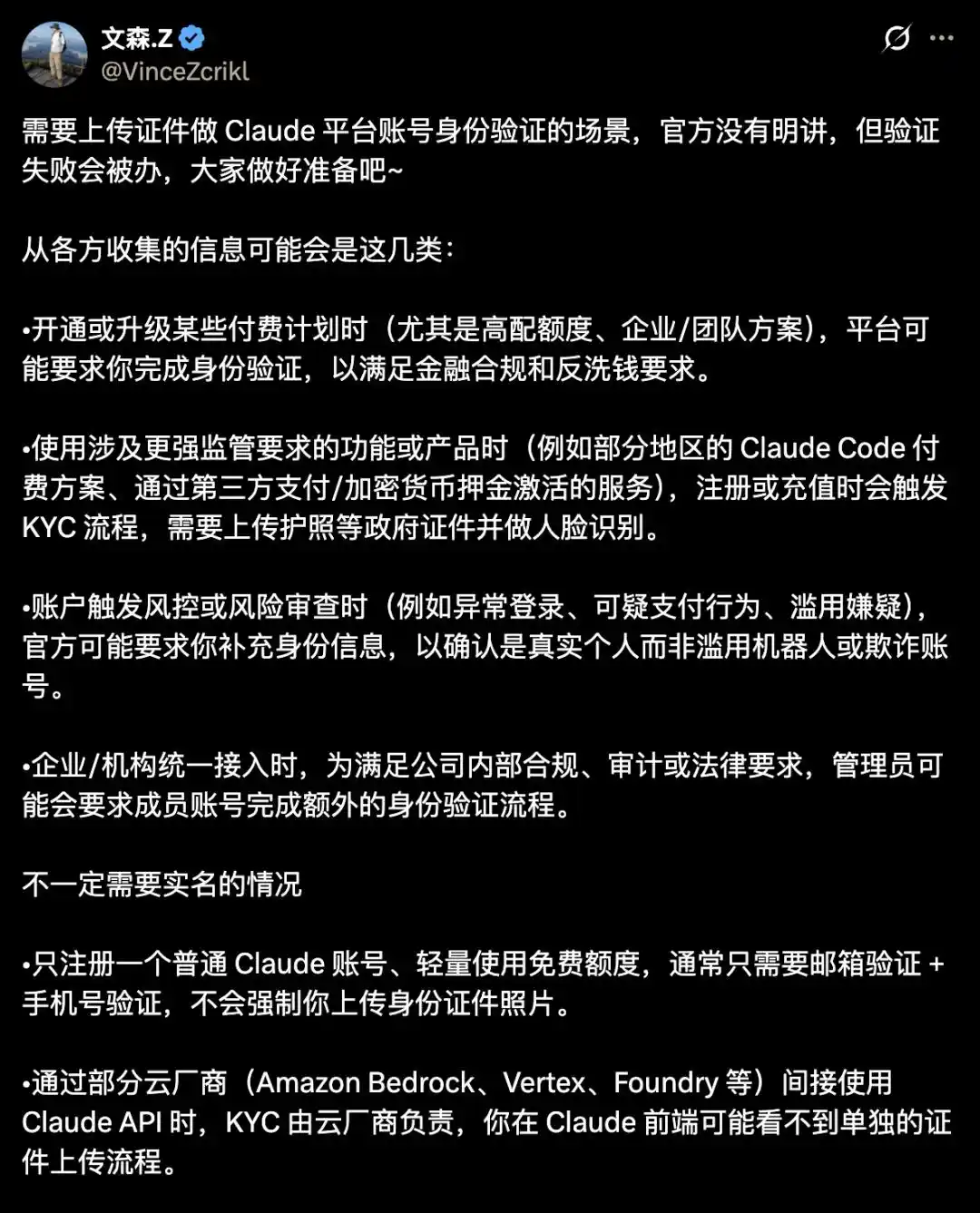
https://x.com/VinceZcrikl/status/2044335219432677556

Another comment is particularly short:

Max is in danger. (开 max 危了 - Using Max subscription is risky)

https://x.com/VinceZcrikl/status/2044336700957298818

These four words carry significant weight.

Because those most afraid of this move are precisely the heavy users, high-volume users, those who use Claude as their core productivity tool.

The deeper you use it, the more you invest, the more you fear the platform suddenly popping up a real-name verification, and then顺手 (conveniently) wiping out your entire workflow in one go!

Others say:

Continuously delivering customers to the competitor. Recently, Opus 4.6 itself had brain issues, now Codex feels even better. (源源不断向对家输送客户, 最近本来 Opus 4.6 就脑子有问题, 现在感觉 Codex 更香了 - Likely referring to GPT-4/Codex)
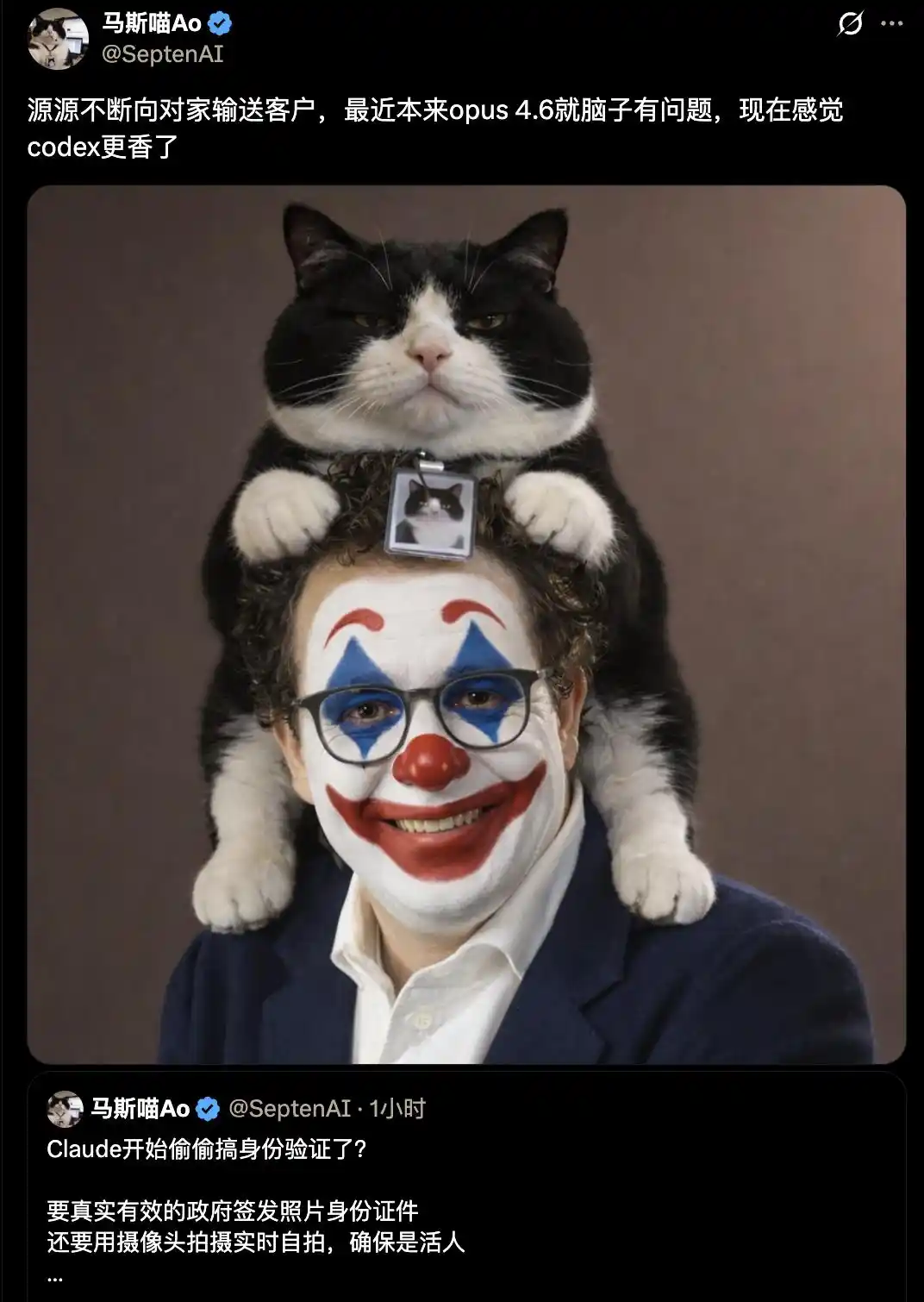
https://x.com/SeptenAI/status/2044308994370744432

The platform increases pressure, degrades experience, and makes users anxious about account security.

Then why should users stick around?

Voting with feet has always been the fastest!

Don't wait for the Sword of Damocles to fall

Cut losses now if you need to!

Pretending not to see it now, continuing to tie your entire workflow, client projects, core data全部绑在 (all tied to) a single Claude account, is ridiculously high risk!

First, reducing the risk of being banned.

The Anthropic help center is very clear: subscription plans like Free, Pro, Max, Team, Enterprise serve Claude's native applications and normal usage scenarios.

You are buying permission to use the official product, not a universal traffic pool, let alone an interface for external distribution or connecting to various third-party projects!

If you want to connect third-party software, open-source projects, or services, the path given by the official is also clear: use API keys, use Claude Console, or use supported cloud platforms.

This sentence is particularly crucial, many people must read it carefully!

Because the easiest way to get into trouble is using personal subscriptions as a universal interface.

Do not use personal Claude subscriptions to run reverse proxies, do not touch shared pools, do not engage in sub2api, do not run tasks for multiple people, do not run tasks for clients.

Especially do not proxy Claude subscription packages to projects like OpenClaw, Hermes Agent to consume quotas!

These practices are now high-risk areas!

Anthropic's attitude is clear: disguising identity, routing third-party traffic through subscription quotas, violating terms and policies, these are all prohibited and may subject to law enforcement action.

This is the point many people need to wake up to the most!

You can put away the侥幸心理 (wishful thinking).

Not getting caught before doesn't mean it won't happen in the future.

Now that the platform is pushing identity verification and risk control forward, many operations that could previously混过去 (slip through) will become precision targets!

Next, reducing losses if banned.

Don't hesitate on this action, do it now, immediately, export all Claude data that can be exported!
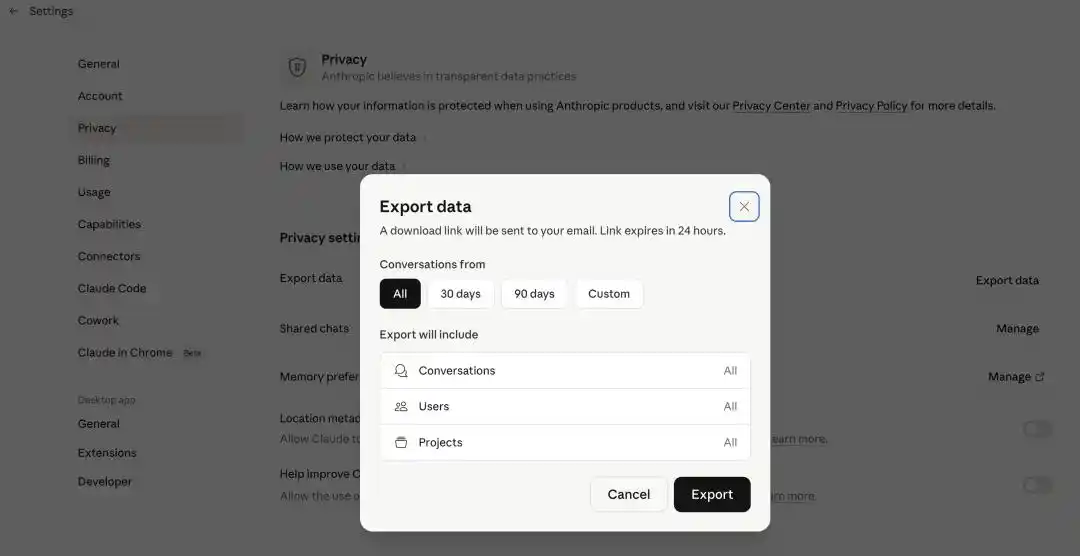
Conversation history, prompts, project context, client communication content, long-accumulated work traces – anything important, back it up!

This is what people最容易忽视 (most easily neglect), always thinking the account is there, so the data is there.

When you really get banned, you realize the real pain isn't losing the subscription fee; the real pain is all historical context being wiped clean, the workflow直接断电 (cut off directly)!

That's the loss that will truly break people!

Time to reconsider ChatGPT too

Ultimately, users need tools that work, not having to anxiously serve the platform's whims every day.

Who is more stable, who can provide long-term support, whose business logic is clearer, who is more worthy of placing core workflows on.

OpenAI has at least one realistic point.

Altman is a realist, a businessperson.

Markets that can make money, he serves.

Users that can be served, he accepts.

The business logic is on the table; making money is making money, the product is the product, without all the extra posturing drama!

This is already very important for users.

What everyone wants is stable delivery, long-term availability, clear rules, and not having to worry every second after paying whether something will go wrong!

Now look at the models themselves.

Claude's recent口碑波动 (reputation fluctuations) are visible to all.

More and more complaints about降智 (reduced intelligence), Opus 4.6 has been吐槽 (criticized) a lot, already starting to lose confidence in many scenarios.

Conversely, GPT-5.4 Pro (Note: Likely refers to a version like GPT-4-turbo or anticipation for GPT-5) now seems more and more like the answer that is more stable, stronger, with lower hallucination rates.

For actually getting work done, handling complex tasks, being a long-term主力 (main force), it's becoming more appealing!

This is also the dumbest part of Anthropic's move this time.

On one hand, implementing real-name verification, making users furious and anxious. On the other hand, the model experience is still losing口碑 (reputation).

Then users switching to ChatGPT is almost natural!

It's perfectly normal for many people to reposition ChatGPT as their main tool next.

This is also the most realistic risk-avoidance action!

Every move Claude makes this time may ultimately hit its own market share, "lifting a rock only to drop it on one's own feet"!

Appendix: Full Text of Claude's Chinese Announcement

《Identity Verification on Claude》

Responsible use of powerful technology starts with knowing who is using it. Identity verification helps us prevent abuse, enforce usage policies, and comply with legal obligations.

We are rolling out identity verification for some use cases. You may see a verification prompt when accessing certain features, as part of our routine platform integrity checks or other safety and compliance measures.

We only use your verification data to confirm your identity, not for any other purpose.

How do we verify?

We selected Persona Identities as our verification partner based on their technical strength, privacy controls, and security safeguards. Please follow the steps below to complete your identity verification process.

What you need to prepare

Before you start, please have the following ready:

Valid government-issued photo ID: Physical document, on hand

Phone or computer with camera: You may need to take a live selfie with your phone or use a webcam

A few minutes: Verification typically takes less than five minutes

Accepted ID types

We accept original, physical government-issued photo IDs from most countries. Common examples include:

Passport

Driver's license or state/provincial ID

National ID card

Your ID must be government-issued, clearly legible, in good condition, and contain your photo.

We do NOT accept:

Copies, screenshots, scans, or photos of photos

Digital or mobile IDs (e.g., mobile driver's license)

Non-government IDs: Student ID, employee badge, library card, bank card

Temporary paper IDs

How your data is protected

We know submitting an ID is a significant request, and we designed this process to protect your information at every step.

Anthropic is the data controller for your verification data. This means we set the rules for how data is used and retained. Persona processes data on our behalf, following our instructions.

Your ID and selfie are collected and stored by Persona, not on Anthropic's systems. Anthropic can access verification records via Persona's platform when needed—for example, to review an appeal—but we do not copy or store these images ourselves.

Persona is contractually restricted in how they use your data: only to provide and support verification, and to improve their fraud prevention capabilities. They must use industry-standard security controls to protect data and delete it per the retention periods we set and applicable law.

All data transmitted to Persona is encrypted in transit and at rest.

For full details on how we handle personal data, see our Privacy Policy.

What we are NOT doing

We do NOT use your identity data to train our models. Verification data is used only to confirm your identity and meet our legal and safety obligations.

We do NOT collect more information than we need. We only request the minimum information needed to verify your identity.

We do NOT share your identity data with anyone. Verification data remains only between you, Persona, and Anthropic, unless we are legally required to respond to valid legal process. Your verification data is never shared with third parties for marketing, advertising, or any purpose unrelated to verification and compliance.

What if my verification fails?

Verification can fail for many reasons: blurry photo, unclear document, expired ID, or technical issues.

If your verification is unsuccessful:

Retry. You will have multiple attempts during the verification process—most failures can be resolved by retaking the photo in better light or using a different government-issued photo ID.

Check your document. Ensure your ID is in good condition and clearly legible.

Contact us. If you've used all attempts and still cannot verify, please contact us via this form, and we will review.

Why was my account disabled after verification?

As part of our security process, we may disable accounts for various reasons:

Repeated violations of our Usage Policies

Creating an account from an unsupported location

Violation of Terms of Service

Use by someone under 18

If you believe your account was disabled in error, please fill out the appeal form and provide your account information so our security team can further investigate why your account was disabled.

Questions?

If you have any questions about identity verification, your data, or the verification process, please contact us via this form.

Reference:

https://support.claude.com/zh-CN/articles/14328960-claude-%E4%B8%8A%E7%9A%84%E8%BA%AB%E4%BB%BD%E9%AA%8C%E8%AF%81

This article is from the WeChat public account "新智元" (New Zhiyuan), author: 新智元, editor: 艾伦 (Allen)


Related Questions

QWhat is the main reason for user outrage regarding Claude's new identity verification policy?

AUsers are primarily outraged because the policy introduces mandatory identity verification requiring government-issued photo ID and real-time selfies, which significantly increases account suspension risks and eliminates previous ambiguities in platform enforcement.

QWhich third-party service is Claude using for identity verification, and why is it significant?

AClaude is using Persona Identities for verification, which is significant because Persona provides a mature, scalable identity infrastructure that enhances Anthropic's ability to enforce compliance, conduct audits, and track users more effectively.

QWhat are some high-risk behaviors that could lead to account suspension under the new policy?

AHigh-risk behaviors include using personal subscriptions for third-party proxy services, sharing accounts, distributing API access, running reverse proxies, or violating terms of service, such as accessing Claude from unsupported regions.

QHow does Anthropic's approach to identity verification compare to OpenAI's business strategy according to the article?

AThe article suggests Anthropic's verification policy creates user anxiety and instability, while OpenAI is portrayed as more pragmatic and business-focused, offering clearer rules and stable service, making it a safer choice for long-term workflows.

QWhat practical steps does the article recommend for users to mitigate risks associated with Claude's new policy?

AUsers should immediately back up all important data (conversations, prompts, project contexts), avoid using personal subscriptions for unauthorized third-party services, and consider switching to more stable alternatives like ChatGPT to reduce dependency on Claude.

Related Reads

An Open-Source AI Tool That No One Saw Predicted Kelp DAO's $292 Million Vulnerability 12 Days Ago

An open-source AI security tool flagged critical risks in Kelp DAO’s cross-chain architecture 12 days before a $292 million exploit on April 18, 2026—the largest DeFi incident of the year. The vulnerability was not in the smart contracts but in the configuration of LayerZero’s cross-chain bridge: a 1-of-1 Decentralized Verifier Network (DVN) setup allowed an attacker to forge cross-chain messages with a single compromised node. The tool, which performs AI-assisted architectural risk assessments using public data, identified several unremediated risks, including opaque DVN configuration, single-point-of-failure across 16 chains, unverified cross-chain governance controls, and similarities to historical bridge attacks like Ronin and Harmony. It also noted the absence of an insurance pool, which amplified losses as Aave and other protocols absorbed nearly $300M in bad debt. The attack unfolded over 46 minutes: the attacker minted 116,500 rsETH on Ethereum via a fraudulent message, used it as collateral to borrow WETH on lending platforms, and laundered funds through Tornado Cash. While an emergency pause prevented two subsequent attacks worth ~$200M, the damage was severe. The tool’s report, committed to GitHub on April 6, scored Kelp DAO a medium-risk 72/100—later acknowledged as too lenient. It failed to query on-chain DVN configurations or initiate private disclosure, highlighting gaps in current DeFi security approaches that focus on code audits but miss config-level and governance risks. The incident underscores the need for independent, AI-powered risk assessment tools that evaluate protocol architecture, not just code.

marsbit1h ago

An Open-Source AI Tool That No One Saw Predicted Kelp DAO's $292 Million Vulnerability 12 Days Ago

marsbit1h ago

Trading

Spot
Futures

Hot Articles

What is LINON

Linde plc Tokenized Stock (Ondo): Revolutionizing Traditional Equity Access Through Blockchain Innovation The emergence of Linde plc Tokenized Stock (Ondo), represented by the ticker $LINON, signifies a monumental shift in the fusion of traditional financial structures and decentralized finance (DeFi). This innovative financial instrument showcases the tremendous potential of blockchain technology to democratize access to traditional equity markets while ensuring the security and regulatory compliance necessary for institutional-grade financial products. Through Ondo Finance's pioneering tokenization platform, $LINON provides a seamless pathway for global investors to engage with one of the world's leading industrial gas companies, Linde plc, creating a blockchain-native representation of the underlying equity. Introduction to Linde plc Tokenized Stock The landscape of financial markets is witnessing a groundbreaking transformation through the tokenization of real-world assets. Linde plc Tokenized Stock (Ondo) epitomizes this revolutionary approach by bridging the gap between conventional stock ownership and blockchain-enabled financial infrastructure. The $LINON token allows investors to gain exposure to one of the prominent industrial companies worldwide through decentralized technology. Operating within Ondo Finance's comprehensive ecosystem, $LINON symbolizes a practical application of tokenization technology that enhances accessibility, efficiency, and global connectivity in traditional financial markets. By leveraging blockchain infrastructure, this tokenized stock enables international investors to participate in U.S. equity markets, overcoming traditional barriers associated with cross-border investing. The significance of $LINON goes beyond technological innovation; it represents a fundamental shift in asset structuring, distribution, and trading in the digital age. This tokenized stock maintains all the economic benefits associated with traditional Linde plc shares while offering improved liquidity, programmable compliance features, and seamless integration with decentralized finance protocols. The development of $LINON indicates a growing acceptance of blockchain technology as a viable means for traditional finance, exemplifying how even well-established assets like Linde plc can integrate into blockchain systems. This approach preserves the core attributes that appeal to investors while introducing advanced capabilities that enhance the overall investment proposition. Project Overview and Objectives Linde plc Tokenized Stock (Ondo) encapsulates a strategic effort to democratize access to traditional equity markets through advanced blockchain technologies. The primary objective of $LINON is to provide approved global investors seamless access to the economic exposure associated with Linde plc shares, furthering an effort to create a more inclusive financial ecosystem. Beyond the digital representation of traditional assets, $LINON endeavors to eliminate barriers of geography and time zones that limit investor participation. Its design ensures that blockchain technology can elevate traditional investment vehicles without undermining the security or compliance requirements expected by investors. Key goals of the project include enhanced liquidity provision, programmable compliance mechanisms, and interoperability with other blockchain networks. Each $LINON token is fortified by actual Linde plc securities housed at U.S.-registered broker-dealers, allowing holders to reap economic advantages akin to traditional stockholders, such as dividend reinvestment. Furthermore, $LINON aims to establish new industry standards for institutional-grade tokenized securities, paving the way for traditional assets to embrace blockchain technology while remaining compliant with regulatory frameworks. By associating itself with a company as reputable as Linde plc, the project opens avenues for exploring tokenized equities catering to both conservative institutional players and daring retail investors. Project Creator and Development Team The vision for Linde plc Tokenized Stock (Ondo) comes from Nathan Allman, founder and CEO of Ondo Finance. His background in traditional finance coupled with expertise in blockchain technology positions him uniquely to navigate the complexities of asset tokenization. Allman's academic journey began at Brown University, focusing on Economics and Biology, equipping him with valuable analytical skills. His time at Goldman Sachs in the Digital Assets division strengthened his understanding of the interplay between financial institutions and emerging technologies, laying the groundwork for his later endeavors in alternative investment strategies. Under Allman's guidance, Ondo Finance has emerged as a leader in asset tokenization, launching $LINON as a flagship example of the company's larger mission towards revolutionizing traditional financial systems using blockchain technology. His commitment to leveraging blockchain for creating institutional-grade financial products has shaped the landscape of real-world asset tokenization. Investment and Funding Structure The growth of Ondo Finance, the platform powering Linde plc Tokenized Stock (Ondo), is bolstered by robust financial backing from prestigious venture capital firms and strategic investors. This strong investment foundation underpins the development of the key infrastructure essential for compliant tokenized securities like $LINON. In August 2021, Ondo Finance secured $4 million in seed funding led by a major venture capital firm, which enabled the company to commence platform development and establish the necessary regulatory processes for tokenizing real-world assets. This early investment cemented Ondo Finance's credibility within the industry. The Series A funding round followed, garnering $20 million with participation from renowned firms committed to transformative technology companies. This backing demonstrated substantial institutional confidence in Ondo Finance's vision, allowing it to hone its approach to asset tokenization through mechanisms that ensure compliance and accessibility. Noteworthy contributors, including institutional investors and experienced partners, have added significant value to Ondo Finance’s development efforts. Their involvement underscores the confidence across sectors in Ondo Finance's approach to bridging traditional finance with blockchain innovations. Technical Infrastructure and Innovation The technical architecture that underpins Linde plc Tokenized Stock (Ondo) represents a sophisticated melding of traditional finance systems and cutting-edge blockchain technology. The architecture's foundation is built on the Ethereum network, renowned for its security and programmability—both critical for intricate financial instruments. The $LINON tokenization process comprises creating a blockchain-native representation of Linde plc shares that preserves economic benefits while augmenting investor capabilities. Each token corresponds to actual shares held at U.S.-registered broker-dealers, creating a compliant custody structure that legitimizes the asset's existence and value. Automated compliance systems are integrated into the tokenization process, managing critical components such as know-your-customer (KYC) verification and anti-money laundering (AML) protocols. This incorporation of programmable compliance empowers $LINON to uphold regulatory standards essential for institutional proliferation. Cross-chain interoperability characterizes the advanced technical features of $LINON. While initially deployed on Ethereum, the framework is designed for expansion to other networks such as Solana and BNB Chain. This adaptability enhances liquidity and accessibility, allowing investors to select their preferred blockchain ecosystems. Historical Timeline and Development Crafting the history of Linde plc Tokenized Stock (Ondo) unfolds in parallel with the evolution of Ondo Finance's tokenization platform. The timeline's inception dates back to March 2021 when Nathan Allman laid the foundations for creating institutional-grade financial products on blockchain infrastructure. The initial funding round in August 2021 provided crucial resources for developing the platform and establishing partnerships necessary for effective tokenization. By January 2023, Ondo Finance launched its tokenized treasury products, establishing mechanisms that would facilitate future tokenized equities such as $LINON. A pivotal milestone arose in February 2025 when Ondo Chain—a Layer 1 blockchain designed specifically for asset tokenization—was introduced. This infrastructure enhances capabilities vital for institutional markets, demonstrating Ondo Finance's long-term commitment to tokenization. Subsequently, the launch of Ondo Global Markets in September 2025 marked the official debut of $LINON. This milestone showcased the successful transition from development to active trading, enabling investors around the world to access American financial markets seamlessly. Ongoing development plans include a targeted expansion of available tokenized assets to over 1,000 by the end of 2025, pointing to a bright future for Ondo Finance's ecosystem and its mission to broaden tokenized equity accessibility. Regulatory Compliance and Legal Framework The legal architecture governing Linde plc Tokenized Stock (Ondo) emphasizes a sophisticated approach to regulatory compliance, allowing tokenized securities to be implemented within a blockchain-based framework. The legal structure governing $LINON spans multiple jurisdictions while maintaining a robust legal footing. Compliance systems ensure that only eligible investors can access the token, enforced through automated verification that aligns with international regulations. This innovative regulatory technology promises real-time enforcement of complex requirements, considerably enhancing efficiency in operating within the regulatory landscape. The custody framework undergirding $LINON ensures that the underlying shares are securely held at U.S.-registered broker-dealers, complying with necessary regulations while delivering blockchain-driven access to investors. The token maintains its economic equivalency and security through this carefully structured custody arrangement. KYC and AML compliance systems are embedded within the smart contract architecture, ensuring integrity and adherence to regulatory practices while fostering transparency for investors. The jurisdictional restrictions mark a commitment to navigating the evolving landscape of international securities laws. Market Impact and Industry Significance The advent of Linde plc Tokenized Stock (Ondo) holds profound implications for the broader financial landscape, symbolizing a clear shift towards blockchain-enabled markets. $LINON serves as a proof-of-concept for integrating traditional companies into blockchain ecosystems, showcasing the potential benefits such as broader accessibility and improved efficiency. The market's response to $LINON indicates a growing acceptance of tokenization among institutional investors, contributing to the emergence of an expanding sector wherein traditional assets can be interconnected with blockchain innovations. The success of $LINON further solidifies market confidence, indicating an overarching shift towards recognizing asset tokenization as a transformative force in finance. Future Development and Expansion Plans The future trajectory for Linde plc Tokenized Stock (Ondo) centers around the expansion of the tokenization ecosystem and enhanced infrastructure supporting blockchain-enabled financial services. Plans for cross-chain integration usher in new opportunities for liquidity and flexibility within the investment framework, with existing capabilities poised for continuous enhancement. With the introduction of Ondo Chain, Ondo Finance aims to transition $LINON to an optimized blockchain environment specifically designed for asset tokenization. This new infrastructure heralds exciting prospects for the development of institutional-grade financial products, ensuring ongoing compatibility with contemporary investment strategies. Further integration with decentralized finance protocols signifies a commitment to empowering $LINON holders through advanced financial strategies. The anticipated expansion of available tokenized assets promises to broaden investor access, enhancing the utility and appeal of the platform. In alignment with ambitions for regulatory expansion, ongoing efforts to secure approvals for new jurisdictions will enhance investor access, further positioning $LINON at the forefront of the burgeoning tokenization market. Conclusion Linde plc Tokenized Stock (Ondo), as represented by the $LINON token, stands at the intersection of traditional finance and blockchain innovation. It embodies a transformative milestone in how financial assets are structured, distributed, and engaged within modern investment ecosystems. The technical sophistication behind $LINON, combined with its regulatory compliance framework, illustrates that asset tokenization can improve financial infrastructure rather than simply digitizing existing products. This pioneering effort not only enhances investor access to U.S. equity markets but also signifies an evolution of how traditional financial services can integrate blockchain technology. As the asset tokenization market grows exponentially, with prospects suggesting significant valuation increases, $LINON paves the way for a future where tokenized securities become standard fixtures in the financial landscape. The trajectory of $LINON will undoubtedly influence how traditional finance adapts to a transformed, blockchain-powered world.

2.1k Total ViewsPublished 2025.12.05Updated 2025.12.05

What is LINON

What is CRMON

Salesforce Tokenized Stock (Ondo): Revolutionising Traditional Equity Access Through Blockchain Innovation The emergence of Salesforce Tokenized Stock (CRMON) marks a pivotal advancement in integrating traditional financial markets with blockchain technology. This innovative approach offers investors unprecedented access to equity exposure through tokenisation. Developed by Ondo Finance, CRMON provides tokenholders with economic exposure equivalent to holding Salesforce stock (CRM) while automatically reinvesting dividends. This effectively bridges the gap between conventional equity markets and decentralised finance (DeFi). Introduction and Comprehensive Overview of Salesforce Tokenized Stock In recent years, the financial landscape has dramatically transformed due to blockchain technology, fundamentally altering how investors access and interact with traditional assets. The development of Salesforce Tokenized Stock (CRMON) is a prime example of this evolution, representing a sophisticated fusion of conventional equity markets with cutting-edge distributed ledger technology. CRMON is a tokenised version of Salesforce stock, emerging from the innovative work of Ondo Finance, a leading platform in the real-world asset tokenisation sector that positions itself as a bridge between traditional finance and decentralised systems. Designed to provide tokenholders with economic exposure that mirrors the performance of the underlying Salesforce stock, CRMON incorporates automatic dividend reinvestment mechanisms. This eliminates many traditional barriers associated with international equity investment, such as complex brokerage relationships, currency conversion challenges, and restricted trading hours. The tokenisation process reimagines stock ownership as a blockchain-native asset while maintaining its economic equivalence with the underlying security, offering enhanced portability and integration capabilities within decentralised finance ecosystems. CRMON transcends its individual utility as an investment instrument to represent a fundamental shift in how financial markets can operate in an increasingly digital world. By maintaining full backing through U.S.-registered broker-dealers and implementing robust compliance frameworks, CRMON demonstrates that tokenised securities can achieve the regulatory standards necessary for institutional adoption while delivering the technological advantages of blockchain infrastructure. Understanding Tokenized Real-World Assets and CRMON's Strategic Position Tokenised real-world assets signify one of the most significant innovations in modern finance, fundamentally reimagining how traditional securities are represented, traded, and utilised within digital ecosystems. CRMON operates as a tokenised equity instrument correlating directly with Salesforce stock while optimising accessibility and efficiency. This aligns with Ondo Finance's broader mission to democratise access to institutional-grade financial products through innovative tokenisation strategies. The tokenisation process guarantees complete economic equivalence with the underlying Salesforce equity. Each CRMON token represents a proportional claim on Salesforce stock held by qualified custodians, with dividend payments automatically reinvested to maintain continuous exposure to total return performance. This structure simplifies dividend management and ensures that tokenholders receive the full economic benefit of their equity exposure, encompassing both capital appreciation and income generation. Ondo Finance's strategy in tokenising Salesforce stock demonstrates its expertise in creating compliant, institutional-grade products that meet traditional financial markets' stringent requirements. The platform’s focus on merging regulatory compliance with blockchain benefits positions it at the forefront of decentralised finance, captivating both institutional and retail investors seeking blockchain-native solutions. The Technology and Innovation Framework Behind CRMON The technological infrastructure supporting CRMON integrates blockchain technology with traditional financial mechanisms, delivering institutional-grade security and compliance while maintaining the operational advantages of decentralised systems. Built on the Ethereum blockchain, CRMON utilises robust smart contract capabilities to ensure transparent, secure operations. The smart contract architecture incorporates layered security and compliance mechanisms, enabling automated compliance checks and real-time asset backing verification. Integration with oracle services maintains accurate pricing and dividend information, ensuring CRMON reflects the underlying Salesforce stock's accurate performance. This architecture delivers automated dividend reinvestments and other corporate actions, eliminating manual processing requirements and directly enhancing tokenholder benefits. Ondo Finance ensures CRMON's security structure includes daily third-party verification of holdings, independent collateral agents, and a multiple-layer custody system through partnerships with established financial institutions. This framework safeguards tokenholder interests against operational risks while providing robust asset backing. The user interface enhances integration capabilities, allowing seamless interaction between CRMON and various decentralised finance protocols, as well as cryptocurrency exchanges. This interoperability enables users to leverage their tokenised equity across multiple platforms, creating sophisticated investment strategies that marry traditional equity characteristics with blockchain-native innovation. Leadership and Corporate Structure of Ondo Finance The leadership team behind CRMON and Ondo Finance blends expertise from traditional finance and blockchain technology, presenting a robust combination of skills essential for successfully bridging conventional markets with decentralised finance. Nathan Allman, the founder and CEO, emerged from a distinguished financial background before establishing Ondo Finance in 2021. Allman's experience includes notable roles at major financial institutions, including significant contributions to developing cryptocurrency market services. His insights into regulatory compliance were paramount in developing products like CRMON that successfully unify traditional securities with blockchain technology. With a team of professionals boasting substantial experience in both conventional finance and blockchain sectors, Ondo Finance's leadership comprises diverse expertise that covers every aspect of tokenised asset development. Justin Schmidt serves as President and COO, contributing unique operational expertise, while Chris Tyrell brings essential compliance knowledge. Investment Landscape and Funding History The investment landscape surrounding Ondo Finance reflects significant institutional confidence in its mission to tokenise real-world assets. The company has raised substantial funds through various investment rounds, attracting leading venture capital firms and strategic investors that recognise the transformative potential of tokenised securities like CRMON. Notably, Ondo Finance completed a successful Series A funding round in 2022, led by well-known venture capital firms. This funding success validates Ondo Finance's innovative approach to creating compliant, institutional-grade tokenised products. In total, Ondo Finance has successfully secured substantial funding, raising significant capital for product development and market expansion, including a noteworthy token sale that reinforced its governance structure through the establishment of the ONDO token. The diverse composition of investors reflects broad market confidence in Ondo Finance's business model, demonstrating support from both traditional and blockchain-native organisations. Operational Mechanics and Technical Implementation The operational framework supporting CRMON exemplifies sophisticated integration of traditional financial mechanisms with blockchain technology. The technical implementation introduces multiple layers of security, compliance, and operational efficiency to meet institutional standards while enhancing accessibility. The tokenisation process begins by acquiring actual Salesforce stock through U.S.-registered broker-dealers, ensuring each CRMON token maintains direct correlation with the underlying equity performance. Smart contracts automate operational processes, including dividend reinvestment and corporate action processing, facilitating a streamlined user experience. The Minting and redemption processes allow authorised participants to manage CRMON tokens effectively. During U.S. trading hours, institutions can mint new tokens by depositing stablecoins that are used to purchase corresponding Salesforce equity. This structure maintains a tight correlation with underlying assets, enhancing liquidity and price discovery. Additionally, the infrastructure supports twenty-four-hour token transfer capabilities, providing CRMON holders with operations outside traditional market hours. This represents a significant advantage over conventional securities ownership, thus promoting integration with decentralised finance applications. Plans for cross-chain compatibility through partnerships signal further ambitions for CRMON's market reach. By expanding to other blockchain networks, Ondo Finance aims to enhance accessibility and user engagement with tokenised equity products. Timeline and Historical Development of Tokenized Equity Innovation The timeline of CRMON's development and Ondo Finance's broader tokenised capabilities demonstrates a systematic innovation process beginning with the company's founding in 2021. 2021: Ondo Finance is founded by Nathan Allman and co-founders, launching initial products focused on structured vault offerings on the Ethereum blockchain. 2022: The company completes substantial funding rounds—both equity and token sales—totaling significant capital and launching initial tokenised U.S. Treasury products. 2023-2024: Ondo Finance experiences substantial growth, establishing partnerships with major financial institutions while expanding its product offerings beyond fixed-income securities. February 2025: Ondo Global Markets is announced, marking the transition into equity tokenisation with plans for accessing over one hundred U.S. stocks and ETFs. September 2025: The official launch of Ondo Global Markets includes CRMON alongside other tokenised equity offerings, marking a significant evolution in Ondo Finance's product ecosystem. This timeline highlights the organisation's rapid growth and its capability to adapt its technological and compliance frameworks to accommodate different asset classes effectively while maintaining security and regulatory integrity. Regulatory Framework and Compliance Approach Ondo Finance's regulatory framework showcases a sophisticated compliance strategy, essential for achieving institutional adoption in the tokenised securities market. The company's strong partnerships with U.S.-registered broker-dealers promote adherence to Securities and Exchange Commission regulations and apply robust investor protections. Acquisitions, such as Oasis Pro—a registered broker-dealer—significantly enhance Ondo Finance's compliance capabilities, ensuring thorough alignment with existing regulatory structures. The company employs independent verification procedures that foster transparency, aiming for a solid performance standards reputation. Furthermore, Ondo Finance's commitment extends to international regulatory compliance, ensuring token access remains restricted to eligible investors while adhering to pertinent cross-border securities regulations. Comprehensive attention to tax implications and reporting requirements fortifies the security and compliance landscape of CRMON, ensuring that investor obligations remain manageable. Future Prospects and Market Positioning The forward-looking landscape for CRMON and Ondo Finance illustrates substantial growth opportunities driven by institutional adoption of blockchain technology and escalating demand for efficient alternatives to conventional securities ownership. Market projections indicate the tokenised asset sector could value multiple trillion dollars by 2030. With plans to scale CRMON offerings significantly and integrate it with a dedicated blockchain infrastructure—Ondo Chain—Ondo Finance aims to elevate its institutional-grade tokenised asset operations. Additionally, the development of strategic partnerships enhances distribution capabilities while establishing the company's credibility in the financial market. Furthermore, the integration of tokenised equity with decentralised finance protocols offers new potential for innovative financial products and strategies previously impossible with traditional securities. These factors underscore CRMON's positioning to effectively capture increased market share and deliver innovative solutions for international investment exposure. Conclusion Salesforce Tokenized Stock (CRMON) symbolises a transformative development within financial markets, successfully bridging traditional equity ownership with blockchain technology to create unprecedented accessibility for global investors. Through Ondo Finance's sophisticated tokenisation framework, CRMON provides complete economic exposure to Salesforce equity performance while enhancing operational advantages that exceed traditional ownership. The launch of CRMON reflects the broader evolution of financial markets towards blockchain infrastructures that maintain regulatory compliance while delivering increased efficiency. Ondo Finance's extensive approach to regulatory adherence, institutional-grade security, and technological innovation solidifies CRMON as a model for future tokenised securities, delivering access previously unattainable in conventional brokerage structures. As the tokenised asset sector continues to develop, CRMON is well-positioned to address historical inefficiencies in capital markets while providing investors with innovative solutions for accessing traditional securities. The outlook for CRMON looks exceptionally promising, supported by ambitious expansion plans, technological innovations, and strategic partnerships, thereby representing a pioneering model of modern financial infrastructure evolving through blockchain integration.

2.1k Total ViewsPublished 2025.12.05Updated 2025.12.05

What is CRMON

What is SHOPON

Shopify Tokenized Stock (Ondo): A Comprehensive Analysis of Real-World Asset Tokenization in Web3 This article delves into the Shopify Tokenized Stock (Ondo), recognised by its ticker symbol $SHOPON, exploring its implications at the intersection of traditional finance and blockchain technology. As a part of Ondo Finance's tokenized securities platform, Shopify’s tokenized stock exemplifies advancements in democratizing access to global capital markets through innovative digital assets. Introduction and Overview of Shopify Tokenized Stock (Ondo) Shopify Tokenized Stock (Ondo), or $SHOPON, portrays a pivotal innovation in the realm of tokenized securities, allowing investors to gain economic exposure akin to directly owning shares of Shopify Inc. This token, developed under the umbrella of Ondo Finance, not only provides investors with the ability to hold digital representations of the company’s stock but also integrates features such as automatic reinvestment of dividends. This advancement represents a substantial shift in the landscape of decentralized finance (DeFi), linking conventional equity markets with blockchain solutions designed to enhance accessibility, transparency, and liquidity. By eliminating geographical barriers and enabling 24/7 trading capabilities, $SHOPON is positioned as a bridge connecting traditional financial instruments and the emerging Web3 ecosystem. What is Shopify Tokenized Stock (Ondo), $SHOPON? The $SHOPON token serves as a digital manifestation of Shopify Inc.'s shares, engineered to provide a direct correlation to the underlying asset's performance. Through the utilization of blockchain technology, the token gives holders a mechanism to participate in the economic benefits associated with equity ownership, including capital appreciation and dividend distribution. The unique aspect of $SHOPON lies in its automatic dividend reinvestment mechanism, which allows returns to compound without necessitating active management by the investor. This feature inherently enhances its attractiveness as an investment vehicle, particularly for individuals seeking passive income growth alongside exposure to high-performing equities. The tokenization process is facilitated by the custody of actual Shopify shares through regulated intermediaries, ensuring that every $SHOPON token is verifiably backed by real equity. This structure empowers investors with the dual advantages of both traditional financial characteristics and the innovative benefits tied to blockchain technology. Who is the Creator of Shopify Tokenized Stock (Ondo)? The creator of Shopify Tokenized Stock (Ondo), Nathan Allman, is an experienced figure in the finance sector, formerly associated with Goldman Sachs. His rich background includes significant expertise in digital asset development, bridging the gap between traditional finance and cryptocurrencies. Allman’s educational journey, marked by studies at Brown University, provided him with a deep understanding of economics and biology, equipping him with analytical skills that inform his strategic vision. In 2021, he founded Ondo Finance, committing to developing tokenized securities that meet institutional-grade standards while leveraging blockchain's transformative capabilities. Under Allman's leadership, Ondo Finance has focused on creating compliant and innovative financial products that empower a diverse investor base. Who are the Investors of Shopify Tokenized Stock (Ondo)? The investment landscape surrounding Shopify Tokenized Stock (Ondo) is notably robust, underpinned by significant institutional support. Primarily, Pantera Capital stands out as a strategic partner through the Ondo Catalyst initiative, a $250 million commitment aimed at accelerating the development of on-chain capital markets. This partnership not only signifies institutional confidence in the potential of tokenized assets but also reinforces Ondo Finance's operational capabilities and market positioning. The funding pathways have included earlier rounds that amassed millions in seed funding and further structural investments, solidifying relationships with both venture capital firms and private investors. Moreover, the financial framework is complemented by strategic partnerships with established financial institutions and technology companies, enhancing Ondo’s infrastructure and operational expertise. How Does Shopify Tokenized Stock (Ondo), $SHOPON Work? At the core of $SHOPON's operational framework is a sophisticated system integrating traditional finance mechanisms with blockchain technology. The custody of actual Shopify shares ensures that token holders retain authentic economic exposure, safeguarding their investments in line with recognized legal structures. The smart contracts employed in managing $SHOPON handle various functions, including automatic dividend reinvestment and ownership transfer, offering instant settlement and increased liquidity, marking a significant departure from conventional trading systems plagued by multi-day settlement delays. By providing interoperability with other decentralized finance applications, $SHOPON empowers holders with potentially lucrative opportunities for advanced investment strategies, including lending and automated market making. This complex integration presents a unique value proposition, catering to both traditional and crypto-native investors. The innovative structure of $SHOPON also allows for real-time settlements and transactions documented on the blockchain, delivering unparalleled transparency and security—a major advancement over standard equity trading practices. Timeline of Shopify Tokenized Stock (Ondo) March 2021: Nathan Allman establishes Ondo Finance, initially focusing on decentralized finance yield optimization. August 2021: Completion of a $4 million seed funding round led by Pantera Capital. January 2023: Launch of initial tokenized treasury security products, laying the groundwork for future equity tokenization. July 2025: Announcement of the Ondo Catalyst initiative, a strategic investment program valued at $250 million, aimed at propelling the development of tokenization in capital markets. September 3, 2025: Launch of Ondo Global Markets featuring over 100 tokenized U.S. stocks and ETFs, including $SHOPON. Technical Implementation and Blockchain Infrastructure Shopify Tokenized Stock (Ondo) operates on a technical architectural framework that marries blockchain protocols with traditional financial custody arrangements. The ecosystem leverages Ethereum's smart contract capabilities, providing seamless transaction management while ensuring compliance with regulatory standards through established financial custodians. Central to this architecture are security measures and transparent transaction records that affirm the legitimacy of each tokenholder's economic stake. With automated features managed by intricate smart contracts, $SHOPON not only streamlines ownership transfers but also allows for the tactical reinvestment of dividends—a hallmark of modern investment strategies. Moreover, the incorporation of LayerZero technology facilitates cross-chain interoperability, making $SHOPON accessible across multiple blockchain environments while preserving its functional robustness. This forward-thinking technical design positions $SHOPON as an adaptable asset within the larger DeFi milieu. Regulatory Framework and Compliance Architecture $SHOPON's regulatory framework is built upon the meticulous navigation of existing financial regulations that govern securities. The custody arrangements for the underlying Shopify shares are managed by U.S.-regulated broker-dealers, ensuring compliance and protection for investors. By maintaining a separation between the blockchain tokenization process and traditional custody, $SHOPON adheres to legal requirements while offering innovative functionalities that challenge conventional constraints. This dual-layered compliance approach enhances investor confidence and underscores Ondo Finance's commitment to regulatory integrity. Notably, the availability of $SHOPON is tailored to international investors from regions such as Asia-Pacific, Europe, and Africa, as regulatory parameters in the U.S. and U.K. present challenges in accessing tokenized securities. Market Access and Global Distribution Strategy The distribution strategy of $SHOPON is keenly designed to optimize global access while conforming to regulatory standards. The platform aims to establish comprehensive coverage for eligible investors across multiple regions, effectively dismantling traditional barriers through the implementation of blockchain technology. Integration with various cryptocurrency wallets and exchanges also promotes user-friendliness and accessibility, establishing a streamlined experience for investors to manage their holdings. Moreover, the 24/7 trading capabilities afforded by the tokenized model allow participants to react promptly to market shifts, fundamentally transforming how global equities are accessed and traded. Technology Integration and Cross-Chain Functionality The remarkable technological underpinnings of $SHOPON propagate its multi-chain functionality, set to expand its reach beyond Ethereum to networks such as Solana and BNB Chain. Such cross-chain capabilities allow users flexibility when navigating between blockchains, concurrently leveraging distinct network attributes to optimize their trading experience. LayerZero serves as the backbone for ensuring decentralized transfers between networks while providing the requisite security and speed, quintessential for maintaining investor trust. This comprehensive interoperability illustrates $SHOPON's commitment to being a versatile, user-centric asset in the evolving investment landscape. Ecosystem Integration and DeFi Compatibility Incorporating $SHOPON into broader DeFi protocols signifies its potential beyond traditional stock ownership. Token holders can leverage their holdings for various sophisticated strategies and applications, enhancing investment returns and liquidity management. By establishing a presence in lending protocols and automated trading systems, $SHOPON effectively democratizes access to advanced financial strategies previously limited to institutional investors. Such integration contributes to a more competitive and dynamic financial landscape, where individual investors can capitalize on tools typically reserved for larger entities. Risk Management and Security Framework Security remains paramount in the operational infrastructure of $SHOPON. The tokenization framework employs multiple layers of protection—beginning with regulated custody of the underlying Shopify shares. The operational protocols establish rigorous auditing, key management, and transaction monitoring standards, thus safeguarding against potential vulnerabilities. Moreover, meticulous adherence to evolving regulatory requirements provides an extra layer of security, fortifying investor protections and institutional compliance. Market Impact and Industry Implications The introduction of Shopify Tokenized Stock (Ondo) heralds a transformative shift in how financial markets operate, emphasizing the potential of tokenized securities to reshape traditional investment paradigms. The successful integration of $SHOPON encapsulates the efficiencies inherent in blockchain technology and opens avenues for new user demographics previously barred from extensive market participation. The impact extends beyond the immediate benefits to token holders, indicating broader trends that may challenge the status quo of investment services, particularly in addressing geographic restrictions and operational costs typically associated with traditional brokerage platforms. Undeniably, $SHOPON encapsulates the potential for traditional institutions to innovate further, leveraging the increasing demand for seamless blockchain access to complement existing financial infrastructure. Future Development Roadmap and Strategic Vision As Ondo Finance looks forward, the trajectory of $SHOPON rests on ambitious goals aimed at broadening the spectrum of available tokenized assets significantly. Over the next few years, plans are in place to expand to more than 1,000 tokenized securities, further enhancing market participation and investment options for individuals worldwide. Continued integration with traditional financial actors, development of specialized institutional products, and enhancements in automated trading capabilities will ensure that $SHOPON maintains its position at the forefront of financial innovation. Regulatory collaboration will also remain a focal point, establishing a framework that not only supports the compliance requirements but also promotes a healthy environment for tokenized asset proliferation. Conclusion and Market Significance In summary, Shopify Tokenized Stock (Ondo), represented by the ticker $SHOPON, is more than merely a tokenized equity offering; it embodies the innovation possible when traditional finance collides with modern blockchain applications. With a robust technical architecture, a commitment to compliance, and a clear strategic vision, $SHOPON exemplifies the potential for tokenized assets to enhance liquidity, accessibility, and functionality in capital markets. As the global investment landscape evolves, the transformative implications of $SHOPON extend beyond individual investors to revolutionize how financial instruments are perceived, traded, and utilized within both traditional and decentralized frameworks.

2.2k Total ViewsPublished 2025.12.05Updated 2025.12.05

What is SHOPON

Discussions

Welcome to the HTX Community. Here, you can stay informed about the latest platform developments and gain access to professional market insights. Users' opinions on the price of BAN (BAN) are presented below.

活动图片












