Bitcoin’s Rally Is Being Supercharged By Strategy, According To Bitwise

bitcoinistPublished on 2026-04-30Last updated on 2026-04-30

If Strategy keeps buying at its current pace, it could surpass Bitcoin’s pseudonymous creator Satoshi Nakamoto as the largest single holder of the cryptocurrency within two years.

That projection, from Galaxy Digital research head Alex Thorn, puts into sharp focus just how much one company has come to shape the crypto market.

A Preferred Stock Is Funding The Buying

Strategy — the treasury firm led by Michael Saylor — has poured $7.2 billion into Bitcoin over the past eight weeks, according to Bitwise chief investment officer Matt Hougan.

He called it the “single biggest factor” behind Bitcoin’s climb of roughly 20% from its February low of $62,820. As of Wednesday, Bitcoin was trading near $76,550.

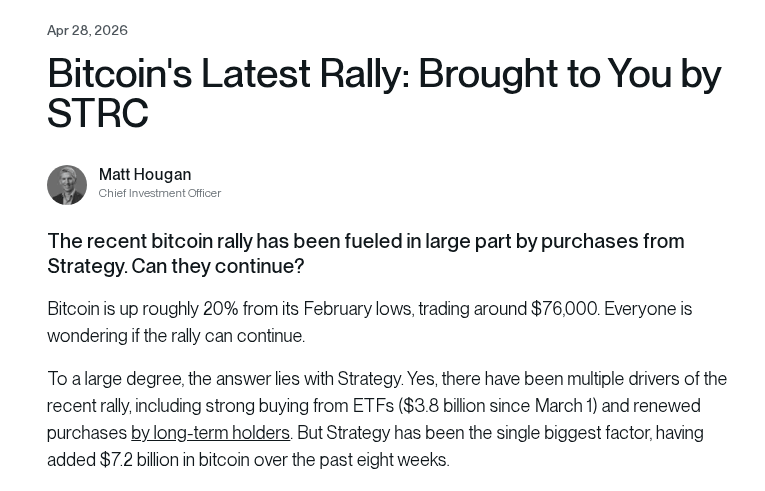
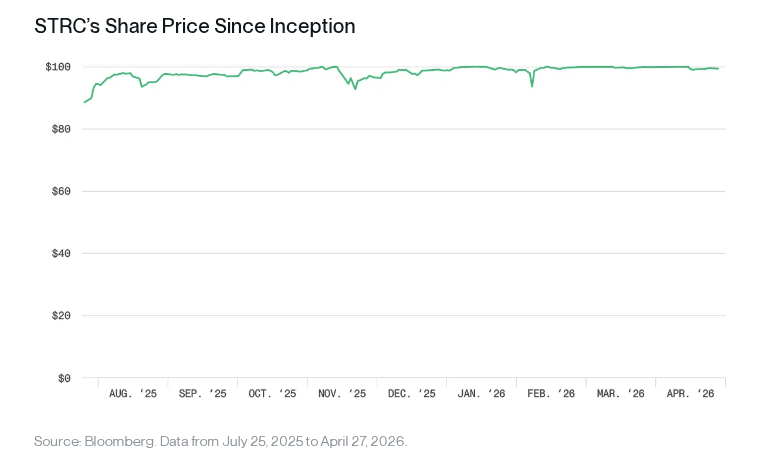
The fuel behind those purchases is STRC, Strategy’s perpetual preferred stock. The company issues STRC shares and channels most of the money raised directly into Bitcoin.
Source: Bitwise

Investors are drawn to it partly because it offers an 11.5% annual yield — well above what junk bonds are currently paying.

Hougan said that with private credit losing favor among investors, STRC’s yield backed by a Bitcoin reserve worth more than $40 billion looks attractive. He expects Strategy to raise billions more through the instrument.

Strategy’s Bitcoin buys have become a weekly occurrence. Its latest purchase — 3,273 coins for $255 million between April 20 and 26 — pushed its total holdings to 818,334 BTC, edging past BlackRock’s roughly 812,300 coins held on behalf of its clients.
Dividend Payments Could Last Decades

Hougan ran the numbers on how long Strategy could sustain its dividend commitments. At current Bitcoin prices, the company could theoretically keep paying existing dividends for 42 years.

If Bitcoin grows at 20% annually, Saylor has argued, those payments could continue indefinitely. Hougan appears to share that view, saying the purchases are likely to continue “for some time to come.”

BTCUSD now trading at $77,158. Chart: TradingView

ETFs and large individual buyers have also played a role in the recovery. ETF inflows have reached $3.8 billion since March 1, and long-term holders have resumed buying. But Hougan was clear that Strategy’s consistent, large-scale purchases have outweighed those other factors combined.

Closing In On Satoshi’s Holdings

Wallets attributed to Nakamoto hold a little over a billion Bitcoin — about 5.5% of the total supply. Strategy would need to acquire roughly 277,660 more coins to match that figure.

Its weekly purchases have ranged widely this year, from as few as 850 coins in February to 34,160 on a single day in April, so the timeline depends heavily on how aggressively the company continues buying.

Featured image from MetaAI, chart from TradingView

Trending Cryptos

Related Reads

CPU Makes a Comeback to the Table, A $170 Billion "Power Seizure" Drama Begins

A new era is dawning for the server CPU (Central Processing Unit), driven by the shift from AI model training to large-scale reasoning and the rise of Agentic AI. This article explores how the CPU is reclaiming a central role in the AI data center. For years, the focus has been on the GPU (Graphics Processing Unit) for AI training. However, as AI moves to the inference and Agent phase—where tasks involve complex, multi-step reasoning, tool calls, and data management—the workload balance is flipping. Studies show CPUs now handle over 70% of the workload in Agentic AI, up from 10-30% in training. This is because Agent tasks generate massive intermediate data (KV Cache) that exceeds GPU memory, forcing it to be offloaded to the CPU's larger, more scalable memory pools. This increased importance is translating into market changes. Major players are taking note: NVIDIA launched its first standalone CPU line, Vera, based on ARM architecture and optimized for Agent performance. AMD doubled its server CPU market forecast to over $1200 billion by 2030. Analyst reports project the total server CPU market could reach $1700 billion by 2030, with AI-driven demand being a primary driver. Furthermore, the classic ratio of CPUs to GPUs in AI servers is rapidly changing, converging from 1:8 toward 1:1 for Agent deployments. This surge in demand has led to a rare industry-wide price increase of 10-15% for server CPUs from Intel and AMD, breaking a decade-long trend of "more performance for the same price." Demand is bifurcating into high-core-count CPUs for in-rack GPU support and moderate-core CPUs for standalone Agent task orchestration. In China, this global trend presents an opportunity for domestic CPU manufacturers like Hygon (海光信息) and Huawei Kunpeng, who are bolstered by both growing AI infrastructure needs and national policies promoting technological self-reliance ("xin chuang"). The maturity of their software ecosystems is also accelerating, evidenced by faster adaptation to new AI models. In conclusion, the narrative is shifting from a GPU-centric view to one where CPU-GPU synergy is critical. The CPU is no longer a peripheral component but a performance-defining bottleneck and a key growth driver in the AI hardware stack, opening a massive new market estimated in the hundreds of billions of dollars.

marsbit11h ago

CPU Makes a Comeback to the Table, A $170 Billion "Power Seizure" Drama Begins

marsbit11h ago

Trading

Spot
Futures

Hot Articles

Discussions

Welcome to the HTX Community. Here, you can stay informed about the latest platform developments and gain access to professional market insights. Users' opinions on the price of S (S) are presented below.

活动图片