Bitcoin’s Institutional Footprint Expands Exponentially Across Markets – Here’s How Much They Hold

bitcoinistPublished on 2026-05-14Last updated on 2026-05-14

Abstract

Bitcoin's adoption has shifted from primarily retail investors to significant institutional accumulation. According to analyst On-Chain Mind, institutions now hold a staggering 3.24 million BTC, valued at approximately $261.2 billion. This massive stack is equivalent to nearly 20 years of new Bitcoin issuance. The holdings are distributed across Bitcoin ETFs (42.9%), corporate firms (38.0%), and sovereign entities (19.1%). Concurrently, on-chain data from Santiment shows key stakeholders (wallets holding 10 to 10,000 BTC) have been accumulating more Bitcoin recently, adding over 16,622 BTC, while smaller retail wallets have sold off minor amounts. This sustained institutional and large-holder accumulation, even amid market uncertainty, highlights Bitcoin's evolution into a strategic reserve asset and supports its price stability above $80,000.

At the beginning, Bitcoin, the largest cryptocurrency asset by market cap, was particularly common among retail investors who saw the coin as a speculative asset rather than an actual store of value. However, years later, the cryptocurrency has become a major target for large firms, acquiring the asset at a significant rate.

Institutional Bitcoin Holdings Reach New Scale

Despite being labeled as a highly volatile asset, Bitcoin continues to see major interest and adoption across the dynamic cryptocurrency sector. One interesting part about this development is the notable interest from big firms in the crypto and financial sectors, who steadily purchased the leading asset.

Over the years, institutional participation in Bitcoin has grown significantly, turning the asset from a specialized digital experiment into a well-known part of contemporary financial portfolios. This accumulation by corporations, asset managers, and financial institutions points to growing conviction in the asset as a reliable store of value and a strategic financial asset.

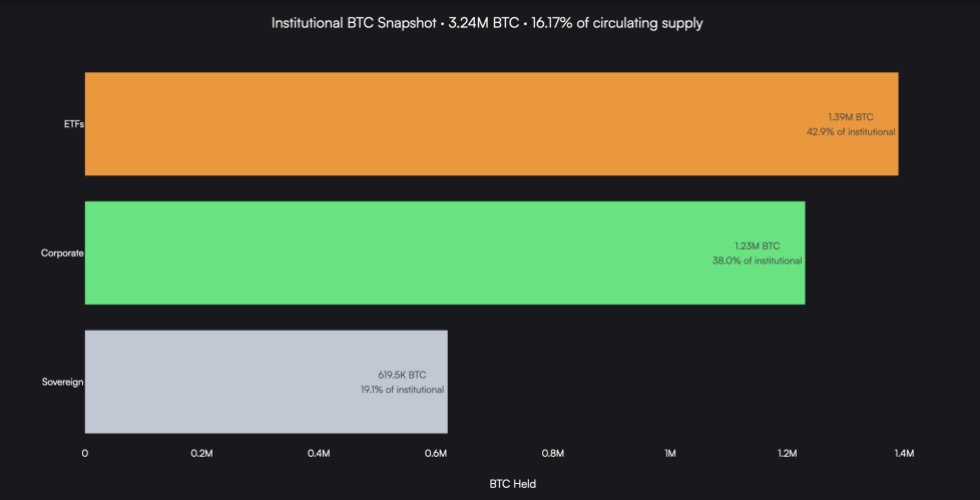
After years of steady accumulation, On-Chain Mind, a crypto data analyst on X, reported that the institutional Bitcoin stack has now reached a staggering 3.24 million BTC, valued at approximately $261.2 billion at current price levels. According to the expert, this BTC stash is equivalent to almost the entire new issuance of BTC in the last 20 years.
Source: Chart from On-Chain Mind on X

As seen in the chart, the Bitcoin Exchange-Traded Funds (ETFs) hold about 1.39 million BTC, reflecting around 42.9% of the entire holdings of institutions. Furthermore, Corporate firms hold 1.23 million BTC, representing 38.0% of the institutional stack. Meanwhile, approximately 619,500 BTC, which marks over 19.1% of the stash, is being held by Sovereigns.

According to On-Chain Mind, this stash is expected to grow higher than this in the next few years. A few years ago, the expert highlighted that the institutions had zero BTC in their portfolios, which strengthens its prediction about additional growth. This sudden adoption by institutional investors demonstrates Bitcoin’s evolution from a risk asset people rent to a reserve asset people fight to own across the sector.

Key Stakeholders Are Buying More BTC

Santiment, a leading on-chain data analytics platform, has outlined a renewed accumulation trend among key stakeholders amid growing momentum. While BTC’s price stayed above the $80,000 mark despite the unexpected CPI report, these investors were observed buying more BTC consistently as retail holders started to exhibit signs of hesitance. This was part of the reason that BTC was able to maintain its newfound upward move.

In the report, it was seen that wallet addresses holding between 10 and 10,000 BTC have scooped up over 16,622 BTC, representing an increase of +0.12%. Meanwhile, those holding less than 0.01 BTC have dumped 28 BTC; a drop of -0.05%.

Large stakeholder persistently adding to their bags while store displays FUD are excellent conditions for any coin, making this bullish for BTC in the short term. During most of crypto’s bull markets, this 10-10,000 BTC group has played a major role in igniting pumps while prices move opposite to retail expectations.

BTC trading at $80,971 on the 1D chart | Source: BTCUSDT on Tradingview.com

Trending Cryptos

Related Questions

QWhat is the total amount of Bitcoin that institutions currently hold, according to the data analyst On-Chain Mind?

AInstitutions currently hold a staggering 3.24 million BTC, valued at approximately $261.2 billion.

QAmong the institutional Bitcoin holdings, which category holds the largest share?

ABitcoin Exchange-Traded Funds (ETFs) hold the largest share at about 1.39 million BTC, representing approximately 42.9% of the entire institutional holdings.

QHow does the article describe the change in institutional perception of Bitcoin over time?

AThe article describes Bitcoin's evolution from a speculative asset primarily held by retail investors into a well-known part of financial portfolios, seen by institutions as a reliable store of value and a strategic financial asset.

QWhat recent accumulation trend among key stakeholders did the on-chain analytics platform Santiment report?

ASantiment reported that wallet addresses holding between 10 and 10,000 BTC accumulated over 16,622 BTC (+0.12%), while addresses holding less than 0.01 BTC sold off 28 BTC (-0.05%).

QWhat does the data suggest about the growth potential of the institutional Bitcoin stash?

AThe data suggests the stash is expected to grow further. The analyst notes that institutions had zero BTC a few years ago, and the current rapid adoption indicates a strong trend of continued accumulation.

Related Reads

From Somersaults to Working 24/7: We Saw the ‘Working-Class’ Aura in Robots at WAIC

From performing acrobatics to working 24/7: Robots at WAIC are getting down to business. This year's World Artificial Intelligence Conference (WAIC) in Shanghai showcased a significant shift in the robotics industry. While "show-off" robots that dance, play music, or compete in sports are still present, the dominant trend is now practical, task-oriented machines. Hundreds of wheeled and humanoid robots were deployed as guides, baristas, factory workers, and even traffic controllers, moving beyond mere demonstrations to highlight real-world "work capabilities." The focus has pivoted from showcasing technical parameters to pursuing mass production and industrial落地 (landing/implementation). This transition presents major challenges. First, deploying powerful AI models onto robots requires overcoming hardware limitations in computing power and latency. Second, robots demand complex, integrated systems for real-time perception and control. Third, achieving reliable mass production necessitates unprecedented industry-wide collaboration on standards and supply chains. A key bottleneck identified by industry leaders is the robot's "brain"—its AI and cognitive capabilities. While hardware and basic movement ("little brain") have advanced rapidly, the higher-level intelligence for understanding complex instructions and adapting to unstructured environments is progressing more slowly. Companies are investing heavily in developing more advanced "brain" systems, but fully autonomous operation in dynamic settings remains a work in progress. Cost is another critical hurdle. While some consumer-oriented humanoid robots are now priced under $15,000, capable industrial models often cost $50,000 or more. The industry consensus is that bringing robots into unstructured home environments for tasks like comprehensive cleaning is still at least five years away due to technical, safety, and cost barriers. Therefore, 2026 is being called the "first year of mass production," but primarily for industrial and specific commercial applications. WAIC 2026 served less as a stage for spectacular tricks and more as a serious examination of robots' commercial viability, marking their transition from laboratory prototypes to real-world products that must prove their value through stable, repetitive work.

marsbit2h ago

From Somersaults to Working 24/7: We Saw the ‘Working-Class’ Aura in Robots at WAIC

marsbit2h ago

Live-Action Short Series Forced onto the Big Screen by AI

Live-action short dramas, originally a popular online format, are now attempting to enter the cinema. Several top IPs like "What a Good Girl" and "One Family, Same Class" have received approval for film adaptations. This shift is driven by several pressures within the short drama industry. After rapid growth fueled by low costs and platform support, the sector now faces a slowdown with fewer hits and reduced investment. A major disruptor is the explosive rise of AI-generated short dramas, which dominate new releases and challenge the traditional model with their speed and low cost. Platform policy changes, such as adjustments to revenue guarantees, have further squeezed producers. In this context, film adaptation is seen as a potential new growth path. It offers a chance to extend a short-lived online hit into a longer-lasting IP asset, moving beyond the "fast production, fast consumption" cycle. Established short dramas bring pre-validated stories and emotional appeal to the table, potentially lowering the risk for film investors. However, significant challenges remain. Translating a fast-paced, fragmented viewing experience designed for phones into a compelling cinematic narrative is difficult. Past attempts by popular TV shows and variety programs to make films have often failed due to weak content. A short drama's massive online viewership does not guarantee box office success, as cinema requires a higher commitment of time and money from audiences. Ultimately, the success of these adaptations will depend not on their original popularity, but on their ability to tell complete, emotionally resonant stories that meet the standards of the theatrical market.

marsbit4h ago

Live-Action Short Series Forced onto the Big Screen by AI

marsbit4h ago

Trading

Spot

Hot Articles

What is $BITCOIN

DIGITAL GOLD ($BITCOIN): A Comprehensive Analysis Introduction to DIGITAL GOLD ($BITCOIN) DIGITAL GOLD ($BITCOIN) is a blockchain-based project operating on the Solana network, which aims to combine the characteristics of traditional precious metals with the innovation of decentralized technologies. While it shares a name with Bitcoin, often referred to as “digital gold” due to its perception as a store of value, DIGITAL GOLD is a separate token designed to create a unique ecosystem within the Web3 landscape. Its goal is to position itself as a viable alternative digital asset, although specifics regarding its applications and functionalities are still developing. What is DIGITAL GOLD ($BITCOIN)? DIGITAL GOLD ($BITCOIN) is a cryptocurrency token explicitly designed for use on the Solana blockchain. In contrast to Bitcoin, which provides a widely recognized value storage role, this token appears to focus on broader applications and characteristics. Notable aspects include: Blockchain Infrastructure: The token is built on the Solana blockchain, known for its capacity to handle high-speed and low-cost transactions. Supply Dynamics: DIGITAL GOLD has a maximum supply capped at 100 quadrillion tokens (100P $BITCOIN), although details regarding its circulating supply are currently undisclosed. Utility: While precise functionalities are not explicitly outlined, there are indications that the token could be utilized for various applications, potentially involving decentralized applications (dApps) or asset tokenization strategies. Who is the Creator of DIGITAL GOLD ($BITCOIN)? At present, the identity of the creators and development team behind DIGITAL GOLD ($BITCOIN) remains unknown. This situation is typical among many innovative projects within the blockchain space, particularly those aligning with decentralized finance and meme coin phenomena. While such anonymity may foster a community-driven culture, it intensifies concerns about governance and accountability. Who are the Investors of DIGITAL GOLD ($BITCOIN)? The available information indicates that DIGITAL GOLD ($BITCOIN) does not have any known institutional backers or prominent venture capital investments. The project seems to operate on a peer-to-peer model focused on community support and adoption rather than traditional funding routes. Its activity and liquidity are primarily situated on decentralized exchanges (DEXs), such as PumpSwap, rather than established centralized trading platforms, further highlighting its grassroots approach. How DIGITAL GOLD ($BITCOIN) Works The operational mechanics of DIGITAL GOLD ($BITCOIN) can be elaborated on based on its blockchain design and network attributes: Consensus Mechanism: By leveraging Solana’s unique proof-of-history (PoH) combined with a proof-of-stake (PoS) model, the project ensures efficient transaction validation contributing to the network's high performance. Tokenomics: While specific deflationary mechanisms have not been extensively detailed, the vast maximum token supply implies that it may cater to microtransactions or niche use cases that are still to be defined. Interoperability: There exists the potential for integration with Solana’s broader ecosystem, including various decentralized finance (DeFi) platforms. However, the details regarding specific integrations remain unspecified. Timeline of Key Events Here is a timeline that highlights significant milestones concerning DIGITAL GOLD ($BITCOIN): 2023: The initial deployment of the token occurs on the Solana blockchain, marked by its contract address. 2024: DIGITAL GOLD gains visibility as it becomes available for trading on decentralized exchanges like PumpSwap, allowing users to trade it against SOL. 2025: The project witnesses sporadic trading activity and potential interest in community-led engagements, although no noteworthy partnerships or technical advancements have been documented as of yet. Critical Analysis Strengths Scalability: The underlying Solana infrastructure supports high transaction volumes, which could enhance the utility of $BITCOIN in various transaction scenarios. Accessibility: The potential low trading price per token could attract retail investors, facilitating wider participation due to fractional ownership opportunities. Risks Lack of Transparency: The absence of publicly known backers, developers, or an audit process may yield skepticism regarding the project's sustainability and trustworthiness. Market Volatility: The trading activity is heavily reliant on speculative behavior, which can result in significant price volatility and uncertainty for investors. Conclusion DIGITAL GOLD ($BITCOIN) emerges as an intriguing yet ambiguous project within the rapidly evolving Solana ecosystem. While it attempts to leverage the “digital gold” narrative, its departure from Bitcoin's established role as a store of value underscores the need for a clearer differentiation of its intended utility and governance structure. Future acceptance and adoption will likely depend on addressing the current opacity and defining its operational and economic strategies more explicitly. Note: This report encompasses synthesised information available as of October 2023, and developments may have transpired beyond the research period.

865 Total ViewsPublished 2025.05.13Updated 2025.05.13

What is $BITCOIN

Discussions

Welcome to the HTX Community. Here, you can stay informed about the latest platform developments and gain access to professional market insights. Users' opinions on the price of BTC (BTC) are presented below.

活动图片