Bitcoin Wholecoin Holders Pulling Back As Inflows To Binance Shrink – What’s Driving It

bitcoinistPublished on 2025-12-15Last updated on 2025-12-15

Abstract

Bitcoin's recent price volatility has pushed it back under $90,000, accompanied by a notable decline in large investor activity. Data reveals that inflows from "wholecoiners" (wallets holding at least 1 BTC) into Binance have dropped significantly, with the yearly average hitting levels not seen since 2018. This trend suggests that large holders are less inclined to sell, possibly due to Bitcoin's higher valuation making full coins harder to acquire and the rise of alternative trading venues like DeFi. Additionally, Bitcoin continues to trade below the short-term holder cost basis of $105,400, a phase that has historically presented accumulation opportunities for long-term investors, though caution is advised.

Bitcoin’s bounce last week was quickly cut off by growing volatility in the broader crypto market, causing the price to fall below the pivotal $90,000 mark once again. Given the recent price fluctuations, investors’ sentiment, especially those on crypto exchanges, has shifted as inflows from BTC wholecoiners plummet.

Binance Sees Sharp Drop In BTC Wholecoiner Inflows

While the price of Bitcoin pulls back this new week, there is one key metric that is currently standing out. This metric is the BTC Wholecoiners Inflows on Binance, which is starting to tell a different story about investors on the largest cryptocurrency exchange in the world.

After examining this metric, Darkfost, a market analyst and author at CryptoQuant, revealed that on the Binance platform, wholecoiner deposits are drying up. Specifically, wholecoiner inflows imply transactions larger than 1 BTC, which provides vital insight into both current selling pressure and the broader evolution of the market.

Data shows that the inflows from this cohort are declining when compared to past years. Presently, BTC’s yearly average now sits around 6,500 BTC, representing a level not seen since 2018. Meanwhile, on the shorter time frame, the weekly average is situated near 5,200 BTC, marking one of its lowest readings of this cycle.
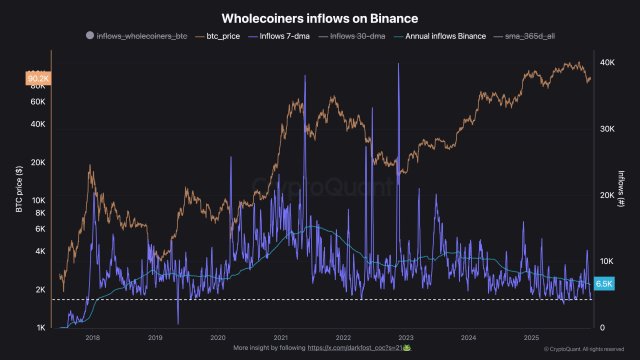
Wholecoiners are leaving exchanges | Source: Chart from Darkfost on X

While the wholecoiner inflows dry up, the pattern that inflows have followed this cycle in comparison to previous ones is very intriguing. Even as Bitcoin continued to rise, wholecoiner inflows to Binance have steadily decreased rather than rising as they once did.

Beyond indicating that investors with sizable Bitcoin holdings are less inclined to sell, this trend could also point to a deeper structural shift in the market. With Bitcoin’s valuation experiencing a steady increase, owning a full BTC has become extremely difficult, which naturally decreases the total number of transactions larger than 1 BTC.

At the same time, Darkfost highlighted that there are now more options available in the ecosystem for owning or trading Bitcoin. Even crypto exchanges have multiplied, and the steady growth of Decentralized Finance (DeFi) provides more venues, a trend that is likely to redirect flows that previously went nearly exclusively to major exchanges such as Binance.

BTC Still Trading Below Short-Term Cost Basis

Bitcoin is still trading below the Short-Term Holder Cost Basis located at $105,400. What this means is that the crypto king has been trading below the level for nearly 2 months now. However, Darkfost stated that staying beneath the level for such an extended period is not uncommon.

During previous corrections, the duration of these phases has ranged from two months to over four months, making the present correction fall well within a typical range. However, since this indication tends to stay negative for much longer after the market actually enters a bear phase, it would be crucial to prevent Bitcoin from declining any further.

In the meantime, this does not invalidate the notion that these periods remain a signal for accumulation opportunities. Nevertheless, caution is still crucial, and access points should be carefully optimized. Darkfost believes that an accumulation of this type is only appropriate for long-term investors.

BTC trading at $89,726 on the 1D chart | Source: BTCUSDT on Tradingview.com

Related Reads

Agents Take Over Traffic Distribution Power: What Are Tencent, ByteDance, and Alibaba Competing For?

In the race to dominate the AI era's entry point, China's tech giants—Tencent, ByteDance, and Alibaba—are aggressively deploying AI Agents to control the future of traffic distribution. Alibaba is pursuing a dual-track "closed loop + openness" strategy. Its Qianwen app is evolving into a super-Agent integrated across its ecosystem (Taobao, Alipay, etc.) to handle complex tasks like travel planning. Concurrently, it is opening its platform to external brands (Luckin Coffee, KFC) and has launched a B2B Agent platform, "Wukong," targeting enterprise automation. Its other flagship, Quark, aims to be an "AI super search box" for information and tasks. ByteDance is executing an omnipresent "sprawl strategy." Its Doubao app boasts over 300 million monthly active users and is evolving into a default AI entry point for daily life, with plans for paid versions and e-commerce integration. Its core weapon is the Kouzi platform, a visual "AI assembly factory" for developers to build custom Agents. ByteDance is also pushing hardware integration, collaborating on AI phones and developing smart glasses to embed Doubao everywhere. Tencent is playing its long-held "ultimate card" by quietly embedding an AI Agent directly into WeChat. This Agent, accessible via a swipe, can understand user commands and automatically execute tasks by calling upon WeChat's millions of mini-programs (e.g., finding and ordering coffee). This leverages WeChat's unparalleled 1.4-billion-user ecosystem to position the app as an AI-powered "service operating system," a move that could dramatically reshape the competitive landscape. The core battleground is shifting from competing for "user screen time" to competing to be the "default execution layer" for user intent. The business model is evolving from an "attention economy" to an "intent economy," where the Agent that can most efficiently fulfill a user's need gains control over service access and token flow. This represents a fundamental change in how users connect with digital services, making the fight for the Agent入口 (entry point) a pivotal moment for redefining industry leadership in the AI age.

marsbit1h ago

Agents Take Over Traffic Distribution Power: What Are Tencent, ByteDance, and Alibaba Competing For?

marsbit1h ago

From Banning Doubao to Embracing Honor: Why Did WeChat Suddenly 'Change Its Face'?

The article explores the sudden shift in WeChat's strategy towards AI assistants from mobile phone manufacturers, transitioning from strict opposition to active collaboration. For over a year, WeChat fiercely resisted attempts by phone AI assistants (like ByteDance's Doubao in late 2025) to control its features via GUI automation ("simulated clicking"), citing security and data control concerns. This stance created a significant barrier for system-level AI integration. Now, Tencent has initiated A2A (Agent-to-Agent) partnerships with major phone brands like Honor, Xiaomi, OPPO, and vivo. This model allows a phone's system AI (e.g., Honor's YOYO) to parse a user's voice command and send a structured request directly to WeChat's own internal AI agent via secure APIs. WeChat then executes the action (e.g., sending a message) and returns the result. The article attributes Tencent's "change of face" to strategic pressure. While leading in social app usage, Tencent trails rivals like ByteDance and Alibaba in standalone AI app popularity. WeChat, with its vast mini-program ecosystem, is Tencent's key asset for an AI comeback. The upcoming WeChat AI agent aims to handle tasks like booking and payments within the app. However, phone system assistants remain the primary AI entry point for most users. The A2A collaboration allows Tencent to extend WeChat's AI reach to this crucial system layer while maintaining control over its core functions and data. For phone manufacturers, embracing A2A is a pragmatic move. The GUI route proved unviable due to WeChat's blocks. A2A offers a compliant path to integrate a vital service, enhancing their AI assistants' usefulness. It allows them to focus on developing their own AI ecosystems for other services while cooperating on WeChat access. The collaboration is framed as a mutual, strategic necessity: Tencent gains a distribution channel, and manufacturers gain a key functionality. The partnership relies on a "dual authorization" mechanism for security, requiring both user and app consent for each action. While questions about long-term data privacy practices remain, experts note A2A is more secure and compliant than GUI automation. Ultimately, this cooperation is seen as a tentative, calculated truce. Tencent's long-term goal is to make WeChat an AI-powered "service OS." Phone manufacturers aim to make their system AI the central user interface. Their paths may converge or clash in the future, but for now, the A2A deal represents the opening chapter in the battle for the AI-era user入口, driven by necessity and strategic calculus on both sides.

marsbit2h ago

From Banning Doubao to Embracing Honor: Why Did WeChat Suddenly 'Change Its Face'?

marsbit2h ago

Trading

Spot
Futures

Hot Articles

Discussions

Welcome to the HTX Community. Here, you can stay informed about the latest platform developments and gain access to professional market insights. Users' opinions on the price of S (S) are presented below.

活动图片