Bitcoin Vs. Altcoins: You Should See This Chart That Shows Another Alt Season Is About To Begin

bitcoinistPublished on 2026-02-27Last updated on 2026-02-27

Abstract

Based on a long-term chart analysis by crypto expert @CyrilXBT, the total altcoin market cap relative to Bitcoin has returned to a critical historical level of approximately 0.129, which has previously signaled the start of major altcoin seasons. This ratio, representing the total crypto market excluding the top 10 assets compared to Bitcoin, is now in what the analyst describes as the "base" or "accumulation zone." Historically, this level has preceded significant altcoin rallies, such as those in 2017-2018 and the largest recorded alt season in 2021 when the ratio surged above 0.55. Despite recent Bitcoin dominance and price declines, the current market reset suggests that conditions may be forming for a new alt season. The analyst notes that if historical patterns repeat, the ratio could potentially reach between 0.80 and 0.90 in the current cycle. This indicates that altcoins are not "dead" but may be poised for a significant upward movement as market dynamics align with past bullish trends.

Talks of a potential altcoin season this cycle have since subsided compared to previous years, despite the recent decline in the Bitcoin (BTC) price and dominance. Notably, a crypto analyst has shared a new long-term chart showing the total altcoin market capitalization relative to Bitcoin at a level that has historically preceded major alt seasons. Based on his analysis, the alt market has fully reset and could be gearing up for a fresh altcoin season if historical trends play out as expected.

Historic Alt Season Setup Forms As Bitcoin Ratio Hits Base Zone

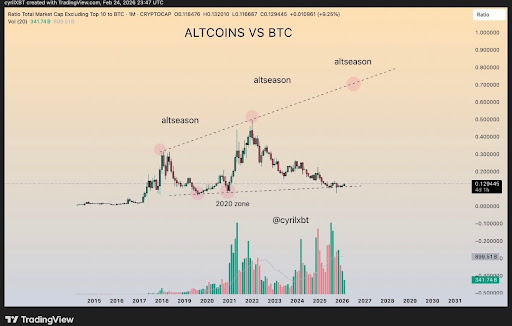
In a recent analysis on X, market expert @CyrilXBT shared a monthly chart tracking the ratio of the total crypto market, excluding the top 10 assets, to Bitcoin. According to the analysis, the chart currently sits at approximately 0.129, a level the analyst describes as the same base or accumulation zone that has launched every major altcoin season in crypto history.

@CyrilXBT noted that this zone is where all alt seasons are born, with each past altcoin rally beginning when the ratio stopped falling and stabilized around the $0.12 to $0.13 range. Looking at the chart, the analyst noted that during the 2015-2016 cycle, the ratio starts near zero and remains flat, with minimal volatility. Following this, a dramatic spike occurred during the 2017-2018 bull run, pushing the altcoin vs Bitcoin ratio above 0.3, marking one of the first major alt seasons.

Source: X

By 2020, the ratio crashed back below the 0.129 level, erasing most of its previous gains as it consolidated near the low-ranged accumulation/base zone. Notably, 2021 marked the largest altcoin season spike in history, with the ratio exploding upward to over 0.55 amid the bull market frenzy. During this time, volume hit new highs, with bars towering above those of previous years.

New Alt Season Conditions Take Shape

Similar to the 2020 crash, the 2022-2024 cycle saw a post-peak correction, with the ratio trending downward as Bitcoin regained dominance. In the current 2025-2026 cycle, the altcoin vs Bitcoin ratio has finally returned to the historically significant 0.129 accumulation zone, with BTC.D falling to a yearly low of 57.9%.

@CyrilXBT has suggested that the current positioning mirrors the pre-altseason setup that led to a major altcoin explosion in previous years. He noted that the rising trendline connecting successive altcoin season peaks on the chart points to a ratio of roughly 0.80 to 0.90 as the next potential target for this cycle.

As the ratio stabilizes and historical trends repeat, @CyrilXBT argues that recent market performance does not indicate that altcoins are dead. Rather, it shows that the market has fully reset and could be quietly creating the conditions for its next alt season.

Total altcoin market cap remains below $1 trillion | Source: Crypto Total Market Cap Excluding BTC from Tradingview.com

Related Questions

QAccording to the analyst @CyrilXBT, what is the significance of the total altcoin market cap to Bitcoin ratio reaching the 0.129 level?

AThe analyst states that the 0.129 level is the historic accumulation or base zone where every major altcoin season in crypto history has been launched from. It is the level where the ratio stops falling and stabilizes, signaling the potential start of a new alt season.

QWhat was the peak value of the altcoin vs. Bitcoin ratio during the 2021 bull market, as mentioned in the article?

ADuring the 2021 bull market, the altcoin vs. Bitcoin ratio exploded upward to over 0.55, marking the largest altcoin season spike in history.

QWhat recent market development, besides the ratio, supports the potential for a new alt season as described in the analysis?

ABitcoin's dominance (BTC.D) has fallen to a yearly low of 57.9%, which, combined with the ratio returning to the 0.129 base zone, helps create the conditions for a potential alt season.

QBased on the historical trendline of alt season peaks, what is the next potential target for the altcoin vs. Bitcoin ratio in the current cycle?

AThe rising trendline connecting successive altcoin season peaks points to a ratio of roughly 0.80 to 0.90 as the next potential target for this cycle.

QHow does the analyst, @CyrilXBT, interpret the recent market performance and the decline in the altcoin ratio?

AHe argues that it does not indicate that altcoins are dead. Instead, it shows that the market has fully reset and could be quietly creating the conditions for its next alt season, mirroring pre-altseason setups from previous years.

Related Reads

You Bet on the News, the Pros Read the Rules: The True Cognitive Gap in Losing Money on Polymarket

The article explains that the key to profiting on Polymarket, a prediction market platform, lies not just predicting real-world events correctly, but in meticulously understanding the specific rules that govern how each market will be resolved. It illustrates this with examples, such as a market on Venezuela's 2026 leader, where the official rules defining "officially holds" the office overruled the intuitive answer of who was in practical control. Other examples include debates over the definition of a "token" or what constitutes an "agreement." The core argument is that a "reality vs. rules" gap creates pricing discrepancies that savvy traders ("车头" or "whales") exploit. The platform has a formal dispute resolution process managed by UMA token holders to settle ambiguous outcomes. This process involves proposal submission, a challenge window, a discussion period, and a final vote. However, the article highlights a critical flaw in this system compared to a traditional court: the lack of separation between the arbiters (UMA voters) and the interested parties (traders with financial stakes in the outcome). This conflict of interest undermines the discussion phase, leads to herd mentality, and results in opaque final decisions without explanatory rulings. Consequently, the system lacks a body of precedent, making it difficult for users to learn from past disputes. The ultimate takeaway is that success on Polymarket requires a lawyer-like scrutiny of the rules to identify and capitalize on the cognitive gap between how events appear and how they are contractually defined for settlement.

marsbit40m ago

You Bet on the News, the Pros Read the Rules: The True Cognitive Gap in Losing Money on Polymarket

marsbit40m ago

Will the Fed Still Cut Interest Rates? Tonight's Data Is Crucial

The core debate surrounding the Federal Reserve's potential interest rate cuts is intensifying amid geopolitical conflict and rebounding inflation. The key question is whether high energy prices will cause persistent inflation or weaken consumer demand enough to force the Fed to cut rates. Citigroup presents a bullish case for cuts, arguing that oil supply disruptions from the Strait of Hormuz are temporary and will not lead to lasting inflationary pressure. They point to receding bond yields and oil prices as evidence the market is pricing in a short-lived shock. Citi's data also shows tightening financial conditions, a stabilizing labor market, and healthy tax returns, supporting their view that the path to lower rates remains open. Conversely, Deutsche Bank offers a starkly contrasting, more hawkish outlook. They argue the Fed's current policy is already neutral and expect rates to remain unchanged indefinitely. Their view is based on stalled disinflation progress and a shift toward more hawkish rhetoric from key Fed officials like Waller, who cited risks from prolonged Middle East conflict and tariffs. Other officials, including Williams and Hammack, signaled rates would likely stay on hold for a "considerable time." The market pricing has shifted dramatically, now forecasting zero cuts in 2026. The imminent release of the March retail sales "control group" data is highlighted as a critical test. This metric, which excludes gas station sales, will reveal if high gasoline prices are eroding consumer spending in other areas. A weak reading could support the case for imminent rate cuts, while a strong one would bolster the argument for the Fed to hold steady. This data is pivotal for determining the near-term policy path.

marsbit1h ago

Will the Fed Still Cut Interest Rates? Tonight's Data Is Crucial

marsbit1h ago

Trading

Spot
Futures

Hot Articles

How to Buy ALT

Welcome to HTX.com! We've made purchasing AltLayer (ALT) simple and convenient. Follow our step-by-step guide to embark on your crypto journey.Step 1: Create Your HTX AccountUse your email or phone number to sign up for a free account on HTX. Experience a hassle-free registration journey and unlock all features.Get My AccountStep 2: Go to Buy Crypto and Choose Your Payment MethodCredit/Debit Card: Use your Visa or Mastercard to buy AltLayer (ALT) instantly.Balance: Use funds from your HTX account balance to trade seamlessly.Third Parties: We've added popular payment methods such as Google Pay and Apple Pay to enhance convenience.P2P: Trade directly with other users on HTX.Over-the-Counter (OTC): We offer tailor-made services and competitive exchange rates for traders.Step 3: Store Your AltLayer (ALT)After purchasing your AltLayer (ALT), store it in your HTX account. Alternatively, you can send it elsewhere via blockchain transfer or use it to trade other cryptocurrencies.Step 4: Trade AltLayer (ALT)Easily trade AltLayer (ALT) on HTX's spot market. Simply access your account, select your trading pair, execute your trades, and monitor in real-time. We offer a user-friendly experience for both beginners and seasoned traders.

3.9k Total ViewsPublished 2024.03.29Updated 2025.03.21

How to Buy ALT

Discussions

Welcome to the HTX Community. Here, you can stay informed about the latest platform developments and gain access to professional market insights. Users' opinions on the price of ALT (ALT) are presented below.

活动图片