Bitcoin stuck at a key level: Investors pause to gauge BTC’s next move

ambcryptoPublished on 2026-04-03Last updated on 2026-04-03

Abstract

Bitcoin remains at a critical juncture as investors assess its next potential move. The market faces headwinds from rising oil prices and inflation fears, driving institutional demand for bearish put options. Short-term holders are limiting upside by securing profits or exiting at breakeven levels. On the 3-day chart, Bitcoin’s February bounce from $60k remains incomplete, failing to breach the key 50% retracement resistance at $78.9k. A move into this “premium” zone could trigger another bearish swing. However, the inability to break below recent swing lows at $65.9k and $62.9k suggests underlying bullish strength on lower timeframes. A close below $65,618 on the 4-hour chart would signal bearish momentum, while a break under $60k on the 3-day chart would confirm a continuation of the long-term downtrend. Until then, a bounce toward $78.9k remains plausible, with the market awaiting a catalyst for the next decisive move.

The West Asia crisis resulted in surging oil prices and fears of growing inflation. This meant that institutional traders were hedging against further downside, evident in the increased demand for puts (bearish bets).

Further downside was possible. Short-term holders were intent on protecting their profits or trying to exit the market at a breakeven, capping the potential of any rally.

Yet, the higher timeframe price action was at an interesting place where a price bounce could not be ruled out completely.

Explaining Bitcoin’s trend expectations
Source: BTC/USDT on TradingView

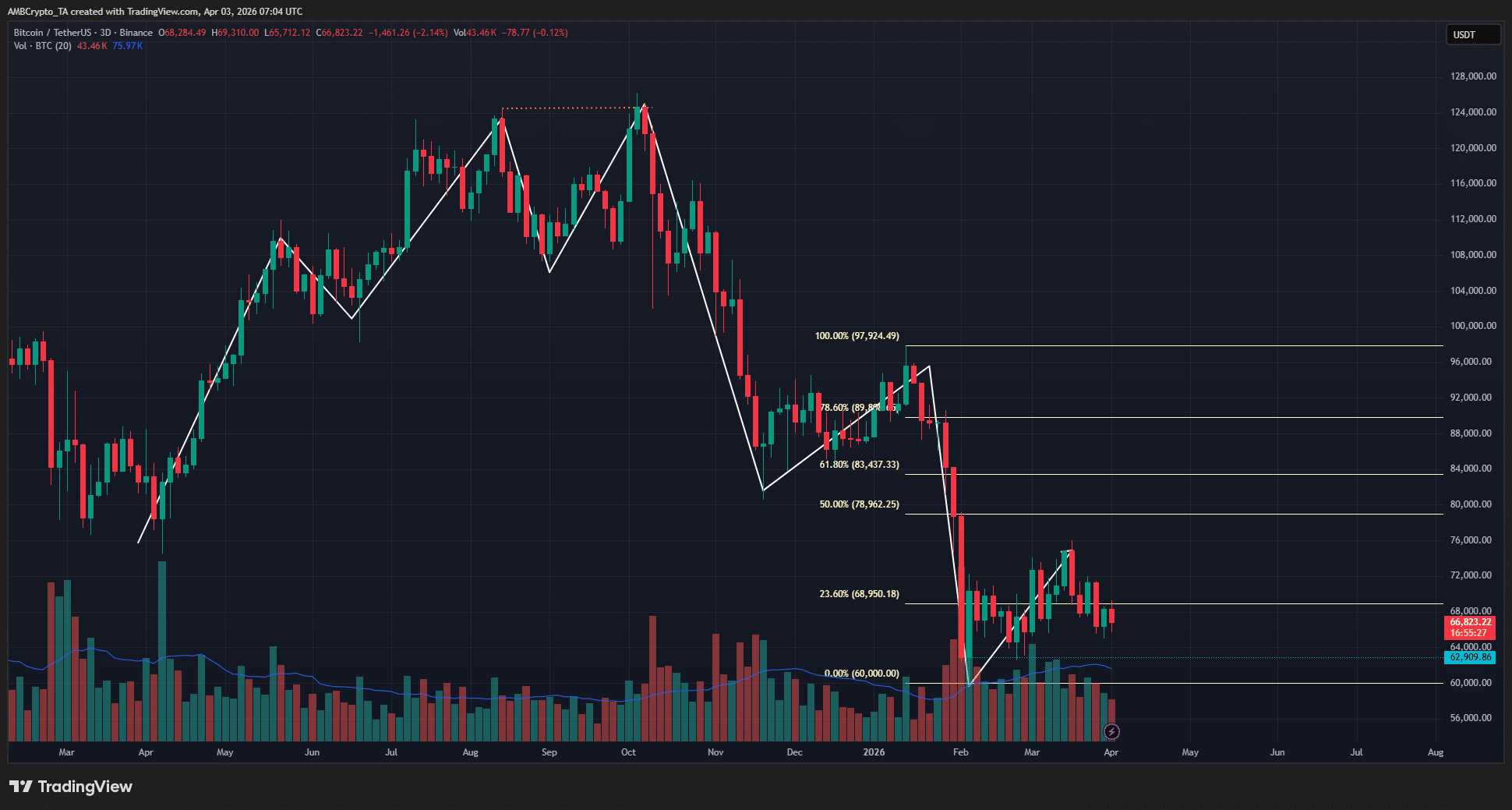
The swing moves on the 3-day timeframe were captured in white. The latest bounce amid the downtrend came in February and was incomplete. There’s a reason why it is considered incomplete.

In October 2025, when the swing structure was bullish, Bitcoin made a double top at $124.4k. This inability to continue the uptrend was an early warning sign of weakness from the bulls.

Subsequently, the swing structure shifted bearishly after the $107.2k low was breached in early November.

Consider the price action since February. The $60k swing low resulted in a bounce that has not climbed above the 50% retracement level.

Many analysts consider the area above the 50% retracement as “premium,” and a move into this area is more likely to result in the next bearish swing move.

The threshold was at $78.9k, and the latest bounce only reached $76k. After this bounce, Bitcoin has not yet climbed below the $60k swing low.

Expectations for Bitcoin’s next move
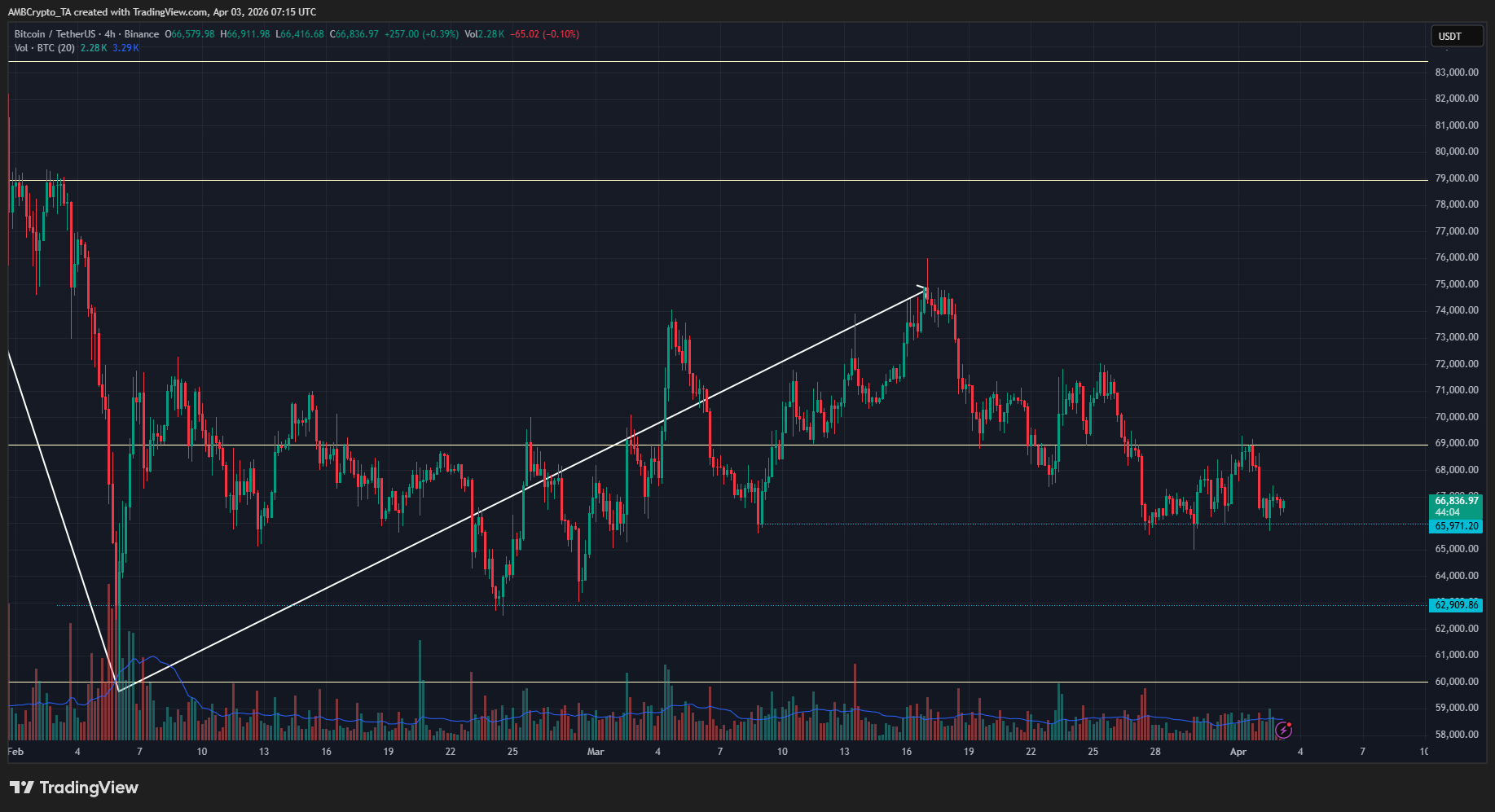
Source: BTC/USDT on TradingView

Like the double top in October 2025, Bitcoin’s inability to set new lows in recent weeks was an intriguing development. Consider the $65.9k and $62.9k levels (dotted cyan).

The H4 timeframe’s swing structure was bullish, but the price was resting near the $65.9k swing lows. A session close below $65,618 is needed to flip the H4 expectations bearishly.

Similarly, a 3-day session closing below $60k is needed to show that the long-term downtrend will continue.

Until this happens, expecting a Bitcoin price bounce into the premium value area above $78.9k is valid. As things stand, the market is waiting for a catalyst to drive the next move.


Final Summary

  • The 3-day and 4-hour timeframe price charts of Bitcoin yielded some counterintuitive bullish expectations around the lower timeframe structure.
  • The importance of the swing low at $65.9k and its defense over the past week means that bears weren’t fully in control of the short-term trend.


Related Questions

QWhat were the main factors causing institutional traders to hedge against downside risk in Bitcoin?

AThe West Asia crisis resulted in surging oil prices and fears of growing inflation, which led institutional traders to hedge against further downside, evident in the increased demand for puts (bearish bets).

QWhat key price level on the 3-day timeframe is considered the threshold for the 'premium' value area?

AThe threshold for the 'premium' value area is at $78.9k, which is above the 50% retracement level.

QWhat are the two critical price levels that need to be breached to confirm a bearish trend continuation?

AA session close below $65,618 is needed to flip the H4 expectations bearishly, and a 3-day session closing below $60k is needed to show that the long-term downtrend will continue.

QWhat was the significance of Bitcoin's price action around the $65.9k level in the short-term?

AThe defense of the $65.9k swing low over the past week means that bears weren't fully in control of the short-term trend, indicating potential for a bounce.

QWhat early warning sign of weakness from the bulls was identified in October 2025?

AIn October 2025, Bitcoin made a double top at $124.4k, and its inability to continue the uptrend was an early warning sign of weakness from the bulls.

Related Reads

Google and Amazon Simultaneously Invest Heavily in a Competitor: The Most Absurd Business Logic of the AI Era Is Becoming Reality

In a span of four days, Amazon announced an additional $25 billion investment, and Google pledged up to $40 billion—both direct competitors pouring over $65 billion into the same AI startup, Anthropic. Rather than a typical venture capital move, this signals the latest escalation in the cloud wars. The core of the deal is not equity but compute pre-orders: Anthropic must spend the majority of these funds on AWS and Google Cloud services and chips, effectively locking in massive future compute consumption. This reflects a shift in cloud market dynamics—enterprises now choose cloud providers based on which hosts the best AI models, not just price or stability. With OpenAI deeply tied to Microsoft, Anthropic’s Claude has become the only viable strategic asset for Google and Amazon to remain competitive. Anthropic’s annualized revenue has surged to $30 billion, and it is expanding into verticals like biotech, positioning itself as a cross-industry AI infrastructure layer. However, this funding comes with constraints: Anthropic’s independence is challenged as it balances two rival investors, its safety-first narrative faces pressure from regulatory scrutiny, and its path to IPO introduces new financial pressures. Globally, this accelerates a "tri-polar" closed-loop structure in AI infrastructure, with Microsoft-OpenAI, Google-Anthropic, and Amazon-Anthropic forming exclusive model-cloud alliances. In contrast, China’s landscape differs—investments like Alibaba and Tencent backing open-source model firm DeepSeek reflect a more decoupled approach, though closed-source models from major cloud providers still dominate. The $65 billion bet is ultimately about securing a seat at the table in an AI-defined future—where missing the model layer means losing the cloud war.

marsbit3h ago

Google and Amazon Simultaneously Invest Heavily in a Competitor: The Most Absurd Business Logic of the AI Era Is Becoming Reality

marsbit3h ago

Computing Power Constrained, Why Did DeepSeek-V4 Open Source?

DeepSeek-V4 has been released as a preview open-source model, featuring 1 million tokens of context length as a baseline capability—previously a premium feature locked behind enterprise paywalls by major overseas AI firms. The official announcement, however, openly acknowledges computational constraints, particularly limited service throughput for the high-end DeepSeek-V4-Pro version due to restricted high-end computing power. Rather than competing on pure scale, DeepSeek adopts a pragmatic approach that balances algorithmic innovation with hardware realities in China’s AI ecosystem. The V4-Pro model uses a highly sparse architecture with 1.6T total parameters but only activates 49B during inference. It performs strongly in agentic coding, knowledge-intensive tasks, and STEM reasoning, competing closely with top-tier closed models like Gemini Pro 3.1 and Claude Opus 4.6 in certain scenarios. A key strategic product is the Flash edition, with 284B total parameters but only 13B activated—making it cost-effective and accessible for mid- and low-tier hardware, including domestic AI chips from Huawei (Ascend), Cambricon, and Hygon. This design supports broader adoption across developers and SMEs while stimulating China's domestic semiconductor ecosystem. Despite facing talent outflow and intense competition in user traffic—with rivals like Doubao and Qianwen leading in monthly active users—DeepSeek has maintained technical momentum. The release also comes amid reports of a new funding round targeting a valuation exceeding $10 billion, potentially setting a new record in China’s LLM sector. Ultimately, DeepSeek-V4 represents a shift toward open yet realistic infrastructure development in the constrained compute landscape of Chinese AI, emphasizing engineering efficiency and domestic hardware compatibility over pure model scale.

marsbit3h ago

Computing Power Constrained, Why Did DeepSeek-V4 Open Source?

marsbit3h ago

Trading

Spot
Futures

Hot Articles

Discussions

Welcome to the HTX Community. Here, you can stay informed about the latest platform developments and gain access to professional market insights. Users' opinions on the price of S (S) are presented below.

活动图片