Bitcoin hikes volatility into ‘tricky’ FOMC as $93.5K yearly open fails

cointelegraphPublished on 2025-12-10Last updated on 2025-12-10

Abstract

Bitcoin (BTC) retreated from recent gains, failing to hold above the $94,500 level and the 2025 yearly open of $93.5K, as traders anticipated volatile price movements around the Federal Reserve's interest rate decision. Analysts noted that FOMC meetings often produce deceptive price action, and a potential drop to $91,000 may not be significant. Liquidity data showed new clusters forming around $90K and $95K. While a 0.25% rate cut was widely expected, the market's main focus was on Fed Chair Jerome Powell's tone regarding future policy. Attention is now shifting to the Bank of Japan's upcoming meeting, as rising Japanese government bond yields could reintroduce volatility from the yen carry trade, a major risk factor for crypto markets in 2024.

Bitcoin (BTC) gave back recent gains on Wednesday as traders predicted fakeout moves around the Federal Reserve interest-rate announcement.

Key points:

  • Bitcoin fails to hold on to its recent trip past $94,500 as nerves accompany the Fed interest-rate decision.

  • Traders are prepared for unreliable moves in both directions around FOMC.

  • Japan-centered risk-asset volatility is already on the horizon as the next key issue.

Bitcoin price fluctuations ignore the yearly open

Data from Cointelegraph Markets Pro and TradingView showed that the BTC price trajectory was heading lower at the Wall Street open.

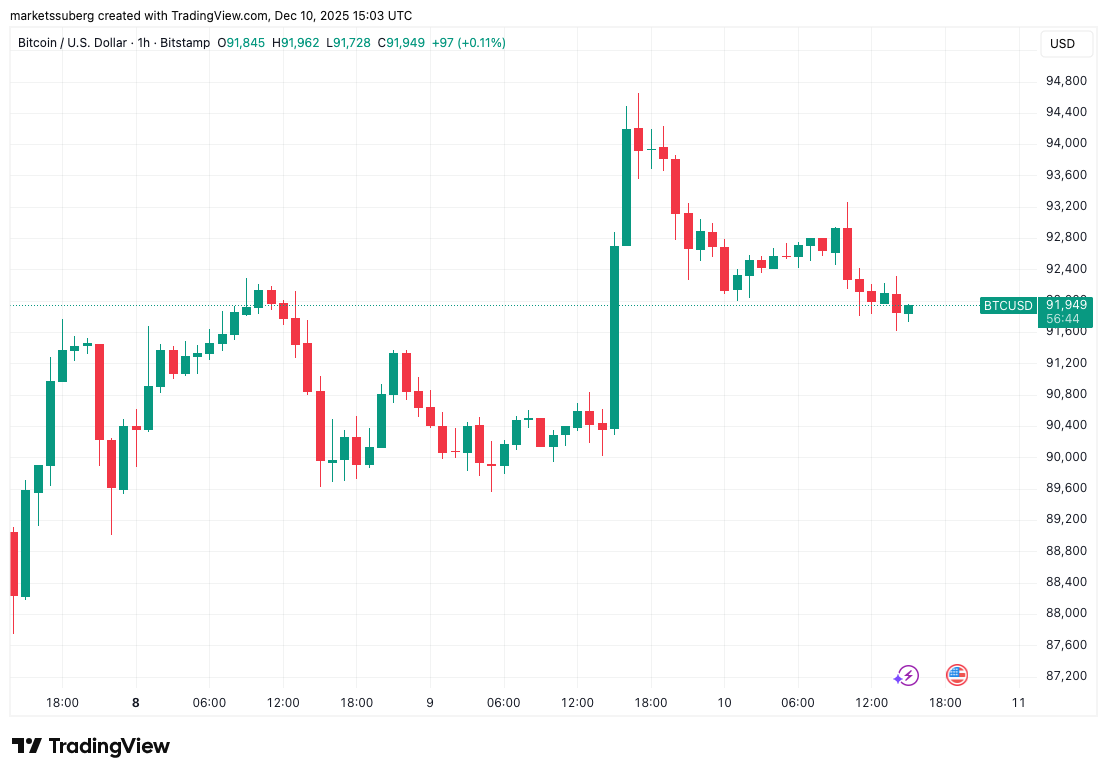
BTC/USD one-hour chart. Source: Cointelegraph/TradingView


Having reached $94,650 the day prior, BTC/USD failed to hold higher levels, including the 2025 yearly open.

At the time of writing, the pair traded around $92,000 as market participants expected unreliable price maneuvers around the rates announcement and press conference.

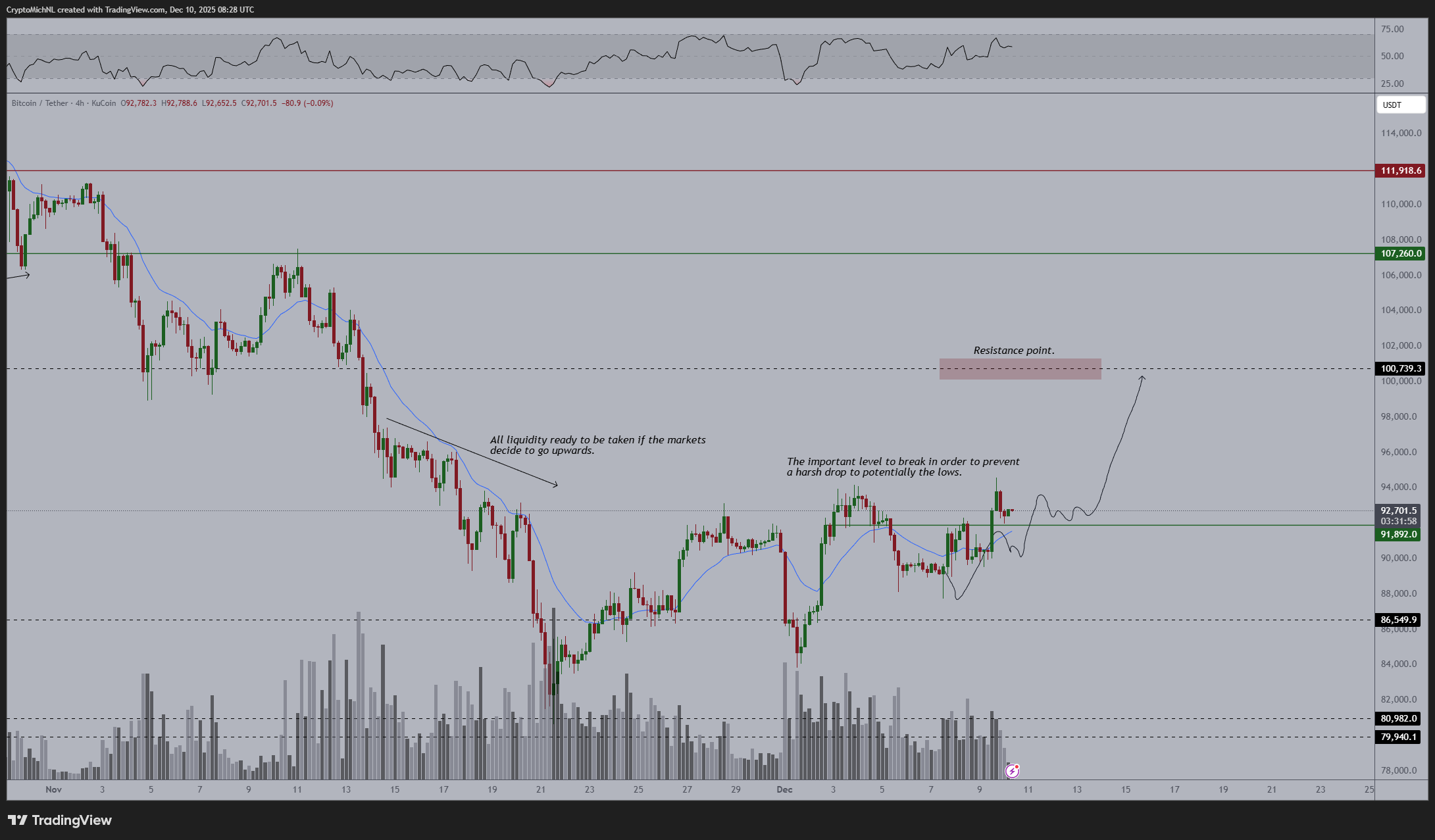
“FOMC meetings can be pretty tricky,” crypto trader, analyst and entrepreneur Michaël van de Poppe wrote on X.

“The price action usually traps everyone before the actual move, so even if Bitcoin drops to $91K, I'm not putting too much weight on it.”
BTC/USDT four-hour chart with RSI, volume data. Source: Michaël van de Poppe/X


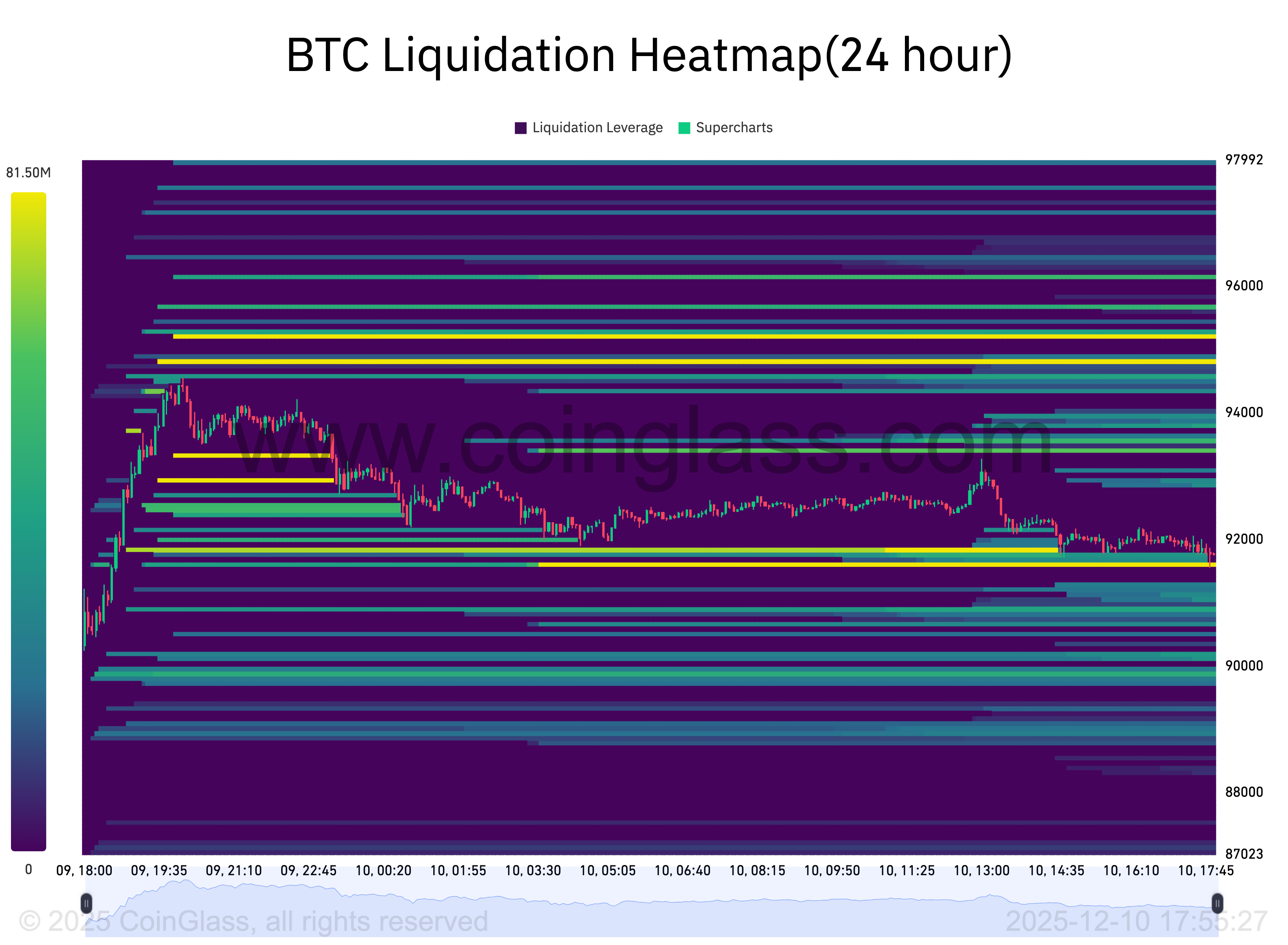
Trader Daan Crypto Trades noted that exchange order books lacked major liquidity clusters on either side of the price after the move higher.

“$BTC Took out that $93K-$94K liquidity cluster as mentioned yesterday. This was the most logical place to go from a liquidity perspective. With that taken out, there's no major area in close proximity,” he told X followers alongside data from monitoring resource CoinGlass.

“But as price is now consolidating, we can see some clusters building up around the $90K & $95K levels.”
BTC liquidation heatmap. Source: CoinGlass


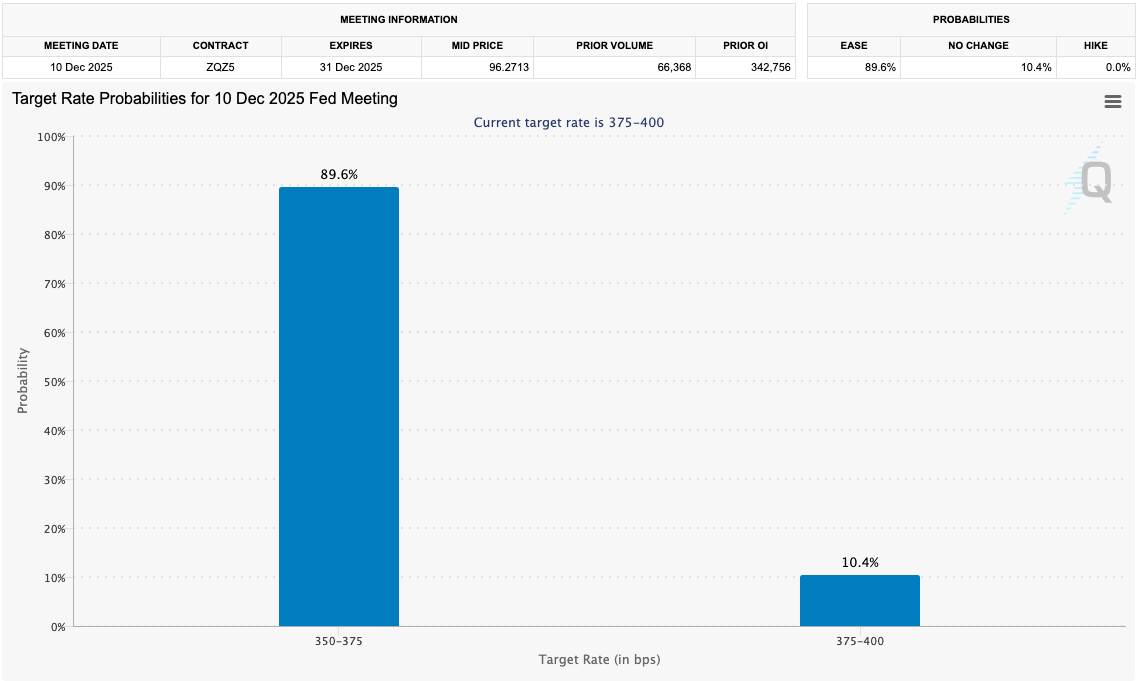
As Cointelegraph reported, markets already saw an overwhelming chance of the Federal Open Market Committee (FOMC) cutting rates by 0.25%. The outlook on future policy from Fed Chair Jerome Powell, however, remained uncertain.

“The rate decision is almost fully priced, but the real focus will be on Powell’s tone,” trading company QCP Capital explained in its latest “Asia Color” market update on the day.

“With little new data since the last meeting, the Fed is unlikely to pre signal a January move, leaving traders to dissect every nuance of the press conference.”
Fed target rate probabilities for Dec. 10 FOMC meeting (screenshot). Source: CME Group FedWatch Tool

Japan brings back familiar crypto risk

Continuing, QCP said that after the FOMC reaction, risk-asset traders would switch their focus to Japan, with its bond market in unusual territory.

Related: Bitcoin retail inflows to Binance ‘collapse’ to 400 BTC record low in 2025

“The BOJ meeting on 19 December has become the next major risk event,” it explained.

“JGB yields are sitting at multi decade highs, with the 10Y near 1.95%, its highest level since 2007, and the 30Y around 3.39%, a record level and more than 100bps higher than a year ago.”

Potential volatility could result from bonds impacting the yen carry trade — an issue already seen in 2024, when crypto markets reacted in real time to the phenomenon.

Japan’s central bank signaled that it could diverge from the global trend and raise interest rates next.

This article does not contain investment advice or recommendations. Every investment and trading move involves risk, and readers should conduct their own research when making a decision. While we strive to provide accurate and timely information, Cointelegraph does not guarantee the accuracy, completeness, or reliability of any information in this article. This article may contain forward-looking statements that are subject to risks and uncertainties. Cointelegraph will not be liable for any loss or damage arising from your reliance on this information.


Related Reads

From Return to Resignation: Chen Hang's 437 Days at DingTalk

The 437-Day Return and Departure of Chen Hang at DingTalk This article chronicles the 437-day period from March 31, 2025, to June 11, 2026, when Chen Hang (also known as "No Move") returned as CEO of DingTalk, the enterprise communication platform he originally founded, only to later step down. Chen Hang, the creator of DingTalk in 2015, was brought back by Alibaba in 2025 after the company acquired his subsequent startup, HHO. His return was driven by Alibaba's renewed focus on AI and DingTalk's strategic role as its key to-B AI application. However, his aggressive management style, marked by strict work policies like mandatory clock-ins and extended hours, quickly caused internal friction and was criticized as being at odds with Alibaba's culture. Despite the internal turmoil, Chen Hang drove significant product launches. In August 2025, he unveiled "AI DingTalk 1.0," featuring new products like the AI-native entry point "DingTalk ONE." By March 2026, he announced "Wukong," touted as the world's first enterprise-grade AI-native work platform, representing a fundamental rebuild of DingTalk's architecture. The turning point came in early June 2026. A detailed internal post criticizing DingTalk's work culture went viral, followed by a public critique from a former executive. This prompted an unprecedented public rebuke from the Alibaba Partners Committee, which stated such management was not aligned with company values. One day later, on June 11, Alibaba announced Chen Hang's departure. He was succeeded by Chen Yusen, a 32-year-old technical expert known for founding cybersecurity firm Changting Technology. While Chen Hang's tenure laid the technical foundation for DingTalk's AI transformation with "Wukong," his leadership style ultimately led to his replacement as the company seeks a new direction under younger leadership.

marsbit9m ago

From Return to Resignation: Chen Hang's 437 Days at DingTalk

marsbit9m ago

The 2026 Landscape of Decentralized AI: Why Blockchain is the Inevitable 'Antidote' for AI?

Decentralized AI 2026 Landscape: Why Blockchain is AI's Essential "Antidote" Centralized AI faces structural bottlenecks—expensive compute, concentrated control, unverifiable outputs, and difficult data access—that cannot be solved by capital or code alone. Blockchain offers a path to make intelligence open, verifiable, and economically accessible. The decentralized AI stack comprises: * **Infrastructure:** The foundation with compute, verifiable inference, distributed training, data/storage, and privacy/verification layers. Projects like Akash, Render, and Filecoin provide cheaper, decentralized alternatives for raw resources. * **Middleware:** The coordination layer for agent discovery, identity, and commerce. Key players include Bittensor (a network of specialized AI subnets), Virtuals (an agent economy OS), and frameworks providing agent identity and tooling. * **Applications & Services:** Dominated by Agentic Finance (AI agents executing on-chain actions based on natural language) and Agentic Payments (machine-to-machine transactions using blockchain as a settlement layer). Projects like Giza, Infinit Labs, and x402 are enabling these use cases. Key trends for 2026-2027 show AI demand outgrowing infrastructure, compute becoming an asset class, and tokenomics emerging as a structural advantage for coordinating capital, compute, and data. While still early—with adoption uneven and revenue often trailing token incentives—projects like Bittensor, NEAR, and Venice demonstrate decentralized AI is evolving from a narrative into a new model for coordinating intelligence.

Foresight News29m ago

The 2026 Landscape of Decentralized AI: Why Blockchain is the Inevitable 'Antidote' for AI?

Foresight News29m ago

Trading

Spot
Futures

Hot Articles

What is $BITCOIN

DIGITAL GOLD ($BITCOIN): A Comprehensive Analysis Introduction to DIGITAL GOLD ($BITCOIN) DIGITAL GOLD ($BITCOIN) is a blockchain-based project operating on the Solana network, which aims to combine the characteristics of traditional precious metals with the innovation of decentralized technologies. While it shares a name with Bitcoin, often referred to as “digital gold” due to its perception as a store of value, DIGITAL GOLD is a separate token designed to create a unique ecosystem within the Web3 landscape. Its goal is to position itself as a viable alternative digital asset, although specifics regarding its applications and functionalities are still developing. What is DIGITAL GOLD ($BITCOIN)? DIGITAL GOLD ($BITCOIN) is a cryptocurrency token explicitly designed for use on the Solana blockchain. In contrast to Bitcoin, which provides a widely recognized value storage role, this token appears to focus on broader applications and characteristics. Notable aspects include: Blockchain Infrastructure: The token is built on the Solana blockchain, known for its capacity to handle high-speed and low-cost transactions. Supply Dynamics: DIGITAL GOLD has a maximum supply capped at 100 quadrillion tokens (100P $BITCOIN), although details regarding its circulating supply are currently undisclosed. Utility: While precise functionalities are not explicitly outlined, there are indications that the token could be utilized for various applications, potentially involving decentralized applications (dApps) or asset tokenization strategies. Who is the Creator of DIGITAL GOLD ($BITCOIN)? At present, the identity of the creators and development team behind DIGITAL GOLD ($BITCOIN) remains unknown. This situation is typical among many innovative projects within the blockchain space, particularly those aligning with decentralized finance and meme coin phenomena. While such anonymity may foster a community-driven culture, it intensifies concerns about governance and accountability. Who are the Investors of DIGITAL GOLD ($BITCOIN)? The available information indicates that DIGITAL GOLD ($BITCOIN) does not have any known institutional backers or prominent venture capital investments. The project seems to operate on a peer-to-peer model focused on community support and adoption rather than traditional funding routes. Its activity and liquidity are primarily situated on decentralized exchanges (DEXs), such as PumpSwap, rather than established centralized trading platforms, further highlighting its grassroots approach. How DIGITAL GOLD ($BITCOIN) Works The operational mechanics of DIGITAL GOLD ($BITCOIN) can be elaborated on based on its blockchain design and network attributes: Consensus Mechanism: By leveraging Solana’s unique proof-of-history (PoH) combined with a proof-of-stake (PoS) model, the project ensures efficient transaction validation contributing to the network's high performance. Tokenomics: While specific deflationary mechanisms have not been extensively detailed, the vast maximum token supply implies that it may cater to microtransactions or niche use cases that are still to be defined. Interoperability: There exists the potential for integration with Solana’s broader ecosystem, including various decentralized finance (DeFi) platforms. However, the details regarding specific integrations remain unspecified. Timeline of Key Events Here is a timeline that highlights significant milestones concerning DIGITAL GOLD ($BITCOIN): 2023: The initial deployment of the token occurs on the Solana blockchain, marked by its contract address. 2024: DIGITAL GOLD gains visibility as it becomes available for trading on decentralized exchanges like PumpSwap, allowing users to trade it against SOL. 2025: The project witnesses sporadic trading activity and potential interest in community-led engagements, although no noteworthy partnerships or technical advancements have been documented as of yet. Critical Analysis Strengths Scalability: The underlying Solana infrastructure supports high transaction volumes, which could enhance the utility of $BITCOIN in various transaction scenarios. Accessibility: The potential low trading price per token could attract retail investors, facilitating wider participation due to fractional ownership opportunities. Risks Lack of Transparency: The absence of publicly known backers, developers, or an audit process may yield skepticism regarding the project's sustainability and trustworthiness. Market Volatility: The trading activity is heavily reliant on speculative behavior, which can result in significant price volatility and uncertainty for investors. Conclusion DIGITAL GOLD ($BITCOIN) emerges as an intriguing yet ambiguous project within the rapidly evolving Solana ecosystem. While it attempts to leverage the “digital gold” narrative, its departure from Bitcoin's established role as a store of value underscores the need for a clearer differentiation of its intended utility and governance structure. Future acceptance and adoption will likely depend on addressing the current opacity and defining its operational and economic strategies more explicitly. Note: This report encompasses synthesised information available as of October 2023, and developments may have transpired beyond the research period.

363 Total ViewsPublished 2025.05.13Updated 2025.05.13

What is $BITCOIN

Discussions

Welcome to the HTX Community. Here, you can stay informed about the latest platform developments and gain access to professional market insights. Users' opinions on the price of BTC (BTC) are presented below.

活动图片