Bitcoin Game Theory Framework Tracks Market Coordination — Here’s How

bitcoinistPublished on 2026-03-29Last updated on 2026-03-29

Abstract

The Bitcoin Game Theory framework analyzes market structure by tracking coordination between miners, investors, traders, and institutions. It aims to detect early signs of alignment breakdown, which has historically preceded major downturns. For example, it signaled exits in May 2022 and October 2025, avoiding subsequent declines of 54% and 45.5%, respectively. Currently, the market is transitioning as long-term whales finished accumulating in late 2025, while new whales are still building positions. This dual accumulation may delay the rally but could lead to a stronger bull run if both groups converge. Despite Bitcoin trading near 2021 prices, analysts project growth to $200,000 by 2027-2030 and potentially $500,000 by 2033-2035, emphasizing that current stability reflects building underlying pressure rather than bearish sentiment.

The Bitcoin market is often analyzed through price charts and macro trends, but a growing approach that focuses on something deeper is taking the spotlight. This approach is designed to track whether alignment between miners, investors, traders, and institutions is holding together or beginning to break down.

How Game Theory Applies To Bitcoin’s Market Structure

The Bitcoin Game Theory framework offers a different lens on market structure, one that focuses on price and on participants that are acting in alignment or drifting apart. Its core purpose is to track coordination across the network and identify when that balance begins to break down.

According to a Delphi Digital post on X, in May 2022, the framework detected early signs of coordination fracturing and signaled a move to cash at $33,988. In the following months, BTC declined by an additional 54%. Meanwhile, a similar pattern emerged in October 2025, with the model exiting at $115,321, preceding a 45.5% drawdown.

In both instances, the regime classifier identified the shift in breakdown before the price confirmed the move. These downturns were characterized by speculative capital overwhelming patient capital, leading to a collapse in coordination. Delphi Digital stated that for allocators, the key question now is whether current market conditions justify continued structural exposure.
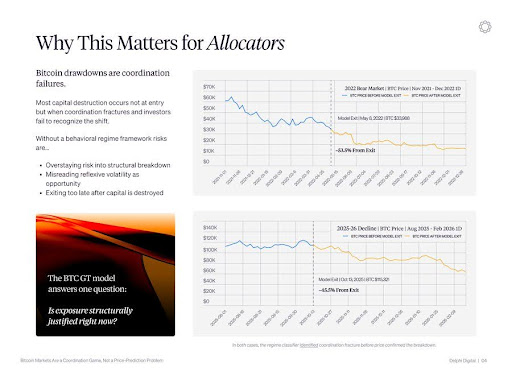
Source: Chart from Delphi Digital on X

The current phase of the Bitcoin market reflects a transition between different groups of large holders, often referred to as whales. An analyst known as CW on X noted that long-term or old whales completed their accumulation phase last October and have finished positioning themselves well ahead of a potential rally. In contrast, a newer wave of whales is still in the process of building positions.

This ongoing accumulation may be one of the key reasons behind the delay of the start of the rally. What makes this cycle unique is the expected shift in leadership. Historically, BTC bull runs have been driven primarily by a single dominant group of whales. However, this cycle is expected to be led by both old and new whales.

While the current market conditions may appear slow and uneventful, this accumulation dynamic suggests that underlying pressure is building. If both groups converge on their positions, the resulting rally could be significantly stronger than in previous cycles.

Why Bitcoin Revisiting Old Prices Is Not Bearish

Crypto analyst Stockmoney Lizards has pointed out that the current timeline is obsessed with Bitcoin being at the same price it was in 2021. The key observation is that BTC should see a continuous growth, higher bases, and explosive bull markets.

If this trend continues, projections suggest that BTC could reach around $200,000 in 2027 and 2030, with potential expansion toward $500,000 in 2033 and 2035.

BTC trading at $66,311 on the 1D chart | Source: BTCUSDT on Tradingview.com

Related Questions

QWhat is the primary purpose of the Bitcoin Game Theory framework mentioned in the article?

AThe core purpose of the Bitcoin Game Theory framework is to track coordination across the network's participants (miners, investors, traders, institutions) and identify when that alignment and balance begins to break down.

QAccording to the article, what did the framework signal in May 2022 and what was the subsequent market outcome?

AIn May 2022, the framework detected early signs of coordination fracturing and signaled a move to cash at $33,988. In the following months, the price of BTC declined by an additional 54%.

QWhat unique shift in leadership among Bitcoin 'whales' is expected in the current market cycle?

AThis cycle is unique because it is expected to be led by both old whales (who completed accumulation last October) and new whales (who are still building positions), a shift from historical cycles which were driven primarily by a single dominant group.

QWhy does the article suggest that the current slow market might be building towards a strong rally?

AThe article suggests that the ongoing accumulation by a new wave of whales is building underlying pressure. If both old and new whale groups converge on their positions, the resulting rally could be significantly stronger than in previous cycles.

QWhat long-term price projection for Bitcoin is cited from analyst Stockmoney Lizards?

AThe projections suggest that BTC could reach around $200,000 in 2027 and 2030, with potential expansion toward $500,000 in 2033 and 2035, based on a trend of continuous growth, higher bases, and explosive bull markets.

Related Reads

What Are Some Good Paths for Chinese Web3 Entrepreneurship? (Part 5)

This article explores pathways for Chinese Web3 teams to pivot toward AI, building on a previous discussion. It focuses on two specific team profiles: **Security & Risk Control Teams:** These teams, skilled in smart contract auditing, wallet security, and on-chain monitoring, can transition to providing **Agent behavior auditing and AI security governance**. As AI Agents automate tasks, access data, and trigger payments, enterprises will need solutions to monitor permissions, audit logs, control data access, and prevent anomalies—creating a strong B2B demand. **Application & Community-Focused Teams:** Instead of completely rebranding as AI companies, these teams should use AI to **enhance their existing products**. For example, research platforms can use AI to summarize information and identify signals; community tools can automate user support and analysis; and educational products can create personalized learning paths. The key is integrating AI to solve existing user pain points, like information overload or high operational costs. The article also advises against certain AI directions for Chinese Web3 teams, such as building general-purpose large language models (too resource-intensive), creating overly broad Agent platforms (hard to monetize), developing AI traders/automated yield products (high regulatory and risk sensitivity), or simply adding superficial AI features without genuine value. The core conclusion: Successful migration depends not on chasing AI hype, but on **identifying how a team's existing Web3 capabilities—be it in data, payments, security, or user operations—can address real needs in new AI application scenarios.**

marsbit2h ago

What Are Some Good Paths for Chinese Web3 Entrepreneurship? (Part 5)

marsbit2h ago

Trading

Spot
Futures

Hot Articles

What is $BITCOIN

DIGITAL GOLD ($BITCOIN): A Comprehensive Analysis Introduction to DIGITAL GOLD ($BITCOIN) DIGITAL GOLD ($BITCOIN) is a blockchain-based project operating on the Solana network, which aims to combine the characteristics of traditional precious metals with the innovation of decentralized technologies. While it shares a name with Bitcoin, often referred to as “digital gold” due to its perception as a store of value, DIGITAL GOLD is a separate token designed to create a unique ecosystem within the Web3 landscape. Its goal is to position itself as a viable alternative digital asset, although specifics regarding its applications and functionalities are still developing. What is DIGITAL GOLD ($BITCOIN)? DIGITAL GOLD ($BITCOIN) is a cryptocurrency token explicitly designed for use on the Solana blockchain. In contrast to Bitcoin, which provides a widely recognized value storage role, this token appears to focus on broader applications and characteristics. Notable aspects include: Blockchain Infrastructure: The token is built on the Solana blockchain, known for its capacity to handle high-speed and low-cost transactions. Supply Dynamics: DIGITAL GOLD has a maximum supply capped at 100 quadrillion tokens (100P $BITCOIN), although details regarding its circulating supply are currently undisclosed. Utility: While precise functionalities are not explicitly outlined, there are indications that the token could be utilized for various applications, potentially involving decentralized applications (dApps) or asset tokenization strategies. Who is the Creator of DIGITAL GOLD ($BITCOIN)? At present, the identity of the creators and development team behind DIGITAL GOLD ($BITCOIN) remains unknown. This situation is typical among many innovative projects within the blockchain space, particularly those aligning with decentralized finance and meme coin phenomena. While such anonymity may foster a community-driven culture, it intensifies concerns about governance and accountability. Who are the Investors of DIGITAL GOLD ($BITCOIN)? The available information indicates that DIGITAL GOLD ($BITCOIN) does not have any known institutional backers or prominent venture capital investments. The project seems to operate on a peer-to-peer model focused on community support and adoption rather than traditional funding routes. Its activity and liquidity are primarily situated on decentralized exchanges (DEXs), such as PumpSwap, rather than established centralized trading platforms, further highlighting its grassroots approach. How DIGITAL GOLD ($BITCOIN) Works The operational mechanics of DIGITAL GOLD ($BITCOIN) can be elaborated on based on its blockchain design and network attributes: Consensus Mechanism: By leveraging Solana’s unique proof-of-history (PoH) combined with a proof-of-stake (PoS) model, the project ensures efficient transaction validation contributing to the network's high performance. Tokenomics: While specific deflationary mechanisms have not been extensively detailed, the vast maximum token supply implies that it may cater to microtransactions or niche use cases that are still to be defined. Interoperability: There exists the potential for integration with Solana’s broader ecosystem, including various decentralized finance (DeFi) platforms. However, the details regarding specific integrations remain unspecified. Timeline of Key Events Here is a timeline that highlights significant milestones concerning DIGITAL GOLD ($BITCOIN): 2023: The initial deployment of the token occurs on the Solana blockchain, marked by its contract address. 2024: DIGITAL GOLD gains visibility as it becomes available for trading on decentralized exchanges like PumpSwap, allowing users to trade it against SOL. 2025: The project witnesses sporadic trading activity and potential interest in community-led engagements, although no noteworthy partnerships or technical advancements have been documented as of yet. Critical Analysis Strengths Scalability: The underlying Solana infrastructure supports high transaction volumes, which could enhance the utility of $BITCOIN in various transaction scenarios. Accessibility: The potential low trading price per token could attract retail investors, facilitating wider participation due to fractional ownership opportunities. Risks Lack of Transparency: The absence of publicly known backers, developers, or an audit process may yield skepticism regarding the project's sustainability and trustworthiness. Market Volatility: The trading activity is heavily reliant on speculative behavior, which can result in significant price volatility and uncertainty for investors. Conclusion DIGITAL GOLD ($BITCOIN) emerges as an intriguing yet ambiguous project within the rapidly evolving Solana ecosystem. While it attempts to leverage the “digital gold” narrative, its departure from Bitcoin's established role as a store of value underscores the need for a clearer differentiation of its intended utility and governance structure. Future acceptance and adoption will likely depend on addressing the current opacity and defining its operational and economic strategies more explicitly. Note: This report encompasses synthesised information available as of October 2023, and developments may have transpired beyond the research period.

363 Total ViewsPublished 2025.05.13Updated 2025.05.13

What is $BITCOIN

Discussions

Welcome to the HTX Community. Here, you can stay informed about the latest platform developments and gain access to professional market insights. Users' opinions on the price of BTC (BTC) are presented below.

活动图片















