Bitcoin ETFs Lose $144.67 Million, Ending Five-Day Inflow Streak

cryptonews.ruPublished on 2026-08-11Last updated on 2026-08-11

Abstract

Bitcoin ETFs experienced a net outflow of $144.67 million, ending a five-day streak of inflows. The selling was concentrated in major funds: BlackRock's IBIT led with $53.56 million in outflows, followed by Grayscale's GBTC with $52.02 million and Fidelity's FBTC with $40.32 million. Only Grayscale's Bitcoin Mini Trust saw inflows, adding $37.06 million. Total trading volume for Bitcoin ETFs reached $2.03 billion. Ether ETFs also started the week with outflows totaling $14.59 million, primarily from BlackRock's ETHA. In contrast, altcoin ETFs saw buying interest. Solana ETFs, specifically Bitwise's BSOL, attracted $8.83 million, and ETFs for $HYPE gathered $2.74 million. XRP ETFs recorded no net activity. In a separate development, BlackRock's Head of Digital Assets, Robert Mitchnick, announced a significant reduction in the minimum threshold for in-kind Bitcoin conversions into its IBIT ETF, lowering it from $25 million to $1 million. This move aims to make the ETF more accessible to a broader range of cryptocurrency holders by easing the process of transferring assets into the traditional brokerage structure.

The week began with a shift in sentiment. After five consecutive sessions characterized by buying, Bitcoin ETF investors began to withdraw funds, with the outflows concentrated in some of the market's largest funds.

The selling also touched Ether. Meanwhile, products based on Solana and $HYPE found buyers, adding another layer of dispersion to institutional cryptocurrency flows.

Bitcoin Selling Spreads to Largest Funds

Bitcoin ETFs recorded a net outflow of $144.67 million across five products.

BlackRock's IBIT ETF led the outflows with $53.56 million, followed closely by Grayscale's GBTC with $52.02 million. Fidelity's FBTC lost $40.32 million. Bitwise's BITB recorded an outflow of $28.44 million, and Franklin Templeton's EZBC saw $7.38 million exit.

Grayscale's Bitcoin Mini Trust was the only fund to attract new capital, adding $37.06 million. This inflow softened the decline, although the overall category remained clearly in negative territory. Total Bitcoin ETF trading volume reached $2.03 billion, with aggregate net assets at the close standing at $78.16 billion.
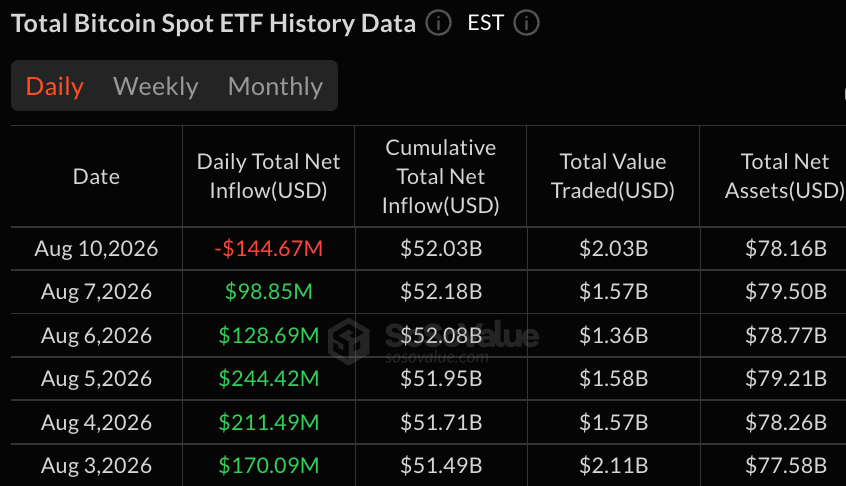
The five-day inflow streak for Bitcoin ETFs ended with an outflow of $144.67 million.

Ether ETFs also started the week with an outflow, losing $14.59 million.

BlackRock's ETHA ETF accounted for the bulk of the selling with an outflow of $23.77 million. Fidelity's FETH ETF lost another $3.27 million. Other funds saw buyers. Grayscale's Ether Mini Trust attracted $8.59 million, and BlackRock's ETHB added $3.86 million.

Ether ETF trading volume was $533.17 million. Net assets at the session's end were $10.50 billion.

Solana and $HYPE Find Buyers

Solana ETFs showed the best dynamics among altcoins, attracting $8.83 million, with the entire sum flowing into Bitwise's BSOL fund. Total trading volume reached $30.93 million, and net assets at the session's close were $905.66 million.

ETFs on $HYPE continued their recent recovery, attracting $2.74 million. Bitwise's BHYP fund drew in $1.56 million, while Grayscale's HYPG fund added $1.18 million. Trading volume for the $HYPE series of ETFs was $5.75 million, and net assets at the close stood at $265.47 million.

XRP ETFs recorded no net creations or redemptions during the session.

BlackRock Lowers IBIT In-Kind Conversion Minimum from $25M to $1M

The day also brought fresh evidence of how Bitcoin ETFs are becoming more accessible to existing cryptocurrency holders.

BlackRock's Head of Digital Assets, Robert Mitchnick, stated in an interview with Bloomberg that the minimum size for in-kind Bitcoin conversion into IBIT has decreased from $25 million to $1 million compared to when the service first became available.

He said activity has picked up over the past three quarters as BlackRock has worked to make the service available to a broader set of investors. The company hopes this threshold can eventually be lowered even further.

This infrastructure is significant. Lower conversion minimums could make it easier for large Bitcoin holders to move assets into ETF structures without selling for cash first, thereby widening the bridge between direct crypto ownership and traditional brokerage accounts.


Trending Cryptos

Related Questions

QWhat was the net outflow amount from Bitcoin ETFs, breaking the five-day inflow streak?

ABitcoin ETFs recorded a net outflow of $144.67 million.

QWhich Bitcoin ETF had the largest outflow, and how much was it?

ABlackrock's IBIT ETF had the largest outflow at $53.56 million.

QWhat was the net flow performance for Solana and Hype ETFs on the day discussed?

ASolana ETFs attracted an inflow of $8.83 million, and Hype ETFs attracted an inflow of $2.74 million.

QWhat significant change did Blackrock announce regarding its spot Bitcoin ETF IBIT?

ABlackrock reduced the minimum threshold for converting physical bitcoins to its IBIT ETF from $25 million to $1 million.

QWhat was the net outflow for Ether (ETH) ETFs on the day discussed?

AEthereum ETFs began the week with an outflow of $14.59 million.

Related Reads

In Just 6 Months, 4 Rounds of Funding: West Lake University Professor's Venture Takes Off

Westlake Robotics, an embodied artificial intelligence company, has completed its Series A financing round within just six months and a total of four rounds, raising a cumulative 5 billion RMB. The investor lineup includes prominent institutions such as SAIF Partners, Xiaomiao Langcheng, Henan Investment Group Huirong Fund, and Haiyuan Fund, forming a high-quality capital matrix comprising state-owned, industrial, and leading venture capital. The rapid and intensive capital injection reflects strong market confidence in the company's technological approach, product deployment capabilities, and long-term potential. The newly acquired funds will be primarily allocated to the research and development of a unified large model for humanoid robots and the establishment of a talent cultivation base for embodied AI. Founded in 2024, Westlake Robotics originated from the industrial transformation of pioneering achievements in AI and robotics at Westlake University. The founding team is led by Wang Donglin, a leading figure in China's embodied AI and robot learning field, and co-founder Zhang Yue, an expert in natural language processing. The core R&D members hail from top-tier tech companies like Alibaba, ByteDance, Tencent, and Huawei, as well as prestigious global universities. The company follows a fully self-developed strategy integrating a "universal brain + humanoid body-specific cerebellum + proprietary humanoid hardware." It is one of the few domestic enterprises capable of holistically connecting the three core areas of embodied AGI cognitive reasoning, full-body motion control, and humanoid hardware. Its proprietary technologies include the General Motion Model-GAE system for low-latency teleoperation and motion generalization, and a dual pre-trained architecture for general and body-specific processing to bridge cognitive reasoning and physical movement. In 2026, Westlake Robotics launched its self-developed humanoid robot "Westlake o1," completing the full technology chain from underlying algorithms to pre-trained models and hardware. The company has secured nearly 100 million RMB in orders, with applications in scientific research, education, data collection, and power inspection. Future targets include high-risk industrial inspection, post-disaster search and rescue, and remote precision assembly. The company has also partnered with the Longyou County government to establish a county-wide real-scenario training base for humanoid robots, aimed at collecting high-quality motion data and validating technology in authentic environments. With the latest funding, Westlake Robotics plans to further advance its core model development and talent acquisition strategy, accelerating progress toward the "GPT moment" for embodied intelligence in China.

marsbit6m ago

In Just 6 Months, 4 Rounds of Funding: West Lake University Professor's Venture Takes Off

marsbit6m ago

Volatility Plummets to Historic Lows, When Will Bitcoin's 'Summer Sideways Move' End?

Bitcoin is experiencing a classic summer of stagnant price action, trapped in a tight range between approximately $62,000 and $66,000. Analysts point to historically low implied volatility and thin summer liquidity as key characteristics of the current market. The consensus among traders is that the catalyst for a decisive breakout will come from macroeconomic factors, not internal crypto dynamics. The immediate focus is on upcoming U.S. CPI data, which could influence Federal Reserve policy expectations. A softer inflation print is seen as potentially supportive for risk assets like Bitcoin. Furthermore, the pending *Clarity Act* legislation is identified as a crucial long-term catalyst that could boost institutional participation by providing regulatory clarity. While U.S. spot Bitcoin ETFs, led by BlackRock's IBIT, have seen their strongest inflows since April, providing underlying support, this buying pressure is being offset by selling from miners and other large holders. This has resulted in continued consolidation even as global crypto trading volumes hit multi-year lows. Market participants expect the range-bound, low-volatility environment to persist for several more weeks, at least until there is clearer progress on macro policy or regulatory fronts. Any sustained break above or below the current range is likely to trigger a significant expansion in volatility. Long-term bullish narratives around adoption, institutional demand, and Bitcoin's unique attributes as collateral remain intact, but the short-term path depends on external macroeconomic catalysts.

marsbit9m ago

Volatility Plummets to Historic Lows, When Will Bitcoin's 'Summer Sideways Move' End?

marsbit9m ago

Predicting the Dormant Period of Market Heat, Polymarket Prepares a Killer Move to Catch Up with Kalshi

Following a period of lower trading activity after the World Cup and during a sports offseason, Polymarket is restructuring in preparation for upcoming major sports events and the US midterm elections in November. Key personnel changes include the appointment of Travis VanderZanden, former Bird founder and Uber/Lyft executive, as Chief Growth Officer to oversee marketing. The company has also hired executives from Robinhood, Coinbase, Nasdaq, and the FBI to strengthen compliance, risk management, and regulatory functions. This push supports Polymarket's renewed focus on the US market after its 2022 exit due to regulatory issues. Its US re-entry accelerated with the 2025 acquisition of licensed exchange QCEX, rebranded as Polymarket US. After launching on iOS in May, a web version recently went live. Trading volume on Polymarket US has surged, growing from $1.77 billion in May to approximately $5 billion in July. This represents 62% of the international platform's volume, up from just 25% two months prior. VanderZanden's immediate task involves addressing past marketing controversies, including CFTC investigations into promotional practices that used simulated trades. The company has since reformed its marketing rules and partner vetting. Despite rapid growth, Polymarket US still trails the US prediction market leader, Kalshi, which saw about $37.7 billion in July volume compared to Polymarket's combined ~$13 billion. Kalshi's valuation also significantly outpaces Polymarket's. The coming autumn, with its slate of sports and political events, presents a critical test for Polymarket's US expansion and its ability to close the gap with Kalshi.

marsbit10m ago

Predicting the Dormant Period of Market Heat, Polymarket Prepares a Killer Move to Catch Up with Kalshi

marsbit10m ago

Trading

Spot

Hot Articles

What is $BITCOIN

DIGITAL GOLD ($BITCOIN): A Comprehensive Analysis Introduction to DIGITAL GOLD ($BITCOIN) DIGITAL GOLD ($BITCOIN) is a blockchain-based project operating on the Solana network, which aims to combine the characteristics of traditional precious metals with the innovation of decentralized technologies. While it shares a name with Bitcoin, often referred to as “digital gold” due to its perception as a store of value, DIGITAL GOLD is a separate token designed to create a unique ecosystem within the Web3 landscape. Its goal is to position itself as a viable alternative digital asset, although specifics regarding its applications and functionalities are still developing. What is DIGITAL GOLD ($BITCOIN)? DIGITAL GOLD ($BITCOIN) is a cryptocurrency token explicitly designed for use on the Solana blockchain. In contrast to Bitcoin, which provides a widely recognized value storage role, this token appears to focus on broader applications and characteristics. Notable aspects include: Blockchain Infrastructure: The token is built on the Solana blockchain, known for its capacity to handle high-speed and low-cost transactions. Supply Dynamics: DIGITAL GOLD has a maximum supply capped at 100 quadrillion tokens (100P $BITCOIN), although details regarding its circulating supply are currently undisclosed. Utility: While precise functionalities are not explicitly outlined, there are indications that the token could be utilized for various applications, potentially involving decentralized applications (dApps) or asset tokenization strategies. Who is the Creator of DIGITAL GOLD ($BITCOIN)? At present, the identity of the creators and development team behind DIGITAL GOLD ($BITCOIN) remains unknown. This situation is typical among many innovative projects within the blockchain space, particularly those aligning with decentralized finance and meme coin phenomena. While such anonymity may foster a community-driven culture, it intensifies concerns about governance and accountability. Who are the Investors of DIGITAL GOLD ($BITCOIN)? The available information indicates that DIGITAL GOLD ($BITCOIN) does not have any known institutional backers or prominent venture capital investments. The project seems to operate on a peer-to-peer model focused on community support and adoption rather than traditional funding routes. Its activity and liquidity are primarily situated on decentralized exchanges (DEXs), such as PumpSwap, rather than established centralized trading platforms, further highlighting its grassroots approach. How DIGITAL GOLD ($BITCOIN) Works The operational mechanics of DIGITAL GOLD ($BITCOIN) can be elaborated on based on its blockchain design and network attributes: Consensus Mechanism: By leveraging Solana’s unique proof-of-history (PoH) combined with a proof-of-stake (PoS) model, the project ensures efficient transaction validation contributing to the network's high performance. Tokenomics: While specific deflationary mechanisms have not been extensively detailed, the vast maximum token supply implies that it may cater to microtransactions or niche use cases that are still to be defined. Interoperability: There exists the potential for integration with Solana’s broader ecosystem, including various decentralized finance (DeFi) platforms. However, the details regarding specific integrations remain unspecified. Timeline of Key Events Here is a timeline that highlights significant milestones concerning DIGITAL GOLD ($BITCOIN): 2023: The initial deployment of the token occurs on the Solana blockchain, marked by its contract address. 2024: DIGITAL GOLD gains visibility as it becomes available for trading on decentralized exchanges like PumpSwap, allowing users to trade it against SOL. 2025: The project witnesses sporadic trading activity and potential interest in community-led engagements, although no noteworthy partnerships or technical advancements have been documented as of yet. Critical Analysis Strengths Scalability: The underlying Solana infrastructure supports high transaction volumes, which could enhance the utility of $BITCOIN in various transaction scenarios. Accessibility: The potential low trading price per token could attract retail investors, facilitating wider participation due to fractional ownership opportunities. Risks Lack of Transparency: The absence of publicly known backers, developers, or an audit process may yield skepticism regarding the project's sustainability and trustworthiness. Market Volatility: The trading activity is heavily reliant on speculative behavior, which can result in significant price volatility and uncertainty for investors. Conclusion DIGITAL GOLD ($BITCOIN) emerges as an intriguing yet ambiguous project within the rapidly evolving Solana ecosystem. While it attempts to leverage the “digital gold” narrative, its departure from Bitcoin's established role as a store of value underscores the need for a clearer differentiation of its intended utility and governance structure. Future acceptance and adoption will likely depend on addressing the current opacity and defining its operational and economic strategies more explicitly. Note: This report encompasses synthesised information available as of October 2023, and developments may have transpired beyond the research period.

1.8k Total ViewsPublished 2025.05.13Updated 2025.05.13

What is $BITCOIN

Discussions

Welcome to the HTX Community. Here, you can stay informed about the latest platform developments and gain access to professional market insights. Users' opinions on the price of BTC (BTC) are presented below.

活动图片