Bitcoin Could Survive Sale Of Satoshi’s Coins, On-Chain Expert Says

bitcoinistPublished on 2026-04-24Last updated on 2026-04-24

Abstract

On-chain analyst James Check argues that a potential quantum-enabled sale of Satoshi-era Bitcoin would not be an existential threat to the market, despite concerns. While approximately 6.934 million BTC are theoretically vulnerable due to exposed public keys, Check contends the real risk is much smaller. He identifies only 1.716 million BTC in old P2PK outputs as the primary concern, comparing a full liquidation to 60-90 days of typical sell-side pressure in a bull market—significant but not fatal. Check emphasizes that the core debate is less about market impact and more about the philosophical principle of whether Bitcoin should intervene to freeze vulnerable coins or preserve absolute property rights.

On-chain analyst James Check has pushed back against claims that a quantum-enabled sale of Satoshi-era Bitcoin would represent an existential market shock, arguing that the likely sell-side pressure is far smaller than the headline numbers suggest.

In an April 23 report titled “Selling Satoshi’s Stack,” Check examined the debate over whether Bitcoin should freeze quantum-vulnerable coins if a cryptographically relevant quantum computer, or CRQC, becomes viable. The discussion has intensified around older Bitcoin outputs whose public keys are exposed, including coins from Bitcoin’s earliest years that many market participants associate with Satoshi Nakamoto.

Bitcoin Quantum Fears Over Satoshi’s Coins Overblown?

Check’s central argument is not that quantum risk should be ignored. He said Bitcoiners should support “the debate, development, and preparation” of credible post-quantum solutions. But he rejected the idea that vulnerable coins automatically translate into a market-ending sell event.

“Quantum bulls often quote the 6.9M vulnerable coins as being a sword of Damocles that threatens to kill Bitcoin should a CRQC ever come to market,” Check wrote. “As with most things, there is a tonne of lost nuance, and the devil is absolutely in the details.”

According to the report, roughly 6.934 million BTC currently fall into categories that could be vulnerable to long-range quantum attacks because their public keys are exposed. That includes 1.716 million BTC in Satoshi-era P2PK outputs, 214,000 BTC in Taproot addresses, and about 4.996 million BTC held in reused addresses.

Check argues that the full 6.934 million BTC figure is best understood as a theoretical upper bound rather than a realistic market-risk estimate. Taproot is relatively new, he noted, meaning many owners are likely still active and able to migrate. Reused addresses, meanwhile, likely include large volumes managed by exchanges, custodians, ETFs and other entities with both the incentive and capacity to upgrade when post-quantum paths become available.

“The real risk are the 1.716M Satoshi Era P2PK coins, which many liken to a sunken galleon full of gold, there for the taking if the lock can be pried open,” Check wrote.

Even under a severe assumption that all 1.716 million P2PK coins are stolen and sold, Check said the market impact would likely be significant but not fatal. He compared the haul against revived supply, URPD shifts, exchange deposits and trading volumes, finding that the full P2PK balance is broadly equivalent to about 60 to 90 days of sell-side activity seen in Bitcoin bull markets or late-stage bear-market capitulations.

“There is no doubt that a QC attacker selling all the P2PK coins would negatively impact the price. It probably creates a bear market. However, where will, I push back strongly, is it is nowhere near the ‘end-of-days’ fatal sell-side many quantum bulls in the debate seem to claim.”

Check pointed to revived supply, which measures coins held for at least six months that are spent on a given day, as one lens for estimating Bitcoin’s ability to absorb older supply. He said a baseline of roughly 10,000 BTC per day is typical even in bear-market conditions, while bull-market profit-taking can push revived supply above 20,000 to 30,000 BTC per day.

On that basis, the sale of Satoshi-era P2PK coins would represent a large but not unprecedented demand test. Check also cited recent 90-day cost-basis turnover, arguing that more than 2.3 million BTC had moved to new buyers between $60,000 and $80,000 since the Feb. 5, 2026 sell-off, exceeding the P2PK balance by 1.36 times.

The report also discusses the proposed “hourglass” compromise in the BIP-360 debate, under which miners could include no more than one P2PK output per block. With about 38,000 P2PK outputs, Check estimated that such a mechanism would take roughly 264 days to fully exhaust the set, roughly in line with an optimistic post-quantum migration timeline for the broader Bitcoin network.

For Check, the quantum debate ultimately goes beyond market mechanics. The sell-side argument, he suggests, is weaker than often claimed; the harder question is whether Bitcoin should preserve property rights even when old coins become vulnerable, or intervene before someone else can take them.

“To the folks who claim we MUST freeze the coins because of the sell-side, I’d encourage you to put some numbers to your claims,” he wrote. “Instead, the actual thrust of this debate is around the principles of what Bitcoin is.”

At press time, BTC traded at $77,869.
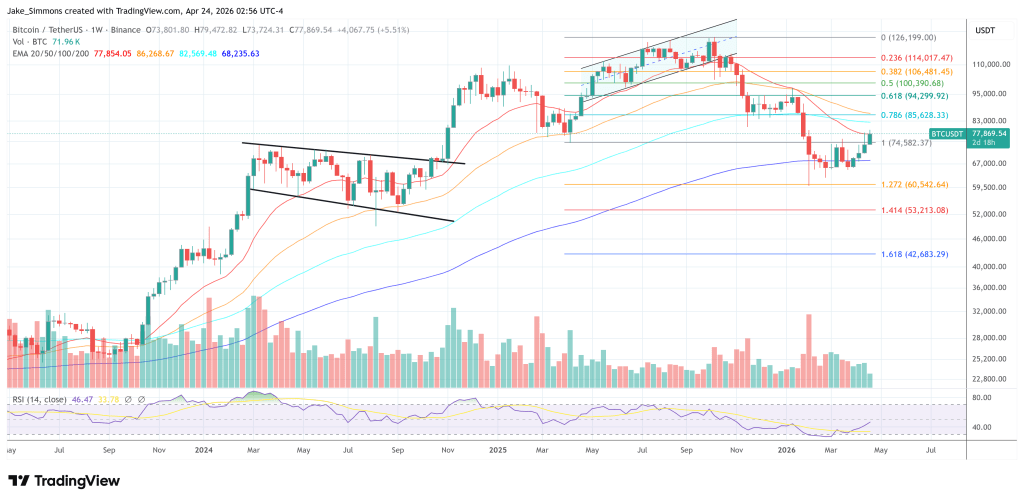
Bitcoin needs a weekly close above the 1.0 Fib, 1-week chart | Source: BTCUSDT on TradingView.com

Related Questions

QAccording to James Check, why is the full 6.934 million BTC figure of quantum-vulnerable coins not a realistic market-risk estimate?

ACheck argues that the 6.934 million BTC figure is a theoretical upper bound, not a realistic risk estimate, because Taproot addresses are new and their owners are likely still active, and reused addresses include large volumes managed by exchanges, custodians, and ETFs that have the incentive and capacity to upgrade to post-quantum security.

QWhat does James Check identify as the 'real risk' in the quantum vulnerability debate?

ACheck identifies the 1.716 million BTC in Satoshi-era P2PK outputs as the 'real risk,' comparing them to a sunken galleon full of gold that is there for the taking if the lock can be pried open by a quantum attack.

QHow does Check quantify the potential market impact of selling all 1.716 million vulnerable P2PK coins?

ACheck states that selling all 1.716 million P2PK coins would be equivalent to about 60 to 90 days of sell-side activity seen in Bitcoin bull markets or late-stage bear-market capitulations. He concludes it would likely create a bear market but is not a market-ending, 'end-of-days' event.

QWhat is the 'hourglass' compromise proposed in the BIP-360 debate, and how long would it take to implement?

AThe 'hourglass' compromise is a proposal where miners could include no more than one vulnerable P2PK output per block. Check estimates that with about 38,000 P2PK outputs, this mechanism would take roughly 264 days to fully exhaust the set.

QBeyond market mechanics, what does James Check suggest is the core of the quantum debate?

ACheck suggests the core of the debate is a philosophical question of principles: whether Bitcoin should preserve property rights even when old coins become vulnerable to theft, or if it should intervene to freeze those coins before a quantum attacker can take them.

Related Reads

Apple's Desired On-Device AI Sees a Dark Horse Emerge: The First Cognitive Model is Born, 4B Matches GPT-5.4

A Chinese company, Tomorrow's Journey (Nextie), has introduced what it is calling the industry's first "cognitive model" for edge devices. Named New Journey Alpha, this 4-billion-parameter model reportedly matches the performance of trillion-parameter giants like GPT-5.4 in group intelligence tasks such as debate and collective decision-making. The development follows Andrej Karpathy's vision of stripping vast factual knowledge from large language models to retain only a smaller "cognitive core" capable of reasoning, planning, and knowing its own limits. This approach directly addresses the soaring computational costs and token expenses hindering AI's widespread deployment, as highlighted by incidents like Amazon shutting down an internal AI tool due to prohibitive costs. Trained via reinforcement learning on a corpus of academic papers from 1800-2020 to enhance generalization, the model enables three key advancements: 1) Improved decision quality in multi-agent systems, 2) Drastically reduced compute costs, allowing for cost-effective cloud or on-device (e.g., MacBook) deployment, and 3) The feasibility of "proactive" AI agents that act autonomously without user prompts, unlocking new commercial possibilities beyond today's reactive models. Built by the former Microsoft Xiaoice team—known for creating a 3.6B model that outperformed a 65B Llama model—the company is now focusing on the multi-agent systems sector, a field gaining significant investor interest. The model's economic impact is profound; by achieving high-level performance with minimal parameters, it fundamentally alters the cost structure of AI services, challenging the prevailing model of ever-larger parameter counts.

marsbit2h ago

Apple's Desired On-Device AI Sees a Dark Horse Emerge: The First Cognitive Model is Born, 4B Matches GPT-5.4

marsbit2h ago

OpenAI's 'Blueprint for the Future': Making AI Beneficial for Every Person on the Planet

A new transformative technology emerges every few generations. OpenAI draws a parallel with the advent of electricity in the 1920s, which initially brought convenience but ultimately enabled unprecedented progress in medicine, engineering, and living standards by empowering people to create new possibilities. AI is poised to recreate this phenomenon. Its true significance lies not in the technology itself, but in what people can achieve with it—from understanding a medical bill or starting a business to aiding scientific discovery. OpenAI believes AI should be universally accessible, allowing everyone to use it according to their own needs. This future, however, is not guaranteed. While transformative tech can centralize power, OpenAI's philosophy is that AI must serve humanity, augmenting human capabilities and broadly distributing its benefits. The company's first commitment is to build AI for human service, aiming to empower the many rather than concentrate power in a few. Safety, alignment with human intent, and oversight are paramount. OpenAI is optimistic about AI's potential to expand human welfare but remains clear-eyed about risks. The goal is to help people achieve more, not to replace them. Full automation is not the desired future; human judgment, values, and direction will become even more critical. OpenAI outlines three core goals: 1. Build automated AI researchers to accelerate and increasingly automate the research process itself, maintaining close human collaboration. The internal projection is that by March 2028, a significant portion of their research will be conducted by AI systems working alongside human researchers. 2. Accelerate economic development by advancing science, boosting productivity, and fostering growth, while ensuring the fruits are widely shared. 3. Provide a personal AGI for everyone on Earth, allowing individuals to benefit from this transformative technology in their own way. The company is entering its third phase, moving from foundational AGI research (Phase 1) to product deployment and learning from real-world use (Phase 2). The current challenge is making advanced AI abundant, affordable, safe, practical, and usable for all individuals and organizations. OpenAI concludes that a widely distributed power structure leads to a more resilient, adaptable, and free society. A positive AI future should not be controlled by a handful of entities but built, benefited from, and owned by many. If realized correctly, AI can become a cornerstone for enhancing global productivity, creativity, scientific advancement, and economic opportunity, fulfilling the mission to ensure AGI benefits all of humanity.

marsbit3h ago

OpenAI's 'Blueprint for the Future': Making AI Beneficial for Every Person on the Planet

marsbit3h ago

Trading

Spot
Futures

Hot Articles

Discussions

Welcome to the HTX Community. Here, you can stay informed about the latest platform developments and gain access to professional market insights. Users' opinions on the price of S (S) are presented below.

活动图片















