Bitcoin Consolidation Underway: Selling Pressure from Long-Term Holders Eases, ETF Outflows Slow

marsbitPublished on 2026-07-16Last updated on 2026-07-16

Abstract

Bitcoin is in the process of bottoming out, with key dynamics shifting. Long-term holder capitulation has cooled from its peak, and profit-taking has largely subsided. The sell-off at the June lows was absorbed by broad-based buying. The price is now recovering and testing towards key overhead resistance around the short-term holder cost basis near $69,000, where significant supply pressure is expected. Macro drivers are evolving: Bitcoin is increasingly reacting inversely to the US dollar and showing a more positive response to favorable economic data like soft inflation reports, while its correlation with equities has weakened. On-chain data shows that long-term holders are now mainly selling at a loss, a classic late-cycle signal. This primary source of sell-side pressure is no longer expanding. ETF outflows have slowed but haven't reversed, indicating institutional selling has paused but not turned into buying. In derivatives markets, bearish bets are being unwound as seen in falling put/call ratios and reduced crash protection costs, though this positioning adjustment hasn't yet translated into strong spot market buying. Volatility has compressed to yearly lows, a potential calm before the next decisive move. While the foundation for a recovery is being laid with seller exhaustion and demand absorption at lows, confirmation is still missing. A sustainable uptrend requires spot-driven buying to decisively break and hold above the short-term holder cost basis. Failure ...

Original Author: Glassnode

Original Compilation: AididiaoJP

Bitcoin's bottom is still forming, but its characteristics are quietly shifting. The capitulation selling by long-term holders is beginning to cool, buy-side demand successfully absorbed the June lows, and the price is gradually recovering, challenging the resistance zone that previously suppressed it.

Executive Summary

  • The market has begun testing overhead resistance.
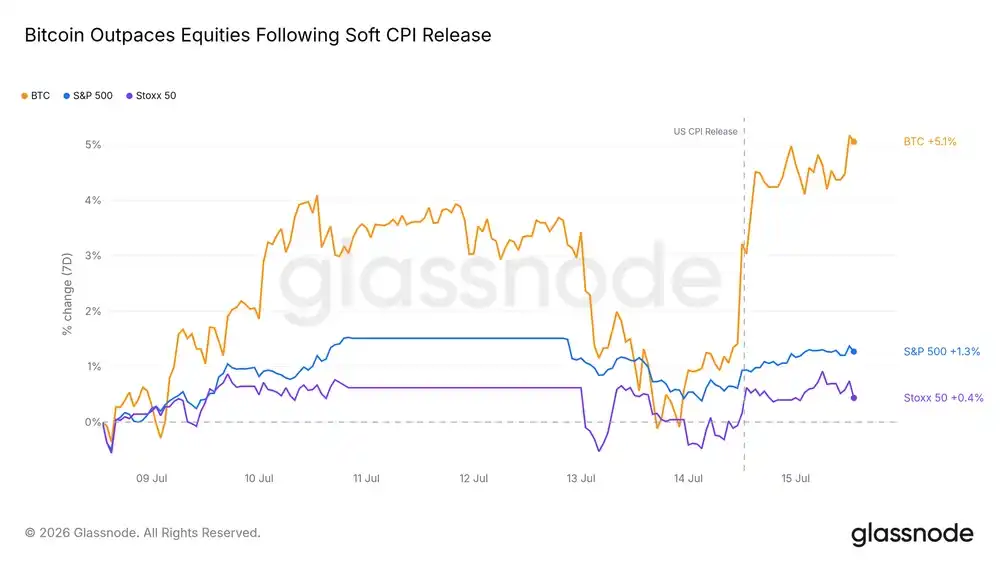
  • Bitcoin reacted much more strongly to weak inflation data than any major stock index, the most positive response to good news in weeks.
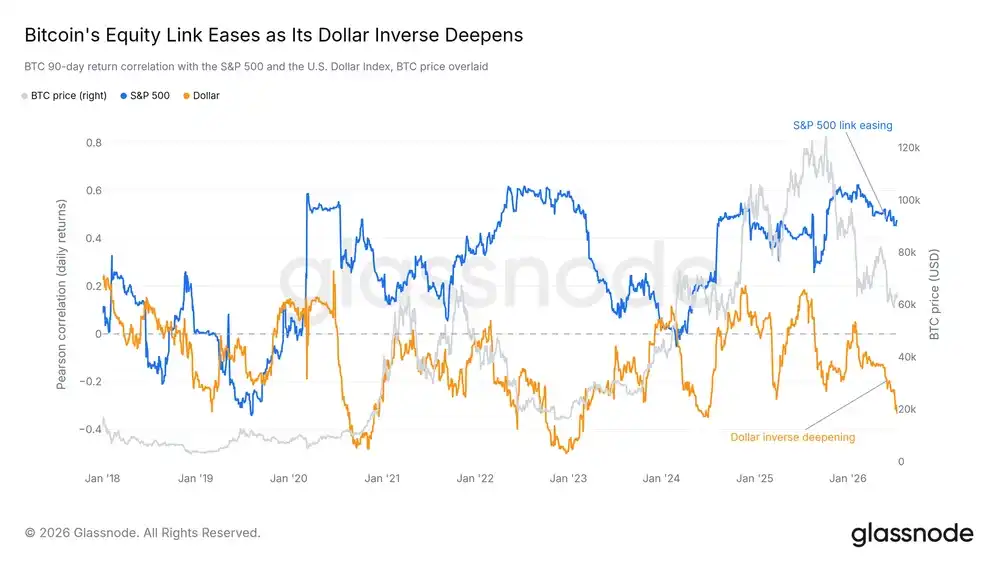
  • Correlation with equities is loosening, while the inverse link with the dollar deepens – liquidity, not risk appetite, is the current driver.
  • Long-term holder selling – the primary source of sell pressure this year – has receded from its peak.
  • Profit-taking has drastically decreased, and buy-side demand fully absorbed the selling at the June lows, reducing the supply pressure faced during each rally.
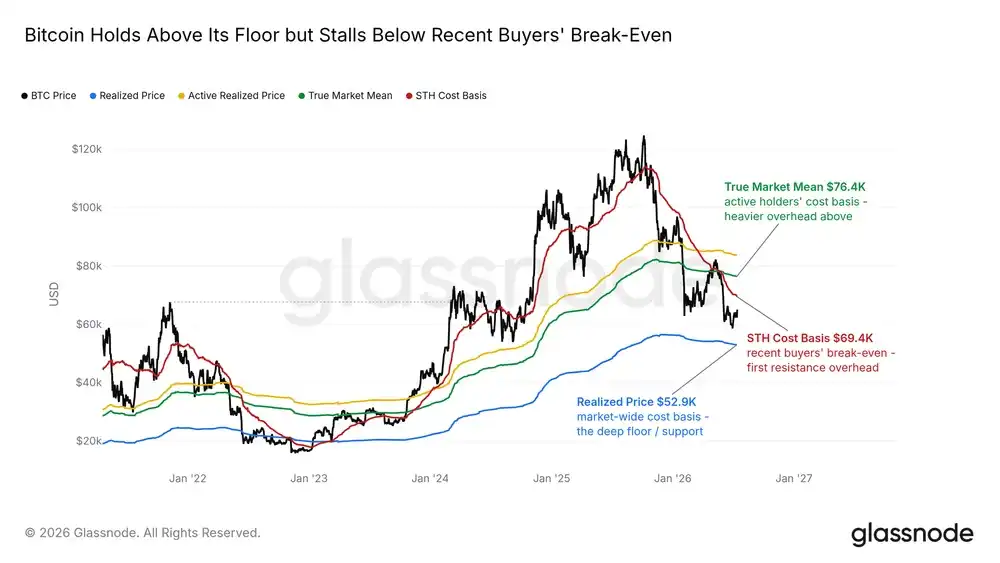
  • The Short-Term Holder Cost Basis, near $69,000, is the breakeven line for recent buyers and will be the next major resistance; a strong reaction is expected there.
  • Derivatives traders are unwinding bearish positions, but spot buying hasn't followed yet – this is the missing link in the current recovery.

Macro Insights

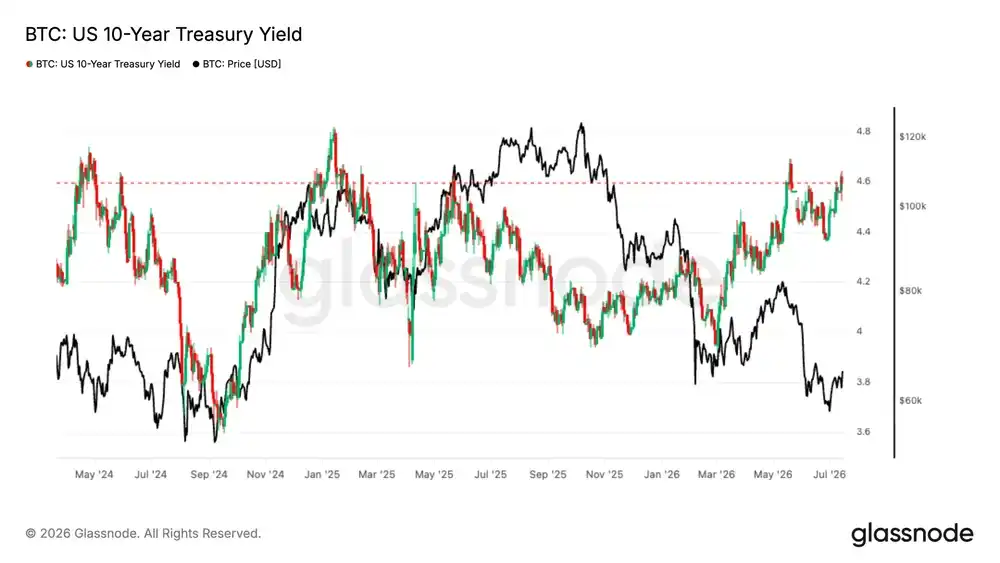
The nature of pressure on Bitcoin this quarter is a story of real rates, not risk aversion. The 10-year real yield has risen near its 2026 highs around 2.4%, and the dollar has stayed above its 200-day moving average since May. However, broader risk assets show no stress: equities are near highs, credit spreads are low, and volatility remains subdued.
Bitcoin Leads the Rally

Following Tuesday's release of mild inflation data, Bitcoin's gains outpaced any other major asset. It jumped immediately after the data and outperformed US and European stocks significantly for the week. After a month of sideways action at low levels, the market has started reacting positively to good news again.

This sensitivity is a signal in itself: a market eager to rally on a single inflation report often indicates sellers are exhausted, and buyers are just waiting for a reason.
Shift in Macro Drivers

Beneath the rally, Bitcoin's drivers are changing. Its correlation with US stocks has been declining since winter, while its inverse relationship with the dollar has been deepening. Bitcoin is acting less like a proxy for equities and more like an asset that strengthens as the dollar weakens.

It hasn't detached from the risk asset universe, but the dollar and liquidity channel now exert more influence than equity sentiment. If the macro environment eases from here, this channel is most likely to transmit it first.
On-Chain Insights

Between Floor and Ceiling

The cost basis map precisely describes the current position. Bitcoin price is above the network-wide Realized Price – the natural floor support in bear markets – yet below the Short-Term Holder Cost Basis (near $69,000) – the average entry price for buyers over the past five months. The current recovery is climbing towards this breakeven resistance level, above which a large number of trapped buyers await an exit.

The first touch of this level will likely trigger a strong reaction, as the group most inclined to sell are those about to break even. Successfully reclaiming it will open space for recovery; rejection will reinforce the range-bound structure.
Sellers Stop Taking Profits

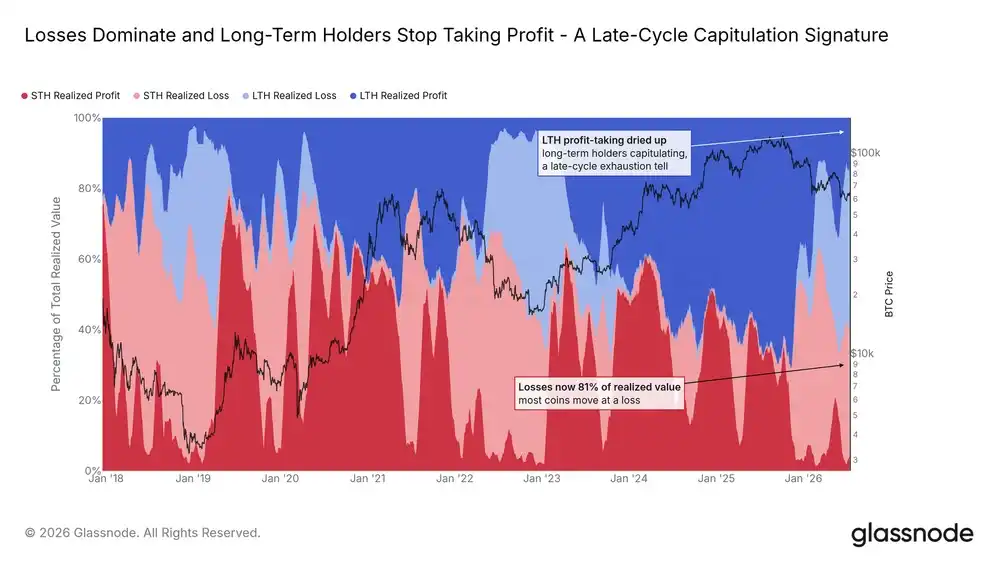
The Long-Term / Short-Term Holder Realized Profit/Loss Relative metric categorizes all on-chain selling into four types: veterans and newcomers, each selling in profit or loss. For most of this cycle, profit-taking sales by Long-Term Holders dominated sell pressure. Now, that flow has almost completely dried up; veterans are selling mostly at a loss.

Loss sales by both groups constitute the primary on-chain volume signature, a classic late-bear-market signal. The key change is that the proportion of Long-Term Holder sales has stopped growing. The wave of selling pressure that met every rally this year is no longer expanding.
Capitulation Selling Begins to Cool

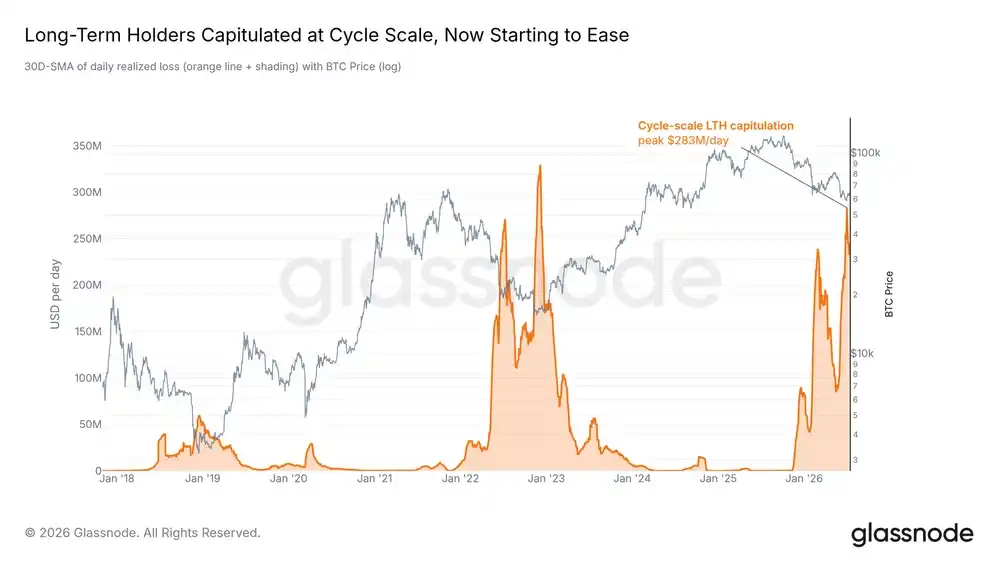
This capitulation rhythm is the most important indicator right now. The Entity-Adjusted Long-Term Holder Realized Loss metric removes internal transfers, truly reflecting the daily volume veterans are actually giving up. This metric hit a cycle peak two weeks ago, and last week's report highlighted that its cooling is a prerequisite for any sustained recovery.

It has now started to decline. One pullback doesn't prove exhaustion, and new shocks could restart selling. But in this cycle, it's the first time this core metric defining the bottoming process has turned from rising to falling. The main sellers driving this bear market are drying up at the margin.
Demand Absorbs Lows Selling

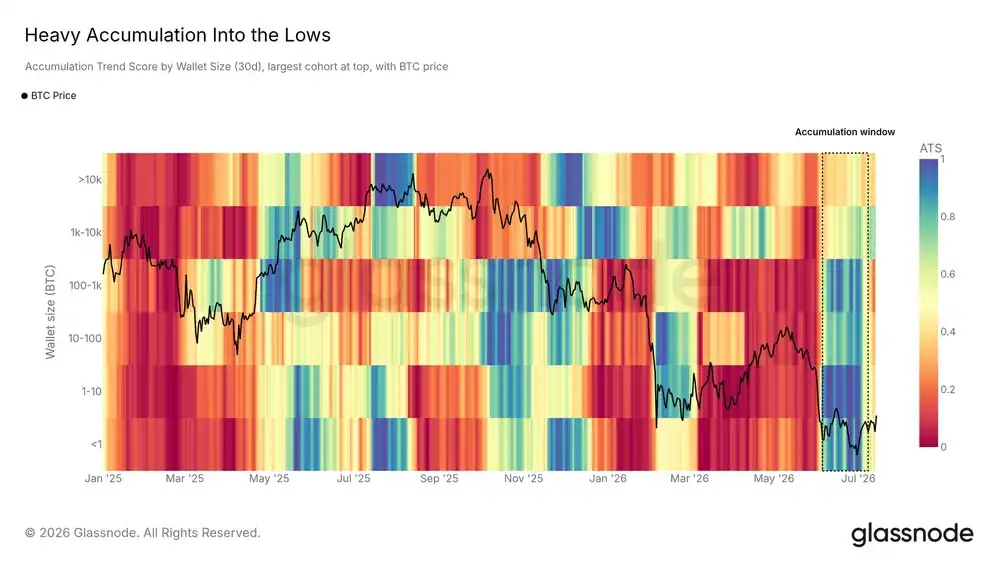
As veterans capitulated, buyers stepped in timely. The Accumulation Trend Score segmented by wallet size shows a broad and strong wave of buying during the June lows, covering wallets from small to large. This intensity has moderated since the price stabilized, entering a waiting mode.

Coins sold at the lows found takers. Whether these buyers return with equal force in the next move will determine if this bottom holds.
Off-Chain / Derivatives Insights

ETF Outflows Slow

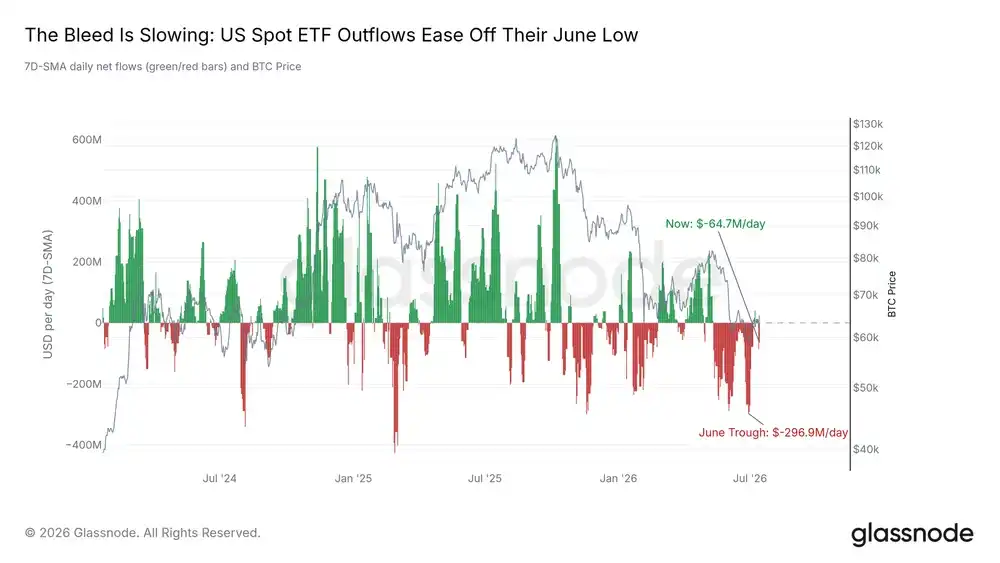
US spot ETFs tell the same story of easing but unresolved pressure. Redemption pressure has significantly receded from June's extreme levels, trending towards stabilization. However, the channel is not fully repaired: the week saw its largest single-day outflow in weeks, partially recouped the next day.

Until inflows return and hold, this remains a market where institutions have stopped fleeing but have not yet started buying.
Bears Abandon Resistance

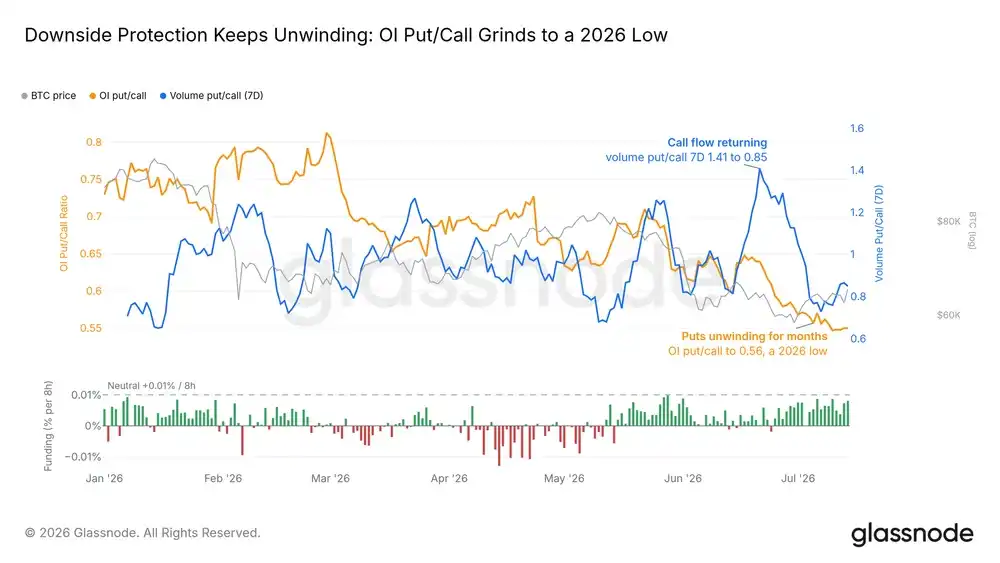
Derivatives markets have been moving in the opposite direction for weeks. The Options Put/Call Ratio has dropped to yearly lows, with traders letting bearish protection expire; perpetual funding rates are just above neutral, far from crowded long levels. Bearish bets are quietly unwinding.

But this unwinding hasn't translated into actual buying. Position adjustments by futures and options traders are not equivalent to capital entering the spot market – the clearest caveat in the current recovery.
Crash Protection Premium Moderates

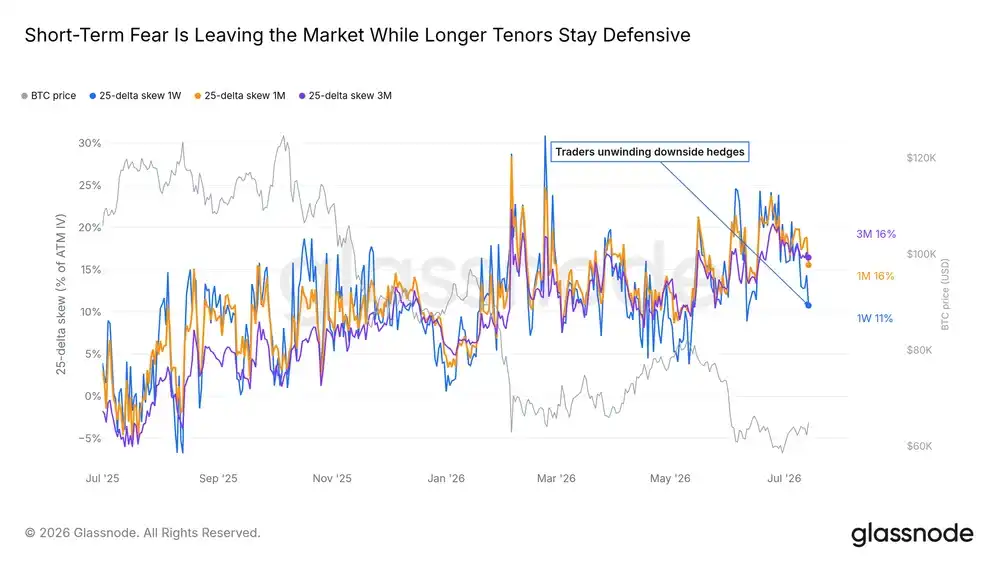
The premium for crash protection in options markets (measured via 25-Delta Skew) spiked during the June sell-off and has been declining since, now well below February's extreme levels. The cost of hedging each dip is significantly lower than a month ago.

Protection demand persists – as it should with the lows unconfirmed – but the overall direction is normalizing.
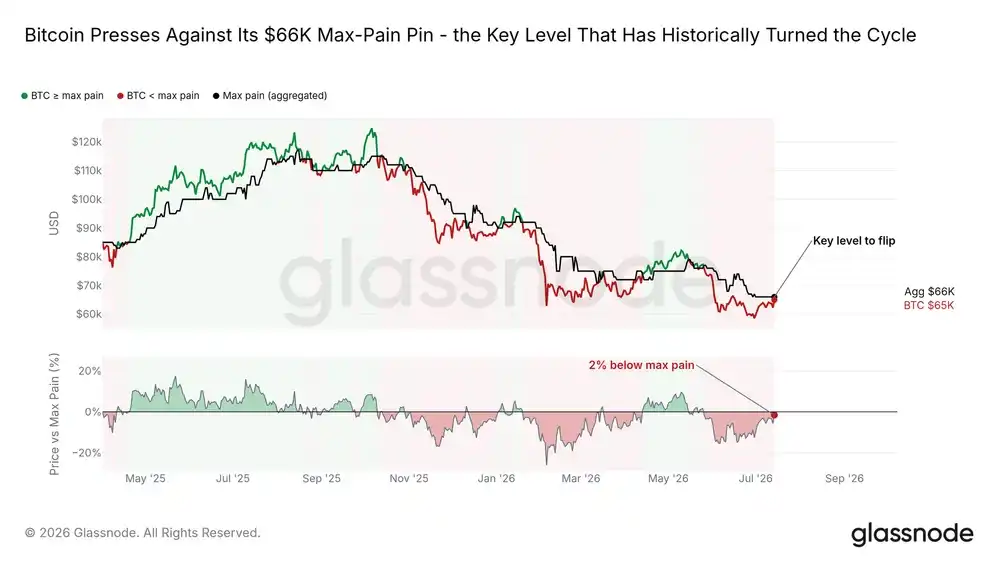
Approaching Max Pain

Max Pain is the price at which the largest share of open options expire worthless, and spot price has oscillated around it all year. Bitcoin is now just below this level, challenging it for the first time in weeks.

Historically, reclaiming Max Pain often coincides with a shift to a friendlier market environment, though the transition takes time. A clean break above it would be the first structural signal of an upside breakout from the range; rejection would confirm the caution still priced into options markets.
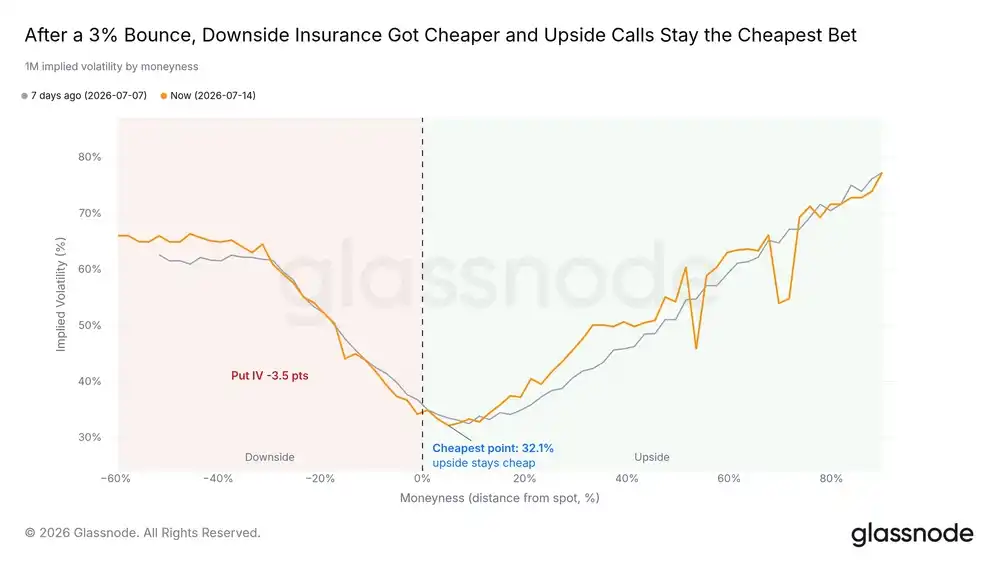
Crash Protection Costs Decline

Absolute protection costs also confirm the moderating trend. During the recovery, one-month crash protection prices have steadily receded, with hedging demand weakening. The market still pays a premium for downside, but far less than at the lows.
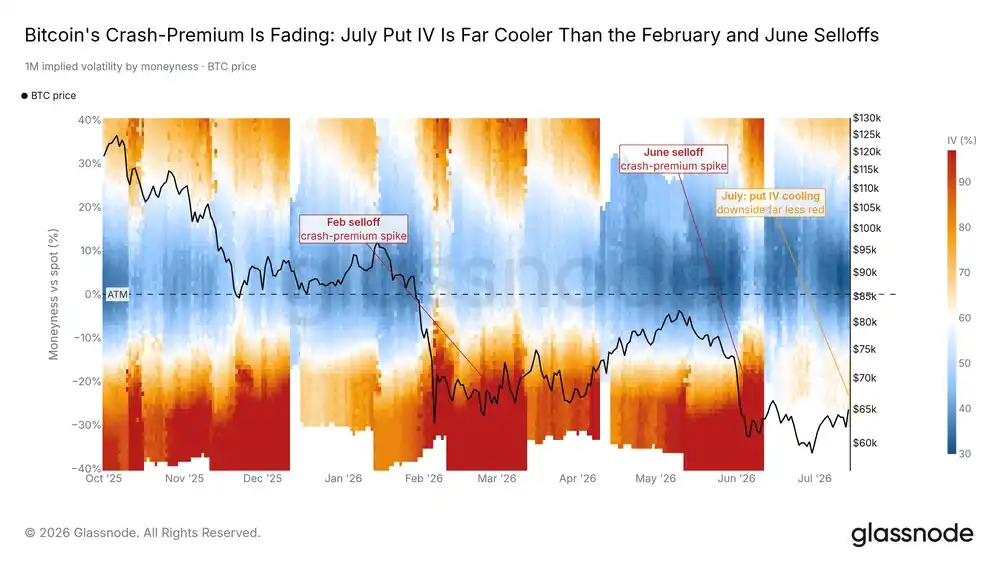
Volatility Enters a Calm Period

A longer-term perspective shows how calm the market has become. The Bitcoin Volatility Index (DVOL) is near one-year lows, and the deep put pressure that erupted in February and June has faded from the volatility surface. Such compression rarely lasts; it's often the backdrop before the next decisive move.
Conclusion

The bottom is still forming, and this week it began to respond. Long-term holder capitulation has receded from its peak, profit-taking has dried up, and the June lows were absorbed by broad-based buying. Bitcoin reacted more strongly to macro good news than other assets, is approaching Max Pain from below, and nearing the Short-Term Holder Cost Basis overhead – the first real test for the recovery.

Confirmation signals are still missing: ETF outflows have slowed but not reversed, derivatives unwinding lacks spot follow-through, and compressed volatility awaits a catalyst. The key signal to change the assessment is spot-driven buying pushing price to effectively break and hold above the Short-Term Holder Cost Basis. If long-term holder losses accelerate again, or price is driven back near the Realized Price, the market returns to range-bound consolidation.

The foundation is laid; the follow-through has yet to arrive.

Trending Cryptos

Related Questions

QAccording to the article, what is the main reason for the slowdown in Bitcoin's selling pressure?

AThe main reason for the slowdown in Bitcoin's selling pressure is the decline in capitulation-style selling by long-term holders (LTHs). The article states that LTH selling, a major source of selling pressure this year, has peaked and begun to recede.

QWhat is identified as the next key resistance level for Bitcoin's price, and why is it significant?

AThe next key resistance level is the Short-Term Holder (STH) cost basis, which is near $69,000. This is significant because it represents the average purchase price for buyers over the last five months, acting as a major break-even level. The article expects a strong reaction upon the first test of this level as sellers may emerge.

QHow has the relationship between Bitcoin and US equities changed recently according to the macro insights section?

AAccording to the macro insights, Bitcoin's correlation with US equities has been weakening since winter, while its inverse relationship with the US Dollar has been deepening. This suggests Bitcoin is increasingly driven by dollar weakness and liquidity factors rather than general risk appetite in the stock market.

QWhat is the current status of US Spot Bitcoin ETF flows as described in the article?

AThe article describes the US Spot Bitcoin ETF flows as showing 'pressure easing but not solved.' Outflow pressure has significantly retreated from June's extreme levels and appears to be stabilizing, but the channel is not fully repaired. The market is characterized by institutions stopping their flight but not yet beginning to buy.

QWhat does the article indicate is the 'missing link' in the current recovery of the Bitcoin market?

AThe 'missing link' in the current recovery is the lack of spot-driven buying following the unwinding of bearish derivative positions. While derivative traders are closing shorts, this adjustment has not been accompanied by actual capital inflows into the spot market.

Related Reads

a16z: The 'Convergence of DeFi and TradFi' is a False Proposition

Title: a16z: "The Fusion of DeFi and TradFi" is a False Proposition In the crypto industry, a common vision is that DeFi and TradFi will merge, creating a hybrid system. This article argues this is largely incorrect. The more honest trajectory is that TradFi will adopt specific blockchain components that improve its existing operations—reducing costs, improving settlement, expanding distribution, and tightening client control—without embracing the core tenets of decentralization like open access or permissionless execution. This is not a fusion but the emergence of a new category: programmable financial infrastructure optimized for institutional constraints, running on blockchain rails. Institutions adopt components like atomic settlement, shared ledgers, and programmable money only when they improve efficiency without compromising control or compliance (e.g., KYC, AML). Projects from J.P. Morgan or BlackRock use blockchain's technical attributes while deliberately discarding DeFi's permissionless nature. For entrepreneurs, this presents two distinct, parallel opportunities. The first is building infrastructure that institutions are ready to adopt today, validating the technology and bringing real volume on-chain. The second is continuing to build the open, crypto-native DeFi system that institutions aren't yet ready for. These paths are complementary, not competitive. The open network remains the primary lab for innovation, whose validated components institutions later adapt. Successful companies must choose their target market clearly. Building for institutions requires understanding procurement, compliance, and risk models, which differs fundamentally from building for open networks focused on developers and composability. The future may see both layers relying on the same public blockchain settlement layer, but convergence won't happen through one assimilating the other. TradFi isn't adopting DeFi; it's selectively using parts that fit its model.

marsbit6m ago

a16z: The 'Convergence of DeFi and TradFi' is a False Proposition

marsbit6m ago

Top 11 NFT games to play in July 2026

NFT games provide players with true ownership of in-game assets through blockchain technology, unlike traditional games. Here are the top 11 NFT games for July 2026: 1. **RavenQuest:** A free-to-play MMORPG with player-driven economy, housing NFTs, and guild wars. 2. **Decentraland:** A user-owned Ethereum-based virtual world for socializing, gaming, and buying digital real estate (LAND NFTs). 3. **Axie Infinity:** A pioneering play-to-earn game where players collect, breed, and battle NFT creatures called Axies. 4. **Pixels:** A free-to-play Ronin-based game focused on farming, crafting, and managing Pixelmon avatars in a player-driven economy. 5. **Gods Unchained:** A free-to-play strategy card game where every card is an NFT, built on Ethereum with Immutable X. 6. **My DeFi Pet:** Combines pet collection, breeding, and battling with DeFi mechanics, using the DPET token. 7. **Alien Worlds:** A fast-paced, decentralized metaverse game where players (explorers) mine resources and compete for the TLM token. 8. **The Sandbox:** A blockchain metaverse where users buy LAND NFTs and create, own, and monetize gaming experiences. 9. **Wreck League:** A mech fighting game with customizable NFT parts, featuring a hybrid Web2/Web3 model and strategic combat. 10. **Undeads Game:** A zombie apocalypse-themed game where players choose to be humans or zombies, with all assets as tradable NFTs. 11. **Shrapnel:** A first-person shooter set in 2043 where players battle for a resource called Sigma, with weapons and gear as NFTs. NFT games offer innovative formats and true digital ownership, but players should research each game before committing.

ambcrypto1h ago

Top 11 NFT games to play in July 2026

ambcrypto1h ago

Trading

Spot

Hot Articles

What is $BITCOIN

DIGITAL GOLD ($BITCOIN): A Comprehensive Analysis Introduction to DIGITAL GOLD ($BITCOIN) DIGITAL GOLD ($BITCOIN) is a blockchain-based project operating on the Solana network, which aims to combine the characteristics of traditional precious metals with the innovation of decentralized technologies. While it shares a name with Bitcoin, often referred to as “digital gold” due to its perception as a store of value, DIGITAL GOLD is a separate token designed to create a unique ecosystem within the Web3 landscape. Its goal is to position itself as a viable alternative digital asset, although specifics regarding its applications and functionalities are still developing. What is DIGITAL GOLD ($BITCOIN)? DIGITAL GOLD ($BITCOIN) is a cryptocurrency token explicitly designed for use on the Solana blockchain. In contrast to Bitcoin, which provides a widely recognized value storage role, this token appears to focus on broader applications and characteristics. Notable aspects include: Blockchain Infrastructure: The token is built on the Solana blockchain, known for its capacity to handle high-speed and low-cost transactions. Supply Dynamics: DIGITAL GOLD has a maximum supply capped at 100 quadrillion tokens (100P $BITCOIN), although details regarding its circulating supply are currently undisclosed. Utility: While precise functionalities are not explicitly outlined, there are indications that the token could be utilized for various applications, potentially involving decentralized applications (dApps) or asset tokenization strategies. Who is the Creator of DIGITAL GOLD ($BITCOIN)? At present, the identity of the creators and development team behind DIGITAL GOLD ($BITCOIN) remains unknown. This situation is typical among many innovative projects within the blockchain space, particularly those aligning with decentralized finance and meme coin phenomena. While such anonymity may foster a community-driven culture, it intensifies concerns about governance and accountability. Who are the Investors of DIGITAL GOLD ($BITCOIN)? The available information indicates that DIGITAL GOLD ($BITCOIN) does not have any known institutional backers or prominent venture capital investments. The project seems to operate on a peer-to-peer model focused on community support and adoption rather than traditional funding routes. Its activity and liquidity are primarily situated on decentralized exchanges (DEXs), such as PumpSwap, rather than established centralized trading platforms, further highlighting its grassroots approach. How DIGITAL GOLD ($BITCOIN) Works The operational mechanics of DIGITAL GOLD ($BITCOIN) can be elaborated on based on its blockchain design and network attributes: Consensus Mechanism: By leveraging Solana’s unique proof-of-history (PoH) combined with a proof-of-stake (PoS) model, the project ensures efficient transaction validation contributing to the network's high performance. Tokenomics: While specific deflationary mechanisms have not been extensively detailed, the vast maximum token supply implies that it may cater to microtransactions or niche use cases that are still to be defined. Interoperability: There exists the potential for integration with Solana’s broader ecosystem, including various decentralized finance (DeFi) platforms. However, the details regarding specific integrations remain unspecified. Timeline of Key Events Here is a timeline that highlights significant milestones concerning DIGITAL GOLD ($BITCOIN): 2023: The initial deployment of the token occurs on the Solana blockchain, marked by its contract address. 2024: DIGITAL GOLD gains visibility as it becomes available for trading on decentralized exchanges like PumpSwap, allowing users to trade it against SOL. 2025: The project witnesses sporadic trading activity and potential interest in community-led engagements, although no noteworthy partnerships or technical advancements have been documented as of yet. Critical Analysis Strengths Scalability: The underlying Solana infrastructure supports high transaction volumes, which could enhance the utility of $BITCOIN in various transaction scenarios. Accessibility: The potential low trading price per token could attract retail investors, facilitating wider participation due to fractional ownership opportunities. Risks Lack of Transparency: The absence of publicly known backers, developers, or an audit process may yield skepticism regarding the project's sustainability and trustworthiness. Market Volatility: The trading activity is heavily reliant on speculative behavior, which can result in significant price volatility and uncertainty for investors. Conclusion DIGITAL GOLD ($BITCOIN) emerges as an intriguing yet ambiguous project within the rapidly evolving Solana ecosystem. While it attempts to leverage the “digital gold” narrative, its departure from Bitcoin's established role as a store of value underscores the need for a clearer differentiation of its intended utility and governance structure. Future acceptance and adoption will likely depend on addressing the current opacity and defining its operational and economic strategies more explicitly. Note: This report encompasses synthesised information available as of October 2023, and developments may have transpired beyond the research period.

834 Total ViewsPublished 2025.05.13Updated 2025.05.13

What is $BITCOIN

Discussions

Welcome to the HTX Community. Here, you can stay informed about the latest platform developments and gain access to professional market insights. Users' opinions on the price of BTC (BTC) are presented below.

活动图片