Bitcoin Bears Lose The Lead: Negative Funding Is The Only Thing Stopping A Structural Breakout

bitcoinistPublished on 2026-03-06Last updated on 2026-03-06

Abstract

Bitcoin has reclaimed the $70,000 level, signaling renewed strength and a potential end to recent bearish conditions. Key structural and regime indicators have turned positive simultaneously for the first time in nearly three months. The Bitcoin Regime Score, which had dropped to -47 in February, has recovered to nearly +1, indicating a shift away from the bearish regime. Price-based structural signals are also aligning, with the Structure Shift Composite reaching +0.56. This synchronized improvement suggests the move toward $73,000 may be a broader market transition rather than a short-term rally. Resistance is near $73,698, with support around $62,981.

Bitcoin is showing renewed strength after reclaiming the $70,000 level, a move that has helped stabilize sentiment following weeks of heightened volatility and uncertain market direction. The recovery comes as several structural indicators begin to shift in favor of a more constructive market environment, suggesting that the recent correction may be transitioning into a new phase.

According to analysis from Axel Adler, multiple regime and structural indicators have moved into positive territory simultaneously for the first time in nearly three months. The report highlights the behavior of the Bitcoin Regime Score, an aggregated metric that incorporates several market variables, including taker imbalance, open interest pressure, funding rates, ETF flows, exchange flows, and price trend. The score is normalized on a scale ranging from -100 to +100 to identify shifts in market regimes.

On February 7, the Regime Score dropped to -47, marking the deepest bearish reading recorded over the past year. For comparison, the market bottom in November 2025 reached -37 and required 33 days to recover to neutral territory, while the August low of -35 reversed in only 11 days.
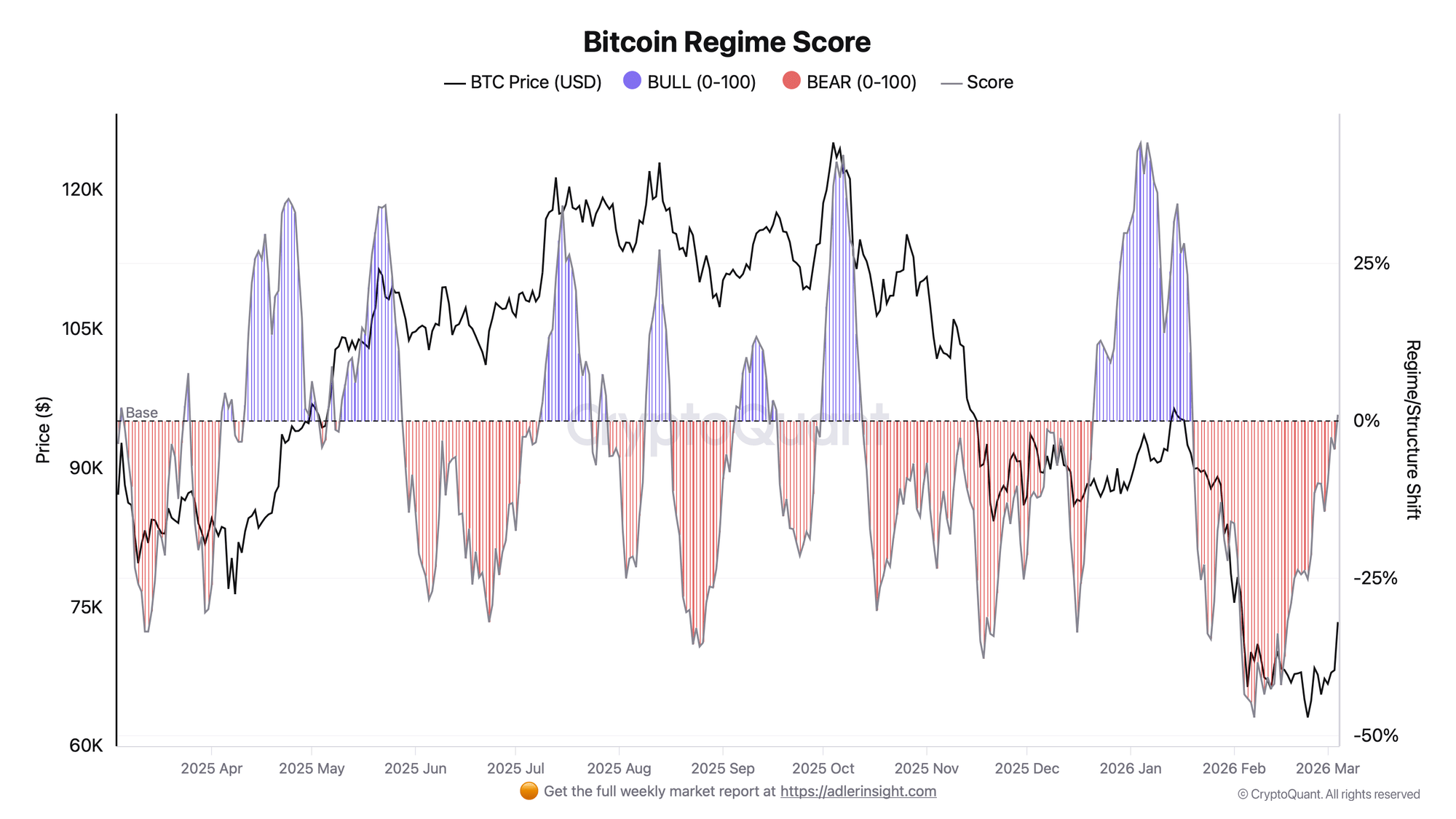
Bitcoin Regime Score | Source: CryptoQuant

In the current cycle, however, the recovery has occurred in approximately 25 days. As of March 4, the indicator has climbed back to around +0.98, signaling a potential transition away from the recent bearish regime.

Structural Indicators Align As Bitcoin Tests Key Resistance

Adler further notes that price-based structural signals are now aligning with regime indicators, reinforcing the significance of Bitcoin’s recent recovery above $70,000. One of the key metrics highlighted in the report is the Structure Shift Composite, a fast signal designed to capture short-term changes in market structure.

The Structure Shift Composite ranges from -1 to +1 and incorporates several elements of price behavior, including momentum, the sequence of price movements, and the asset’s position relative to its exponential moving averages. At the same time, the Donchian Channel provides a framework for identifying current technical boundaries, placing resistance near $73,698 and support around $62,981.
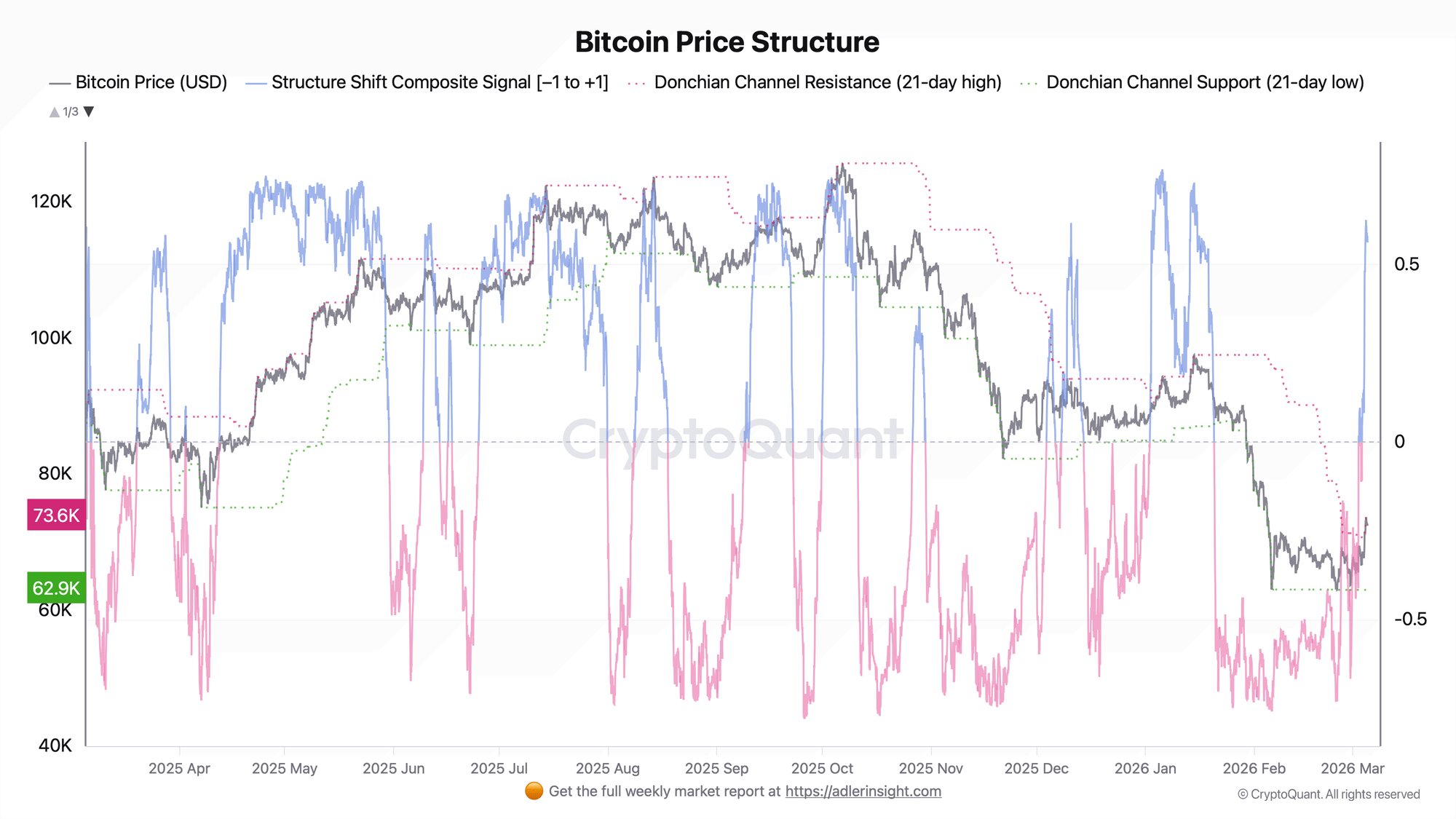
Bitcoin Price Structure | Source: CryptoQuant

Earlier in the cycle, the relationship between these indicators followed a different pattern. In January, the Structure Shift signal crossed above zero in a single sharp move—from -0.05 to +0.57—on January 2, but only after the Regime Score had already been firmly in bullish territory for several days. That confirmation was followed by a rally that eventually pushed Bitcoin toward the $97,000 region.

The current transition has developed differently. Between March 2 and March 4, both Structure Shift and the Regime Score crossed into positive territory simultaneously. With Structure Shift now near +0.56 and Regime Score at +0.98, this synchronized shift suggests that the recent move toward $73,000 may represent a broader structural transition rather than a temporary short squeeze.


Related Questions

QWhat is the Bitcoin Regime Score and what does it measure?

AThe Bitcoin Regime Score is an aggregated metric that incorporates several market variables, including taker imbalance, open interest pressure, funding rates, ETF flows, exchange flows, and price trend. It is normalized on a scale from -100 to +100 to identify shifts in market regimes.

QWhat was the lowest Bitcoin Regime Score reading in the past year and when did it occur?

AThe lowest Bitcoin Regime Score reading in the past year was -47, which occurred on February 7.

QWhat key price level did Bitcoin recently reclaim, helping to shift market sentiment?

ABitcoin recently reclaimed the $70,000 level, which helped stabilize sentiment and signaled a potential transition away from the recent bearish regime.

QWhat are the current resistance and support levels for Bitcoin according to the Donchian Channel analysis?

AAccording to the Donchian Channel analysis, the current resistance level is near $73,698 and the support level is around $62,981.

QHow does the current transition of the Structure Shift and Regime Score indicators differ from the pattern observed in January?

AIn January, the Structure Shift signal crossed above zero after the Regime Score had already been in bullish territory for several days. In the current transition (between March 2 and 4), both indicators crossed into positive territory simultaneously, suggesting a broader structural transition.

Related Reads

Anthropic's IPO Launch: Commercial Miracle or Valuation Bubble?

Anthropic has confidentially filed for an IPO, led by Morgan Stanley and Goldman Sachs, potentially going public by October. Following its latest $650 billion funding round, its pre-IPO valuation stands at $965 billion, with projections reaching up to $2 trillion at listing, which would make it the highest-valued private company ever. The article, written by Fu Sheng, addresses skepticism that this represents an AI bubble akin to the 2000 dot-com crash. It argues the current situation differs fundamentally. Unlike the internet bubble era, which relied on speculative narratives with little revenue, Anthropic's valuation is backed by unprecedented, measurable financial performance. Key data points include: * **Revenue Growth:** ARR skyrocketed from $10 billion in early 2025 to $470 billion by May 2026, targeting $100 billion by year-end—a growth curve unmatched in business history. * **Profitability:** It achieved operating profitability in Q2 2026 with an estimated $5.6 billion profit. * **Efficiency:** With ~3,000 employees and ~$470 billion ARR, its revenue per employee exceeds $10 million. Products like Claude Code, launched less than a year ago, already generate $25 billion in annualized revenue. * **Enterprise Adoption:** It boasts a strong enterprise client base, with 8 of the Fortune 10 and over 1,000 large firms spending over $1 million annually on Claude. The valuation is framed using a traditional SaaS model (e.g., a 10x Price-to-Sales multiple on $100 billion revenue). The author contends the core question for analysts has shifted from "How big could this be?" to "How much is it earning and will earn next quarter?" The discussion extends beyond Anthropic to a broader paradigm shift: the transition from a "carbon-based" to a "silicon-based" economy. Companies are increasingly prioritizing investment in compute and AI capabilities over human resources, as these directly scale productivity and competitive advantage. Anthropic's IPO is thus positioned not just as a corporate milestone, but as a price anchor for this new economic era.

链捕手1h ago

Anthropic's IPO Launch: Commercial Miracle or Valuation Bubble?

链捕手1h ago

Near Returns to the AI Stage: Transformation into a Public Chain Due to 'Payroll Difficulties,' Agent and Privacy Emerge as New Growth Narratives

NEAR Returns to AI Origins: From Payroll Struggles to Blockchain, Now Focusing on AI Agents and Privacy NEAR Protocol's journey began not with grand blockchain ambitions, but from a practical hurdle: its AI startup founders, including Transformer paper co-author Illia Polosukhin, couldn't efficiently pay international developers in 2017. This led them to pivot and build a high-performance, scalable blockchain. After years navigating various crypto narratives like sharding and cross-chain interoperability, NEAR is now leveraging its AI roots to re-enter the AI arena. A key driver is its "NEAR Intents" layer, which abstracts complex cross-chain transactions. Users simply state their goal (e.g., swap BTC for ETH), and a solver network finds the optimal route. This system has processed over $20B in cross-chain volume, generating significant fee revenue. A major growth area is private transactions via "Confidential Intents/Swaps," which hide trade details until settlement to protect against MEV and front-running. Remarkably, private swaps recently accounted for over 40% of NEAR's transaction volume, highlighting strong demand but also potential regulatory scrutiny. With its AI-founder pedigree, NEAR is positioning itself at the intersection of blockchain, AI agents, and privacy, aiming to become infrastructure for the emerging agent economy while navigating the challenges of its rapid adoption.

marsbit4h ago

Near Returns to the AI Stage: Transformation into a Public Chain Due to 'Payroll Difficulties,' Agent and Privacy Emerge as New Growth Narratives

marsbit4h ago

Trading

Spot
Futures

Hot Articles

What is $BITCOIN

DIGITAL GOLD ($BITCOIN): A Comprehensive Analysis Introduction to DIGITAL GOLD ($BITCOIN) DIGITAL GOLD ($BITCOIN) is a blockchain-based project operating on the Solana network, which aims to combine the characteristics of traditional precious metals with the innovation of decentralized technologies. While it shares a name with Bitcoin, often referred to as “digital gold” due to its perception as a store of value, DIGITAL GOLD is a separate token designed to create a unique ecosystem within the Web3 landscape. Its goal is to position itself as a viable alternative digital asset, although specifics regarding its applications and functionalities are still developing. What is DIGITAL GOLD ($BITCOIN)? DIGITAL GOLD ($BITCOIN) is a cryptocurrency token explicitly designed for use on the Solana blockchain. In contrast to Bitcoin, which provides a widely recognized value storage role, this token appears to focus on broader applications and characteristics. Notable aspects include: Blockchain Infrastructure: The token is built on the Solana blockchain, known for its capacity to handle high-speed and low-cost transactions. Supply Dynamics: DIGITAL GOLD has a maximum supply capped at 100 quadrillion tokens (100P $BITCOIN), although details regarding its circulating supply are currently undisclosed. Utility: While precise functionalities are not explicitly outlined, there are indications that the token could be utilized for various applications, potentially involving decentralized applications (dApps) or asset tokenization strategies. Who is the Creator of DIGITAL GOLD ($BITCOIN)? At present, the identity of the creators and development team behind DIGITAL GOLD ($BITCOIN) remains unknown. This situation is typical among many innovative projects within the blockchain space, particularly those aligning with decentralized finance and meme coin phenomena. While such anonymity may foster a community-driven culture, it intensifies concerns about governance and accountability. Who are the Investors of DIGITAL GOLD ($BITCOIN)? The available information indicates that DIGITAL GOLD ($BITCOIN) does not have any known institutional backers or prominent venture capital investments. The project seems to operate on a peer-to-peer model focused on community support and adoption rather than traditional funding routes. Its activity and liquidity are primarily situated on decentralized exchanges (DEXs), such as PumpSwap, rather than established centralized trading platforms, further highlighting its grassroots approach. How DIGITAL GOLD ($BITCOIN) Works The operational mechanics of DIGITAL GOLD ($BITCOIN) can be elaborated on based on its blockchain design and network attributes: Consensus Mechanism: By leveraging Solana’s unique proof-of-history (PoH) combined with a proof-of-stake (PoS) model, the project ensures efficient transaction validation contributing to the network's high performance. Tokenomics: While specific deflationary mechanisms have not been extensively detailed, the vast maximum token supply implies that it may cater to microtransactions or niche use cases that are still to be defined. Interoperability: There exists the potential for integration with Solana’s broader ecosystem, including various decentralized finance (DeFi) platforms. However, the details regarding specific integrations remain unspecified. Timeline of Key Events Here is a timeline that highlights significant milestones concerning DIGITAL GOLD ($BITCOIN): 2023: The initial deployment of the token occurs on the Solana blockchain, marked by its contract address. 2024: DIGITAL GOLD gains visibility as it becomes available for trading on decentralized exchanges like PumpSwap, allowing users to trade it against SOL. 2025: The project witnesses sporadic trading activity and potential interest in community-led engagements, although no noteworthy partnerships or technical advancements have been documented as of yet. Critical Analysis Strengths Scalability: The underlying Solana infrastructure supports high transaction volumes, which could enhance the utility of $BITCOIN in various transaction scenarios. Accessibility: The potential low trading price per token could attract retail investors, facilitating wider participation due to fractional ownership opportunities. Risks Lack of Transparency: The absence of publicly known backers, developers, or an audit process may yield skepticism regarding the project's sustainability and trustworthiness. Market Volatility: The trading activity is heavily reliant on speculative behavior, which can result in significant price volatility and uncertainty for investors. Conclusion DIGITAL GOLD ($BITCOIN) emerges as an intriguing yet ambiguous project within the rapidly evolving Solana ecosystem. While it attempts to leverage the “digital gold” narrative, its departure from Bitcoin's established role as a store of value underscores the need for a clearer differentiation of its intended utility and governance structure. Future acceptance and adoption will likely depend on addressing the current opacity and defining its operational and economic strategies more explicitly. Note: This report encompasses synthesised information available as of October 2023, and developments may have transpired beyond the research period.

363 Total ViewsPublished 2025.05.13Updated 2025.05.13

What is $BITCOIN

Discussions

Welcome to the HTX Community. Here, you can stay informed about the latest platform developments and gain access to professional market insights. Users' opinions on the price of BTC (BTC) are presented below.

活动图片