Bitcoin Axed By Top Wall Street Strategist On Quantum Fears

bitcoinistPublished on 2026-01-20Last updated on 2026-01-20

Abstract

Jefferies strategist Chris Wood has removed Bitcoin from his long-term model portfolio, citing quantum computing as a threat to Bitcoin's store-of-value proposition for long-term investors like pension funds. While not predicting an immediate price crash, Wood expressed concern that quantum computers could compromise Bitcoin’s cryptographic security within years rather than decades, making private keys vulnerable. He reallocated the 10% Bitcoin exposure to gold and gold miners. VanEck’s Matthew Sigel acknowledged the move but emphasized the difference between Bitcoin's decentralized, hard-to-upgrade nature and traditional reversible banking systems. He views quantum risk as a solvable challenge rather than a fatal flaw and maintains spot Bitcoin exposure while making small hedges. The article notes Bitcoin's significant outperformance versus gold since 2020 despite the recent strategic shift.

Jefferies strategist Chris Wood has removed Bitcoin from his long-term model portfolio, citing quantum computing as a risk that weakens Bitcoin’s store-of-value framing for pension-style allocations. VanEck head of research Matthew Sigel flagged the change on X, calling it a notable “downgrade” from one of the Street’s most widely followed global strategists.

Veteran Strategist Chris Wood Exits Bitcoin

Wood wrote that he is not positioning for an imminent price shock, but that the long-duration mandate is where the quantum question bites. “While GREED & fear does not believe that the quantum issue is about to hit the Bitcoin price dramatically in the near term, the store of value concept is clearly on less solid foundation from the standpoint of a long-term pension portfolio,” Wood wrote. “For that reason, GREED & fear will remove the 10% allocation to Bitcoin this week with 5% reallocated to gold and 5% reallocated to gold-mining stocks.”

The move is framed as risk management rather than a retrospective performance critique. Wood noted that despite gold’s recent outperformance versus Bitcoin, Bitcoin remained well ahead since his model first added it: Bitcoin had risen 325% since December 17, 2020, while gold bullion was up 145% over the same period.

In a note dated January 15, 2026, Wood described how the quantum discussion has moved from abstract theory into something asset allocators are being asked to underwrite. “GREED & fear is no pure mathematician,” he wrote, adding that he has found himself pulled into conversations about “elliptic curves” because of “the growing focus in recent months on the threat posed to the Bitcoin system by the arrival of quantum computing.”

His core claim is that the perceived timeline is compressing. He referenced rising concern that cryptographically relevant quantum computers could arrive “a few years away rather than a decade or more,” and argued that any credible threat to Bitcoin’s security model is “potentially existential” because it undermines the store-of-value concept that underpins the “digital alternative to gold” narrative.

Wood’s mechanism is straightforward: what is computationally infeasible today could become tractable under CRQCs. He wrote that the current asymmetry, easy to derive a public key from a private key, effectively impossible to reverse, could collapse, with the time to derive a private key from a public key shrinking to “mere hours or days.”

Wood said the industry is already debating potential responses, including whether to “burn” quantum-vulnerable coins to protect system integrity or to do nothing and accept the possibility that vulnerable coins could be stolen by entities with CRQCs. He presented the dispute as a conflict between preserving Bitcoin’s property-rights ethos and avoiding a policy choice that looks confiscatory, adding that one computer scientist he spoke with described the do-nothing stance as a “suicidal delusion.”

Wood said his thinking was informed by discussions with knowledgeable parties and pointed to a Chaincode report as background reading, without treating it as a near-term trading trigger.

VanEck’s Sigel Responds

Sigel’s takeaway was less about whether quantum risk exists and more about how different systems respond. When one user argued that quantum would wipe out bank accounts, email, and brokerage systems as well, Sigel dismissed that as “not a sufficient take anymore,” drawing a sharp distinction between upgrade paths and reversibility.

“Banks upgrade top-down; BTC requires years of consensus,” Sigel wrote. “Banks have an ‘undo’ button; BTC is finality-first.”

Sigel also linked the debate to a familiar fault line inside Bitcoin governance. Asked how representative Wood’s view might be, Sigel said that in the “Adam Back vs. Nic Carter” debate he is “on Nic’s side,” and described Wood’s decision as supporting evidence. At the same time, Sigel emphasized process: he met Wood in New York before the note was published and said that although he disagreed with the conclusion, Wood “came to it honestly.”

On positioning, Sigel said he has “added quantum exposure” previously to VanEck’s Onchain Economy ETF (NODE) and made small hedges, with a preference for “diversified” AI miners over “DATs / leveraged BTC,” while keeping spot BTC via an ETF as the largest holding. He framed the quantum issue as “solvable” and akin to a “wall of worry like blocksize wars,” rather than a thesis-breaker.

At press time, BTC traded at $90,941.
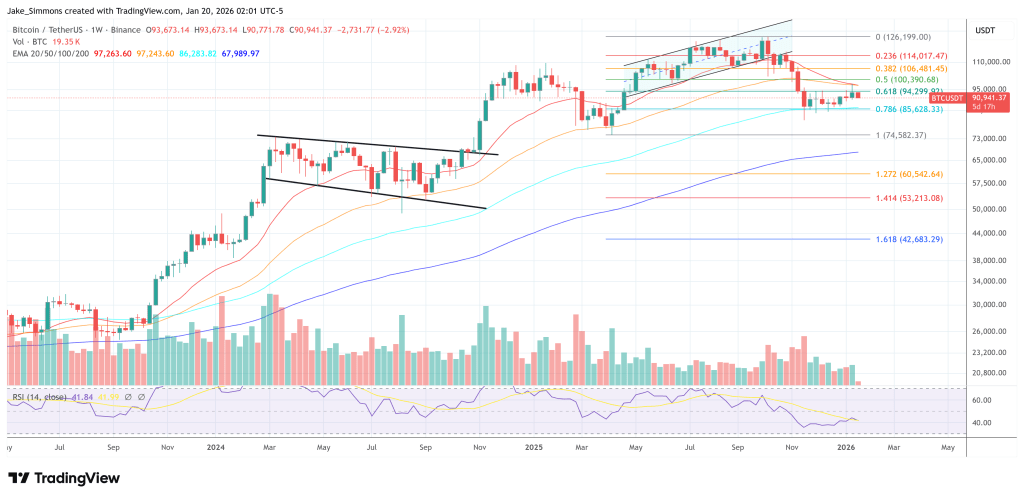
Bitcoin rejected at the 0.618 Fib, 1-week chart | Source: BTCUSDT on TradingView.com

Related Questions

QWhy did Jefferies strategist Chris Wood remove Bitcoin from his long-term model portfolio?

AChris Wood removed Bitcoin from his long-term model portfolio due to concerns that quantum computing poses a risk to Bitcoin's store-of-value narrative, which is critical for pension-style allocations.

QWhat specific actions did Chris Wood take in reallocating the portfolio after removing Bitcoin?

AAfter removing the 10% allocation to Bitcoin, Wood reallocated 5% to gold and 5% to gold-mining stocks.

QHow does Matthew Sigel of VanEck distinguish between the impact of quantum computing on traditional banking systems versus Bitcoin?

ASigel argues that banks can upgrade their systems top-down and have an 'undo' button for reversibility, whereas Bitcoin requires years of consensus for upgrades and is finality-first, making it more vulnerable to quantum threats.

QWhat is the core concern regarding quantum computing and Bitcoin's security model as presented by Chris Wood?

AThe core concern is that cryptographically relevant quantum computers could drastically reduce the time required to derive a private key from a public key from being effectively impossible to 'mere hours or days,' undermining Bitcoin's security and store-of-value proposition.

QHow does Matthew Sigel view the solvability of the quantum computing threat to Bitcoin?

ASigel views the quantum issue as 'solvable' and compares it to a 'wall of worry like blocksize wars,' suggesting it is a manageable challenge rather than a thesis-breaker for Bitcoin.

Related Reads

AI Giants Enter the Dark Forest

In the AI industry's "dark forest," major players like Anthropic, OpenAI, and DeepSeek are strategically withholding their most advanced models to avoid becoming targets in a high-stakes competitive landscape. Anthropic released Claude Opus 4.7 but admitted it underperforms compared to their unreleased model Mythos, citing safety concerns. They delayed addressing user complaints about performance regression until OpenAI’s GPT-5.5 launch, highlighting a tactic of controlled disclosure aligned with competitors’ moves. OpenAI’s GPT-5.5, though a full retrain since GPT-4.5, was seen as incremental rather than revolutionary. Leaks revealed internal models like Glacier and Heisenberg, indicating significant unreleased capabilities. OpenAI acknowledges a "capability overhang," where real model power exceeds what users experience, often due to infrastructure-driven throttling. DeepSeek launched V4 Preview, a cost-efficient model, but its full potential (V4 Pro Max) awaits Huawei’s Ascend 950 super-nodes量产 in late 2026. Their strategy focuses on affordability and scalability, aiming to democratize AI access globally, a move noted even by NVIDIA’s CEO as a disruptive threat. Together, these actions reflect a broader trend: leading AI labs are deliberately pacing releases, hiding strengths, and aligning disclosures with competitive dynamics—each avoiding the risk of exposure in a forest where first movers become targets.

marsbit1h ago

AI Giants Enter the Dark Forest

marsbit1h ago

Trading

Spot
Futures

Hot Articles

What is $BITCOIN

DIGITAL GOLD ($BITCOIN): A Comprehensive Analysis Introduction to DIGITAL GOLD ($BITCOIN) DIGITAL GOLD ($BITCOIN) is a blockchain-based project operating on the Solana network, which aims to combine the characteristics of traditional precious metals with the innovation of decentralized technologies. While it shares a name with Bitcoin, often referred to as “digital gold” due to its perception as a store of value, DIGITAL GOLD is a separate token designed to create a unique ecosystem within the Web3 landscape. Its goal is to position itself as a viable alternative digital asset, although specifics regarding its applications and functionalities are still developing. What is DIGITAL GOLD ($BITCOIN)? DIGITAL GOLD ($BITCOIN) is a cryptocurrency token explicitly designed for use on the Solana blockchain. In contrast to Bitcoin, which provides a widely recognized value storage role, this token appears to focus on broader applications and characteristics. Notable aspects include: Blockchain Infrastructure: The token is built on the Solana blockchain, known for its capacity to handle high-speed and low-cost transactions. Supply Dynamics: DIGITAL GOLD has a maximum supply capped at 100 quadrillion tokens (100P $BITCOIN), although details regarding its circulating supply are currently undisclosed. Utility: While precise functionalities are not explicitly outlined, there are indications that the token could be utilized for various applications, potentially involving decentralized applications (dApps) or asset tokenization strategies. Who is the Creator of DIGITAL GOLD ($BITCOIN)? At present, the identity of the creators and development team behind DIGITAL GOLD ($BITCOIN) remains unknown. This situation is typical among many innovative projects within the blockchain space, particularly those aligning with decentralized finance and meme coin phenomena. While such anonymity may foster a community-driven culture, it intensifies concerns about governance and accountability. Who are the Investors of DIGITAL GOLD ($BITCOIN)? The available information indicates that DIGITAL GOLD ($BITCOIN) does not have any known institutional backers or prominent venture capital investments. The project seems to operate on a peer-to-peer model focused on community support and adoption rather than traditional funding routes. Its activity and liquidity are primarily situated on decentralized exchanges (DEXs), such as PumpSwap, rather than established centralized trading platforms, further highlighting its grassroots approach. How DIGITAL GOLD ($BITCOIN) Works The operational mechanics of DIGITAL GOLD ($BITCOIN) can be elaborated on based on its blockchain design and network attributes: Consensus Mechanism: By leveraging Solana’s unique proof-of-history (PoH) combined with a proof-of-stake (PoS) model, the project ensures efficient transaction validation contributing to the network's high performance. Tokenomics: While specific deflationary mechanisms have not been extensively detailed, the vast maximum token supply implies that it may cater to microtransactions or niche use cases that are still to be defined. Interoperability: There exists the potential for integration with Solana’s broader ecosystem, including various decentralized finance (DeFi) platforms. However, the details regarding specific integrations remain unspecified. Timeline of Key Events Here is a timeline that highlights significant milestones concerning DIGITAL GOLD ($BITCOIN): 2023: The initial deployment of the token occurs on the Solana blockchain, marked by its contract address. 2024: DIGITAL GOLD gains visibility as it becomes available for trading on decentralized exchanges like PumpSwap, allowing users to trade it against SOL. 2025: The project witnesses sporadic trading activity and potential interest in community-led engagements, although no noteworthy partnerships or technical advancements have been documented as of yet. Critical Analysis Strengths Scalability: The underlying Solana infrastructure supports high transaction volumes, which could enhance the utility of $BITCOIN in various transaction scenarios. Accessibility: The potential low trading price per token could attract retail investors, facilitating wider participation due to fractional ownership opportunities. Risks Lack of Transparency: The absence of publicly known backers, developers, or an audit process may yield skepticism regarding the project's sustainability and trustworthiness. Market Volatility: The trading activity is heavily reliant on speculative behavior, which can result in significant price volatility and uncertainty for investors. Conclusion DIGITAL GOLD ($BITCOIN) emerges as an intriguing yet ambiguous project within the rapidly evolving Solana ecosystem. While it attempts to leverage the “digital gold” narrative, its departure from Bitcoin's established role as a store of value underscores the need for a clearer differentiation of its intended utility and governance structure. Future acceptance and adoption will likely depend on addressing the current opacity and defining its operational and economic strategies more explicitly. Note: This report encompasses synthesised information available as of October 2023, and developments may have transpired beyond the research period.

363 Total ViewsPublished 2025.05.13Updated 2025.05.13

What is $BITCOIN

Discussions

Welcome to the HTX Community. Here, you can stay informed about the latest platform developments and gain access to professional market insights. Users' opinions on the price of BTC (BTC) are presented below.

活动图片