Assessing Bitcoin’s sideways drift as dormant $290M BTC whale reloads

ambcryptoPublished on 2026-07-19Last updated on 2026-07-19

Abstract

Bitcoin continued trading sideways between $63,000 and $64,000, with trading volume declining 46%. A dormant whale, inactive for a year, returned to acquire 1,001 BTC worth $64 million, suggesting renewed confidence. However, broader whale activity remains subdued, as indicated by the sideways Exchange Whale Ratio around 0.3. Spot Netflow stayed negative for four days, showing net outflows from exchanges, which may reduce immediate selling pressure but doesn't confirm accumulation. Technical indicators like the ADX and -DI point to stronger downward pressure, with downside risk elevated. If whale demand stays weak, BTC could retest support near $62,697. To avoid further decline, it must hold above $63,906 and break through $64,000.

Bitcoin continued trading sideways between $63,000 and $64,000. At press time, BTC traded around $63,923 after gaining 1.82% over 24 hours.

However, Trading Volume fell 46%, reflecting weaker market participation.

Why did this Bitcoin whale return?

As Bitcoin [BTC] traded sideways, one long-term holder returned to the market after a year of inactivity.

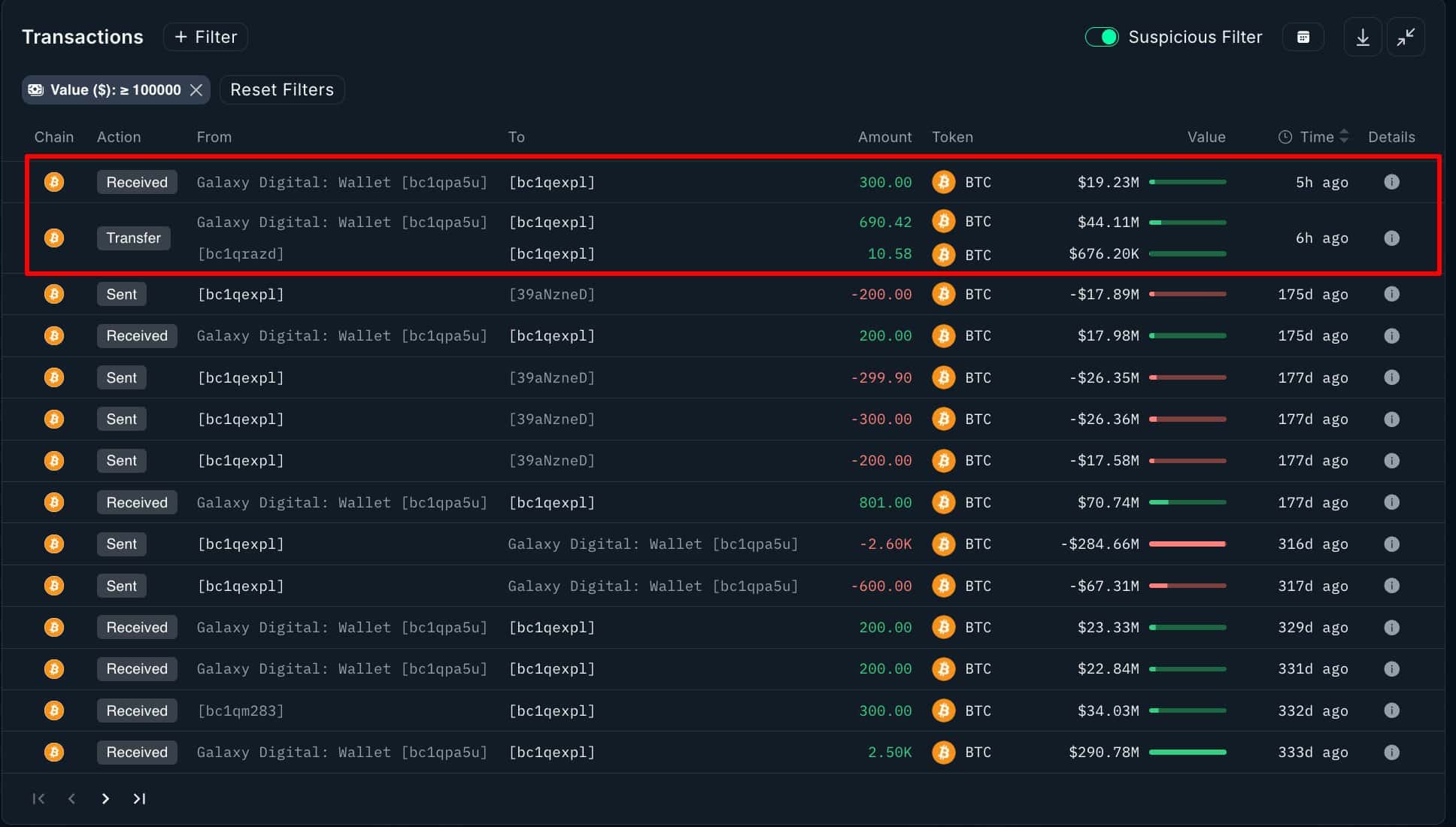
According to Onchain Lens, the whale wallet received another 1,001 BTC worth approximately $64 million. A year earlier, the whale acquired $290 million worth of Bitcoin through Galaxy Digital.

Its return during weaker market conditions suggested renewed confidence, although the transfer alone did not confirm broader whale demand.
Source: Onchain Lens

Are other whales buying BTC?

Interestingly, even though this whale returned, other whales have scaled back significantly and are now sitting on the sidelines.

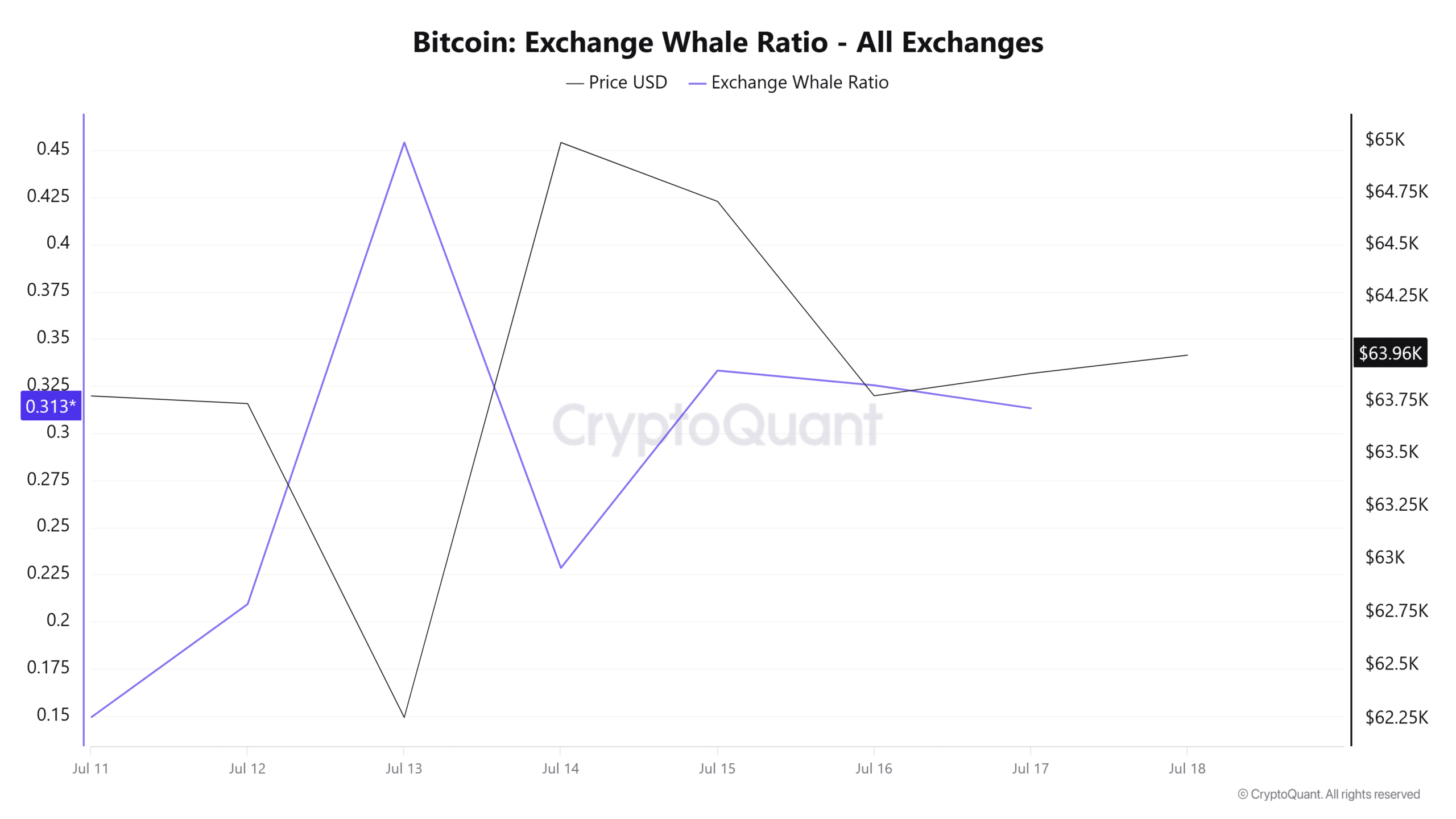
Looking at the Exchange Whale Ratio, this metric has continued to move sideways, holding around 0.3 over the past three days. In the short term, this metric indicates that whales have reduced buying and selling.
Source: CryptoQuant

The ratio slipped from 0.33 to 0.31. This meant the largest inflows accounted for a slightly smaller share of total deposits.

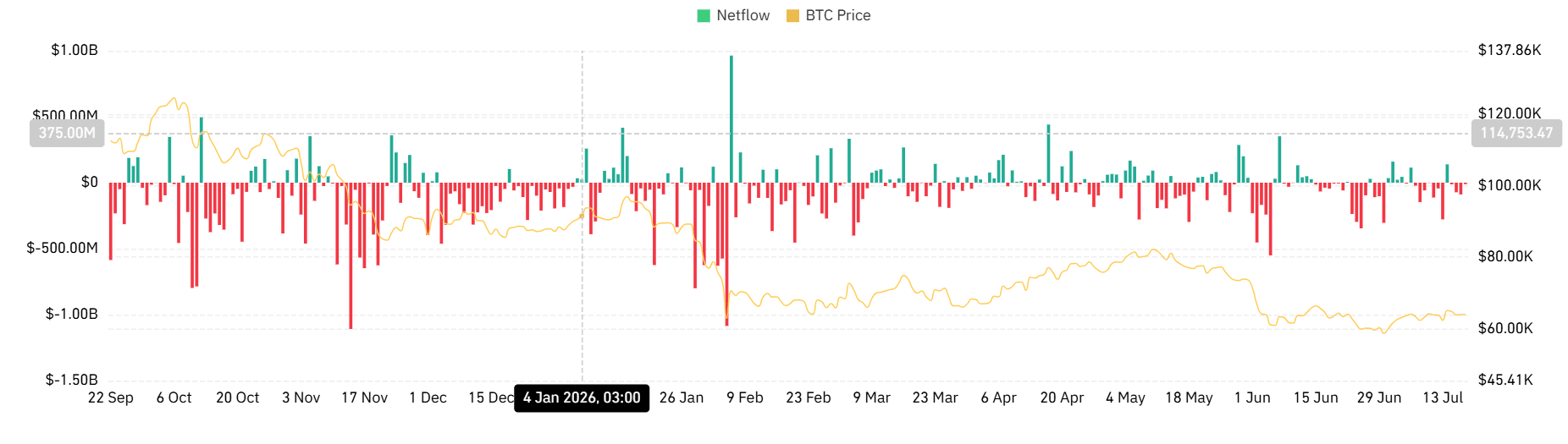
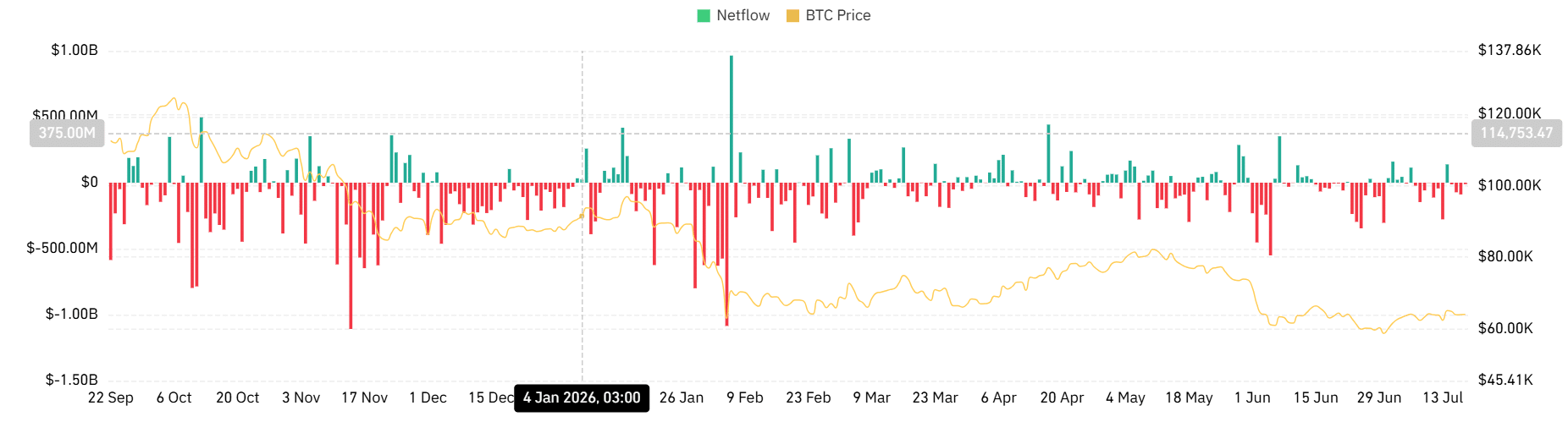
By contrast, Spot Netflow remained negative for four consecutive days, showing that overall exchange outflows exceeded inflows.
Source: CoinGlass

Spot Netflow stood near -$10.86 million at press time. Continued outflows could reduce immediate selling pressure, but they did not confirm whale accumulation.

What’s next for BTC?

Although some whales still remain active in the market, demand remains weak. The group’s buying activity currently remains below par.

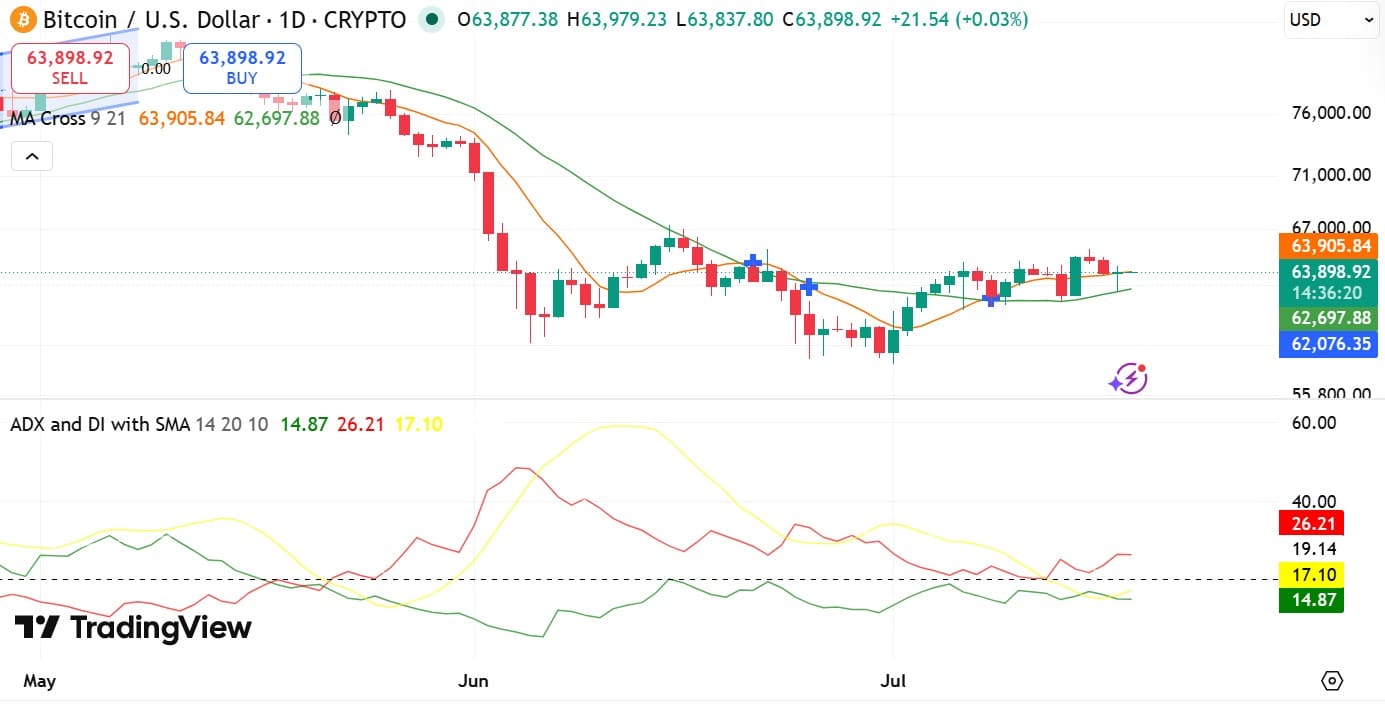
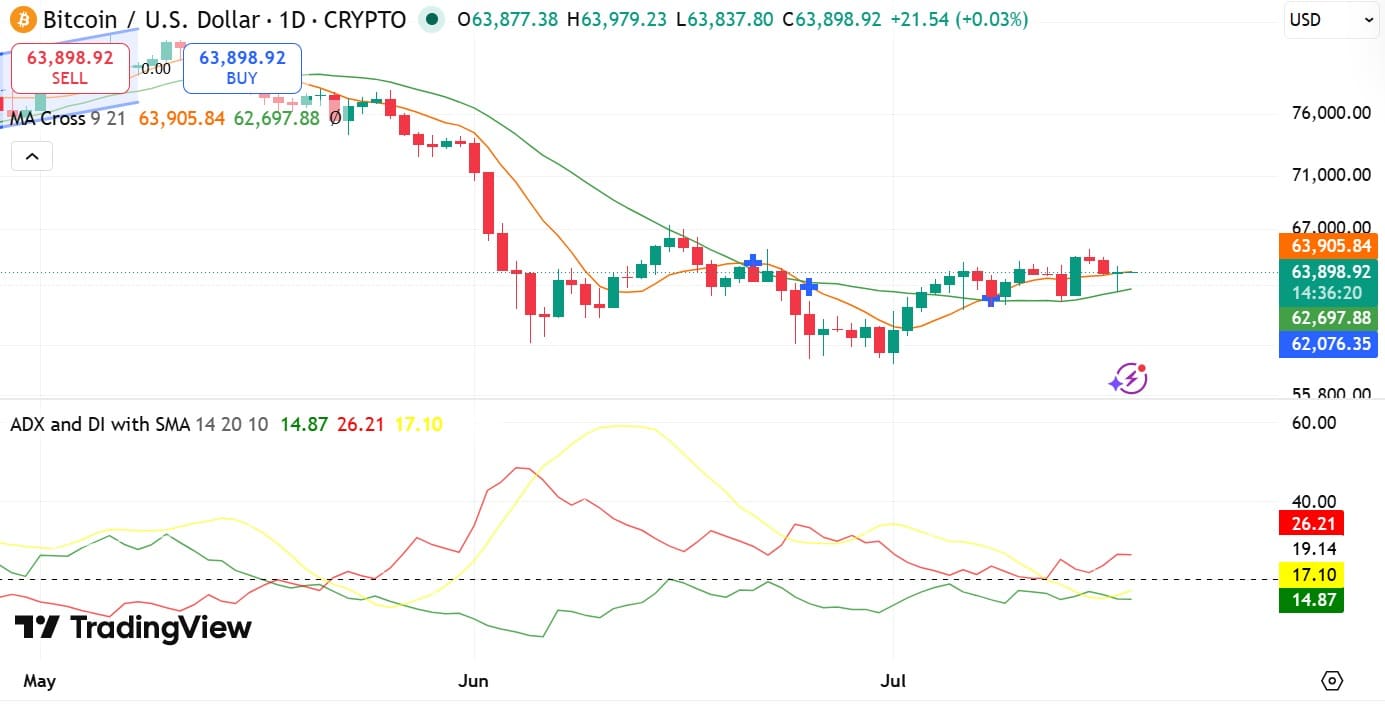
As a result, the downside risk remains elevated. A look at the ADX with the SMA indicator shows the positive index has continued to drop. The +DI fell to 14, while the negative index rose to 26 and the ADX rose to 17.
Source: TradingView

ADX and -DI rising together suggested that the downward pressure is stronger. Thus, Bitcoin is most likely to see some losses on the price charts.

If whale demand remains weak, as it currently is, BTC is likely to drop below $63k again, towards $62,697, where the Long MA currently sits. To avoid further slippage, BTC must hold above $ 63,906 and flip $64k.


Final Summary

  • A dormant whale received 1,001 BTC worth $64 million after one year of inactivity.
  • Negative Spot Netflow reduced immediate supply, but broader demand and price momentum remained weak.


Trending Cryptos

Related Questions

QWhat recent action did a dormant Bitcoin whale take, and what does it suggest?

AA dormant whale wallet received 1,001 BTC (worth approximately $64 million) after a year of inactivity. This return during weaker market conditions suggests renewed confidence from that specific holder, although it does not confirm broader whale demand in the market.

QAccording to the Exchange Whale Ratio, what is the current behavior of whales in the market?

AThe Exchange Whale Ratio has been moving sideways around 0.3 over the past three days, indicating that whales have significantly scaled back their activity and are currently reducing both buying and selling, sitting on the sidelines.

QWhat does the negative Spot Netflow indicate about Bitcoin exchange activity?

ASpot Netflow remained negative for four consecutive days, standing near -$10.86 million at press time. This indicates that overall exchange outflows (withdrawals) exceeded inflows (deposits), which could reduce immediate selling pressure but does not confirm active whale accumulation.

QBased on the ADX and DI indicators, what is the current market momentum for Bitcoin?

AThe rising ADX (to 17) and rising negative index (-DI to 26), coupled with a falling positive index (+DI to 14), suggest that downward price pressure is stronger. This indicates an increased likelihood of Bitcoin seeing losses on the price charts.

QWhat are the potential price levels mentioned for Bitcoin's near-term movement?

AIf whale demand remains weak, BTC is likely to drop below $63k again, potentially towards the Long MA level at $62,697. To avoid further slippage, BTC must hold above $63,906 and flip the $64,000 resistance level.

Related Reads

WEEX Labs Weekly Observation: The 'Power Restructuring' of AI Infrastructure and the 'Deep Dive Movement' into the Real Economy

WEEX Labs Weekly Review: AI Infrastructure's "Power Restructuring" and the "Deep Dive" into the Real Economy Mid-July 2026 marks a pivotal shift in the global AI industry. The allocation of computing power is transferring from cloud giants to compute resource owners, while the core value of AI is solidifying around its penetration into physical industry, moving beyond the race for model parameters. The era of fragmented model development is over, replaced by a capital-intensive, integrated chain driven by hard tech. Key developments this week include Meta's planned entry into the cloud computing market with "MetaCompute." This move by social media giants with massive GPU clusters challenges traditional cloud providers like AWS, integrating compute, models, and data into one-stop services, which will squeeze smaller rental providers and shift enterprise focus towards underlying model ecosystems. Chinese foundational models like DeepSeek-V4 and Tencent's Hy-3 are pushing towards "utility" status through open-source releases and extreme cost reductions via MoE architectures. This lowers entry barriers for enterprises, allowing them to focus resources on private deployment and deep business integration. Embodied intelligence, particularly humanoid robots, is transitioning from lab demos to real-world factory applications, driven by policies promoting large-scale, practical deployment in logistics and manufacturing. The value focus is shifting from spectacle to stable industrial data and real operational efficiency. Global governance, through forums like WAIC, is evolving from theoretical ethics to practical operational frameworks for "Sovereign AI," raising geopolitical compliance barriers and making auditability and data sovereignty core design requirements from the outset. WEEX Labs Insights: The current transformation shows AI's prosperity is deeply embedding into the fabric of global manufacturing. Strategic recommendations include: 1) leveraging open-source models for private, proprietary knowledge bases; 2) maintaining cloud provider diversity to avoid vendor lock-in from integrated model ecosystems; and 3) seeking opportunities in the "embodied infrastructure" supporting robots, such as data collection, industrial simulation, and factory AI adaptation services.

marsbit16m ago

WEEX Labs Weekly Observation: The 'Power Restructuring' of AI Infrastructure and the 'Deep Dive Movement' into the Real Economy

marsbit16m ago

Is WEEX TradFi Reliable? What You Should Know Before Your First Trade of U.S. Stock Tokens

In recent years, cryptocurrency users have expanded their focus beyond Bitcoin and Ethereum to include popular traditional financial (TradFi) assets like Nvidia, Apple, and Tesla stocks. This shift raises key questions: What do these TradFi assets represent on crypto trading platforms? How do they differ from traditional stock ownership? And how can users assess the reliability of platforms offering such products? TradFi products, such as those offered by WEEX TradFi (including NVDA, MSFT, AAPL, TSLA, and QQQ tokens), are blurring the lines between crypto and traditional markets. They allow users to trade based on the price movements of traditional assets within a familiar digital asset trading environment. However, it's crucial to understand that trading a "stock token" is not equivalent to owning the actual stock. Users are participating in price speculation, not gaining shareholder rights like dividends or voting. A key feature of these products is 7x24 trading, offering flexibility beyond traditional market hours. While convenient, this also introduces unique risks, such as potential liquidity gaps and volatility when underlying markets are closed. For users evaluating TradFi products, reliability hinges on transparency and risk management. Critical factors include understanding the product mechanism, how prices track the underlying assets, and the associated risks—especially when using leverage. Popular stocks and indices are still subject to company performance, macroeconomic shifts, and sector trends. Ultimately, TradFi represents a new gateway connecting crypto users to global markets. The future points toward integrated trading environments where the distinction between "crypto investor" and "traditional investor" fades. For newcomers, a platform's reliability stems not from promises, but from a clear understanding of the product, a comprehensive view of risks, and informed judgment of the platform's capabilities.

marsbit16m ago

Is WEEX TradFi Reliable? What You Should Know Before Your First Trade of U.S. Stock Tokens

marsbit16m ago

2026 Altcoin Season Guide: Current Values & Market Signals, Is It Time to Prepare for Altcoin Season?

Altcoin Season Guide 2026: Signals & Timing Analysis This guide explores the dynamics of an "altcoin season," defined as a 90-day period where at least 75% of the top 50 cryptocurrencies outperform Bitcoin (BTC). Historically signaling capital rotation from BTC to alternative assets ("alts"), these periods have evolved. Key differences for the 2026 market cycle include the "ETF Wall," where institutional capital via spot Bitcoin ETFs may remain concentrated in BTC, potentially slowing a broad altseason. A genuine, sustainable altseason now likely requires BTC profit-taking combined with new retail and on-chain liquidity entering the wider market. Analysts use tools like the Altseason Index (values >75 indicate an altseason) but also monitor key pairs like ETH/BTC and SOL/BTC for confirmation. Additional signals include a declining Bitcoin Dominance rate (ideally below 40-50%), accelerating altcoin total market cap growth, and surges in trading volume and social sentiment for alts. Modern altseasons are increasingly narrative-driven and selective, not uniform across all coins. Capital typically rotates in stages: from BTC to major altcoins (like ETH), then into leading narratives (e.g., AI, RWA, DePIN), and finally into mid/small-cap projects and meme coins. The peak phase is often marked by extreme greed, parabolic rises, and high leverage, serving as a cautionary signal. For preparation, investors are advised to build a quality watchlist based on fundamentals, product traction, and team strength. Strategies should include portfolio diversification, disciplined risk management (position sizing, stop-losses, stablecoin reserves), and capitalizing on sector rotations rather than chasing past winners. While precise timing is uncertain, historical patterns suggest strong altcoin rallies often follow Bitcoin halvings by 12-30 months. For the 2024 halving cycle, 2026-2027 could present favorable conditions if supported by macro liquidity, technological narratives, and a sustained drop in Bitcoin Dominance. A true, broad altseason is unlikely if Bitcoin experiences a sharp crash (>20%), as capital tends to flee the entire crypto market.

Foresight News1h ago

2026 Altcoin Season Guide: Current Values & Market Signals, Is It Time to Prepare for Altcoin Season?

Foresight News1h ago

Trading

Spot

Hot Articles

Discussions

Welcome to the HTX Community. Here, you can stay informed about the latest platform developments and gain access to professional market insights. Users' opinions on the price of S (S) are presented below.

活动图片