All about Revolut moving $1.2B on Polygon and if that makes it faster than SWIFT

ambcryptoPublished on 2026-03-28Last updated on 2026-03-28

Abstract

Digital banking giant Revolut has processed over $1.2 billion in stablecoin transfers on the Polygon network, demonstrating blockchain's growing role in mainstream finance. These transactions settled in seconds with total fees under $700, showcasing significant cost and efficiency advantages over traditional systems like SWIFT, which can take days and involve high intermediary fees. Polygon's low transaction costs—up to 426x cheaper than Ethereum—make it an attractive infrastructure for institutional payments. This milestone signals a structural shift toward blockchain-based settlements, with stablecoins enabling near-instant, low-cost, and transparent cross-border transactions.

Across the Internet and socials, there has been a heated debate between traditional finance and blockchain. However, as it stands, most investors and institutions are now accepting blockchain as an equal competitor.

Just recently, digital banking giant Revolut crossed a major milestone, processing over $1.2 billion in stablecoin transfers on the Polygon network. The figure reflects real user activity, not test flows, while highlighting how blockchain rails are quietly entering mainstream finance.

In fact, according to Polygon’s official report, these transactions settled in seconds and cost fractions of a cent, making them significantly cheaper than legacy systems.

Why are institutions choosing Polygon?

The economics behind this shift are hard to ignore. Revolut reportedly processed the entire $1.2 billion volume for less than $700 in total fees, demonstrating the scale advantage of blockchain-based settlements.

Polygon consistently offers the lowest transaction costs among major chains – Up to 426x cheaper than Ethereum and 4x cheaper than Solana in many cases.

For institutions moving large capital, this difference compounds quickly. What would cost millions in traditional infrastructure can now be executed almost instantly at near-zero cost.

Traditional cross-border transfers still lag behind

Despite decades of innovation, traditional cross-border systems remain slow and expensive. Payments routed through correspondent banking networks like SWIFT can take 1–5 business days and involve multiple intermediaries.

Fees are another major drawback. Global remittance costs average around 6.49%, with banks often charging over 14% in some corridors.

On the contrary, Polygon-based transfers eliminate intermediaries, settle in seconds, and offer 1:1 stablecoin conversions with no hidden FX spreads.

A structural shift, not a trend

Revolut’s $1.2 billion milestone is more than a headline. In fact, it’s a proof point. Institutions are no longer experimenting with blockchain; they’re deploying it at scale.

As stablecoin infrastructure matures, networks like Polygon are positioning themselves as the back end for global money movement – Faster, cheaper and increasingly invisible to the end user.

Polygon’s network token is benefiting from network adoption

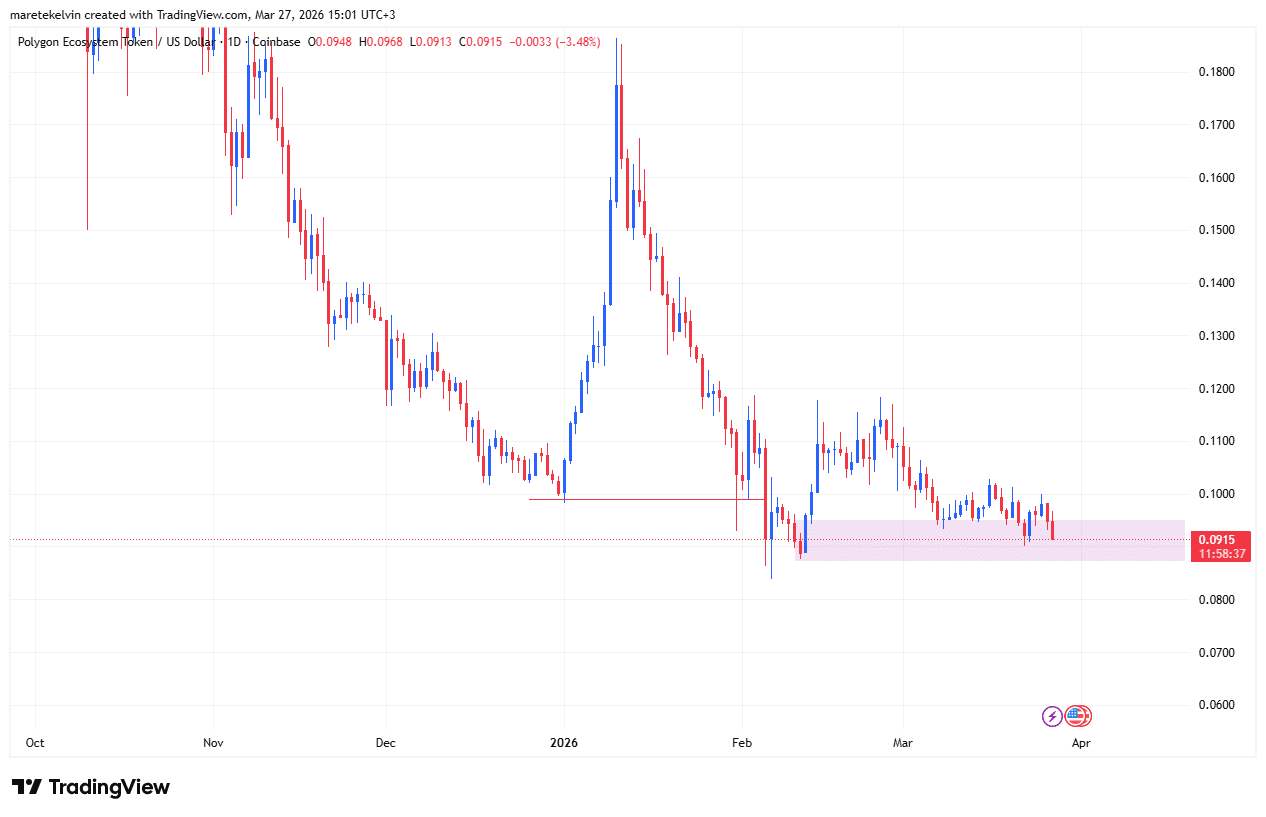
On the daily chart, POL seemed to be gaining some traction at press time. This, despite the fact that the token’s prices have been consolidating over the last few weeks.

If the network keeps recording these significant gains, the altcoin’s prices could usher in a potential breakout as long as the demand zone at around $0.095 holds.
Source: TradingView

Final Summary

  • Blockchain rails like Polygon are proving significantly cheaper and faster than traditional cross-border systems at institutional scale.
  • Revolut’s $1.2B volume signals a structural shift towards stablecoin-powered global payments, rather than a temporary trend.


Related Questions

QWhat major milestone did Revolut achieve on the Polygon network?

ARevolut processed over $1.2 billion in stablecoin transfers on the Polygon network, reflecting real user activity.

QHow do transaction costs on Polygon compare to traditional systems like SWIFT?

APolygon transactions cost fractions of a cent, significantly cheaper than traditional systems. For example, Revolut processed $1.2 billion for less than $700 in total fees, while traditional cross-border transfers average around 6.49% in fees.

QWhat are the advantages of using Polygon for cross-border transfers compared to traditional banking networks?

APolygon-based transfers settle in seconds, eliminate intermediaries, offer 1:1 stablecoin conversions with no hidden FX spreads, and are much cheaper than traditional systems like SWIFT, which can take 1-5 business days and involve multiple intermediaries.

QWhat does Revolut's $1.2 billion volume on Polygon indicate about institutional adoption of blockchain?

AIt signals a structural shift towards stablecoin-powered global payments, showing that institutions are no longer just experimenting with blockchain but are deploying it at scale for faster and cheaper transactions.

QHow has Polygon's network token (POL) been performing according to the article?

AAt the time of writing, POL was gaining some traction despite consolidating over the previous weeks. If network adoption continues, the token's price could potentially break out as long as the demand zone around $0.095 holds.

Related Reads

Not Speculation but a Necessity: The 4 Unique Values of Prediction Markets

Polymarket's recent $4 billion funding round and soaring valuation of $15 billion highlight the explosive growth of prediction markets, with trading volume reaching $25.7 billion in March 2026—a 10.6% monthly increase. This analysis argues that prediction markets serve critical non-speculative functions, positioning them as essential tools rather than mere gambling platforms. Prediction markets offer four unique values: entertainment consumption, insurance-like protection, risk hedging, and truth discovery. Firstly, they stimulate economic activity by engaging users in event-based betting, similar to the broader sports industry. Secondly, they act as a form of decentralized insurance, allowing users to hedge against specific, well-defined risks (e.g., weather events) transparently and without traditional overhead costs. Thirdly, institutions and individuals use these markets to hedge against geopolitical and commodity price risks, as demonstrated during the U.S.-Iran conflict and the launch of 24/7 commodity markets on platforms like Kalshi. Finally, prediction markets counter media bias by aggregating crowd-sourced information, often achieving 30% higher accuracy than surveys due to users' vested interests. Experts like Bitwise’s Jeff Park and SIG’s Jeff Yass emphasize the markets' role in risk transfer and financial innovation. As these platforms evolve, they are poised to become trillion-dollar markets, offering more reliable, decentralized mechanisms for information pricing and risk management.

marsbit2h ago

Not Speculation but a Necessity: The 4 Unique Values of Prediction Markets

marsbit2h ago

Trading

Spot
Futures
活动图片




