
After Hitting $94,000, Holding Firm at $90,000, BTC Continues to Face Risk Appetite Test (01.05~01.11)

marsbitPublished on 2026-01-14Last updated on 2026-01-14

Abstract

BTC opened the week at $91,499.04 and closed at $90,872.01, a slight decline of 0.68% with amplified volatility of 6.15%. After briefly testing the $94,000 resistance level—driven by improved Fed liquidity and soft-landing expectations from U.S. employment data—selling pressure from ETF investors and long-term holders pushed the price back toward the $90,000 support zone. Macro conditions show a resilient U.S. economy with low unemployment and steady wage growth, reducing the likelihood of a January rate cut. This has kept risk appetite subdued, particularly for high-duration assets like Bitcoin. Despite this, technical indicators suggest a gradually strengthening structure, with the 60-day moving average providing support. A break above $94,000 could open a path toward $95,000. On-chain data reveals continued distribution by long-term holders, though the pace has slowed. Capital flow trends show net outflows from BTC ETFs and stablecoins, while large holders (“whales”) continue accumulating at lower levels without aggressively supporting upward moves. The market remains in a fragile balance between distribution and accumulation, with overall sentiment cautious. According to EMC Labs’ cycle metrics, BTC is currently in a “downtrend” phase (bear market).

The markets, projects, currencies and other information, views and judgments mentioned in this report are for reference only and do not constitute any investment advice.

This week, BTC opened at $91,499.04 and closed at $90,872.01, a decrease of 0.68%, with an amplitude of 6.15%. Trading volume increased significantly compared to last week.

As mentioned in previous reports, BTC surged again towards $94,000 this week, driven by the continued improvement in Federal Reserve liquidity and the "soft landing" expectations fueled by US employment data meeting expectations.

However, with no hope of a rate cut in January, the risk appetite of on-market funds continues to deteriorate. After rising to the resistance level of $94,000, increased selling from BTC ETFs and long-term holders caused the rebound to fail, forcing a retreat back to the $90,000 line.

Currently, BTC and the crypto market remain in a dilemma where buying power supports but does not lift, while selling pressure intensifies on rallies. A renewal of buying sentiment, or an overall improvement in risk appetite, may be necessary for BTC to break through the $94,000 suppression and further expand the rebound space.

Technically, BTC is already in a favorable trend with rising retreat lows, and there are signs of stabilizing above the 60-day moving average. Barring negative external shocks, the price may break through $94,000 in the short term, challenging the 90-day moving average pointing to $95,000.

Policy, Macro Finance, and Economic Data

Considering the government shutdown, the monthly economic data released by the US this week was the first batch since data normalization, making it very important, but the final results did not exceed market expectations.

On January 8th, initial jobless claims data showed 208,000 applicants for the week, slightly below expectations and previous values. This is mildly positive for risk assets but aligns with "soft landing" expectations, indicating stronger economic resilience.

On January 9th, US seasonally adjusted non-farm payrolls for December were announced at 50,000, below the expected 60,000 and the previous value of 56,000, but the unemployment rate was only 4.4%, slightly below the expected 4.5%. Wage growth was 3.8%, higher than the 3.6% expected. These seemingly "conflicting" employment data suggest the crisis level in the job market is lower than expected, which caused the probability of a January rate cut shown by FedWatch to drop to single digits.

This week's data strengthened the consensus—the economy is achieving a soft landing, employment is cooling but not as bad. As the main battlefield for global capital, US stocks remained strong, with the S&P 500 and Dow Jones indices hitting new historical highs. The Nasdaq, questioned for excessive AI investment, also rose 1.88%, approaching its previous historical high. There are signs of capital shifting from tech stocks to consumer stocks, value stocks, and small to mid-cap stocks.

The 10-year US Treasury yield closed at 4.173%, with a real yield as high as 1.91%, which still puts enormous pressure on high-duration assets like tech stocks and BTC.

Crypto Market

Macro liquidity is improving but has not yet reached ample levels, and high-risk assets remain suppressed. If AI tech stocks are still under pressure, BTC is even more so.

At the fund level, it can be seen that cyclical and short-term funds are still exiting on rallies, while long-term allocation funds are buying at low levels, currently entering a fragile balance.

This week, as the price rebounded to previous highs, a wave of selling reappeared before the release of major economic and employment data.
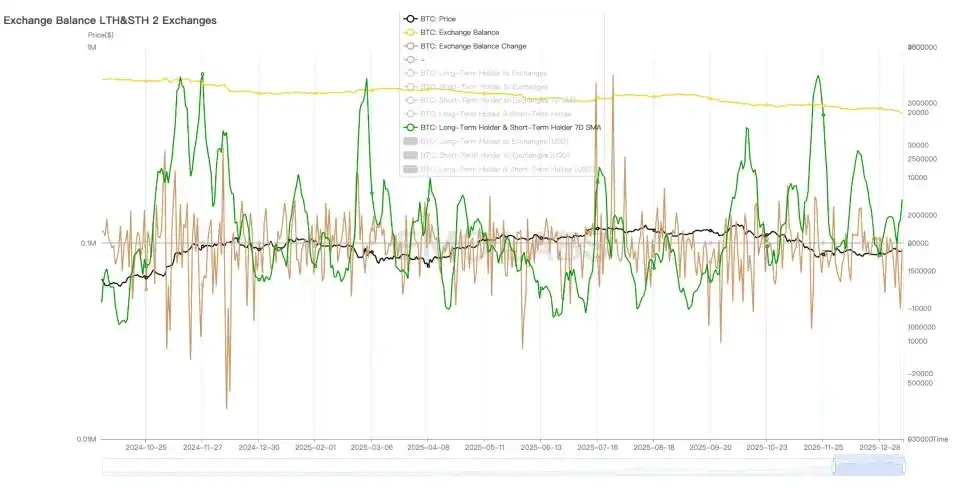
Centralized Exchange Long/Short Holder Selling Statistics (Daily)

This risk appetite-induced selling is not persistently destructive and is currently decreasing in scale. The continuous selling by long-term holders remains the biggest mid-term threat to the crypto market.
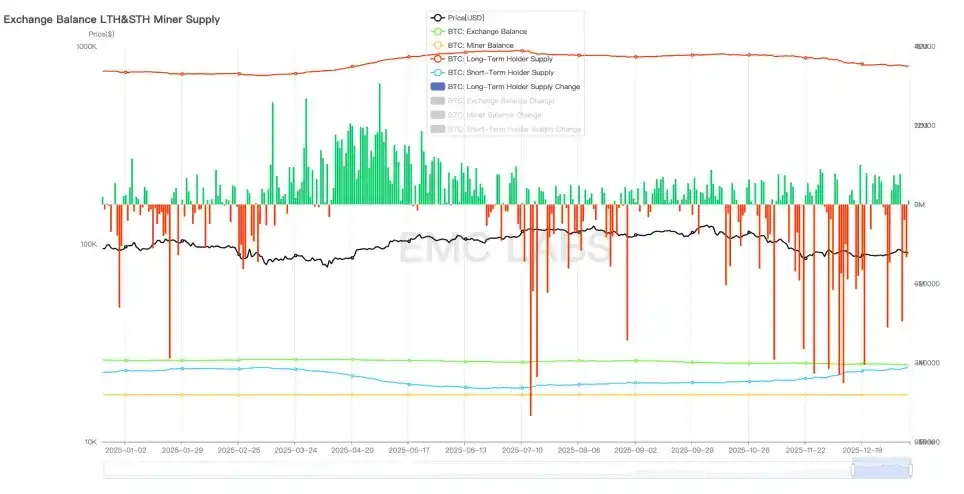
Long-term Holder Position Change Statistics (Daily)

The extent of continuous reduction by long-term holders weakened last week but is still ongoing, which also caused BTC to turn down after rebounding to $94,000.

The fund level also confirms this. The largest inflow occurred on January 5th, followed by continuous outflows, resulting in a net outflow for the week, with BTC ETF outflows at $647 million and stablecoin outflows at $539 million.
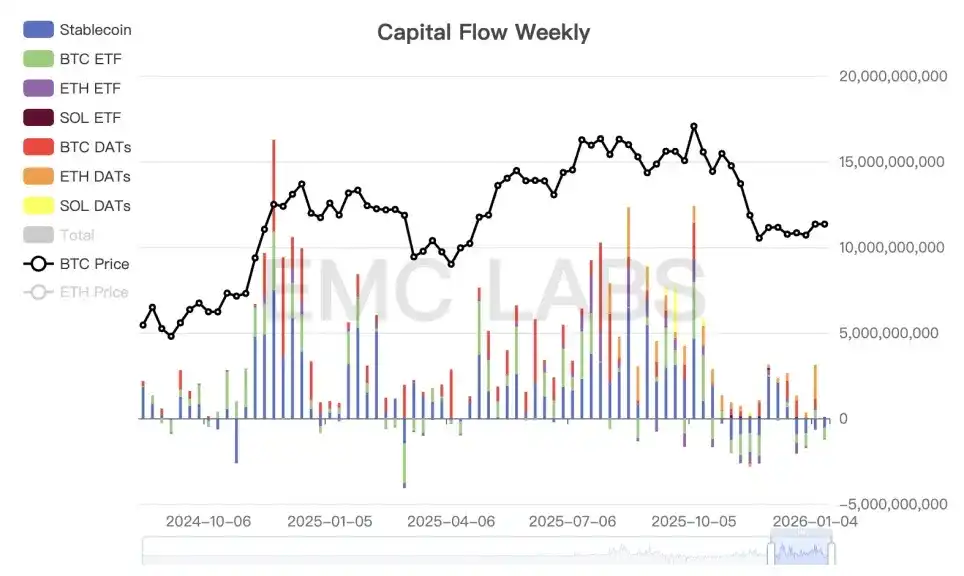
Crypto Market Fund Inflow/Outflow Statistics (Weekly)

Last week, centralized exchanges saw a net outflow of nearly 25,000 coins. The force supporting the market still comes from the "whale and shark group," whose holdings have been continuously increasing over the past week. However, this group currently adopts a "support but not lift" strategy, only accumulating at low levels and never creating upward buying pressure.

Cycle Metrics

According to eMerge Engine, the EMC BTC Cycle Metrics indicator is 0, entering the "downturn period" (bear market).

About Us

EMC Labs (Emergent Labs) was established in April 2023 by crypto asset investors and data scientists. Focused on blockchain industry research and Crypto secondary market investment, with core competencies in industry foresight, insight, and data mining, it is committed to participating in the booming blockchain industry through research and investment, promoting the well-being that blockchain and crypto assets bring to humanity.

For more information, please visit: https://www.emc.fund

Related Questions

QWhat was the opening and closing price of BTC for the week mentioned in the report, and what was the percentage change?

ABTC opened at $91,499.04 and closed at $90,872.01 for the week, resulting in a weekly loss of 0.68%.

QAccording to the report, what were the two main factors that provided the momentum for BTC to surge towards $94,000?

AThe momentum came from the continued improvement in Federal Reserve liquidity and the 'soft landing' expectations brought about by US employment data meeting expectations.

QWhy did the price of BTC fail to break through the $94,000 resistance level and fall back to around $90,000?

AThe price fell back because the hope for a January interest rate cut vanished, risk appetite among on-market funds continued to deteriorate, and BTC ETFs and long-term holders increased their selling pressure after the price reached the $94,000 resistance.

QWhat does the report identify as the biggest mid-term threat to the crypto market?

AThe report identifies the continued selling by long-term holders as the biggest mid-term threat to the crypto market.

QWhat was the net flow of funds for BTC ETFs and stablecoins for the week, according to the data presented?

AFor the week, BTC ETFs had a net outflow of $647 million, and stablecoins had a net outflow of $539 million.

Related Reads

Trading

Spot
Futures

Hot Articles

What is $BITCOIN

DIGITAL GOLD ($BITCOIN): A Comprehensive Analysis Introduction to DIGITAL GOLD ($BITCOIN) DIGITAL GOLD ($BITCOIN) is a blockchain-based project operating on the Solana network, which aims to combine the characteristics of traditional precious metals with the innovation of decentralized technologies. While it shares a name with Bitcoin, often referred to as “digital gold” due to its perception as a store of value, DIGITAL GOLD is a separate token designed to create a unique ecosystem within the Web3 landscape. Its goal is to position itself as a viable alternative digital asset, although specifics regarding its applications and functionalities are still developing. What is DIGITAL GOLD ($BITCOIN)? DIGITAL GOLD ($BITCOIN) is a cryptocurrency token explicitly designed for use on the Solana blockchain. In contrast to Bitcoin, which provides a widely recognized value storage role, this token appears to focus on broader applications and characteristics. Notable aspects include: Blockchain Infrastructure: The token is built on the Solana blockchain, known for its capacity to handle high-speed and low-cost transactions. Supply Dynamics: DIGITAL GOLD has a maximum supply capped at 100 quadrillion tokens (100P $BITCOIN), although details regarding its circulating supply are currently undisclosed. Utility: While precise functionalities are not explicitly outlined, there are indications that the token could be utilized for various applications, potentially involving decentralized applications (dApps) or asset tokenization strategies. Who is the Creator of DIGITAL GOLD ($BITCOIN)? At present, the identity of the creators and development team behind DIGITAL GOLD ($BITCOIN) remains unknown. This situation is typical among many innovative projects within the blockchain space, particularly those aligning with decentralized finance and meme coin phenomena. While such anonymity may foster a community-driven culture, it intensifies concerns about governance and accountability. Who are the Investors of DIGITAL GOLD ($BITCOIN)? The available information indicates that DIGITAL GOLD ($BITCOIN) does not have any known institutional backers or prominent venture capital investments. The project seems to operate on a peer-to-peer model focused on community support and adoption rather than traditional funding routes. Its activity and liquidity are primarily situated on decentralized exchanges (DEXs), such as PumpSwap, rather than established centralized trading platforms, further highlighting its grassroots approach. How DIGITAL GOLD ($BITCOIN) Works The operational mechanics of DIGITAL GOLD ($BITCOIN) can be elaborated on based on its blockchain design and network attributes: Consensus Mechanism: By leveraging Solana’s unique proof-of-history (PoH) combined with a proof-of-stake (PoS) model, the project ensures efficient transaction validation contributing to the network's high performance. Tokenomics: While specific deflationary mechanisms have not been extensively detailed, the vast maximum token supply implies that it may cater to microtransactions or niche use cases that are still to be defined. Interoperability: There exists the potential for integration with Solana’s broader ecosystem, including various decentralized finance (DeFi) platforms. However, the details regarding specific integrations remain unspecified. Timeline of Key Events Here is a timeline that highlights significant milestones concerning DIGITAL GOLD ($BITCOIN): 2023: The initial deployment of the token occurs on the Solana blockchain, marked by its contract address. 2024: DIGITAL GOLD gains visibility as it becomes available for trading on decentralized exchanges like PumpSwap, allowing users to trade it against SOL. 2025: The project witnesses sporadic trading activity and potential interest in community-led engagements, although no noteworthy partnerships or technical advancements have been documented as of yet. Critical Analysis Strengths Scalability: The underlying Solana infrastructure supports high transaction volumes, which could enhance the utility of $BITCOIN in various transaction scenarios. Accessibility: The potential low trading price per token could attract retail investors, facilitating wider participation due to fractional ownership opportunities. Risks Lack of Transparency: The absence of publicly known backers, developers, or an audit process may yield skepticism regarding the project's sustainability and trustworthiness. Market Volatility: The trading activity is heavily reliant on speculative behavior, which can result in significant price volatility and uncertainty for investors. Conclusion DIGITAL GOLD ($BITCOIN) emerges as an intriguing yet ambiguous project within the rapidly evolving Solana ecosystem. While it attempts to leverage the “digital gold” narrative, its departure from Bitcoin's established role as a store of value underscores the need for a clearer differentiation of its intended utility and governance structure. Future acceptance and adoption will likely depend on addressing the current opacity and defining its operational and economic strategies more explicitly. Note: This report encompasses synthesised information available as of October 2023, and developments may have transpired beyond the research period.

363 Total ViewsPublished 2025.05.13Updated 2025.05.13

What is $BITCOIN

Discussions

Welcome to the HTX Community. Here, you can stay informed about the latest platform developments and gain access to professional market insights. Users' opinions on the price of BTC (BTC) are presented below.

活动图片