Author: Dilip Kumar Patairya
Compiled by: Chopper, Foresight News
In the past, cybersecurity education often taught simple methods to identify scams: watch for spelling errors, awkward phrasing, and abnormal formatting. In early phishing attacks, this approach was indeed effective. Scam emails were often hastily written, poorly translated, and full of obvious flaws. Over time, people began to view clumsy writing as a red flag.
The emergence of artificial intelligence has completely changed this landscape.
Using advanced AI tools, fraudsters can quickly produce fluent emails, realistic customer service chats, professional-looking websites, and highly deceptive social media content. Scammers no longer need strong writing skills to create convincing traps. In the crypto space, where a single click to authorize a transaction can lead to instant asset loss, this shift presents entirely new security risks.
Today, the threat no longer comes from information riddled with errors. Instead, well-written, seemingly legitimate scam content is more likely to lower people's guard.
As AI technology continues to evolve, the mindset of crypto users regarding security must also change. Rather than obsessing over whether information itself seems suspicious, it's better to verify each operational request through independent channels.
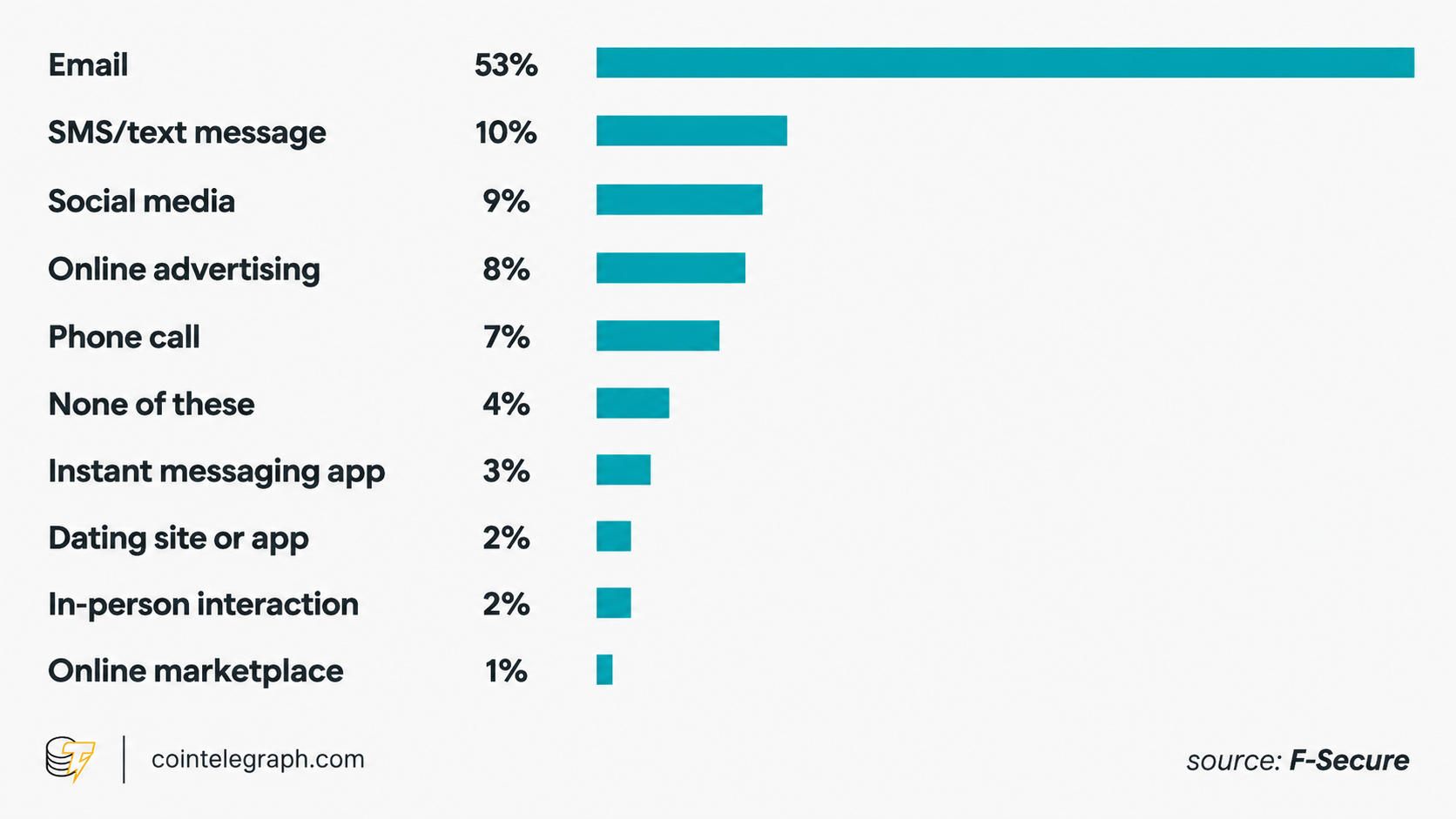
Common Scam Channels
Why Text Authentication Used to Work
Early phishing scams focused on casting a wide net, prioritizing quantity over content quality. Scammers sent out mass messages, hoping just a few people would bite.
Since most scam operations were based overseas or used simple translation tools, the sent information often contained grammatical errors, awkward expressions, and messy formatting. Users gradually learned to treat these details as warning signs.
Various cybersecurity awareness campaigns also popularized a series of basic identification techniques:
- Check if the text contains spelling mistakes.
- Avoid messages with poor grammar.
- Be wary of strange or unusual phrasing.
- Watch for abnormal formatting.
These small tricks could quickly filter out crudely made scam content.
However, this was never a foolproof defense method, serving only as a reminder. But over time, many people began to assume that professional, fluent writing equated to trustworthy content. The widespread adoption of AI has completely shattered this ingrained perception.
AI tools can generate well-formatted and eloquently phrased phishing content in bulk. Relying on spotting textual errors to prevent scams is becoming increasingly unreliable.
How AI Upgrades Scam Tactics
Large language models can generate natural, fluent text in multiple languages, allowing fraudsters to fabricate various types of false content:
- Falsify customer service chat logs
- Produce sophisticated phishing emails
- Impersonate legitimate exchange notifications
- Write highly enticing investment pitches
- Post realistic Telegram group announcements
- Create customized fake wallet recovery guides
Simultaneously, AI also assists in implementing precise targeted attacks. Scammers use data breach information and user data from platforms like LinkedIn, X, Discord, and Telegram to tailor scam narratives.
Information received by users might mention these details:
- Tokens you recently purchased
- Your exchange account information
- The wallet service provider you are using
- Decentralized Finance (DeFi) platforms you've interacted with
- Customer service questions you've asked in public channels
Highly customized content significantly increases the credibility of scams.
Furthermore, AI image generation and voice cloning technologies make identity impersonation much easier. Forging executive videos, simulating customer service voices, and replicating brand visual elements can now be achieved effortlessly.
Unique Risks Faced by Crypto Users
The security logic of crypto assets is fundamentally different from traditional banking. In traditional finance, if you encounter a mistaken transfer or scam, you can usually contact your bank, payment institution, or risk control team to recover the funds. However, once a crypto transaction is confirmed on the blockchain, it is essentially irreversible.
Self-custody wallets also expand the attack surface. Scammers may not need to steal passwords or private keys; often, simply tricking users into authorizing malicious transactions or granting high-risk wallet permissions is enough to succeed.
This means that even if users never leak their seed phrase, well-crafted scam interfaces still pose a significant risk.
Common scam forms in the crypto space include:
- Fake airdrop claim websites
- Counterfeit NFT minting events
- Impersonated exchange login pages
- Inducement to connect to malicious wallets
- Pop-ups prompting authorization of malicious tokens
- Fake staking or mining interfaces
- Impersonation of official customer support
- High-imitation accounts registered on platforms like Telegram and Discord
With the help of AI, such scams can be produced in bulk while maintaining high fidelity in content and interface design.
Core Verification Methods Users Should Master
Facing increasingly realistic scams, crypto users can no longer rely on superficial judgment; verification must become the primary rule.
1) Scrutinize the Domain Name Carefully
A website's appearance can be copied, but the URL is difficult to replicate perfectly. Fraudulent domains commonly use these tricks: adding extra characters, inserting random hyphens, using look-alike symbols, tampering with subdomains, choosing obscure top-level domains.
Even if the page looks identical to a legitimate platform, do not trust it based solely on logos and visual effects. Recommended practices include:
- Manually type the URLs of commonly used platforms.
- For wallets and exchanges, prioritize using saved bookmarks.
- Always verify the domain name before connecting a wallet.
- Avoid clicking links in unfamiliar messages or promotional content.
A beautiful page does not equate to a legitimate website.
2) Prioritize Links from Official Channels
Fake announcements, impersonated influencer accounts, and scam accounts are common vectors for spreading scams. Fraudulent links primarily spread through: Telegram groups, Discord channels, X (formerly Twitter) comment sections, paid search ads, fake customer service messages.
Always confirm that links originate from the project's official website or officially announced channels. Cross-referencing information across multiple official accounts can further reduce risk.
Be highly vigilant when receiving unsolicited private messages claiming your account has an urgent issue.
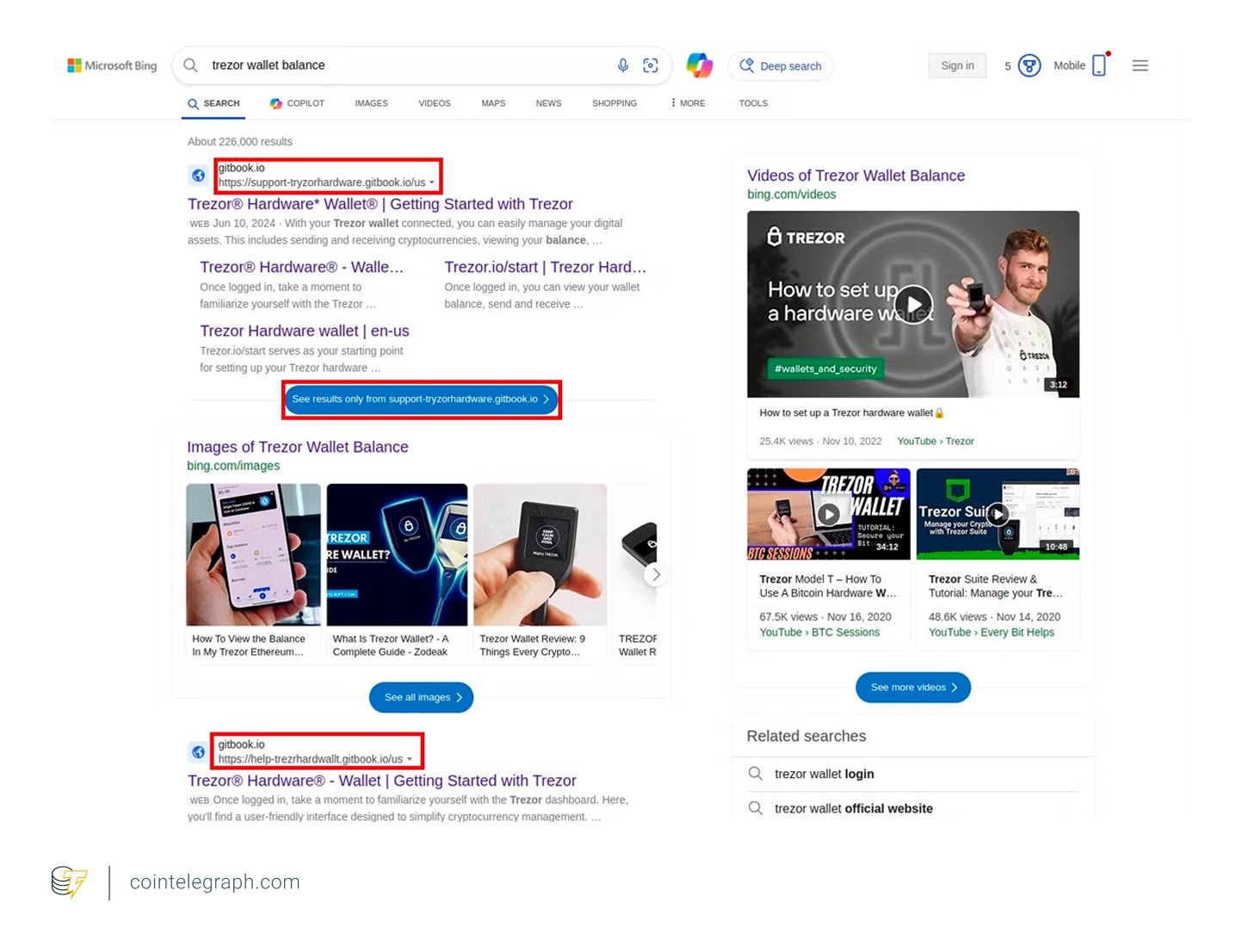
Malicious Trezor Balance Check Link Found in Bing Search
3) Understand Wallet Permissions Before Authorizing
Many users have the misconception that any request popping up from their wallet must be safe. Especially when faced with professional-looking websites, people often casually click confirm, overlooking permission details.
Wallet interactions involve various operation types: connecting a wallet, signing messages, authorizing token transfers, granting general permissions, triggering smart contract interactions, etc.
Among these, unlimited approvals carry the highest risk, allowing malicious contracts to transfer your assets arbitrarily in the future. Before approving, always verify that the token types, allowed transfer amounts, the requesting contract address, and the operation details match your expectations.
Even if a website looks flawless, it might trigger high-risk wallet operations.
4) Verify All Details Before Signing a Transaction
AI scams often exploit a sense of urgency to rush users into quick confirmation. Before signing any transaction, meticulously check the recipient address, token amount, selected blockchain, contract interaction information, fee structure, and approval scope.
If a page is labeled "Claim Reward" but requests unlimited token permissions, or labeled "Wallet Verification" but initiates an asset transfer, stop immediately and investigate the risk.
Once transaction details deviate from expectations, do not proceed.
Many wallet scams begin when users publicly complain about account issues on social media. Scammers monitor such posts and then impersonate customer support via private messages.
5) Verify Contract Addresses, Don't Blindly Trust Token Names
Scammers can copy token names and icons to create high-imitation fake tokens. A token that appears to be named "USDT" or "ETH Earnings" might be issued by a completely unrelated entity.
Verification method: Confirm the token's corresponding contract address through the project's official website, legitimate blockchain explorers, officially published materials, or mainstream exchange information. As AI scams become more convincing, relying solely on token names and icons to judge authenticity is increasingly risky.
6) Be Wary of Unsolicited Customer Service Private Messages
Impersonating official customer support remains a prevalent scam method in the crypto space. Scammers monitor users' help-seeking comments on social platforms, then send private messages posing as staff. They may induce users to perform wallet "verification," ask for seed phrases, send malicious links, recommend remote control tools, or guide users to complete dangerous authorizations.
Legitimate official customer support almost never initiates private contact first. Platforms will also never ask for private keys or seed phrases. If you encounter a problem, proactively contact support through official channels. Do not respond to unsolicited private messages.
7) Urgent Pressure is Often a Sign of a Scam
Even the most professionally crafted scams often use psychological pressure to create urgency. Common narratives include: "Your wallet has been hacked," "Tokens are about to expire, claim now," "Account will be suspended soon," "KYC failed," "Security update required immediately."
Such tactics can cloud judgment. The more someone pressures you to act immediately, the more you should slow down and verify carefully.
A simple rule for crypto security: Whenever you're asked to act on your wallet immediately, pause and calmly verify first.
Polished Appearance No Longer Equals Security
Today's scam websites can accurately replicate brand logos, color schemes, page layouts, and writing styles. AI can also help create high-fidelity FAQ pages, fake customer service replies, impersonated news articles, and complete new user onboarding flows and promotional copy.
Judging a platform's trustworthiness based on visual appeal alone is no longer possible. Attackers only need to catch a user off guard for a moment to execute irreversible asset theft.
The core of security protection remains verification: check the domain name, inspect the contract, review wallet requests, confirm support identities, clarify transaction purposes. A beautifully designed interface does not equate to trustworthiness.
Crypto Security Has Evolved into a Battle of Verification
AI hasn't created entirely new scam models; it has simply significantly upgraded the presentation and disguise of traditional scam techniques. In the past, people relied on surface characteristics to identify risks but neglected the act of verification itself. This mindset can lead to massive losses in the crypto industry.
Behind a perfectly phrased paragraph, a malicious link might lurk. Within a seemingly professional customer service reply, instructions to authorize asset transfers could be hidden. A convincingly realistic website might also request high-risk permissions.
The core takeaway is simple: fluent copy, exquisite interfaces, and familiar brand imagery cannot serve as security credentials. Faced with every link, every wallet pop-up, every customer service message: verify first, then act.