CLARITY Act, 401(k) Plans, and Long-Term Holders – 5 Factors Driving Bitcoin's Rise

cryptonews.ruPublished on 2026-08-18Last updated on 2026-08-18

Abstract

Bitcoin faces near-term headwinds but potential catalysts for future growth are emerging. After peaking in October 2025, BTC is trading at roughly half its high. Key pressures include a reversal in spot Bitcoin ETF flows, which saw net outflows in H1 2026; stalled corporate treasury buying strategies like MicroStrategy's; and a Federal Reserve maintaining high interest rates, dampening risk appetite. Bitcoin miners are under severe economic strain, leading to record coin sales and facility repurposing, while security breaches at wallet providers like Coldcard have eroded user confidence. However, several factors could support a future rally. Long-term holder supply reached a multi-year high in May 2026, indicating coins are being locked away. Significant regulatory developments are on the horizon: the U.S. Department of Labor is considering rules that could open the massive 401(k) retirement market to crypto, and the CLARITY Act is progressing in the Senate, aiming to provide clearer federal oversight. Finally, the mining sector is undergoing a natural correction, with network hash rate and difficulty declining as inefficient operators exit. The key question remains whether fresh institutional demand will emerge to meet this tightening supply.

On Tuesday, August 18, at 12:10 PM Eastern Time (EDT), Bitcoin was trading around $64,738, roughly half of its peak value recorded in October 2025. The dividing line in the market is becoming increasingly difficult to ignore: bearish forces are already putting pressure on balances and order books, while the most compelling arguments for growth still require decisions, implementation, and an influx of fresh capital that has not yet arrived.

ETF Trend Reversed

Unlike the record inflows of 2025, US spot market Bitcoin exchange-traded funds (ETFs) recorded a net outflow of approximately $5.4 billion in the first half of 2026. ETFs allow investors to access Bitcoin through regular brokerage accounts, making their daily flows one of the most accurate indicators of whether institutional funds are truly entering or leaving the market.

According to sosovalue.com, the funds still hold a significant base of investment capital, with a cumulative net inflow of about $51.79 billion. The issue is that the steady demand that once absorbed Bitcoin's supply has become unpredictable. In the past week, from August 10 to 14, the net outflow was approximately $389.7 million. Nevertheless, US spot Bitcoin ETFs currently hold over 1.1 million $BTC worth $76.61 billion.

Treasury Company's 'Flywheel' Mechanism Has Stalled

The strategy transformed the corporate Bitcoin treasury model into a capital markets mechanism, selling stocks and debt, buying Bitcoin, and using its inflated valuation to raise even more funds. This mechanism becomes significantly harder to operate when the company's stock no longer trades at a significant premium to the Bitcoin held on its balance sheet.

This year, the company sold $BTC three times and used the proceeds to repurchase preferred shares. The company still owns 840,447 $BTC, so liquidation is still far off. What has changed is more important: Bitcoin has demonstrated it can become a funding source when the company needs to defend its capital structure.

The Fed, Which Could Hike Rates, Not Cut Them

In July, the Federal Reserve kept the benchmark rate at 3.50–3.75%, although three officials favored a quarter-percentage-point hike. Since then, markets have scaled back expectations for a September rate hike, but traders are barely pricing in the aggressive easing cycle that risk assets would prefer.
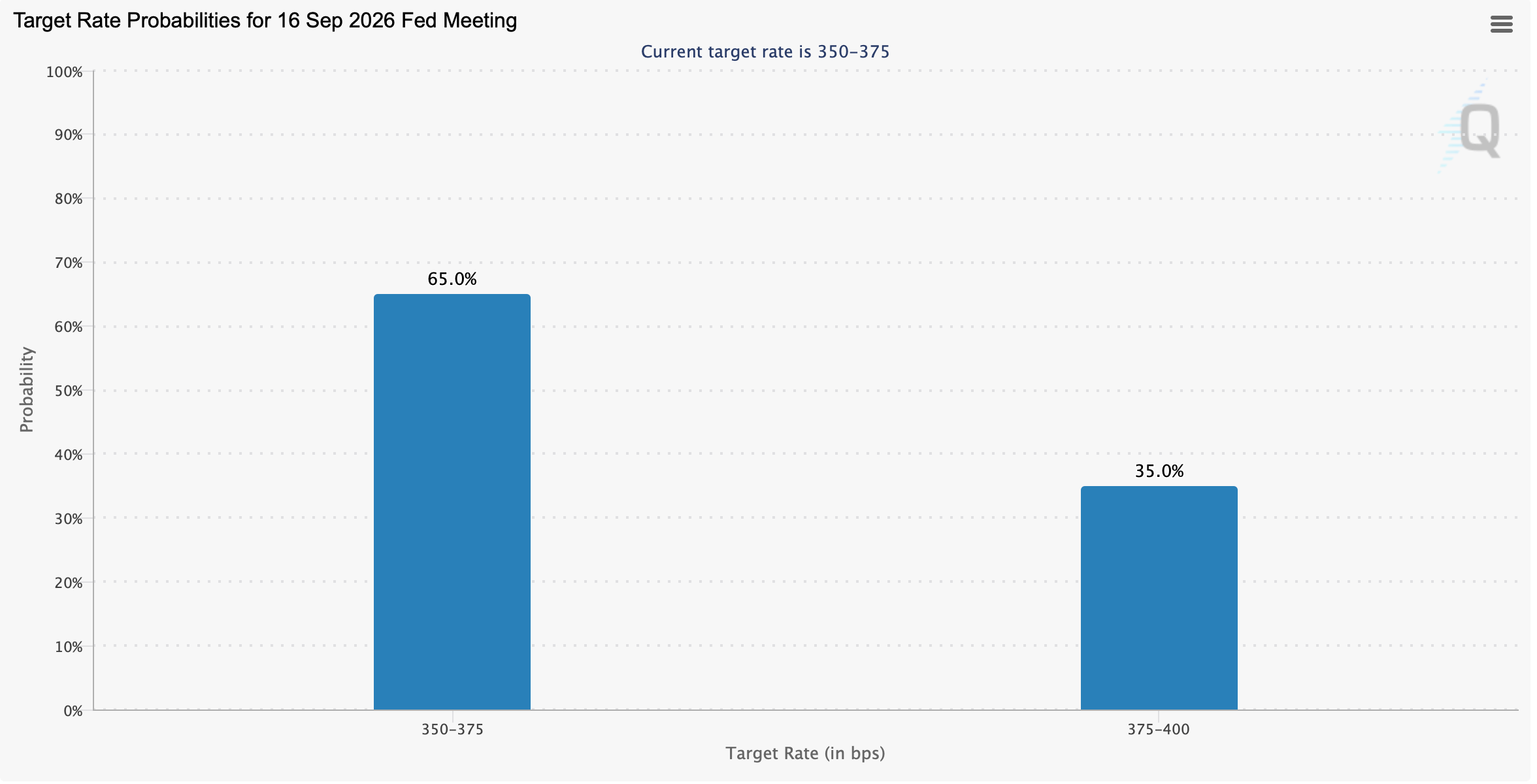
According to the CME Fedwatch tool, there is a 35% probability the US Federal Reserve will raise the federal funds rate. Image source: CME Fedwatch, August 18, 2026.

This distinction matters because high rates give investors attractive yields without needing to turn to volatile assets. The Fed doesn't need another rate hike to make life harder for Bitcoin. Simply holding rates high can have a significant effect on its own. Inflation and employment data to be released before the September 15–16 meeting could sharply alter these expectations.

Mining Economics Hit a Wall

Bitcoin miners are experiencing one of the toughest economic periods in recent years. The Hashprice metric, which measures the mining revenue generated per unit of computational power, averaged $31.21 per petahash per second per day in July, putting operators dangerously close to historical lows.

Owners of outdated hardware and miners forced to use expensive power supplies are faring the worst. Public miners sold over 32,000 $BTC in Q1 2026, setting a quarterly record as operators raised cash to continue operations. Others are repurposing valuable power-plant sites for AI and high-performance computing clients, where contracts can be more lucrative than chasing block rewards.

Custody Shock

The now-infamous Coldcard vulnerability taught a painful lesson to wallet owners affected by the incident, although the Bitcoin network itself was never compromised. Attackers stole nearly 2,000 $BTC, worth about $116 million at the time, after vulnerable devices generated recovery seeds that were weaker than assumed. For wallet owners, the Coldcard failure was an even harsher lesson: firmware and recovery seed security can turn theoretical vulnerabilities into irreversible losses.

Meanwhile, companies Trezor and Safepal faced data leaks that exposed customers' personal information, including home addresses and private data. These leaks compromised customer privacy.

Favorable Trends for Bitcoin

However, Bitcoin's story in 2026 isn't just about a crash. Washington may pass new regulations, access to pension funds could well open up, and long-term holders are holding steady. If fresh capital encounters this shrinking supply, $BTC could soon break above the upper range in Q4. Bitcoin market bears have left, and traders see new catalysts that could make sidelined funds return to the market right now.

Supply from Long-Term Holders Reached a Record Level

Long-term holders—investors whose coins have remained inactive for extended periods—appear to be rebuilding their positions. On-chain analytics firm Cryptoquant recorded a 1.29 million $BTC increase in its long-term holder metric in May—the highest reading in over six years.

There's an important nuance here: the record level does not mean investors bought 1.29 million $BTC in one month. Coins simply enter the long-term category by remaining untouched. Nonetheless, the growing number of coins not in circulation matters because, should demand resume, there will be fewer readily available coins to chase.

The Door to $9.9 Trillion in 401(k) Plans Cracks Open

The US Department of Labor is considering a mechanism that could make it easier for retirement plan fiduciaries to evaluate products that include alternative assets. No one is mandating 401(k) plans to buy Bitcoin, but easing regulatory barriers could open a channel that has remained largely closed to this asset so far.

The numbers explain why bulls are watching. US 401(k) plan assets stood at about $9.9 trillion in March 2026, meaning a hypothetical 1% allocation represents a risk of about $99 billion. This capital won't arrive tomorrow. Plan sponsors, asset managers, and employees would still need to choose suitable products, making this opportunity more of a multi-year development than an instant liquidity event.

The Digital Asset Market Clarity Act (CLARITY) Returns from the Abyss

The Digital Asset Market Clarity Act, known as CLARITY, is nearing a procedural vote in the Senate scheduled for September 15. The bill aims to address one of the crypto industry's longest-standing problems by defining how US regulators will oversee specific segments of the digital asset market, including trading venues, custodians, and intermediaries.

Passage is far from guaranteed, as disputes over consumer protection, market integrity, and conflicts of interest remain unresolved. However, financial institutions have for years used regulatory uncertainty as a reason to delay. Clearer federal rules could remove that excuse, and a planned Securities and Exchange Commission (SEC) regulatory framework for crypto assets offers an alternative regulatory path should Congress drag its feet.

Mining Contracts as One Tail Risk Fades

Mining issues eventually resolve themselves when inefficient hardware goes offline, and the Bitcoin network's automatic difficulty adjustment improves the economics for those who survive. The network's hash rate has remained about 12% below the December 2025 peak, while difficulty fell roughly 5.7% in July—indicating that some of this cleansing process is already happening.

Another potential protocol-related problem has also receded. BIP-110—a proposed activation scenario requiring 55% miner support—failed to gain significant traction and never even remotely threatened Bitcoin's dominant chain. Low volatility and restrained use of leverage could amplify any next significant move, but neither gives the market a clear directional signal.

Bitcoin's immediate problem is whether real demand will return before another wave of supply hits the market. Sustained ETF inflows, new purchases by strong treasury companies, and easing pressure from the Fed would support the bull case with real money. Continued ETF outflows, miner liquidations, and corporate Bitcoin sales, conversely, would send the opposite signal: the market still hasn't found its next major buyer.


Trending Cryptos

Related Questions

QWhat is the current trend of US spot Bitcoin ETFs based on the article, and how does it differ from 2025?

AUnlike the record inflows in 2025, US spot Bitcoin ETFs have seen a net outflow of approximately $5.4 billion in the first half of 2026, with a net outflow of about $389.7 million in the week of August 10-14. This indicates a shift from stable demand that absorbed Bitcoin supply to unpredictable institutional fund flows.

QHow has the strategy of corporate Bitcoin treasuries like MicroStrategy changed recently, and what does this indicate about Bitcoin's role?

AThe strategy of selling shares and debt to buy Bitcoin has become harder as stock premiums over Bitcoin holdings have diminished. MicroStrategy has sold Bitcoin three times this year to buy back preferred stock, indicating Bitcoin has demonstrated it can serve as a source of financing to protect a company's capital structure when needed.

QWhat is a major obstacle for Bitcoin's price according to the article, stemming from the Federal Reserve's monetary policy?

AA major obstacle is that the Federal Reserve is not expected to begin an aggressive easing cycle that risk assets like Bitcoin would prefer. High interest rates offer investors attractive yields without needing volatile assets. Even maintaining rates at current high levels can have a significant negative effect on Bitcoin's appeal.

QWhat is the significance of the increase in long-term holder supply mentioned in the article, and what important nuance does it have?

ALong-term holder supply increased by 1.29 million BTC in May, the highest jump in over six years. This is significant because it means fewer coins are readily available for sale, which could pressure prices upward if demand returns. The important nuance is that this doesn't mean 1.29 million BTC were bought in one month; coins simply age into the category by remaining untouched.

QWhat are the two key regulatory developments mentioned that could act as potential catalysts for Bitcoin growth?

ATwo key regulatory catalysts are: 1) The U.S. Department of Labor considering a mechanism to make it easier for retirement plan fiduciaries to evaluate products with alternative assets, potentially opening 401(k) plans. 2) The Digital Asset Market Clarity Act (CLARITY) approaching a procedural Senate vote, which aims to establish clearer federal rules for digital asset market segments, reducing uncertainty.

Related Reads

Lei Jun Reports Xiaomi's Q2 Performance, Phone Premiumization Takes Effect, While Automotive and AI Continue 'Burning Cash'

Xiaomi released its Q2 2026 financial results, showing mixed performance. Total revenue was approximately 108.9 billion yuan, down 6.1% year-over-year, while adjusted net profit fell 42.6% to about 6.2 billion yuan. The company's core smartphone business saw a 7.5% decline in revenue to 42.1 billion yuan, primarily due to lower shipment volumes, partially offset by a record high average selling price (ASP) which rose 25.9%. Xiaomi's global smartphone market share held steady at third place. Its AIoT platform connected over 1.16 billion devices, a 17.4% increase. Despite pressures on traditional revenue streams, Xiaomi continues heavy investment in new growth areas. Its innovation segment, encompassing smart electric vehicles and AI, generated 24.9 billion yuan in revenue (up 17.1%), but reported an operating loss of 2.6 billion yuan. Capital expenditure for these businesses reached 2.4 billion yuan in Q2. Vehicle deliveries grew 28.2% to 104,199 units, with cumulative deliveries for the SU7 series surpassing 500,000 units by mid-August. The company also highlighted significant R&D spending of 9.2 billion yuan for the quarter. On the technology front, Xiaomi announced several AI and software developments, including the new Xiaomi HyperOS 4, the "Super Xiaoai 2.0" assistant, and advancements in its MiMo large language model and robotics platform. The company noted its first-generation self-developed chip, the Xuangjie O1, has surpassed one million units shipped across three products, with a new generation chip soon to be released. Management acknowledged that memory price increases impacted low-end phone sales more severely but expects the trend to moderate.

marsbit26m ago

Lei Jun Reports Xiaomi's Q2 Performance, Phone Premiumization Takes Effect, While Automotive and AI Continue 'Burning Cash'

marsbit26m ago

From Minting to Tape-Out: A First-Timer’s Guide to TapeOut

Title: From Mint to Tapeout: A First-Timer’s Guide to TapeOut **Summary:** This guide provides a risk-conscious, step-by-step introduction to TapeOut, a platform where users can mint logic components (NAND, LATCH) and use them to "tape out" on-chain circuits. It emphasizes a fundamental shift in mindset: instead of focusing first on prices or speculation, users should first understand how to use the platform's core functionality. The recommended path begins with preparation: use a separate, low-fund wallet on BNB Smart Chain for experimentation. The first step is to choose a "Processor"—the foundational unit for components and circuits—by examining its details (supply, mintage, creator) rather than chasing trends. If a Processor has remaining supply, users can mint a small number of components. The guide stresses that minting acquires specific components for a specific processor, not a generic asset. For sold-out Processors, trading occurs on an order book market. Users must carefully understand order prices, quantities, and the 1% fee, and always verify transactions on a block explorer. The core "play" experience is in the Canvas, where users can build and test logic circuits without a wallet. Before proceeding to tapeout—the irreversible, on-chain act of finalizing a circuit which consumes components—users must verify their design, component costs, and target processor. After taping out a circuit, the guide encourages users to interact with it, for example by calling its functions via BscScan's read contract feature, completing the "components -> circuit -> verification" loop. It concludes with critical safety checks to perform before any wallet signature, and cautions against misinterpreting demo pages (like the "on-chain BTC miner") as profit-generating services. The goal is to approach TapeOut as a hands-on lesson in on-chain logic, minimizing financial risk while learning its unique mechanics.

marsbit1h ago

From Minting to Tape-Out: A First-Timer’s Guide to TapeOut

marsbit1h ago

Wall Street Analyst Predicts SpaceX Stock Price Drop to $75

A Wall Street analyst from Phillip Securities, Glenn Tumm, has issued a "Sell" recommendation for SpaceX stock (SPCX), maintaining a 12-month price target of $75. This implies a potential 46.6% drop from the current price of $140.50. The bearish outlook is based on the company's significant capital expenditures, reliance on temporary cloud service contracts, and customer concentration in its AI services, suggesting a need for longer-term commitments to support its valuation. This stance contrasts sharply with the broader Wall Street consensus. An average of 31 analysts polled by TipRanks sets a 12-month price target of $232.35, implying 64% upside, with the highest forecast at $800 and the lowest at $75. The report follows SpaceX's impressive Q2 2026 results, where total revenue surged 92% year-over-year to $7.8 billion. Starlink subscriber count doubled to 12 million, driving communications revenue up 66% to $4.3 billion. AI-related revenue skyrocketed 247% to $2.6 billion, fueled by new cloud services and infrastructure deals. Despite the strong earnings, SPCX shares fell over 4% in the last 24 hours, reducing the company's market cap to $1.9 trillion. The stock had initially jumped over 17% post-earnings but faced resistance near $149. The analyst concludes that SpaceX's future trajectory hinges on securing more long-term contracts with its AI and Starlink customers. Success could validate Wall Street's bullish forecasts, while failure may render the recent stock rebound temporary.

cryptonews.ru1h ago

Wall Street Analyst Predicts SpaceX Stock Price Drop to $75

cryptonews.ru1h ago

Trading

Spot

Hot Articles

Discussions

Welcome to the HTX Community. Here, you can stay informed about the latest platform developments and gain access to professional market insights. Users' opinions on the price of S (S) are presented below.

活动图片