Circle Issues 5 Billion USDC in a Week Amid Intensifying Competition with Tether to Boost Supply

cryptonews.ruPublished on 2026-08-26Last updated on 2026-08-26

Abstract

Circle issued approximately 5 billion USDC within a week, marking another in a series of major issuances this year. This includes a record 3.25 billion USDC on Solana in April and an additional 1.25 billion in late August, boosting Solana's share of total USDC supply above 10%, though Ethereum still holds about two-thirds. USDC's circulating supply is around $74 billion, less than half of Tether's $183.1 billion market cap. Together, they dominate roughly 83% of the $304 billion stablecoin market. Circle highlights its higher transaction volume as a counterpoint to Tether's larger supply, noting USDC facilitated $18.3 trillion in volume in 2025 compared to USDT's $13.3 trillion. The latest issuance coincides with Circle becoming the technical operator for USDC on the Hyperliquid derivatives exchange. Hyperliquid's recent upgrade directs yield from the platform's ~$5 billion in USDC reserves to buy back its HYPE token. Following Hyperliquid's shift from its own stablecoin to USDC in May, this partnership incentivizes Circle to maintain fresh USDC inflows to such platforms. Analysts will monitor whether this surge is a one-time event and if Circle will pursue more aggressive distribution partnerships, like the one with Hyperliquid, to continue closing the gap with Tether.

On-chain analytics platform Solscan reported today that approximately 5 billion $USDC were issued, with analysts noting that this emission is just one of many billion-dollar emissions that have occurred this year.
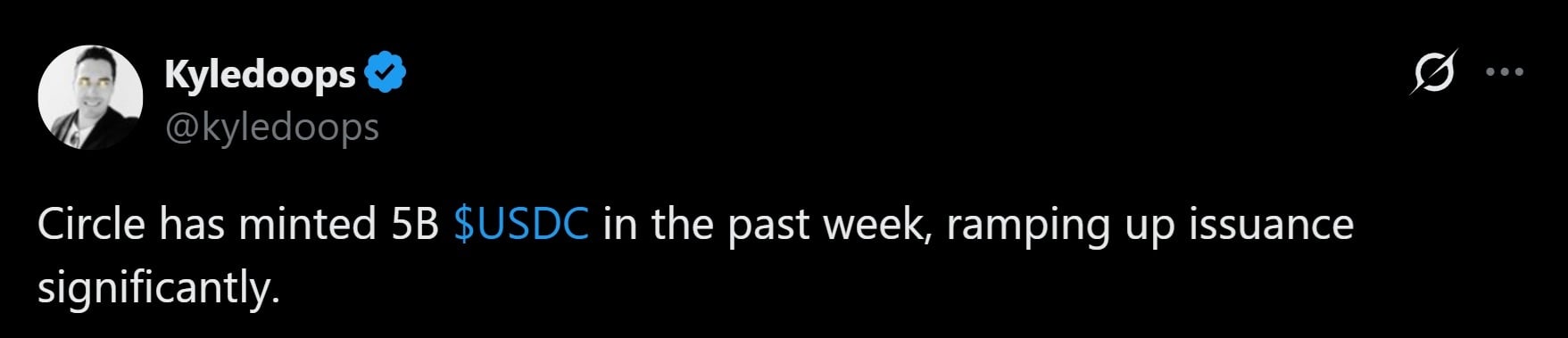
In more detail, earlier in April, Circle issued a record 3.25 billion $USDC on Solana in several tranches—at the time, this was the largest weekly issuance in 2026—and then, in the week beginning August 20, issued another 1.25 billion $USDC on Solana, including 250 million in a single day.

As a result, Solana's share of the total $USDC supply in 2026 exceeded 10%, although Ethereum still holds roughly two-thirds of the $USDC in circulation.

Slowly Catching Up to Tether

The circulating supply of $USDC stands at about $74 billion, which is still less than half of Tether's $183.1 billion market capitalization; together, these two stablecoins account for about 83% of the entire stablecoin market, valued at $304 billion.

The company relies on transaction volume as a counterargument to Tether's larger circulation, considering that in 2025, $18.3 trillion passed through $USDC compared to $13.3 trillion through USDT, and accounted for roughly 70% of adjusted stablecoin transaction volume in the first half of the year, despite its circulating supply being only a fraction of the total.

It's All About Timing

The latest data emerges just as Circle has assumed a new role as the technical operator for $USDC on Hyperliquid—a derivatives exchange that today activated the "AQAv2" upgrade to direct revenue from the reserves of approximately $5 billion $USDC on its platform towards buying back its own HYPE token.

Back in May, Coinbase became the official treasury custodian for $USDC on Hyperliquid, and Circle became the technical infrastructure partner, after Hyperliquid's own stablecoin—USDH—was phased out in favor of $USDC. This arrangement gives Circle a direct incentive to maintain the inflow of fresh $USDC onto platforms like Hyperliquid, as every dollar placed there as a reserve now generates revenue that Circle's partners can use as a growth argument, not just a number on a balance sheet.

In any case, Circle's upcoming financial reports should indicate whether this week's issuance was a one-time spike or not. Furthermore, analysts will monitor whether Tether's more extensive reserve base and the recent surge in new holders of that coin will compel Circle to compete more aggressively in securing distribution agreements like the one with Hyperliquid, not just in terms of supply, to continue narrowing the gap between these two stablecoins.

end-content

Trending Cryptos

Related Questions

QHow much USDC did Circle issue last week, according to the article?

ACircle issued approximately 5 billion USDC last week.

QWhich blockchain has seen a significant increase in USDC supply in 2026, and what is its approximate share?

ASolana has seen a significant increase, with its share exceeding 10% of the total USDC supply in 2026.

QWhat is the total market capitalization of Tether (USDT) and USDC, as mentioned in the article?

AThe market capitalization of Tether is $183.1 billion, while USDC's is about $74 billion.

QWhat role has Circle recently taken on the Hyperliquid exchange regarding USDC?

ACircle has taken on the role of technical operator for USDC on the Hyperliquid derivatives exchange.

QWhat key metric does Circle use to argue against Tether's larger circulation, despite having a smaller supply?

ACircle uses transaction volume as a counterargument, noting that $18.3 trillion passed through USDC in 2025 compared to $13.3 trillion through USDT, and it accounted for about 70% of adjusted stablecoin transaction volume in the first half of the year.

Related Reads

Bitcoin Is Ready for "Parabolic Growth". Is Altseason Upon Us?

Amid a general market uptrend, experts are discussing the potential start of an 'altcoin season', where major cryptocurrencies could outpace Bitcoin's growth. This follows Bitcoin surpassing $81,000, predictions of a new bull market, and a capital shift from AI stocks toward Bitcoin and gold. Since August 17th, the crypto market has risen over 22%, primarily driven by Bitcoin (BTC) and Ethereum (ETH), which gained 25% and 30% respectively, reaching highs last seen in May. Analysts suggest the Bitcoin bear cycle has ended, anticipating a historically strong rally, with renewed institutional demand for cryptocurrency ETFs. BitMEX founder Arthur Hayes, in a recent interview, declared the start of a new bull market, predicting Bitcoin could quickly reach "hundreds of thousands" of dollars. Market observers interpret this as an expectation for 'parabolic growth.' Signs of a bull market revival include Bitcoin ETFs re-entering the top 10 most-traded ETFs, displacing some AI-focused funds. Analysts at CryptoQuant note capital is flowing from Bitcoin into riskier altcoins, with their bull market indicators showing the most optimistic signals since October 2025. However, the reality is more nuanced. The current surge is a rebound from yearly lows; Bitcoin's price is still down nearly 40% from its October peak. The Altcoin Season Index has dropped to 39 from 67 in early August, and Bitcoin's dominance remains around 60%, indicating investor focus is still on Bitcoin rather than altcoins. Experts predict the market is entering a phase where project fundamentals and real revenue, rather than speculation, will increasingly determine asset value.

cryptonews.ru6m ago

Bitcoin Is Ready for "Parabolic Growth". Is Altseason Upon Us?

cryptonews.ru6m ago

$120 Million Vanishes Overnight! Crypto's 'Steadiest Giant' Stumbles in South America

Summary: Tether's $120 million Bitcoin mining venture in Uruguay, initiated in May 2023, was abruptly shut down in July 2025 when the national power utility UTE cut off electricity. The project, developed in partnership with local firm Microfin in Florida province, was touted as a model for leveraging the country's nearly 98% renewable energy grid. The collapse stemmed from a fundamental contract dispute over electricity supply. Tether interpreted the agreed power volume as a "minimum guaranteed supply," expecting to request more as the mining operation expanded. UTE, however, viewed it as a "strict maximum cap." This disagreement led to frequent power curtailments for the 24/7 mining facility, causing significant revenue loss from lost computing power. Following the 2025 election of left-wing President Yamandú Orsi and a management change at UTE, negotiations broke down. Microfin stopped paying electricity bills in May 2025, formally notified UTE of contract termination in June, and did not attend a final meeting where UTE presented a revised contract. By the July 25 power cut, Microfin's debt approached $5 million. The operation ceased, laying off 30 of its 38 local staff, with all outstanding debts settled by December 2025. The failure highlights key risks for heavy-asset overseas investments: Uruguay's green energy proved not to be cheap energy, especially after the 2024 Bitcoin halving squeezed industry profits. Furthermore, political changes can swiftly alter utility company policies, undermining the long-term regulatory stability critical for such projects. While financially absorbable for Tether, the incident underscores that operational success depends on unambiguous contracts and genuine cost advantages, not just technological scale.

marsbit31m ago

$120 Million Vanishes Overnight! Crypto's 'Steadiest Giant' Stumbles in South America

marsbit31m ago

Is Bitcoin Price Lagging? Record Global M2 Money Supply Could Be a Springboard for BTC's Rise

Bitcoin Price Lagging? Record Global Money Supply M2 Could Springboard BTC Growth The global money supply (M2) is expanding rapidly, similar to global debt. The US M2, representing all money circulating in its economy, has reached a record $23.16 trillion. Combined with figures from major economies like the Eurozone, China, and Japan, the global M2 is approximately $103 trillion. Some estimates, however, place it closer to $195 trillion. This surge in liquidity is significant because excess capital often seeks higher returns in assets like precious metals, stocks, and cryptocurrencies. Bitcoin's recent price surge above $81,000 has brought the global M2 metric back into focus. Following a sharp rise in early August after a US Treasury bond buyback announcement, BTC still trades about 37% below its October 2025 all-time high exceeding $126,000. This gap presents a potential "catch-up" trade thesis. Bitcoin's fixed supply of 21 million contrasts with governments' ability to print fiat currency, making scarce assets like BTC attractive if monetary expansion continues. Historically, Bitcoin's bull cycles in 2017-2018 and 2020-2021 coincided with M2 expansion and increased liquidity. Over the past year, the correlation seemed broken as M2 grew while Bitcoin's price fell sharply from its peak. Observers believe fresh dollars may have remained locked in cash-favorable investments. Some, like Ash Crypto, now suggest a long-awaited alignment between Bitcoin and M2 may be starting, especially as a weakening US Dollar Index this month has seen assets like gold and Bitcoin surge. A softer dollar pressures cash havens and prompts holders to act. While record M2 doesn't guarantee higher Bitcoin prices, a sustained influx of liquidity, a weak dollar, and capital flowing into alternative assets could trigger a catch-up rally sooner than expected. However, changes in these conditions could lead to the opposite outcome.

cryptonews.ru55m ago

Is Bitcoin Price Lagging? Record Global M2 Money Supply Could Be a Springboard for BTC's Rise

cryptonews.ru55m ago

Trading

Spot

Hot Articles

What is USDC(WORMHOLE)

USD Coin (Wormhole): A Comprehensive Overview Introduction In the rapidly evolving world of cryptocurrencies, USD Coin (Wormhole), referred to as $USDC(Wormhole), stands out as a pioneering solution within the DeFi (Decentralized Finance) landscape. Operating on several blockchain platforms, including Solana, USD Coin (Wormhole) is more than just a digital representation of the United States dollar. It embodies the innovative spirit of modern finance, enabling seamless cross-chain transactions and enhanced interoperability among diverse blockchain ecosystems through the advanced Wormhole protocol. What is USD Coin (Wormhole)? USD Coin (Wormhole) is a tokenized version of the US dollar designed to facilitate frictionless transactions across different blockchain networks. Its primary aim is to bolster liquidity and enhance the functionality of the DeFi ecosystem. By leveraging the Wormhole protocol, which establishes a robust cross-chain communication network, users can effortlessly transfer USDC tokens across various platforms. This cross-chain capability marks a significant advancement in cryptocurrency use, promoting a more interconnected and efficient ecosystem where assets can flow freely between different blockchains. The value proposition of USD Coin (Wormhole) lies not only in its stability, being pegged to the US dollar, but also in its ability to bridge gaps between disparate blockchain environments. This innovative approach fosters a greater level of participation among users and developers, paving the way for new and exciting applications within decentralized finance. Who is the creator of USD Coin (Wormhole)? The origins of USD Coin (Wormhole) are intricately tied to the Wormhole network, which was developed by Jump Crypto. While specific individual creators are not prominently documented, Jump Crypto is notable for its involvement in advancing blockchain technology and supporting its applications in finance. By creating the Wormhole network, Jump Crypto has played a vital role in promoting cross-chain asset transfers, enhancing the efficiency and diversity of cryptocurrency usage. Who are the investors of USD Coin (Wormhole)? The success of USD Coin (Wormhole) is supported by investments from several notable funds and organizations within the cryptocurrency realm. Key investors include: Coinbase Ventures: A prominent venture capital arm backed by one of the leading cryptocurrency exchanges in the industry, Coinbase Ventures provides essential capital and strategic support to promising blockchain projects. Arrington XRP Capital: Specializing in digital assets, Arrington XRP Capital recognizes the potential of innovative projects like USD Coin (Wormhole) and has invested accordingly to back its development. Jump Trading: As the parent organization of Jump Crypto, Jump Trading brings not only investment but a wealth of expertise in trading technology and market dynamics to bolster the Wormhole project. How Does USD Coin (Wormhole) Work? The operational framework of USD Coin (Wormhole) is intricately designed to facilitate effective cross-chain transactions, maximizing security and efficiency. Here’s a simplified overview of how it functions: Asset Locking: When a user wishes to transfer USDC from one blockchain to another, they first lock their tokens on the source blockchain. This process ensures that the assets are secure and are set to be either burned or moved later. Token Minting: After the tokens are locked, an equivalent amount of USDC is minted on the destination blockchain. This provides the user with access to their funds on a new platform, reflecting the flexibility that the Wormhole protocol enables. Cross-Chain Transfer: The Wormhole protocol efficiently facilitates the entire transfer process. It ensures that once the USDC is minted on the destination chain, the equivalent tokens are burned on the source chain. The result is a seamless transfer of value between two distinct blockchain environments. This cross-chain methodology ensures that transactions remain secure and transparent, significantly enhancing liquidity within the different DeFi ecosystems. Timeline of USD Coin (Wormhole) Understanding the evolution of USD Coin (Wormhole) provides vital context for its significance in the cryptocurrency arena. Here’s a timeline highlighting important milestones in the project’s history: 2021: The Wormhole project is launched, establishing a framework for cross-chain asset transfers and setting the stage for the development of USD Coin (Wormhole). 2022: The Wormhole network experiences a significant challenge with a security breach that results in a $325 million theft. However, the incident is later addressed and refunded by Jump Crypto, showcasing the project’s commitment to security and transparency. 2023: USD Coin (Wormhole) integrates with Circle’s Cross-Chain Transfer Protocol (CCTP), enhancing its capabilities for cross-chain transfers and further solidifying its place within the DeFi ecosystem. 2024: Ongoing development and expansion of the Wormhole network continue, aimed at increasing the utility and reach of USD Coin (Wormhole) as well as enhancing its operational framework. Key Features The success of USD Coin (Wormhole) can be attributed to several key features that differentiate it from other cryptocurrency offerings: Cross-Chain Interoperability At the core of USD Coin (Wormhole) is its ability to facilitate seamless transfers across multiple blockchain networks. This interoperability serves as a cornerstone for decentralized finance, allowing various platforms to interact with each other, thereby accelerating the evolution of financial services. Security Wormhole employs a well-designed Guardian Network comprised of node validators that ensure secure cross-chain transactions. This collective oversight minimizes the risk of fraud and provides users with confidence that their assets are protected during cross-chain transfers. Liquidity Enhancement By enabling USDC to circulate freely across different blockchains, USD Coin (Wormhole) enhances liquidity in the DeFi ecosystem. This increased liquidity can foster more efficient trading, contribute to better pricing strategies, and improve the overall market dynamics encompassing various digital assets. Conclusion USD Coin (Wormhole) is a pivotal innovation in the blockchain space, reinforcing the capabilities of decentralized finance (DeFi) and establishing a more connected financial ecosystem. With its robust framework for cross-chain transactions, security features, and strong backing from reputable investors, USD Coin (Wormhole) is positioned to play a key role in the future of cryptocurrency. As the digital finance landscape continues to evolve, USD Coin (Wormhole) not only embraces the future of interconnectivity among blockchain networks but also reaffirms the power of tokenization and blockchain technology in transforming how we perceive and utilize value in a digital world. By navigating the complexities of cross-chain functionality, it demonstrates a sophisticated approach to enabling financial inclusivity and innovation in the world of cryptocurrencies.

1.9k Total ViewsPublished 2024.04.01Updated 2024.12.03

What is USDC(WORMHOLE)

What is $USDC

Classic USDC: A Comprehensive Overview Introduction to Classic USDC In the rapidly evolving landscape of the cryptocurrency market, stablecoins have emerged as critical components, particularly in providing stability amid the volatility that characterizes digital assets. One such project is Classic USDC, a digital currency initiative that aims to deliver a stable and reliable medium of exchange. By maintaining a 1:1 peg with the US dollar, Classic USDC strives to offer users a dependable digital asset, equipped for various applications within the web3 and cryptocurrency ecosystems. What is Classic USDC? Classic USDC is fundamentally a stablecoin, which is a type of cryptocurrency designed to minimize the price volatility typically seen in the digital asset market. Specifically, Classic USDC aspires to represent the value of the US dollar closely, ensuring that users can leverage this digital currency for transactions, savings, and other financial activities without the fear of sudden price fluctuations that can otherwise plague many cryptocurrencies. The primary aim of Classic USDC is to provide a reliable and trustworthy digital equivalent of the US dollar, designed for seamless integration into a wide range of web3 applications, decentralized finance (DeFi) platforms, and other crypto-related financial systems. By delivering a stable digital currency, Classic USDC seeks to facilitate everyday commerce, make blockchain technology more user-friendly, and encourage the adoption of cryptocurrencies for mainstream usage. Creator of Classic USDC The identity of the creator or the development team behind Classic USDC remains largely unknown, and the lack of transparency has led to a degree of uncertainty regarding the project’s origins. While many cryptocurrency initiatives prominently showcase their founders and development teams, Classic USDC does not provide clear information about its creators, which poses challenges for potential users or investors weighing the project's credibility and reliability. Investors of Classic USDC Alongside the ambiguity surrounding its creators, Classic USDC also lacks specificity with regards to its investors. The financial backing of a project can often lend it credibility and stabilize its operations; however, the absence of documented investment foundations or organizations supporting Classic USDC raises questions about its funding structure. This lack of clarity could potentially hinder stakeholder confidence in the project. How Does Classic USDC Work? The operational mechanics of Classic USDC rely heavily on its reserve system, which is fundamental to the underpinnings of any stablecoin. Classic USDC undertakes to maintain a reserve of assets that directly correspond to the value of the digital currency in circulation. Specifically, for every Classic USDC token issued, an equivalent amount of backing assets is retained in reserve, whether in cash or near-cash equivalents. This strategy is designed to uphold the value of Classic USDC, offering reassurance to users that redeeming their tokens for US dollars is feasible at any time. This reserve structure aims to enhance the stability and reliability of Classic USDC, positioning it as a secure alternative in the cryptocurrency market. By ensuring that the value of Classic USDC is consistently correlated with the US dollar, the project aspires to engender trust among users who may be wary of the broader market dynamics. Timeline of Classic USDC The history of Classic USDC is marked by several key milestones that reflect its journey and evolution within the cryptocurrency ecosystem: 2021: The inception of Classic USDC is noted, introducing a new digital currency option designed for stability. During this year, the first records of the token’s activity surfaced and its initial price levels were established. 2024: Classic USDC begins to experience notable price fluctuations, as the crypto market overall grapples with various trends and user sentiment. Predictions regarding its future potential emerge, indicating a strong interest from market observers and analysts who foresee growth opportunities. Future Projections Experts speculate that Classic USDC may reach higher levels of adoption and stability in the years to come, with potential further developments anticipated around 2025 and 2026. However, these projections should be approached with cautious optimism, as the cryptocurrency market is inherently unpredictable, and various external factors may influence the trajectory of Classic USDC. Key Points About Classic USDC Stability: Classic USDC’s core proposition revolves around providing a digital currency that parallels the value of the US dollar, thereby ensuring stability in an often volatile marketplace. Reserve System: The project’s commitment to maintaining a reserve of assets to back its value underscores its reliability and operational soundness. Web3 and Crypto Integration: Classic USDC is engineered to facilitate easy integration within various applications, aiming to enhance the user experience and broaden the acceptance of cryptocurrency in everyday transactions. Future Growth Potential: While still emerging, Classic USDC holds prospective avenues for growth as awareness and utilization of stablecoins increases in the web3 and crypto contexts. Conclusion Classic USDC presents itself as a notable stablecoin initiative within the cryptocurrency sphere, striving to provide users with a reliable digital currency that embodies the stability of the US dollar. Despite uncertainties regarding its creators and financial backing, the underpinning principles of Classic USDC—centered on reserve-backed assurances—endeavour to position it as a trustworthy option for individuals and businesses navigating the digital economy. With an eye towards the future, market analysts are keen to observe how Classic USDC evolves in response to the shifting dynamics of the cryptocurrency landscape, potentially establishing itself as a significant player in the realm of stablecoins.

982 Total ViewsPublished 2024.05.01Updated 2024.12.03

What is $USDC

Discussions

Welcome to the HTX Community. Here, you can stay informed about the latest platform developments and gain access to professional market insights. Users' opinions on the price of USDC (USDC) are presented below.

活动图片