From ANSEM to CZ, The Celebrity Coin Relay Race Between Solana and BSC

marsbitPublished on 2026-07-06Last updated on 2026-07-06

Abstract

The past week was a whirlwind of on-chain activity, sparked by the meteoric rise of $ANSEM, a Solana-based meme coin that surged 600x and hit a $100 million market cap in a single day. This rally began when crypto influencer Ansem announced his return to buying Solana meme coins and publicly advocated for an airdrop from the platform pump.fun. Ansem’s subsequent "soft claim" of the token—promising to airdrop creator revenue to followers—ignited a frenzy, drawing comparisons to past community-led token distributions. However, his dual role as a co-founder of the trading terminal Bullpen, which later hosted the $ANSEM airdrop, suggests a strategic promotional element. The narrative quickly shifted to "celebrity coins," where tokens named after influencers are sent to their public addresses in hopes of endorsement. While a similar coin, $TJR, briefly gained traction, it faltered after the influencer TJR urged focus back on $ANSEM. Attention then turned to projects Ansem endorsed and coins found in his wallet, like $manlet, but momentum on Solana began to stall. The action then migrated to BSC with the viral resurgence of a 2021 tweet from former Binance CEO CZ, referencing a "final form" bull. This sparked the explosive launch of $CZ, which briefly approached a $90 million market cap despite expectations that CZ wouldn't actively engage like Ansem. Another BSC token, $TCC, gained attention due to CZ's interactions with its promoter. The BSC ecosystem saw faster-paced, albeit ...

The past week was likely the busiest on-chain week ever. And it all started with $ANSEM, which astonishingly surged to a $100 million market cap in just 24 hours, achieving a staggering 600x increase in a single day.

The Return of Ansem, The On-Chain Kickoff

On June 9th, crypto KOL Ansem claimed it was his first time returning to buy Solana meme coins in over a year. Recently, he repeatedly mentioned the pump.fun airdrop, frequently interacting with pump.fun's tweets suggesting they issue an airdrop now, and publicly stated this on the Market Bubble podcast:
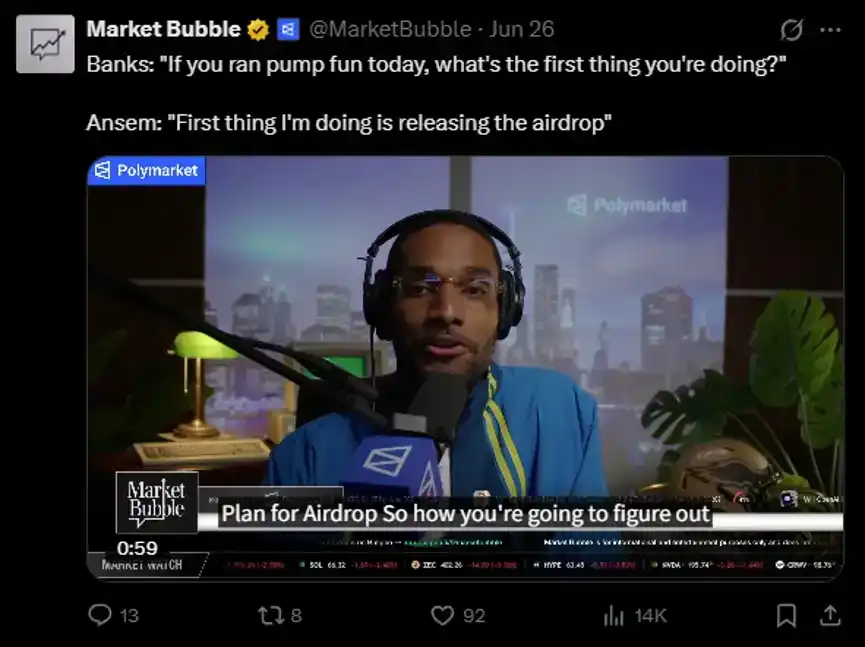
If you were running pump.fun today, what's the first thing you'd do? Ansem: An airdrop.

Since June 21st, he has continuously mentioned the concept of "RTM (Return to meme, let meme coins return)".

However, at that time, no one anticipated the start of this trend, nor did they imagine it would be initiated in the form of a "celebrity coin" like $ANSEM. Initially, Ansem's high popularity was largely because he played the role of a "meme justice warrior," leading the charge by suggesting to pump.fun, during a prolonged slump in the meme market, that an airdrop could re-activate market liquidity.

It wasn't until Ansem stated on X that he would randomly select lucky followers each week from those who retweeted his posts, followed him on pump.fun, and left their pump.fun profile links in the comments, and airdrop out this portion of creator revenue. This "soft endorsement" ignited the emotions of on-chain players.
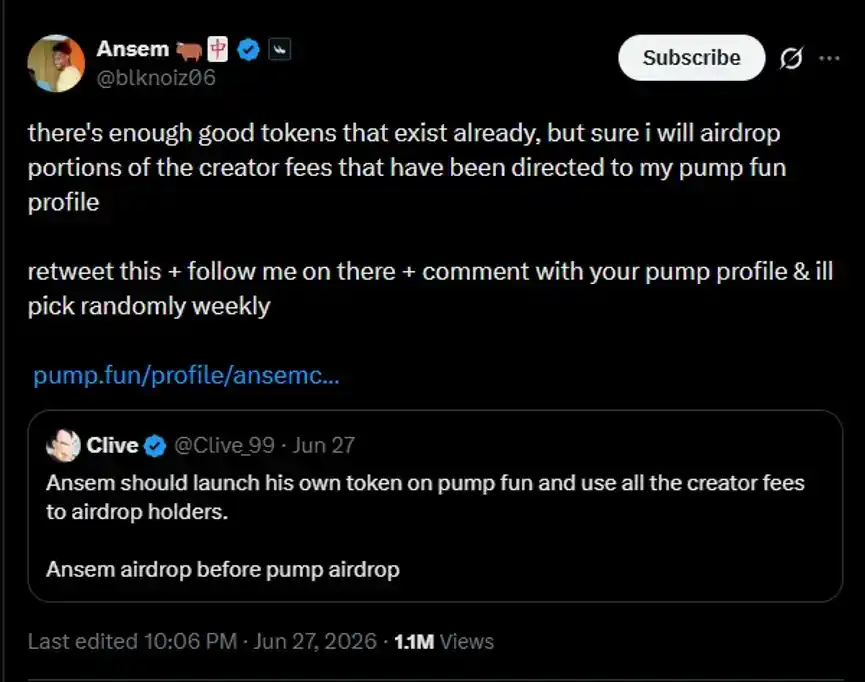
At the time, the feeling among many on-chain players was somewhat reminiscent of when OpenSea delayed its token, leading to the emergence of OpenDAO ($SOS) airdropping tokens to NFT players. Both had KOLs leading the charge, both capitalized on long-standing user dissatisfaction.

However, our estimation was, "It's hard to say if Ansem truly wants to return to the trenches as a pure meme hero. Because Ansem is no longer just a meme coin legend or crypto KOL. One of his identities now is co-founder of the trading terminal Bullpen."

Judging from Ansem later setting up an $ANSEM airdrop claim page on Bullpen, this estimation was correct. When he stepped forward to endorse the token, he likely already planned for it to become the best advertisement for his trading platform.

Rapid Narrative Shifts Within a Week

After $ANSEM broke the $100 million market cap, the narrative quickly shifted from confronting pump.fun and demanding airdrops to "celebrity coins."

Here, "celebrity coin" refers to the play of sending a token, with a ticker named after a crypto KOL and 60% or more of its supply, to the celebrity's public address, waiting for them to post on X to claim it. Soon after $ANSEM surpassed $100 million in market cap, $TJR, once nearing a $30 million market cap, emerged and was seen as the runner-up.

However, TJR ended all possibilities for this runner-up during his livestream that night. He stated that dilution is terrible and urged everyone to refocus their attention on $ANSEM, striving to push its market cap to $1 billion.

This caused $TJR to falter from then on, but it also prevented more severe dilution, redirecting attention and funds back to $ANSEM.

After this incident, the frenzy for launching new "celebrity coins" temporarily cooled, and everyone turned their attention to specific projects Ansem favored. Projects like the US stock stablecoin project Nest, Solana-based game Kintara, saw gains during this phase.

Next, people focused on Ansem's public address. $manlet appeared in a tweet where Ansem showed his wallet. Following this tweet, its market cap rapidly surged from $3 million to over $13 million, and even broke through $25 million that night.
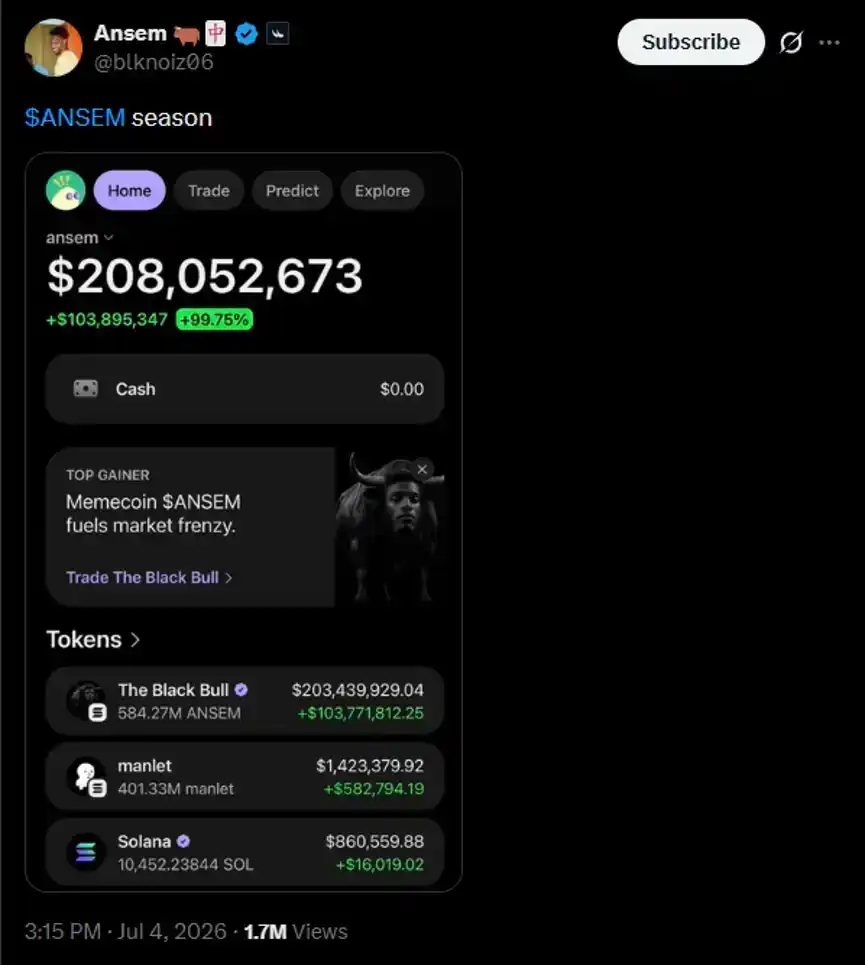
Overall, after $TJR, there was no clear main narrative on Solana, and there wasn't much liquidity overflow from $ANSEM to other narratives. In theory, the play of copying Ansem's portfolio like $manlet should have been captured by the market earlier, but earlier tweets from Ansem didn't spark speculation:
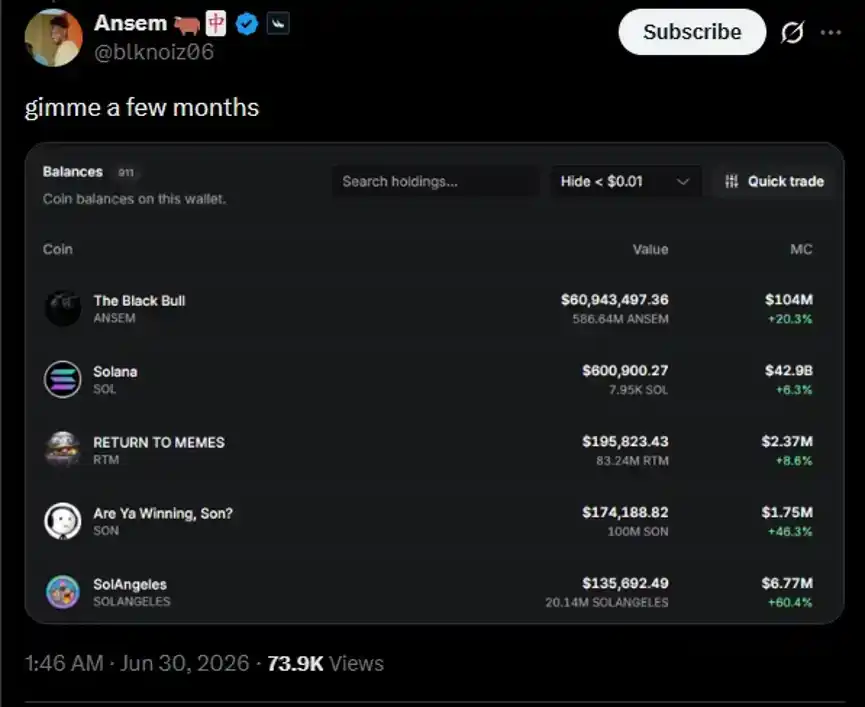
Since the relay for new launches on Solana wasn't performing well, it was BSC's turn to take the baton.

The Trend Moves to BSC

At 5 AM yesterday, a tweet from CZ in 2021 was dug up. Similar to the "big black bull" image associated with $ANSEM, CZ said 5 years ago, "Everyone knows I'm a bull, but you haven't seen my final form."
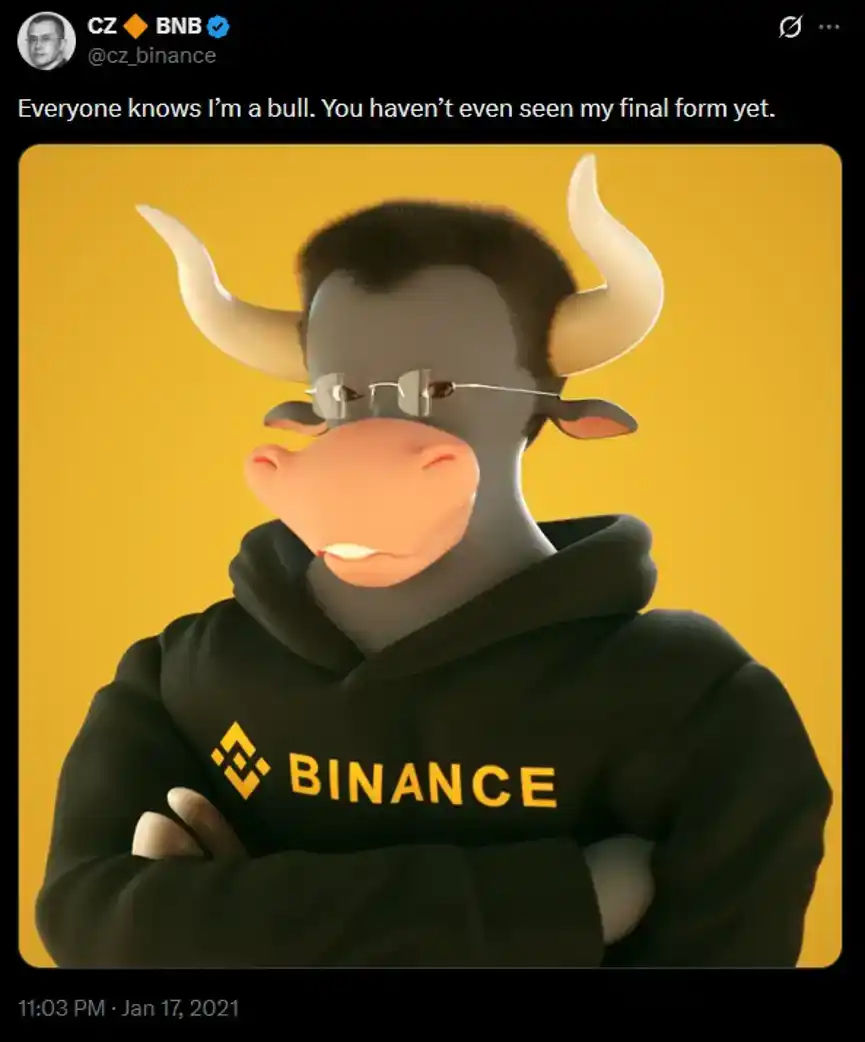
Thus, $CZ suddenly experienced a buying frenzy, surging nearly 200x within an hour. Although everyone thought CZ wouldn't personally jump in like Ansem, posting tweets daily and giving airdrops, the coin still rose. Moreover, it ultimately withstood copycat tokens (with the same ticker) and a rapid correction after the sharp increase (its market cap once dropped from around $40 million to under $6 million, also within an hour), eventually approaching a $90 million market cap.

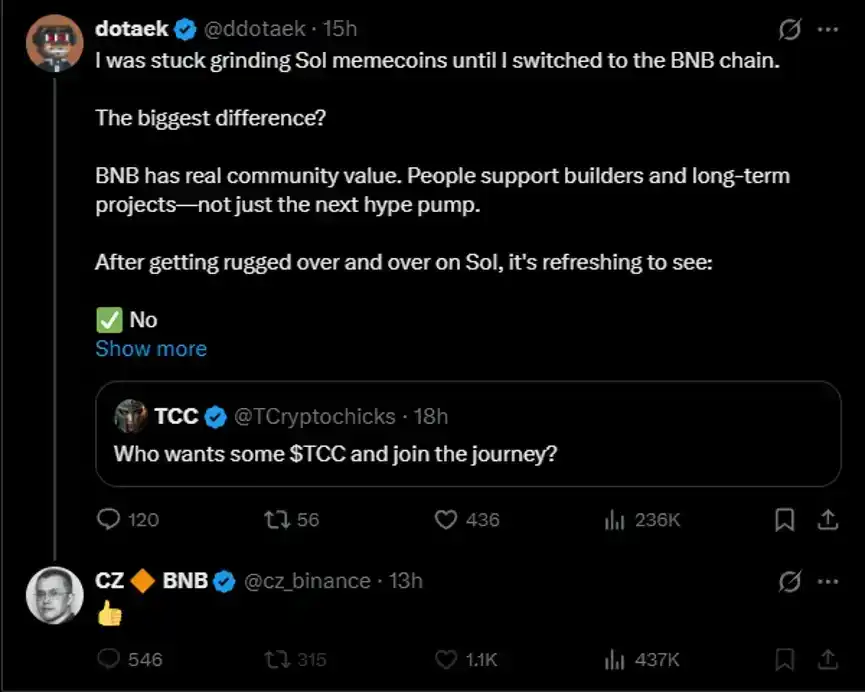
What more closely resembled BSC's $ANSEM was $TCC, because tokens were sent to @TCryptochicks, and he frequently promoted this coin on X. It gained attention due to CZ's multiple interactions with him on X, creating a sense that "this is the BSC Ansem endorsed by CZ":
"Ambushing celebrities" is also happening on BSC. This morning, $dingaling, without being claimed, was once FOMO'd to a $5 million market cap. It then quickly fell, currently holding less than $300,000 in market cap.

For now, the sentiment on BSC is already better than on Solana, especially for primary market launch players. The pace on BSC is faster, and currently offers more opportunities than Solana. How the trends on these two chains will develop afterwards is still uncertain. Hopefully, new narratives that can succeed "celebrity coins" will emerge.


Trending Cryptos

Related Questions

QWhat triggered the initial surge of the $ANSEM token according to the article?

AThe initial surge of the $ANSEM token was triggered by crypto KOL Ansem's 'soft claim' of the token. He announced on X that he would airdrop a portion of his creator earnings from pump.fun to followers who retweeted his post, followed him on pump.fun, and left a link to his pump.fun profile in the comments. This action ignited excitement among on-chain players.

QHow did the 'celebrity coin' narrative evolve on the Solana blockchain after $ANSEM's success?

AAfter $ANSEM's success, the narrative shifted briefly to other 'celebrity coins' like $TJR. However, TJR himself discouraged the split of attention, causing $TJR to fade. The focus then shifted to projects Ansem publicly endorsed (like Nest and Kintara) and later to tokens found in Ansem's public wallet, such as $manlet. However, the article states there was no clear, sustained secondary narrative on Solana, and the momentum for launching new 'celebrity coins' cooled down.

QWhat event marked the shift of the 'celebrity coin' trend from Solana to BSC?

AThe shift from Solana to BSC was marked by the 'archaeological' discovery of a 2021 tweet from former Binance CEO CZ. In the tweet, CZ likened himself to a bull that hadn't revealed its 'final form,' which was similar to the 'big black bull' imagery associated with $ANSEM. This led to a rapid and massive pump of the $CZ token on the BSC chain.

QAccording to the article, what was a key reason behind Ansem's potential motivation to champion the $ANSEM token?

AA key reason behind Ansem's potential motivation was his role as a co-founder of the trading terminal Bullpen. The article suggests that by claiming and promoting $ANSEM, he likely planned to use the token as a powerful advertisement for his own trading platform, Bullpen, which later hosted an airdrop claim page for $ANSEM.

QHow does the article compare the current opportunities for 'celebrity coin' plays on BSC versus Solana?

AThe article suggests that, at the time of writing, the sentiment and opportunities for 'celebrity coin' plays, especially for primary market (new launch) participants, were better on BSC than on Solana. It states that BSC had a faster pace and more opportunities, as the momentum for new launches on Solana had waned without a clear narrative to succeed the initial 'celebrity coin' trend.

Related Reads

Reviewing 8 'Cash Cow' Projects in the Bear Market: The Leader Repurchased $283 Million Worth This Year

This article highlights eight cryptocurrency projects that have demonstrated strong cash-generating capabilities and implemented significant token buyback programs during the bear market of 2026. These projects, dubbed "cash cows," are repurchasing their own tokens, often reducing supply. According to data from Tokenomist, the projects with notable buyback activity from January 1st to June 30th are: Meteora (MET), Pump.fun (PUMP), GMX, Rollbit (RLB), Metaplex (MPLX), Hyperliquid (HYPE), Lighter (LIT), and Aave. Notably, MET's buybacks equaled 71% of its January token supply, while HYPE executed the largest buyback by value at $283 million. Key project summaries include: - **Hyperliquid (HYPE):** The leader by dollar value, its perpetual DEX protocol has repurchased and burned 44 million HYPE tokens (approx. 4.4% of supply) using a significant portion of trading fees, with total buybacks exceeding $1.1 billion since March 2025. - **Meteora (MET):** Its buyback of 336.2 million MET tokens had the greatest proportional impact on its circulating supply, equivalent to 71% of its supply at the start of the year. - **Pump.fun (PUMP):** The popular memecoin launchpad has cumulatively bought back over $400 million worth of PUMP since July 2025, using 50% of net revenue for buybacks and burns since April. - **Aave (AAVE):** Despite facing a major security incident earlier in the year, the lending protocol has continued its buyback program, repurchasing over 200,000 AAVE tokens. Its team is designing a new automated buyback mechanism. - **GMX, Lighter (LIT), Rollbit (RLB), and Metaplex (MPLX)** also have active buyback mechanisms funded by protocol fees or revenues. The article concludes that while token buybacks and burns do not guarantee price appreciation—as market conditions, news, and other factors play a role—these projects stand out for their ability to generate consistent cash flow in a challenging market environment.

marsbit16m ago

Reviewing 8 'Cash Cow' Projects in the Bear Market: The Leader Repurchased $283 Million Worth This Year

marsbit16m ago

Ethereum Sheds Its Load? What Ethereum Supporters Think About the Lean Ethereum Upgrade and the Future Market

Ethereum is back in focus with the announcement of the "Lean Ethereum" upgrade roadmap, described by Vitalik Buterin as Ethereum's third major update. This proposal aims to fundamentally redesign the consensus, data, and execution layers from first principles, striving to make Ethereum **simpler, more secure (quantum-resistant), more verifiable, and more scalable.** The announcement comes amidst a broader restructuring within the ecosystem, including a 20% staff reduction at the Ethereum Foundation and the emergence of new organizations like EthLabs. This has sparked a debate among Ethereum supporters ("E-bizens"). **Optimists** view Lean Ethereum as a critical refocusing on core protocol fundamentals: * **sassal.eth** calls it the ultimate bullish catalyst, envisioning a future where running a node is so lightweight it could be done on a smartwatch, greatly enhancing decentralization. * **Ryan Sean Adams** sees it as Ethereum moving from "narrative expansion" to "protocol hardening," addressing long-term foundational issues like security and scalability. * Analysts like **BITWU** and **蓝狐 (Blue Fox)** frame it as a third-phase evolution towards a "minimal, durable, and credible base layer" designed for the next decade. * **gigi发财猪** interprets the organizational changes as Ethereum "shedding old baggage and forming new teams" for a lighter, more agile approach. * **Xiyu** notes that the roadmap itself provides a much-needed new narrative for market sentiment recovery. **Cautious voices** acknowledge the vision but emphasize execution and market timing: * **Ignas** warns that while the roadmap addresses key community requests, it overlooks tokenomics, and competitors are gaining ground in areas like RWA. Timely delivery is crucial; delays could be bearish. * **Dankrad Feist**, a former Ethereum Foundation researcher, agrees on direction but criticizes the proposed 3-4 year timeline as too slow for the current market pace, especially with AI-aided development available. **In summary,** optimists believe Lean Ethereum reaffirms Ethereum's long-term value proposition as a decentralized world computer, while the cautious argue that its success hinges on faster delivery and tangible results to maintain market relevance. Despite ongoing criticism, the move signals Ethereum's effort to regroup and reclaim initiative at the protocol level.

marsbit1h ago

Ethereum Sheds Its Load? What Ethereum Supporters Think About the Lean Ethereum Upgrade and the Future Market

marsbit1h ago

AI Folding: Fable 5 and GPT-5.6 Are Becoming the Privilege of a Few

【AI Accessibility Gap Widens: Elite Tools Like Fable 5 and GPT-5.6 Are Becoming Privileged】 We are witnessing a growing "AI divide." A stark reality is emerging: a tiny fraction of elites, primarily in tech, are using powerful next-generation models like Fable 5 or the upcoming GPT-5.6, while the vast majority of the public only has access to "toys" - free, limited models equivalent to ChatGPT's basic versions (8B to 30B parameters). This creates a massive experiential chasm and cognitive dissonance. Industry outsiders see AI as overhyped and ineffective, unable to grasp its transformative potential, while insiders leverage these advanced models for a decisive competitive edge. The gap isn't just about model quality but product functionality. Free users get a simple chatbot. Paying elites get integrated workflow systems—capable of creating specialized agents, processing complex data, and handling real-world tasks like management, coding, and planning. Demos showcasing AI planning weddings or building apps feel disconnected from everyday needs like managing bills, groceries, or health. The cost barrier is immense, with reports of engineers spending $1000 daily on Fable 5 inference. Elite users employ sophisticated multi-model workflows, combining different AIs for ideation, architecture, execution, and review, completing complex projects in minutes instead of weeks. This divide extends to critical areas like healthcare, where free models are dangerously unreliable for medical queries. However, some argue that for 90% of common business tasks, mid-tier models like GPT-5.5 are sufficient; the perceived limitation often stems from poor integration and lack of context, not model intelligence. Ultimately, unequal access to cutting-edge AI is creating a new form of social stratification, where the most powerful tools are becoming the exclusive privilege of a few.

marsbit1h ago

AI Folding: Fable 5 and GPT-5.6 Are Becoming the Privilege of a Few

marsbit1h ago

Cathie Wood's June $77M Investment: Are Crypto Stocks a True 'Substitute' for Bitcoin?

In June, Cathie Wood's ARK Invest purchased $77 million worth of publicly traded crypto-related stocks, including Coinbase, Circle, and Bullish, during Bitcoin's worst monthly performance in four years. This aligns with the investment thesis that such stocks offer a compliant way to gain exposure to the crypto cycle without directly holding Bitcoin. However, data analysis reveals significant drawbacks. A group of nine U.S.-listed crypto companies showed 30-day annualized realized volatility between 68% and 90%, nearly double Bitcoin's 37.6%. Over 90 days, Circle's volatility reached 103.6% versus Bitcoin's 37.8%. Drawdowns were also more severe for stocks like Circle (-51.4%) and MicroStrategy (-48.6%) compared to Bitcoin's -36.4% from its January high. Correlation analysis shows most stocks share only a moderate link to Bitcoin. For example, Circle, Robinhood, and Bullish have a 90-day correlation coefficient of just 0.55–0.58 with BTC, meaning only about one-third of their price movement is explained by Bitcoin's action. The rest stems from company-specific risks: earnings, competition, fundraising, and equity dilution. MicroStrategy (MSTR) is the notable exception, acting as a leveraged Bitcoin proxy with a beta of 1.59 and 0.85 correlation. Coinbase offers relatively balanced exposure. Circle exemplifies "crypto-wrapped" corporate risk, with its recent crash tied to stablecoin competition, not Bitcoin. Robinhood's diversified business insulates it from crypto downturns but also limits upside. Bitcoin miners like RIOT and MARA have posted significant gains year-to-date, driven primarily by their pivot to AI compute services, not Bitcoin's price. The article highlights that investing in crypto stocks often means accepting amplified volatility or layering on business-specific risks absent from direct Bitcoin ownership. For instance, MicroStrategy's recent challenges—its market value falling below its Bitcoin holdings (mNAV <1) and facing potential Bitcoin sales for liquidity—demonstrate equity-specific hazards like dilution and financing pressures not faced by a direct Bitcoin holder. ARK's buying spree represents a bet on a basket of different business models with varying crypto exposure, not a simple, lower-risk substitute for holding Bitcoin.

marsbit1h ago

Cathie Wood's June $77M Investment: Are Crypto Stocks a True 'Substitute' for Bitcoin?

marsbit1h ago

Trading

Spot

Hot Articles

Discussions

Welcome to the HTX Community. Here, you can stay informed about the latest platform developments and gain access to professional market insights. Users' opinions on the price of SOL (SOL) are presented below.

活动图片