"Stock Market Maestro" Trump Lifts Up the Entire Quantum Computing Sector

Odaily星球日报Published on 2026-05-27Last updated on 2026-05-27

Abstract

U.S. President Trump's administration, adopting an "active investor" approach, has announced $2 billion in funding for nine quantum computing companies in exchange for minority, non-controlling equity stakes. The funding, sourced from the 2022 CHIPS and Science Act, targets firms like IBM, GlobalFoundries, D-Wave, Rigetti, and several private companies to advance various quantum modalities and overcome key engineering hurdles. This move mirrors the administration's earlier strategic investments, such as the highly profitable stake in Intel, and shifts from pure subsidies to an equity-for-funding model under the same legislation. The announcement triggered significant stock gains for the quantum sector. The strategy is part of a broader "America First" industrial policy aimed at securing U.S. technological leadership, reducing foreign dependencies, and providing credibility and policy support alongside capital. The administration indicates continued openness to similar investments across semiconductors, critical minerals, defense, and other strategic sectors.

Original|Odaily Planet Daily(@OdailyChina)

Author|Wenser(@wenser 2010 )
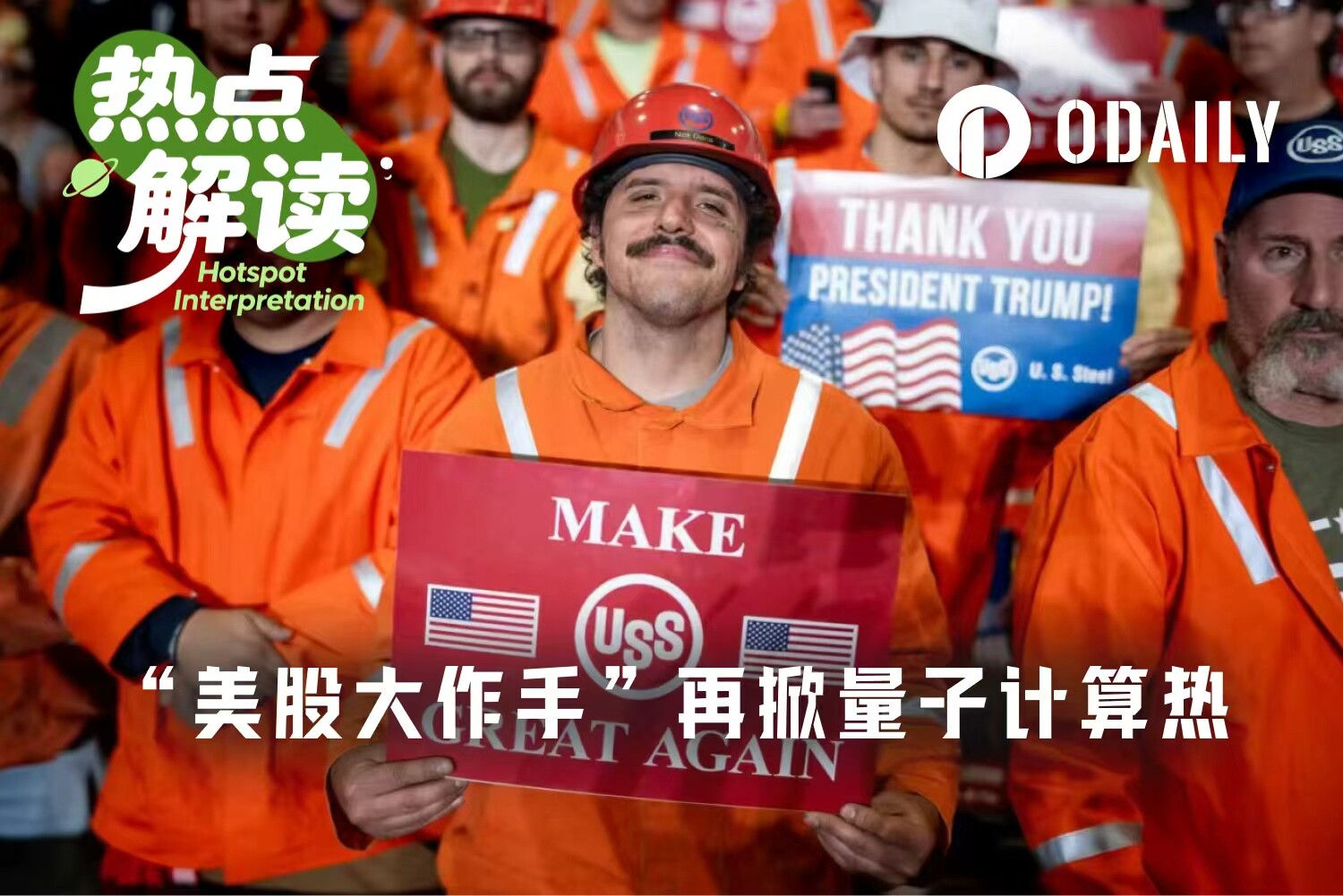
Last August, driven by Trump, the U.S. government converted funds through the "Chips Act," directly purchasing nearly 10% of Intel's newly issued shares (approximately 433.3 million shares) at $20.47 per share. At that time, it was worth less than $9 billion; by early May, less than a year later, as Intel's stock price hit a record high, the total value of these shares had reached $54.1 billion, appreciating by over $45 billion in just seven months.

Mentioning this, Trump couldn't hide his pride and posted: "I made America $45 billion in the last 8 months."

As a capital maestro who doesn't hesitate to "move the stock market by posting," Trump exerts an extraordinary influence on the rise and fall of U.S. stocks. Recently, he has started his performance again—providing a total of $2 billion in funding to 9 quantum computing companies through the U.S. Department of Commerce in exchange for equity. Odaily Planet Daily will provide a brief analysis in this article.

U.S. Government Acts Again, Investing $2 Billion in Quantum Computing

On May 21, the Trump administration announced it would provide a total of $2 billion in funding to 9 quantum computing companies through the U.S. Department of Commerce, in exchange for partial equity. The specific allocation plan is as follows:

  • $1 billion will be granted to IBM (IBM) for the operation and development of its independent subsidiary, Anderon;
  • $375 million is allocated to chip manufacturer GlobalFoundries (GFS);
  • Publicly listed companies D-Wave (QBTS), Infleqtion (INFQ), Rigetti (RGTI) each receive $100 million;
  • Private companies Atom Computing, PsiQuantum, Quantinuum (an independent subsidiary of Honeywell-HON) each receive $100 million;
  • Startup Diraq is expected to receive $38 million.

According to official documents, this is part of the Trump administration's "active investor" industrial policy, with funding sourced from the R&D allocation of the 2022 CHIPS and Science Act. The Commerce Department emphasized that this is a "portfolio" strategy, covering two quantum wafer foundries and 7 quantum computing companies. It targets various quantum modalities including neutral atom, silicon spin, superconducting, photonic, and trapped ion, addressing key engineering bottlenecks such as device reproducibility, error rates, optical complexity, and cryogenic system integration.

On the day the news was released, the U.S. stock quantum computing sector surged sharply at the market open. Among them, D-Wave Quantum rose 16%, Rigetti Computing rose 14%, Infleqtion's stock rose 25%, Quantum Computing rose 9%, and IonQ rose 3.1%.

It's worth mentioning that among these companies receiving funds, only GlobalFoundries Inc. (GFS) revealed that the equity swap ratio is about 1%. For other companies, whether public or private, it's a minority non-controlling equity stake, and the specific ratios have not been disclosed. Final ratios await formal agreement signing and SEC filing disclosure.

Capital Operations Under the "America First" Strategy

Looking closely at this "investment for equity" operation, it remains an action by the Trump administration under the "America First" strategy.

Previously, U.S. government investments in Intel (INTC), the only fully integrated U.S. rare earth producer MP Materials (MP), Trilogy Metals (TMQ), Lithium Americas (LAC), U.S. Steel, and others were also strategic moves to maintain the advantage of the domestic semiconductor industry chain.

Especially the nearly $9 billion investment in Intel, the Trump administration explicitly stated that this move was to support domestic advanced semiconductor manufacturing in the U.S. and reduce reliance on TSMC. Therefore, the U.S. government's related holdings are passive, with no board seats, and no participation in the company's daily operations or management. They largely follow board votes on most matters.

However, the U.S. government's "equity investment" is not just financial support; it also includes credit endorsement and multi-faceted policy support (such as export licenses, tariff protection). Previously, Intel received strong support from U.S. Commerce Secretary Loutnik after obtaining the government investment. Over the past year, he has repeatedly met with Apple CEO Tim Cook, Tesla CEO Elon Musk, and NVIDIA CEO Jensen Huang, persuading them to cooperate with Intel. With Apple joining, Intel has now established relevant collaborations with all three companies mentioned above.

Shift in Operational Approach Under the CHIPS and Science Act: From Grants to Equity Swaps

The $2 billion in funding for quantum computing-related companies comes from the CHIPS and Science Act, a landmark bipartisan bill introduced by the U.S. government in 2022, officially named the "CHIPS and Science Act of 2022." The total authorized funding of the act is approximately $280 billion over 10 years, for supporting semiconductor industry development and basic science and technology R&D. Its main purpose is to revitalize U.S. semiconductor manufacturing, strengthen scientific research and innovation capabilities, and address competition from other countries in high-tech fields through large-scale investment.

But different from the grant or pure subsidy model during the Biden administration, the Trump administration's operational model is the aforementioned "active investor" model—switching to funding in exchange for minority non-controlling equity stakes. As of May this year, the act has attracted over $645 billion in private investment in semiconductor manufacturing, with over 140 projects and the creation of 525,000 new jobs.

It must be said, while personally calling shots and moving stocks like Dell (DELL), Micron (MU), and Palantir (PLTR), Trump is also promoting U.S. stock market prosperity in the name of U.S. government departments, which is why he repeatedly boasts, "The stock market highs are mainly because of me."

Additionally, it's worth noting that a previous investment announcement from the U.S. Department of Commerce stated, "The CHIPS Research and Development Office continues to solicit proposals from eligible applicants for research, prototyping, and commercial solutions for microelectronics technology in the United States. Eligible applicants should submit applications via Notice 2025-NIST-CHIPS-CRDO-01 on the www.grants.gov website." In other words, the U.S. government's "investment door" remains open. For more information and funding announcements, please refer to official sources.

Of course, the U.S. government invests in a wide range of company fields, also involving critical minerals like electricity and rare earths, new energy sources like lithium batteries, medical supplies, and communication infrastructure. Examples include Westinghouse Electric, Lithium Americas, Trilogy Metals, USA Rare Earth, Vulcan Elements, XLight, L3 Harris Technologies, etc.

Furthermore, U.S. Commerce Secretary Loutnik once revealed to the media that the current administration might take equity stakes in major defense contractors like Lockheed Martin (LMT).

In summary, the various publicly listed companies, critical mineral/rare earth/battery material supply chains, nuclear/small modular reactor (SMR) and advanced nuclear fuel, and other quantum computing targets mentioned above may become the focus of continued investment by the Trump administration in the second half of the year.


Related Questions

QWhat specific action did the Trump administration take to support the quantum computing sector, and how much funding was announced?

AOn May 21, the Trump administration announced that it would provide a total of $2 billion in funding to 9 quantum computing companies through the U.S. Department of Commerce, in exchange for partial equity stakes in those companies.

QWhich publicly listed quantum computing companies received $100 million each from the funding announced by the U.S. Department of Commerce?

AThe publicly listed quantum computing companies that each received $100 million are D-Wave Quantum (QBTS), Infleqtion (INFQ), and Rigetti Computing (RGTI).

QWhat is the source of the $2 billion funding for the quantum computing companies, and how does this Trump-era approach differ from the previous administration's policy?

AThe $2 billion funding comes from the research and development appropriations of the 2022 CHIPS and Science Act. Unlike the Biden administration's approach of grants or pure subsidies, the Trump administration's model is that of an 'active investor,' providing funding in exchange for minority, non-controlling equity stakes.

QAccording to the article, what was a key strategic reason behind the U.S. government's investment in Intel, and what terms govern its stake?

AA key strategic reason for the U.S. government's investment in Intel was to support advanced domestic semiconductor manufacturing and reduce dependence on TSMC. The government's stake is passive, meaning it holds no board seats, does not participate in daily operations, and generally follows the board's votes on most matters.

QWhat broader areas or sectors, beyond quantum computing, does the article suggest the U.S. government under Trump has invested in or may invest in?

ABeyond quantum computing, the article suggests the U.S. government has invested or may invest in areas including critical minerals/rare earths, battery materials, nuclear energy/Small Modular Reactors (SMRs), advanced nuclear fuel, electrical infrastructure, medical supplies, communications infrastructure, and major defense contractors like Lockheed Martin.

Related Reads

Retail Investors' 'Lead Brother' Serenity vs. Newly Minted Stock God Leopold: How Are the Two Top Hunters Mining AI's 'Physical Limits'?

The article profiles two prominent figures, Serenity and Leopold Aschenbrenner, who are gaining attention for their unconventional investment strategies focused on the physical constraints of the AI boom, moving beyond mainstream software narratives. Serenity, an anonymous online trader, advocates a "shiso leaf" theory. He targets small-cap companies with monopolies on critical, overlooked components in the AI hardware supply chain, such as specific semiconductor materials. His deep, technical analysis of bottlenecks in areas like co-packaged optics (CPO) has reportedly yielded massive returns, though his anonymity and focus on illiquid micro-cap stocks pose significant risks for followers. Leopold Aschenbrenner, a former OpenAI researcher, founded a multi-billion dollar hedge fund. His macro thesis argues that physical infrastructure—power grids, land, data centers—is the true bottleneck for AI growth, lagging far behind chip production. Consequently, his fund employs an infrastructure arbitrage strategy: heavily investing in storage and compute infrastructure companies while placing massive bearish bets (put options) against major semiconductor stocks, betting their valuations will correct as physical constraints become apparent. While their methods differ—Serenity drills into microscopic supply chain details, while Leopold takes a macroscopic, infrastructure-focused view—both share a core belief: the real power and investment alpha in the AI era lie in controlling scarce physical resources, not just software. The article concludes by noting the inherent risks in both approaches, such as liquidity issues for micro-caps and timing risks for macro bets, but suggests they signal a broader market re-evaluation of AI's foundational assets.

marsbit5m ago

Retail Investors' 'Lead Brother' Serenity vs. Newly Minted Stock God Leopold: How Are the Two Top Hunters Mining AI's 'Physical Limits'?

marsbit5m ago

Who Will Make Money in the Age of Agents?

In the Agents era of blockchain, traditional value capture theories face challenges. The "Fat Protocol" theory, dominant since 2016, suggested protocols capture most value as their tokens are essential for network use. However, the proliferation of interchangeable L1s, L2s, and modular layers has eroded protocol scarcity and pricing power. Conversely, the "Fat App" theory posits that applications capturing user relationships (like wallets and exchanges) become the primary value layer by controlling distribution and transaction flows. This aligns with the current "Great Repricing" cycle. Agents disrupt this logic. As software users, they lack brand loyalty, prioritize cost and efficiency, and switch between platforms seamlessly. This undermines the front-end UX moats that "Fat Apps" rely on. The article explores several potential futures: 1. **Headless Applications:** Current leading apps could strip their front-ends and become backend API infrastructure for Agents, preserving their role. 2. **Protocol Resurgence:** If integration becomes trivial, Agents might bypass aggregators and interact directly with protocols, reviving "Fat Protocol" dynamics. 3. **Pricing Power Collapse:** Agents' rational, frictionless routing could commoditize the entire stack, compressing margins toward cost and leaving little profit for intermediaries. 4. **Unprecedented Activity:** Agents may enable new, high-frequency, machine-to-machine economic activities, expanding the total value pie even if margins are thin. 5. **A New, Unnamed Model:** Historically, major tech shifts (like the internet's attention economy) create unforeseen business models. The Agents era may spawn entirely new ways to capture value. The most likely outcome is a coexistence where "Fat Apps" continue to serve human users valuing UX, while a separate, Agent-driven economy emerges governed by different rules—where loyalty is based on factors like liquidity, latency, and settlement guarantees rather than brand.

marsbit1h ago

Who Will Make Money in the Age of Agents?

marsbit1h ago

Trading

Spot
Futures
活动图片