
Image Source: Visual China
Author / Yang Jiyun
Report / Investment Community PEdaily
A super IPO is coming to Shenzhen.
Recently, Shenzhen Yunbao Intelligent Co., Ltd. (referred to as "Yunbao Intelligent") officially submitted its IPO application for the ChiNext board, which has been accepted by the Shenzhen Stock Exchange. It has become another company choosing to list using the fourth set of listing standards for the ChiNext board, sprinting to become the "first domestic DPU stock".
Looking back six years, Dr. Xiao Qiyang from Stanford founded Yunbao Intelligent in Shenzhen, focusing on the DPU track. Two months after this team set sail, the trillion-yuan DPU market began to explode. To date, he is backed by a long line of investors including Tencent.
Tencent is undoubtedly the heaviest investor and has become the largest shareholder of Yunbao Intelligent. Together with Yuexin Semiconductor, backed by Guangdong state-owned capital, Yunbao Intelligent has become another landmark semiconductor case in the Greater Bay Area.
Stanford PhD Founds Shenzhen Unicorn, Fast Approaching IPO
Let's start with the founder, Xiao Qiyang.
He was born in Hong Kong, China, and went to the United States for studies in his early years, with an extremely impressive academic resume: He graduated with the highest honors (Summa Cum Laude) simultaneously from New York University (Bachelor's in Mathematics and Computer Science) and Cooper Union (Bachelor's in Electrical Engineering). At the age of 24, he obtained a PhD in Electrical Engineering from Stanford University. Subsequently, he taught at the University of California, Irvine, and the Massachusetts Institute of Technology.
During his PhD, Xiao Qiyang focused on artificial intelligence and neural networks. One of his achievements solved a theoretical problem in the AI field that had remained unsolved for over thirty years, receiving high praise from "the father of artificial intelligence" Marvin Minsky, who personally wrote the preface.
His first venture was in 2002 when he co-founded the chip company RMI in Silicon Valley, which was later acquired by Broadcom for a staggering $3.7 billion in cash, shocking the industry.
In 2020, witnessing the opportunity for domestic substitution in computing power, Xiao Qiyang started another business. Considering the talent and cost advantages in China, in August of that year, he returned to Shenzhen to establish Yunbao Intelligent—focusing on DPU while many were still discussing CPUs and GPUs.
Coincidentally, soon after, NVIDIA officially introduced the DPU concept at its GTC conference. Jensen Huang proposed the "three-chip" strategy of "CPU + DPU + GPU", and the DPU track rapidly became a fiercely contested territory.
Since then, Yunbao Intelligent has risen rapidly. It independently developed China's first high-performance, general-purpose programmable DPU SoC chip, with network bandwidth reaching 400Gbps, achieving a 4x performance improvement and over 50% reduction in power consumption compared to traditional solutions. It took only 4 years to complete the entire process from FPGA verification to 6nm SoC mass production.
According to the prospectus, Yunbao Intelligent currently provides a one-stop solution including functions such as elastic networking and storage, virtualization, security, and low-latency RDMA.
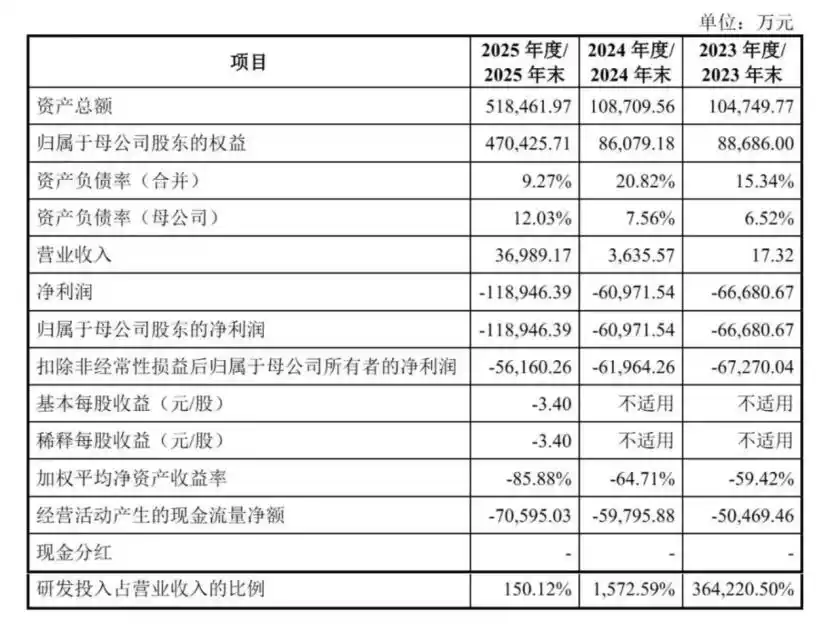
Prospectus
The prospectus shows that Yunbao Intelligent's revenue for 2023, 2024, and 2025 was 170,000, 36.35 million, and 370 million yuan respectively; net losses were 667 million, 600 million, and 1.19 billion yuan respectively; non-GAAP net losses were 670 million, 620 million, and 560 million yuan respectively. Although revenue in 2025 increased by over 900% year-on-year, Yunbao Intelligent is still in a loss-making state.
Thus, another super IPO in Shenzhen emerges.
VC/PE Gathered, Tencent Becomes Largest Shareholder
Chip startups are undoubtedly money-burning ventures.
As of the submission of the prospectus, Yunbao Intelligent has also undergone several rounds of financing. The earliest was at the end of 2020, when the company had just been registered for two months. It secured a seed round backed by investment institutions including 5Y Capital, ZhenFund, China Integrated Circuit Industry Investment Fund, Huayecheng Capital, Yaotu Capital, and Hongzhuo Capital.
Six months later, Yunbao Intelligent completed another angel round with a star-studded lineup, including Sequoia Capital China, Shenzhen Capital Group, Tencent, 5Y Capital, Huayecheng Capital, and QBN Capital. Xiao Qiyang mentioned in a speech, "When I founded Yunbao Intelligent, I was alone. Only after getting the angel round did I dare to invite the founding team."
It was in this round that Tencent, Yunbao Intelligent's most important shareholder to date, appeared. This was Tencent's first entry, and it continued to invest heavily thereafter.
In September 2021, Yunbao Intelligent completed its Series A financing. Tencent again invested several hundred million RMB. Other investors, in addition to existing shareholders like Sequoia Capital China, Shenzhen Capital Group, and 5Y Capital, included Temasek, NIO Capital, ZhenFund, investment platform Yicun Capital under Huaxicun Shares, Minsheng Bank's listed financial holding platform Minsheng Bank Financial Holdings, Yaotu Capital, and others.
By this point, Yunbao Intelligent had become a domestic DPU unicorn.
Subsequent financings progressed even more rapidly—in 2023, it secured financing from Sunshine Insurance, Guoxin Capital, Runxin Xinguanxiang Industrial Fund, etc. After 2024, government guidance funds entered, with the Shenzhen Guidance Fund and Bao'an District Industrial Investment Guidance Fund participating in the Series B financing. In 2025, IDG Capital, Hangzhou Industrial Investment, Hangshi Asset Management, Xiaoshan Capital (three Hangzhou state-owned capitals), Pegatron Corporation, Yunjian Information, and other industry players all entered, with old shareholders participating.
In late November 2025, several Shenzhen-based VCs including Tongchuang Weiye, Oriental Fortune Capital, and Jinshi Capital participated in a round, with IDG Capital and Tencent joining again. The valuation subsequently exceeded 14 billion yuan.
Before the IPO, Tencent became the largest shareholder of Yunbao Intelligent through related entities, holding 19.7792% of the shares. The company's actual controllers, Xiao Qiyang and Zhang Xueli, directly held 7.1520% of the company's equity collectively and indirectly controlled 22.6588% of the voting rights through two equity incentive platforms, Yunbao Chuangxin and Yunbao Chuangzhi.
This also indicates a risk: As the largest shareholder, Tencent's future share purchases or sales in the secondary market may impact the stability of the company's control.
ChiNext Window Opens, Greater Bay Area Starts IPO Wave
Finally, it's Shenzhen's turn.
For a long time, Shenzhen's label in the semiconductor field was more about "consumer electronics applications" and "terminal manufacturing." In the wave of the AI computing power explosion, the capital race surrounding domestic computing power is accelerating comprehensively. Shenzhen urgently needs a super IPO representing underlying core technology.
In the previous IPO wave of domestic GPUs, companies like Moore Threads, MetaX, and Biren Technology were mostly concentrated in Beijing, Shanghai, and other places. Now, Yunbao Intelligent sprinting to become the "first domestic DPU stock" precisely adds an important piece to the puzzle for Shenzhen in the dimension of "infrastructure chips."
Looking from this perspective, semiconductor capitalization in the Greater Bay Area is forming a tiered effect.
Not long ago, Yuexin Semiconductor Technology Co., Ltd. ("Yuexin Semiconductor") successfully passed the review for its ChiNext board IPO, planning to raise 7.5 billion yuan. For investors, this was also a long-term bet—starting eight years ago from an empty plot in Huangpu, Guangzhou, it later became the first 12-inch wafer manufacturer in the Greater Bay Area to achieve mass production.
Along the way, behind this Guangzhou super unicorn, Guangdong state-owned capital was involved in almost every round of financing, placing heavy expectations on it.
It seems that Yuexin Semiconductor represents a breakthrough for the Greater Bay Area in wafer manufacturing, while Yunbao Intelligent represents a breakthrough in high-end chip design (DPU).
At this moment, they are riding the tailwind of the ChiNext board's reform红利.
Yuexin Semiconductor chose to apply the third set of listing standards for the ChiNext board, becoming the second unprofitable company to pass the review after Dapu Microelectronics. In April this year, the ChiNext board officially activated the "fourth set of listing standards," focusing on R&D investment and market value rather than short-term net profit. Subsequently, Yunbao Intelligent's IPO progressed smoothly. They both signal to hard-tech companies—as long as the technology is solid, R&D is high, and growth potential is strong, the door to the capital market is now open.
The ChiNext board is getting lively. Since September 2024, the ChiNext Index has risen by approximately 150%, becoming one of the most prominent main lines in the A-share market. Looking around, the ChiNext board has become one of the most concentrated capital market samples for Chinese hard-tech companies.
Among them, the hard-tech army of the Greater Bay Area has sounded the horn for a breakthrough.
This article is from the WeChat public account "Investment Community," author: Yang Jiyun