Is Strategy’s $54.5B Bitcoin bet no longer just about BTC’s price?

ambcryptoPublished on 2026-07-19Last updated on 2026-07-19

Abstract

Michael Saylor's company, Strategy, holds a $54.5 billion Bitcoin (BTC) treasury, but its financial model faces new challenges. While it historically relied on issuing premium-priced shares to fund more Bitcoin purchases, its market-to-net asset value (mNAV) has fallen sharply to 1.03x, eroding that advantage. The company's cost basis for its BTC is now higher than its market value. To meet obligations like dividends, it recently sold some Bitcoin, shifting focus from pure accumulation to balance sheet sustainability. Key measures like Bitcoin per share and BTC yield have declined. The company must now prove it can sustainably finance future purchases and maintain investor confidence amidst a complex capital structure with significant funding gaps. While Strategy's scale is unmatched, its aggressive accumulation model is being tested, with the debate moving beyond treasury size to long-term financial resilience.

For years, Michael Saylor’s Bitcoin [BTC] strategy looked nearly impossible to challenge. Every capital raise financed another Bitcoin purchase. Every rally reinforced the model. Shareholder dilution also seemed justified because the corporate treasury kept expanding.

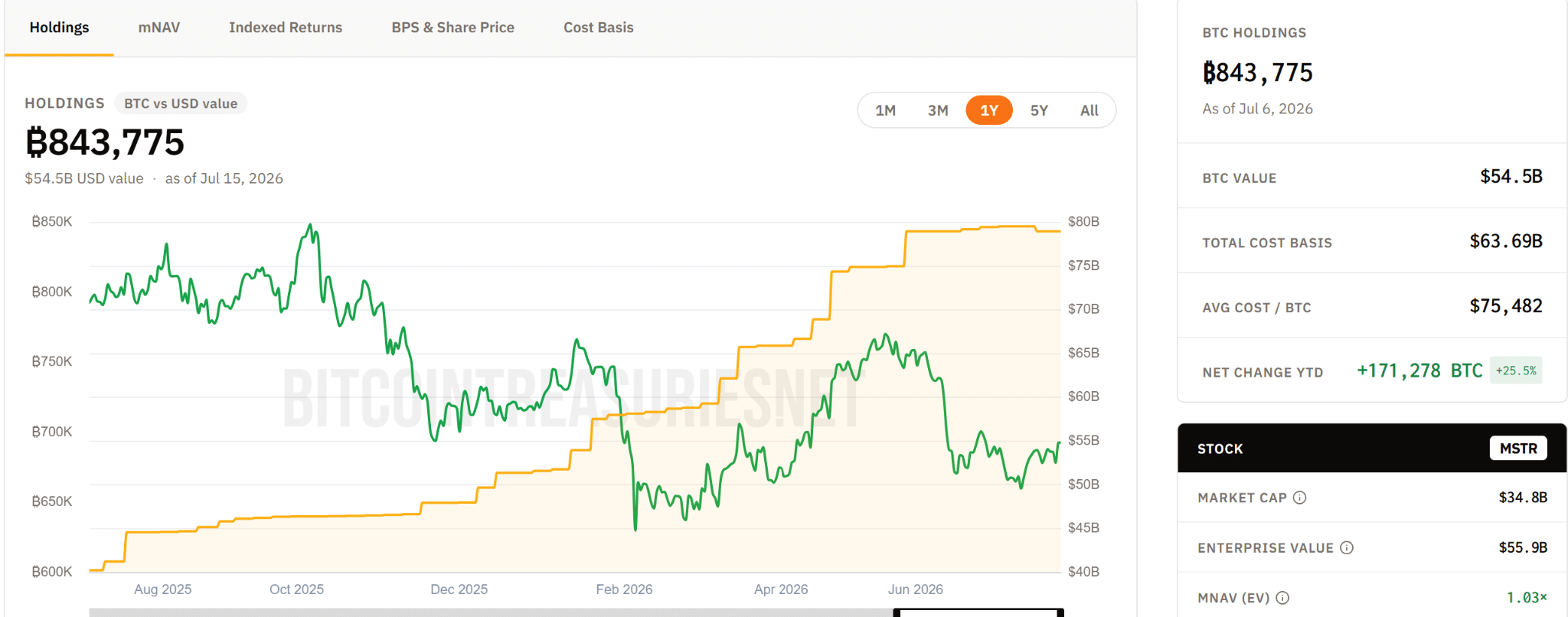
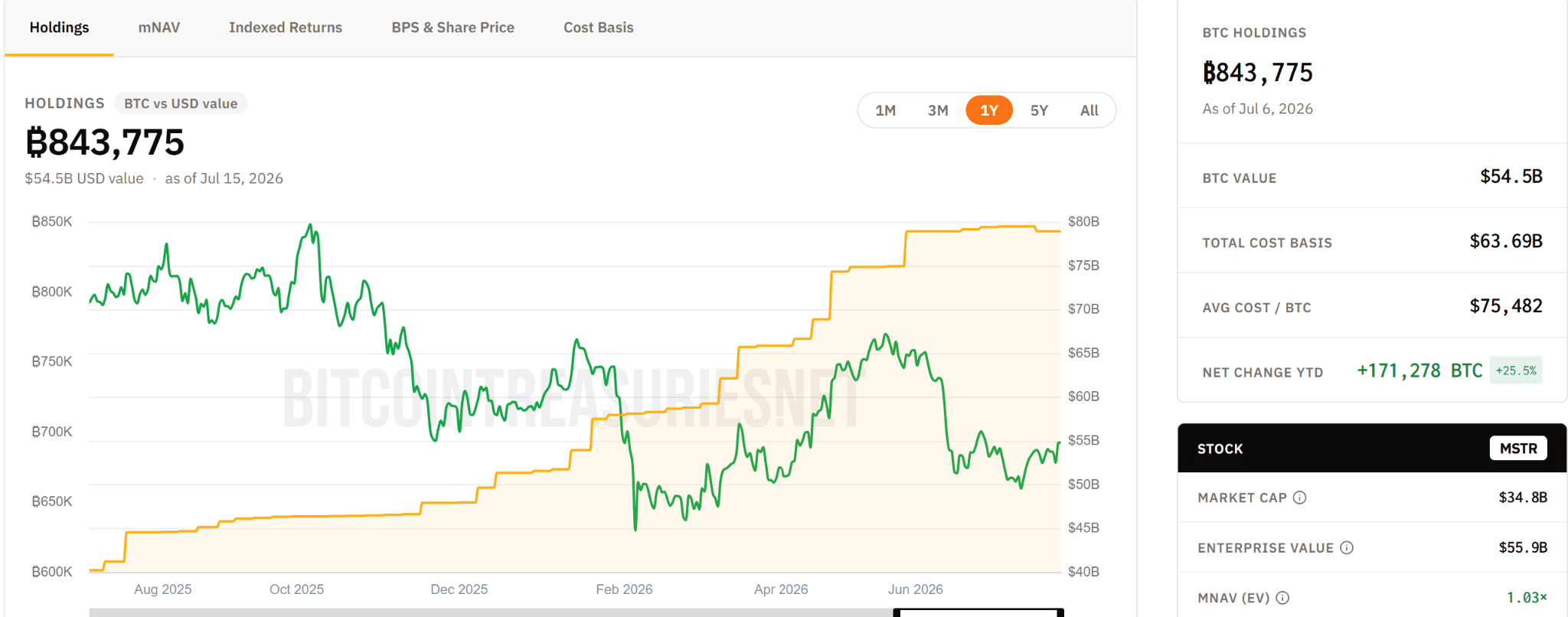
Yet, success gradually introduced a different challenge. The financial engine behind the relentless accumulation is now demanding more from the treasury it was built to grow. At press time, Strategy held 843,775 BTC, worth about $54.5 billion. This milestone comes after adding 171,278 BTC this year.
Source: Bitcoin Treasuries

However, those holdings carry a $63.69 billion cost basis, with an average purchase price of $75,482. That gap has shifted attention from accumulation toward the sustainability of the model. Reflecting that transition, the recent sale of 3,588 BTC was used to support STRC dividends and strengthen $3 billion in cash reserves.

That said, the real question remains. Can Bitcoin‘s future appreciation continue offsetting dilution, financing costs, and an increasingly self-dependent capital structure?

The engine behind Strategy

Dependence on the rising price of Bitcoin is no accident; it has been the foundation of Strategy’s accumulation engine since day one.

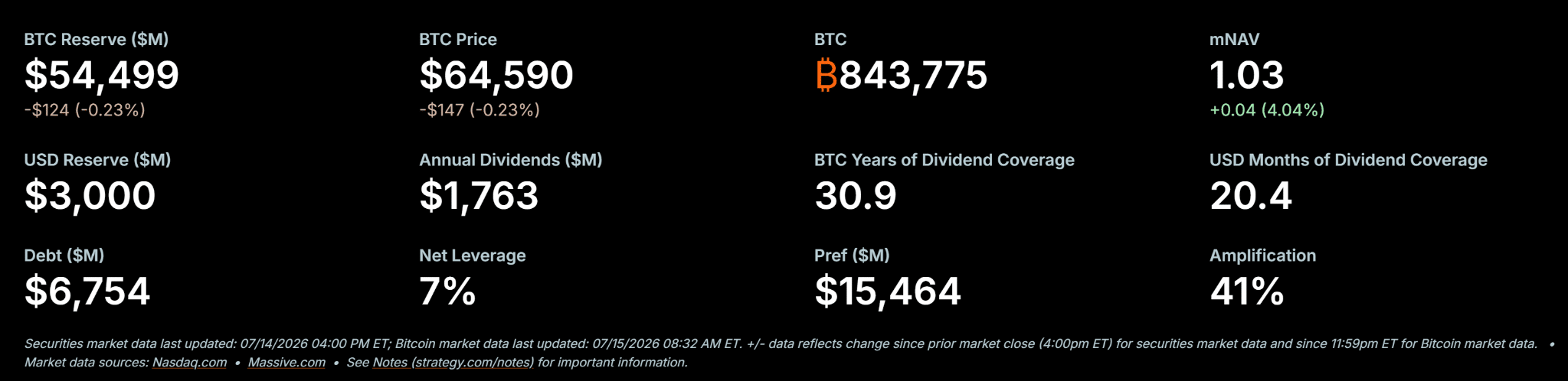
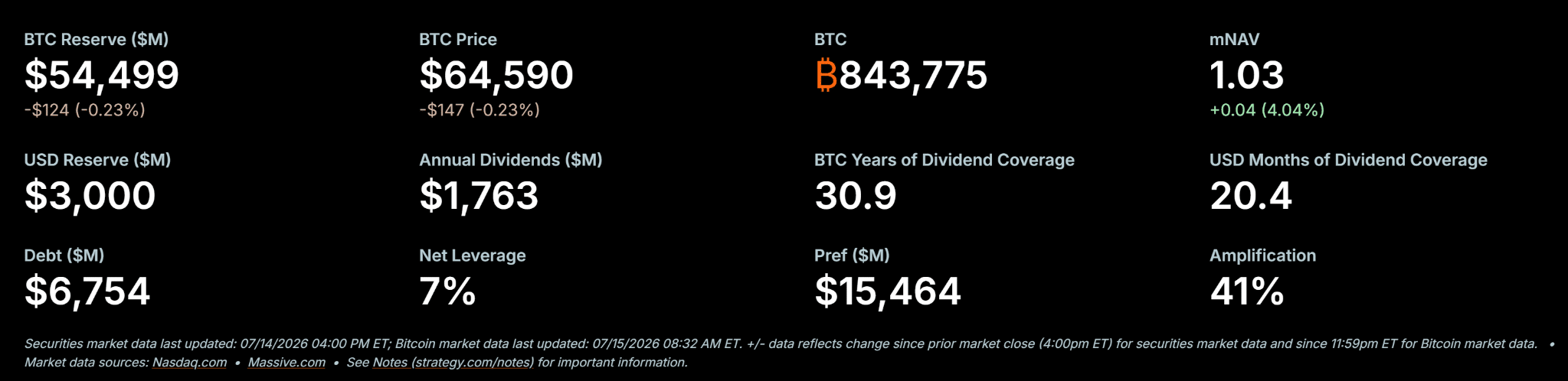
Meanwhile, the Market to Net Asset Value (mNAV) has slipped to just 1.03x. The metric gauges how the market values a Digital Asset Treasury (DAT). Previously, it spiked as high as 2.51x, but the sharp decline has eroded the premium that once made equity issuances highly accretive.

Rather than relying on operating cash flow, the company depended on maintaining an enterprise mNAV above 1, allowing it to issue shares at a premium and recycle fresh capital into Bitcoin purchases.

For years, that formula worked remarkably well in favor of the DAT. As mNAV climbed to 3.89x, Strategy raised $25.3 billion during 2025 and accelerated its treasury expansion without materially weakening shareholder exposure. However, currently, the math has changed.
Source: Strategy

Therefore, Strategy will likely have to shift its focus away from adding to its Bitcoin holdings and toward creating flexibility within its balance sheet. Still, not everyone views the recent pressure as evidence that the model is failing.

Lead Information Compliance Assurance Manager at SpaceX, Vincent Peters, observed,

People often confuse volatility with failure. Bitcoin has experienced extraordinary appreciation punctuated by significant corrections.

He added that while those corrections create headlines, they “don’t necessarily invalidate a long-term strategy.” Unless Bitcoin regains sustained upward momentum, rebuilding the premium may prove more important than acquiring the next Bitcoin.

The per-share challenge

That changing reality is also reshaping how Strategy measures success. The company was never trying to own more Bitcoin for the sake of it. Instead, the objective was to ensure every shareholder owned more Bitcoin over time. Such a distinction made BTC Yield and Bitcoin per share the clearest measures of whether the model was truly creating value. For several years, the model delivered on that promise.

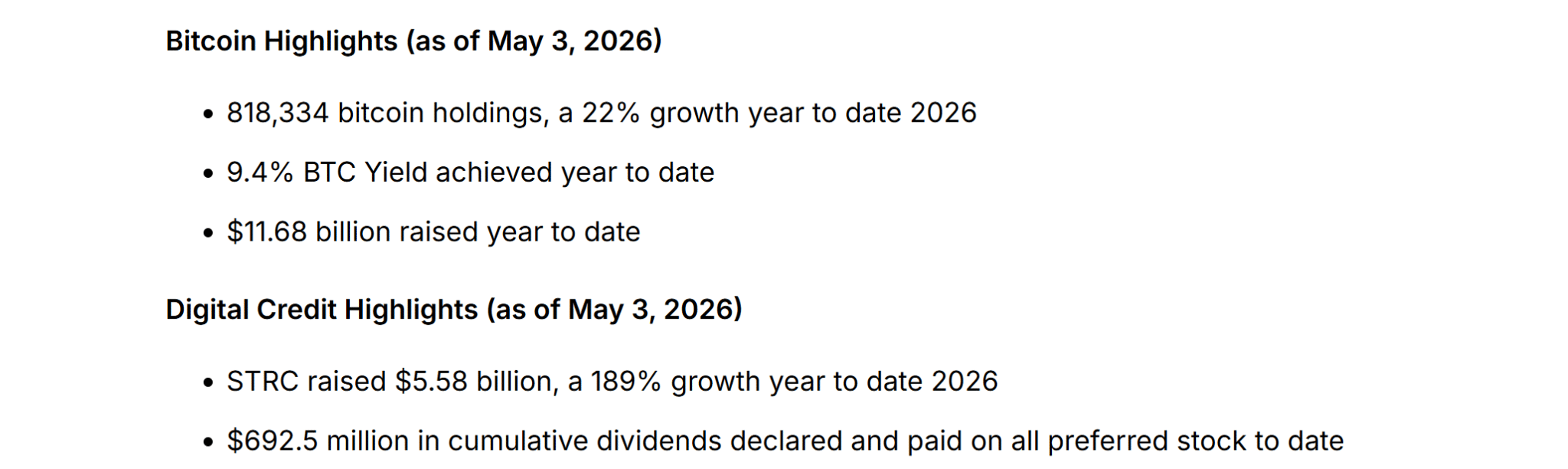
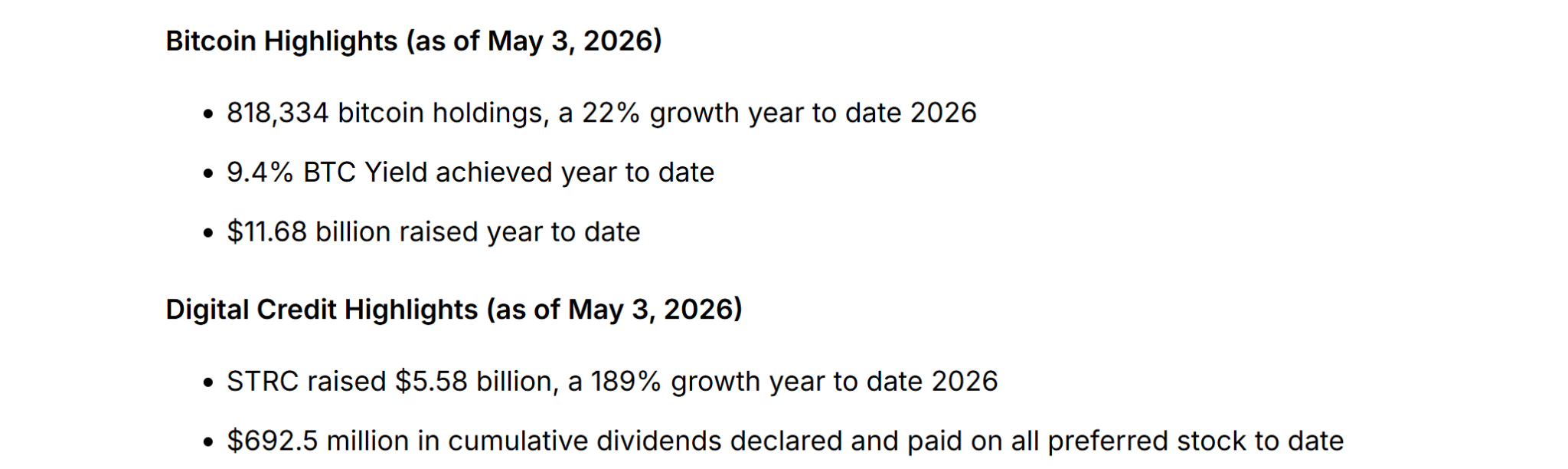
BTC yield reached 9.4% in early 2026, while Bitcoin per share climbed to 207,776 satoshi (sats), supported by 171,278 BTC in net accumulation. Yet, the BTC yield has fallen off slightly, hovering around 6.6% as of press time. Although the flywheel has slowed down considerably, that same slowdown has started to impact how well Strategy is performing, according to those same metrics.

As enterprise mNAV compressed toward 1.03x, each new share issued generated less incremental Bitcoin ownership than before.
Source: Strategy

More importantly, investors are no longer watching Strategy solely for the size of its Bitcoin treasury. They are watching whether it can continue funding future purchases. That debate has also attracted criticism from longtime Bitcoin skeptic Peter Schiff, who questioned Strategy’s capital allocation. He argued,

The model needlessly destroyed shareholder value by selling discounted MSTR shares instead of Bitcoin.

That shift matters. Rather than being simply the largest owner of Bitcoin, Strategy has become a proxy indicator for institutional demand for Bitcoin.

Therefore, the debate is moving beyond treasury growth alone, with the focus now on whether Strategy can maintain investor confidence in its ability to generate shareholder wealth over the long term by continuing to fund future purchases.

The cost of conviction

Building the world’s largest corporate Bitcoin treasury has given Strategy its greatest financial burden. That trade-off is becoming harder to ignore as Strategy’s capital structure grows more complex.

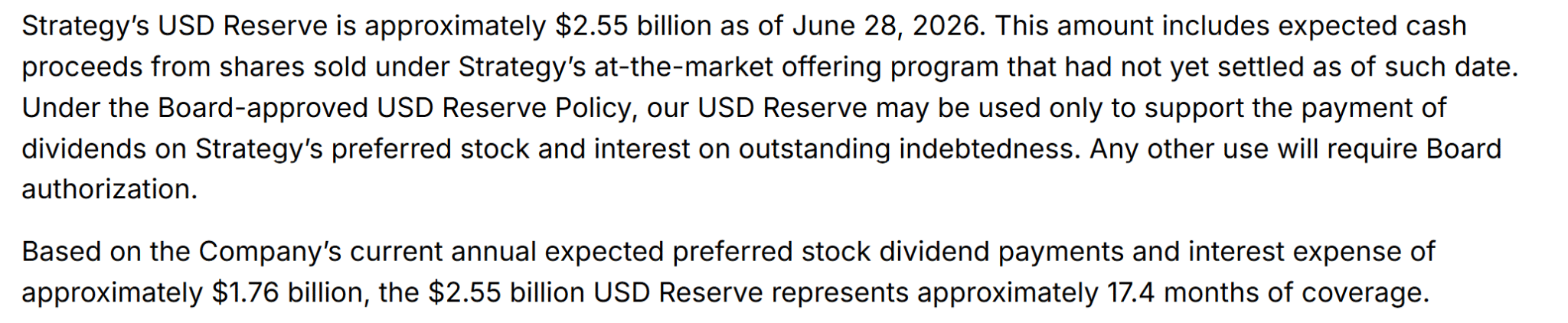
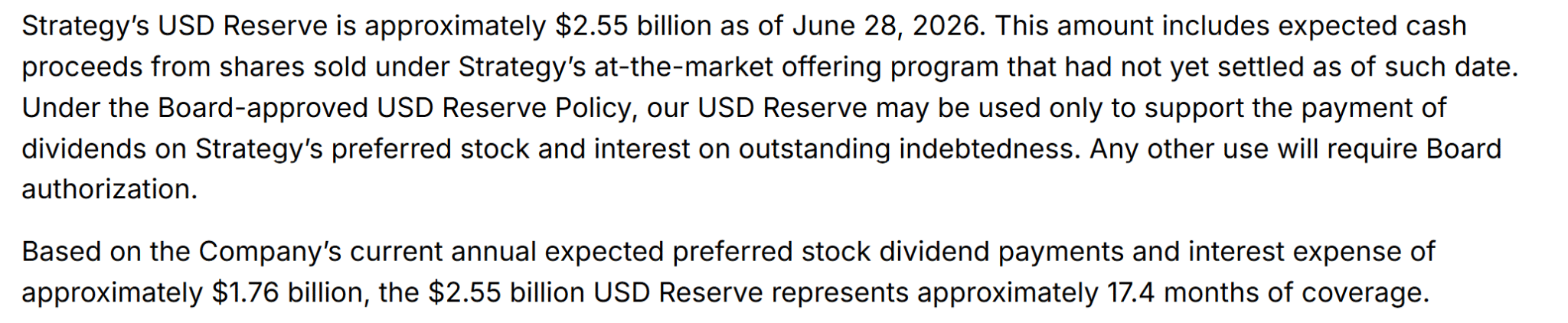
The DAT has approximately $1.76 billion annually in Stretch (STRC) dividend obligations. In addition to those, it also has convertible notes and continuing equity financing. Meanwhile, its software business generates only about $500 million in annual revenue.
Source: Strategy

Therefore, there exists a large funding gap. This funding gap explains why, currently, capital markets are equally important to the price of Strategy’s Bitcoin.

As Andrew Bahlmann, founder of Deal Leaders International, noted,

Having conviction with respect to an asset does not equate to having confidence in the ability to finance it.

He added that lenders ultimately favor collateral that remains stable across market cycles rather than assets whose value fluctuates sharply.

Strategy has approximately $2.5 to $3 billion in cash reserves. Therefore, it retains some financial flexibility. Still, prolonged mNAV compression may limit access to accretive capital. This would increase reliance upon reserves or selective sales of the Strategy’s Bitcoin to meet obligations. As such, this challenge is evident when compared to peers.

Metaplanet continues to expand through lower-cost yen-denominated financing. This is by accepting currency risk in exchange for cheaper capital despite mNAV near 0.92x. In contrast, Semler Scientific has adopted a more conservative approach, relying on lower issuance and minimal preferred obligations.
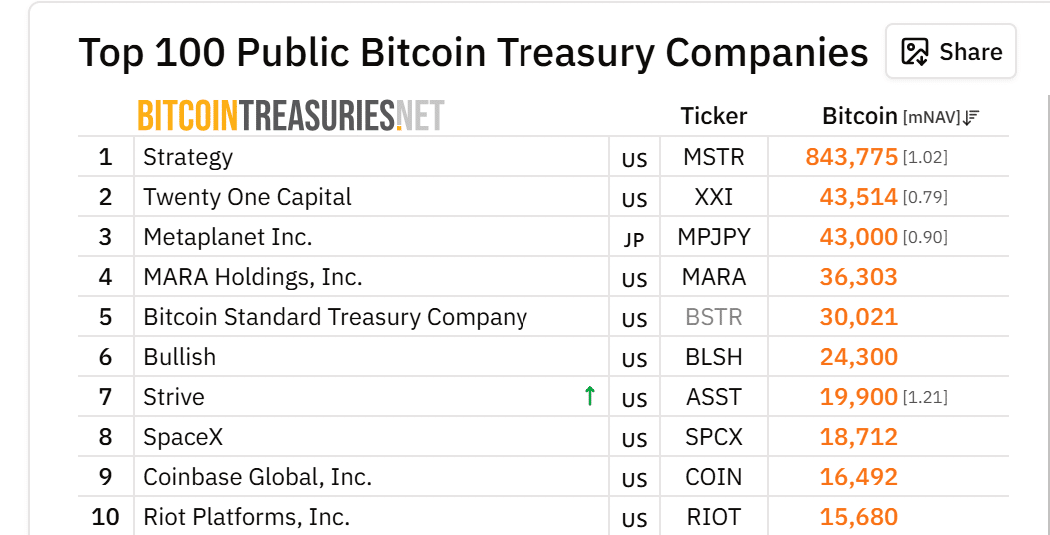
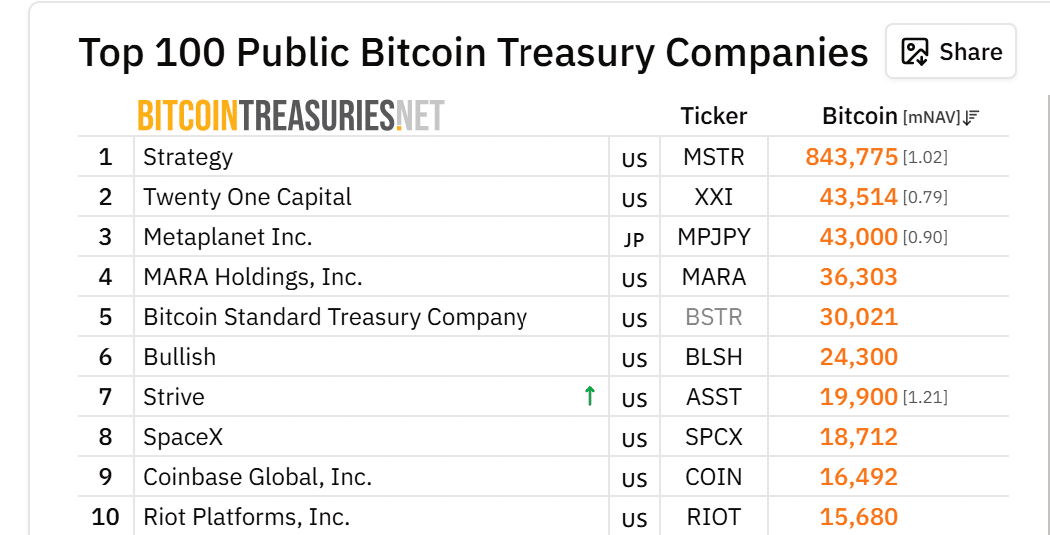
Source: Bitcoin Treasuries

Strategy still commands unmatched scale with 843,775 BTC, yet its funding model is also the most demanding. The comparison highlights a growing trade-off across Bitcoin treasury companies.

All in all, aggressive accumulation can accelerate growth, but resilient capital structures ultimately determine how well that growth survives prolonged market stress.


Final Summary

  • Bitcoin accumulation alone no longer guarantees Strategy’s long-term success.
  • BTC treasury growth now hinges on sustainable capital, not just larger holdings.

Trending Cryptos

Related Questions

QWhat is the central challenge Strategy now faces, beyond just accumulating more Bitcoin?

AStrategy's central challenge has shifted from simply accumulating more Bitcoin to ensuring the sustainability of its financial model. This involves managing dilution, financing costs, and an increasingly self-dependent capital structure while continuing to generate shareholder value.

QWhat key metric has declined, impacting Strategy's ability to raise capital accretively through equity issuance?

AThe key metric is the Market to Net Asset Value (mNAV), which has declined sharply to 1.03x from highs as high as 2.51x. This erosion of the premium limits the company's ability to issue shares at a price above the value of its Bitcoin holdings, making equity financing less accretive for expanding the treasury.

QAccording to the article, what is the purpose of Strategy's recent sale of 3,588 BTC?

AThe recent sale of 3,588 BTC was used to support STRC dividend obligations and to strengthen Strategy's cash reserves, which total approximately $3 billion.

QWhat funding gap does Strategy face, according to the article?

AStrategy faces a significant funding gap. Its obligations, including STRC dividends, convertible notes, and equity financing, amount to approximately $1.76 billion annually. In contrast, its core software business generates only about $500 million in annual revenue, creating a shortfall that must be covered by other means.

QHow does the article contrast Strategy's approach with that of its peer, Metaplanet?

AThe article contrasts Strategy's demanding funding model with Metaplanet's approach. While Strategy relies on maintaining a high mNAV for accretive equity financing, Metaplanet expands through lower-cost yen-denominated financing, accepting currency risk in exchange for cheaper capital despite having a lower mNAV near 0.92x.

Related Reads

Dialogue with Jia Hang | Looking Back at Two Decades of Chinese Payment Going Global

**Summary: A Conversation with Jia Hang on Two Decades of China's Payment Globalization** Jia Hang, a veteran with over twenty years in payments, reflects on China's attempts to build a global payment network through three key phases: UnionPay (card networks), Alipay+ (digital wallets), and now, stablecoins. His journey began at UnionPay International, aiming to establish China's card network abroad. While successful in following Chinese tourists ("where Chinese go, UnionPay goes"), it struggled to achieve true global scale. The core lesson: card networks like Visa/Mastercard's unassailable advantage isn't just technical standards, but their deeply entrenched **governance and profit-sharing models** that create powerful network effects. Competing as the "same species" is nearly impossible. At Ant Group, he led Alipay+, a strategy to bypass card networks by interconnecting local e-wallets worldwide. While innovative, it faced a similar ceiling. Mobile QR payments and card swipes were essentially **the same species competing for the same pie**, lacking a disruptive value proposition for users or a sustainable new incentive model to replace the card networks' established flywheel. Today, at Singapore's DCS, Jia focuses on stablecoin-based payments. He argues stablecoins represent a fundamental shift. They are not competing with Visa for consumer payments but challenging the **traditional banking and account system for value movement**. Products like "U Cards" (stablecoin-linked payment cards) are transitional, leveraging existing card networks for acceptance while building new rails. The real potential lies in stablecoins enabling seamless, low-cost global value transfer, potentially reorganizing the financial infrastructure around **accounts rather than cards**. Jia believes stablecoin adoption for local retail payments, cross-border transactions, and as high-yield savings vehicles is becoming irreversible. This could gradually reduce reliance on traditional fiat channels, especially in regions with weak currencies or capital controls. The quest for the "next global payment network" continues, now centered on whether stablecoins can successfully bridge Web2 and Web3, establish new governance, and create compelling user value beyond mere cost reduction.

marsbit4m ago

Dialogue with Jia Hang | Looking Back at Two Decades of Chinese Payment Going Global

marsbit4m ago

Circle's Stock Price Plunges 76%, Hong Kong Dollar Stablecoin Set to Launch Within Two Weeks

Circle's stock price has plunged approximately 76% from its 2023 peak, reflecting a major market revaluation. Despite this, Circle President Heath Tarbert emphasized the company's focus on long-term execution and its dominant position with USDC's $73 billion circulation across 34 blockchains. The competitive landscape is intensifying. A new consortium-backed stablecoin, Open USD, is attempting to challenge incumbents by sharing reserve yields with partners. More significantly, Visa's new stablecoin platform, initially supporting Open USD while also being compatible with USDC, could erode Circle's network effects. In response, Circle is expanding into real-world payments through partnerships like the one with Japan's JCB. Separately, Tether (USDT) faces a two-year compliance window under new U.S. regulations, requiring it to adjust its reserve composition away from assets like Bitcoin and loans towards cash and U.S. Treasuries. Meanwhile, in Hong Kong, Standard Chartered-backed fintech firm Dian Dian is poised to launch a licensed HKD-pegged stablecoin (HKDAP), moving the industry into a phase where the real test is integrating licensed stablecoins into actual payment flows and corporate treasury systems. The sharp decline in Circle's stock underscores a broader shift: the stablecoin market is moving from a winner-takes-all dynamic to a multi-player competitive arena where execution, compliance, and real-world utility are becoming paramount.

marsbit4m ago

Circle's Stock Price Plunges 76%, Hong Kong Dollar Stablecoin Set to Launch Within Two Weeks

marsbit4m ago

Amidst Capital's Encirclement, Decentralization is the Sole Defense for Public Blockchains

In a landscape dominated by power and profit motives, the author argues that decentralization is not merely one desirable feature among many in blockchain design—it is the singular, non-negotiable defense against corporate and capital capture. The article adopts a Machiavellian, realist perspective on human institutions, positing that businesses will inevitably attempt to co-opt any valuable network to protect their profits and dominance. While external attacks like 51% forks are often discussed, the greater existential risk is internal capture—the gradual erosion of a protocol’s neutrality by vested interests, as seen historically with platforms like Visa and Google. The piece critiques permissioned chains, highly centralized “permissionless” layer-1s, and layer-2s without sufficient decentralization (e.g., single sequencers) as inherently vulnerable. These compromised systems, promoted by established financial players, are framed as delaying tactics to stifle truly open networks that threaten existing high-fee, inefficient business models. Real-world examples, such as closed enterprise consortiums that exclude competitors, illustrate how such systems cement oligopolies rather than foster innovation. The author concludes that while decentralized protocols like Ethereum are imperfect and costly to operate, they represent the only viable long-term equilibrium. In a market where value naturally flows to the most secure and neutral settlement layer, only maximally decentralized public blockchains can resist being subsumed by capital and powerful incumbents.

Foresight News15m ago

Amidst Capital's Encirclement, Decentralization is the Sole Defense for Public Blockchains

Foresight News15m ago

Who Decides the Rules of Bitcoin? BIP-110 Ignites Governance Debate

Bitcoin's governance is once again at the center of a heated debate, this time ignited by BIP-110, the "Reduced Data Temporary Softfork." This proposal aims to curb non-monetary data (like inscriptions and Runes) by introducing seven new consensus-layer restrictions over a year, such as limiting new output scripts to 34 bytes and restoring the OP_RETURN cap to 83 bytes. The controversy stems from BIP-110's fundamental shift: it moves the battle against "spam" from node relay and miner policies to the consensus layer, rendering currently valid transactions invalid. Supporters, arguing that default policy governance has failed (highlighted by Bitcoin Core v30's relaxation of OP_RETURN limits), see this as necessary to protect node resources and Bitcoin's monetary focus. Opponents, led by figures like Michael Saylor and Adam Back, warn it dangerously centralizes governance. Saylor listed 110 reasons against it, criticizing its low 55% miner activation threshold and potential for chain splits. Back emphasized Bitcoin's "permissionless" ethos, arguing no single group should impose value judgments via consensus rules. Further complicating matters, technical critiques suggest BIP-110 may be technically circumventable, and a "BlockSlop" vulnerability in its upgrade path poses a consensus risk. The debate has drawn in diverse stakeholders: miners (with pools like Ocean signaling support and Foundry polling clients), node operators (like Bitcoin Knots), and new players like corporate treasury holder MicroStrategy (Saylor), whose market influence adds a novel dimension. Ultimately, BIP-110 acts as a governance stress test, exposing the unresolved question: who decides Bitcoin's rules? It pits the authority of miners, node operators, developers, and capital holders against each other, with each side claiming to defend Bitcoin's core principles of neutrality and security.

marsbit31m ago

Who Decides the Rules of Bitcoin? BIP-110 Ignites Governance Debate

marsbit31m ago

Who Decides Bitcoin's Rules? BIP-110 Ignites Governance Debate

Title: Who Decides Bitcoin's Rules? BIP-110 Ignites Governance Debate A new technical proposal, BIP-110 (Reduced Data Temporary Softfork), has sparked a fundamental governance debate within the Bitcoin community. It aims to impose new consensus rules for one year to limit non-financial data (like inscriptions and Runes) on-chain, moving beyond simple node and miner policy filters to invalidate currently valid transactions. Supporters argue that default policies have failed due to workarounds, necessitating consensus-layer changes to protect Bitcoin's core monetary function from data spam. Critics, including Michael Saylor and Adam Back, contend this dangerously centralizes judgment, undermines permissionlessness, and sets a risky governance precedent. They advocate for market-based solutions like fees or Layer 2s instead. The debate exposes deeper tensions: miners are divided on activation; node operators assert their sovereignty; Bitcoin Core developers influence defaults without direct accountability; and large corporate holders like MicroStrategy now wield narrative influence. Technically, BIP-110 may not fully block data and carries a disclosed consensus bug risk. Ultimately, BIP-110 acts as a stress test, forcing the community to confront the unresolved question: who legitimately decides what Bitcoin is and how it evolves, amidst competing claims from miners, nodes, developers, and capital holders.

链捕手43m ago

Who Decides Bitcoin's Rules? BIP-110 Ignites Governance Debate

链捕手43m ago

Trading

Spot

Hot Articles

Discussions

Welcome to the HTX Community. Here, you can stay informed about the latest platform developments and gain access to professional market insights. Users' opinions on the price of S (S) are presented below.

活动图片