Strategy's Accounting Gimmick: The Cap on BTC Sales Far Exceeds $1.25 Billion

Odaily星球日报Published on 2026-07-10Last updated on 2026-07-10

Abstract

The article, originally from Bankless, discusses how MicroStrategy's (MSTR) recent Bitcoin (BTC) sales reveal a much larger potential selling capacity than the widely reported $1.25 billion "reserve-building" cap. On July 7, MicroStrategy disclosed a sale of 3,588 BTC (~$216M) to pay dividends for its STRAT (STRC) preferred shares and replenish its USD Reserve. Crucially, the company stated this sale did not count against its stated $1.25 billion "reserve-building capacity." The analysis explains that MicroStrategy's "BTC Monetization Plan," part of its broader "Digital Credit Capital Framework," actually outlines three main purposes for selling BTC, only one of which has the $1.25B cap: 1. **Building the USD Reserve** (capped at $1.25B). 2. **Covering preferred share/ debt costs** (replenishing the reserve after payments). 3. **Funding buybacks** (up to $10B for preferred shares and $10B for MSTR common stock). The key nuance is the accounting distinction between "building" the reserve (selling BTC before making payments) and "replenishing" it (selling BTC after using reserve funds for payments). While functionally the same—converting BTC to cash for obligations—only "building" counts against the publicized $1.25B limit. This means sales for "replenishing" and the $20B+ buyback pool allow for total potential sales exceeding $30B. The article frames this as part of MicroStrategy's shift from a simple "buy and hold" Bitcoin narrative to an "active capital management" mo...

This article is from:Bankless

Compiled by|Odaily Planet Daily (@OdailyChina); Translator|Azuma (@azuma_eth)

On July 7th, Strategy disclosed that the company sold 3,588 BTC between June 29th and July 5th, worth approximately $216 million.

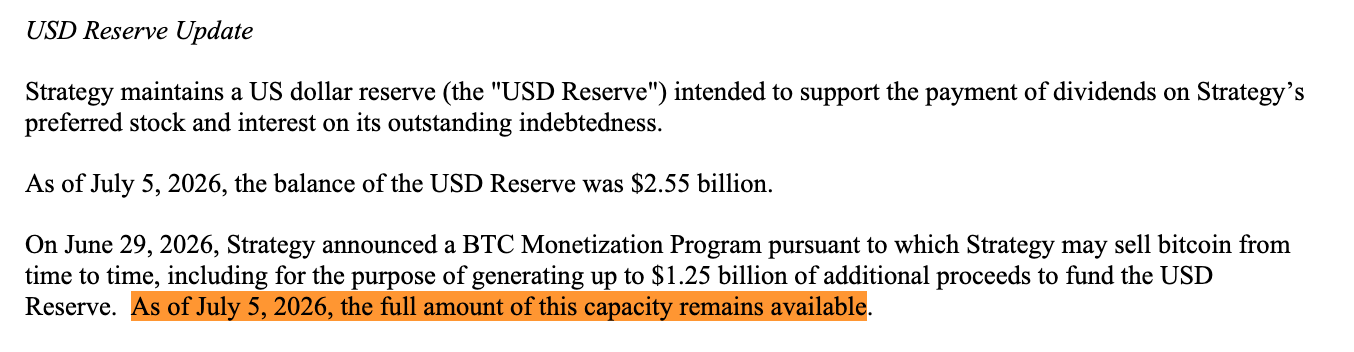
These funds were used to pay STR C dividends and replenish the USD Reserve previously used for dividend payments. Despite completing this sale, Strategy stated that its full $1.25 billion reserve-building capacity remains intact.

  • Odaily Note: In the "self-help plan" announced last week, Strategy had indicated it authorized the company to sell BTC to build a USD reserve of up to $1.25 billion.

In other words, the $216 million worth of BTC sold to replenish the reserve is not counted against the previously disclosed reserve-building capacity.

Strictly speaking, there is a technical distinction: one is "replenishing," and the other is "building." However, in practice, both types of sales ultimately flow into the same reserve pool for the same purpose, just categorized for different uses.

From another perspective, the previously disclosed "BTC Monetization Program" never limited Strategy to selling only $1.25 billion worth of Bitcoin in total; it only capped one specific funding pool — the sale of BTC to "build" the USD reserve.

The plan also permits Strategy to sell BTC for other purposes, which is exactly what we are seeing now.
Three Funding Pools

On June 29th, after weeks of pressure on MSTR and STR C, Strategy launched the aforementioned BTC "Monetization Program" as part of its broader "Digital Credit Capital Framework."

This plan allows Strategy to sell Bitcoin and actually mentions three primary uses:

  • First, to Build the reserve: Sell up to $1.25 billion worth of BTC to establish a USD Reserve.
  • Second, to Cover the preferreds: Sell BTC to cover Strategy's fixed dividend and interest obligations on its preferred shares and debt. If management deems it "more advantageous to sell BTC than issue common stock," they may also sell BTC to replenish reserve funds previously used to cover these obligations.
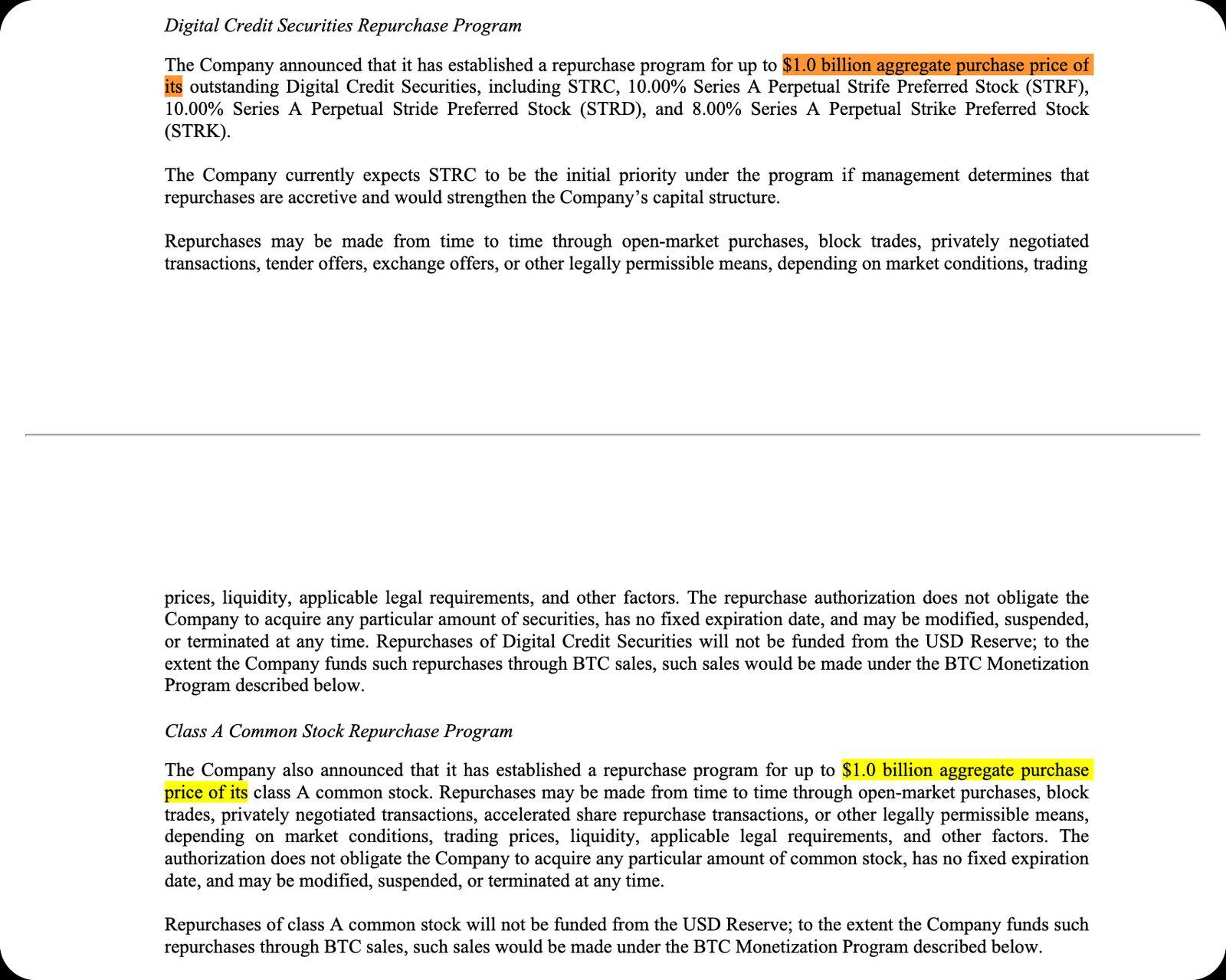
  • Third, to Fund buybacks: Sell BTC to repurchase up to $1 billion worth of preferred shares and up to $1 billion worth of MSTR common stock. Additionally, proceeds from BTC sales may also cover related taxes, fees, and other expenses.

At the time, the entire market discussion focused on the $1.25 billion cap for the first funding pool, but the reality is far more complex.

Looking solely at the third pool, it adds an additional $2 billion in potential sales. Therefore, even calculating only the parts with explicit caps, Strategy's currently designed BTC sale plan already exceeds $3 billion. This does not include the funding pool for paying dividends, interest, and replenishing the reserve — for which there is no disclosed cap.
Building vs. Replenishing

This is where it gets truly subtle.

The purpose of the USD Reserve is to pay these preferred share dividends and debt interest obligations. Under the current policy framework, it cannot be used for stock buybacks.

As of June 28th, Strategy's USD Reserve stood at $2.55 billion, sufficient to cover the company's annual obligations of approximately $1.76 billion for debt and preferred shares, providing about 17 months of coverage. The board has set a minimum requirement to maintain 12 months of coverage unless board-approved reductions occur.

This is why the distinction between "building" and "replenishing" the reserve is noteworthy.

  • Selling BTC before paying dividends to add cash to the reserve: This is defined as "building."
  • Using the reserve to pay dividends, then selling BTC to refill the reserve: This is defined as "replenishing."

The plan treats these as different categories, but they essentially accomplish the same thing — converting BTC into cash to cover preferred share dividends and interest payments.

These details were already disclosed in the documents, but the recent sale made this categorical distinction more apparent. Strategy sold $216 million worth of BTC, using the funds to pay dividends and replenish the reserve, while simultaneously announcing that its $1.25 billion reserve-building capacity remains intact.

Now, the market needs to start understanding Strategy's "proprietary language": "Building" and "replenishing" are essentially accounting classifications, but they determine whether Strategy's BTC sales count against the "public cap" the market sees.

From Hoarding to Active Capital Management

In the June 29th announcement, Michael Saylor stated that this framework reflects Strategy's need for "liquidity, discipline, and active capital management."

Strategy CEO Phong Le was more direct: "Strategy is shifting from a one-way capital issuance model to an active capital management model."

As Matt Walsh and Jeff Dorman from Castle Island explained in a podcast last week, Strategy has essentially evolved into an actively managed hedge fund.

The past Strategy narrative was simple: sell MSTR stock → buy Bitcoin → provide investors with leveraged BTC exposure. But the logic has now changed.

Today, Strategy is buying and selling different components within its own capital structure to manage the pressures between common stock (MSTR), preferred shares, the USD Reserve, and Bitcoin assets (BTC).

This dynamic also introduces new conflicts of interest. Walsh and Dorman pointed out:

  • Selling common stock can support preferred share dividends but depress MSTR's premium relative to its underlying BTC holdings.
  • Selling Bitcoin can extend the cash runway but further erode the core "never sell" narrative.
  • Supporting the preferred share system can maintain market confidence but depletes cash reserves.
  • Cutting preferred share dividends can protect liquidity but may cause preferred share prices to crash.

The so-called "reserve loophole" is an embodiment of this shift. Bitcoin is no longer just an asset for Strategy to accumulate; it is becoming a balance-sheet lever used to keep the preferred share system operational.

What We Will Ultimately See

Now, investors must assess Saylor's ability to operate this "machine" — each adjustment to one lever in the capital structure helps one part while potentially threatening another.

This is the most significant takeaway following the July 6th filing disclosure. Strategy is not out of options. It likely has more room to maneuver than what is apparent on the surface.

Don't continue to mistakenly believe that the $1.25 billion cap represents the total ceiling for Strategy's Bitcoin sales.

Today, Strategy has become an institution that the market must relearn to understand. Now, every proprietary term matters more:

  • Build
  • Replenish
  • Issue
  • Repurchase
  • Defend

Just as Fed watchers parse every punctuation mark in policy statements, the market must also deconstruct every term Strategy uses to gauge what it implies for future BTC sales.

By rolling out this plan, Strategy has secured greater flexibility for itself, but the underlying contradictions persist. This is no longer a simple "leveraged Bitcoin play." It has now become a bet on active capital management prowess.

Can Strategy consistently manage to "sell BTC," "replenish reserves," "issue securities," "repurchase stock," and "maintain the capital structure" without any one action undermining the others?

Personally, I wouldn't want to bet on it.

Trending Cryptos

Related Questions

QWhat are the three main purposes for which MicroStrategy's BTC Monetization Program allows the company to sell Bitcoin, according to the article?

AAccording to the article, MicroStrategy's BTC Monetization Program allows the company to sell Bitcoin for three main purposes: 1) To build a USD reserve (up to $1.25 billion). 2) To cover the costs of preferred shares and debt (covering fixed dividend and interest obligations). 3) To fund buyback programs (up to $1 billion for preferred shares and up to $1 billion for MSTR common stock).

QWhat is the key difference between 'building' and 'replenishing' the USD reserve, and why is this distinction important in understanding MicroStrategy's potential Bitcoin sales?

AThe key difference is an accounting classification. 'Building' refers to selling BTC and adding cash to the USD reserve *before* using it to pay obligations. 'Replenishing' refers to using the reserve cash to pay obligations (like dividends) first and *then* selling BTC to refill the reserve. This distinction is crucial because the publicly announced $1.25 billion cap applies only to 'building' the reserve. Sales for 'replenishing' do not count against this public limit, meaning the total potential BTC sales for reserve purposes is effectively uncapped.

QAccording to the article, what is the new narrative for MicroStrategy, shifting away from its previous simple model?

AThe article states that MicroStrategy's narrative has shifted from a simple model of 'selling MSTR stock → buying Bitcoin → providing leveraged BTC exposure' to becoming an 'actively managed hedge fund.' It is now actively buying and selling different components of its capital structure (common stock, preferred shares, USD reserve, Bitcoin assets) to manage the pressure and conflicts between them.

QWhat core conflict or dilemma does the article highlight regarding MicroStrategy's use of Bitcoin as a 'balance-sheet lever'?

AThe article highlights that Bitcoin is no longer just an asset for perpetual accumulation but has become a 'balance-sheet lever' used to maintain the preferred share system. This creates a core conflict: selling Bitcoin can extend cash flow and support the preferred share system, but it simultaneously weakens the foundational 'never sell' narrative that was central to the company's original investment thesis.

QWhat is the main conclusion or warning the article provides to investors regarding the $1.25 billion reserve-building capacity?

AThe main conclusion and warning is that investors should not mistake the $1.25 billion reserve-building capacity as the total upper limit for MicroStrategy's Bitcoin sales. When including the other authorized purposes (like funding buybacks and covering obligations without a stated cap), the designed potential sales exceed $3 billion, and sales for 'replenishing' the reserve are effectively unlimited within the framework. The company has given itself far more flexibility to sell BTC than the headline $1.25 billion figure suggests.

Related Reads

Top 8 DEXs of July 2026

This article presents the top 8 decentralized exchanges (DEXs) for July 2026, highlighting their key features and evolution within the DeFi space. DEXs, which enable peer-to-peer cryptocurrency trading via smart contracts without intermediaries, are praised for offering users greater control, privacy, transparency, and global access compared to centralized platforms. The listed DEXs are: 1. **Shadow Exchange**: A Sonic-native DEX specializing in concentrated liquidity for efficient trading and reduced slippage. 2. **Uniswap**: A leading protocol using an Automated Market Maker (AMM) model across multiple blockchains. 3. **SushiSwap**: An evolved platform offering token swaps, yield farming, and governance via its SUSHI token across 40+ networks. 4. **Orca**: A user-friendly AMM on Solana featuring capital-efficient "Whirlpools" for concentrated liquidity. 5. **Meteora**: A Solana-based DEX focusing on dynamic liquidity infrastructure and vaults for advanced strategies. 6. **Raydium**: A hybrid exchange on Solana combining AMM pools with a central limit order book for deep liquidity. 7. **Hyperliquid**: A Layer 1 blockchain hosting a non-custodial perpetual futures exchange using an on-chain order book. 8. **PancakeSwap**: A multi-chain AMM hub originating on BNB Chain, now supporting thousands of trading pairs across several networks. The article concludes by noting the significant role of DEXs in crypto, their expansion beyond simple swaps into areas like derivatives and cross-chain interoperability, and advises users to conduct their own research before engaging with any platform.

ambcrypto46m ago

Top 8 DEXs of July 2026

ambcrypto46m ago

USDT Market Cap Approaches Ethereum's: What Signal Does This Convey?

The market capitalization of USDT has nearly reached that of Ethereum, making it the second-largest cryptocurrency after Bitcoin. This prompts an examination of what this signifies and what it does not. Firstly, this does not relate to economic security. Unlike some Web3 systems where a governance token's value must underpin the security of its applications (e.g., oracles), USDT's stability is not backed by the value of the underlying blockchains it operates on. Tether, the issuer, controls the assets, and can freeze, reissue, or abandon tokens on a compromised chain. While stablecoins require functional blockchains, a chain's native token market cap does not provide direct security for the stablecoin. Secondly, USDT's growth does not inherently reflect poorly on Ethereum. USDT is a dollar-pegged store of value, while ETH represents a claim on future Ethereum network revenue. Their valuations are driven by different factors. USDT's rising market cap simply indicates strong demand for stablecoin utility, independent of Ethereum's technological merits or competitive position. The core insight is the overwhelming market demand for permissionless dollar transfers. This is the most established and essential use case in crypto. It requires minimal technological sophistication—essentially just a trusted issuer's promise of redemption on a functional chain. This explains why stablecoin supply has grown exponentially while the combined market cap of major non-stablecoin cryptocurrencies like Bitcoin, Ethereum, and others has stagnated for years. Users primarily seek accessible dollar-denominated assets. They largely disregard the issuer's credibility (as seen with Tether's dominance over more credible alternatives like USDC or BlackRock's BUIDL) and are indifferent to the governance or decentralization of the underlying blockchain. As long as a stablecoin is widely accepted and easy to transfer, users will adopt it across any chain. The trend suggests that the market for permissionless stablecoins could continue to expand far beyond the total value of the smart contract platforms that host them, driven by this singular, powerful use case.

Foresight News1h ago

USDT Market Cap Approaches Ethereum's: What Signal Does This Convey?

Foresight News1h ago

Trading

Spot

Hot Articles

How to Buy CAP

Welcome to HTX.com! We've made purchasing Cap (CAP) simple and convenient. Follow our step-by-step guide to embark on your crypto journey.Step 1: Create Your HTX AccountUse your email or phone number to sign up for a free account on HTX. Experience a hassle-free registration journey and unlock all features.Get My AccountStep 2: Go to Buy Crypto and Choose Your Payment MethodCredit/Debit Card: Use your Visa or Mastercard to buy Cap (CAP) instantly.Balance: Use funds from your HTX account balance to trade seamlessly.Third Parties: We've added popular payment methods such as Google Pay and Apple Pay to enhance convenience.P2P: Trade directly with other users on HTX.Over-the-Counter (OTC): We offer tailor-made services and competitive exchange rates for traders.Step 3: Store Your Cap (CAP)After purchasing your Cap (CAP), store it in your HTX account. Alternatively, you can send it elsewhere via blockchain transfer or use it to trade other cryptocurrencies.Step 4: Trade Cap (CAP)Easily trade Cap (CAP) on HTX's spot market. Simply access your account, select your trading pair, execute your trades, and monitor in real-time. We offer a user-friendly experience for both beginners and seasoned traders.

309 Total ViewsPublished 2026.06.26Updated 2026.06.26

How to Buy CAP

Discussions

Welcome to the HTX Community. Here, you can stay informed about the latest platform developments and gain access to professional market insights. Users' opinions on the price of CAP (CAP) are presented below.

活动图片