Opinion: EIP-8361 is a Meaningless and Counterproductive 'Helping Hand'—Ethereum Should Not Cut Off Its Own Arms

marsbitPublished on 2026-08-06Last updated on 2026-08-06

Abstract

Author: 0xTodd Discussion of the EIP-8361 proposal submitted by Ethereum France (organizer of ETHCC, considered a core Ethereum organization). In essence, this proposal aims to drastically reduce the APR for ETH staking. If the staking rate exceeds 50%, it would slash the yield to 0%. The author evaluates this as a meaningless and counterproductive proposal. The principle is that a functioning system should not be altered lightly, and Ethereum currently operates well. Based on the author's extensive experience with Ethereum staking, the current staking yield is only about 2.4%, less competitive than half the yield of U.S. Treasury bonds. For individual散户 stakers, solo staking收益 barely covers costs, resulting in minimal profit or even a slight loss, sustained mainly by dedicated supporters. Implementing EIP-8361 would push solo stakers into an untenable position, while large institutional stakers with fixed server costs would be less affected. Solo stakers are crucial for maintaining the decentralization of the Ethereum ledger. Regarding concerns about validator churn rates, the issue has already improved post the large-node era (2048 ETH), and adjusting the churn rate parameter is a low-risk, simple change. In contrast, slashing staking yields requires a hard fork,涉及 the core interests of ETH and could potentially lead to a new token split. For Ethereum in its current volatile state, this carries excessively high risk. The proposal is deemed毫无意义.

Author: 0xTodd

Let's talk about the EIP-8361 proposal submitted by Ethereum France (they are also the organizers of ETHCC, considered a core organization within Ethereum).

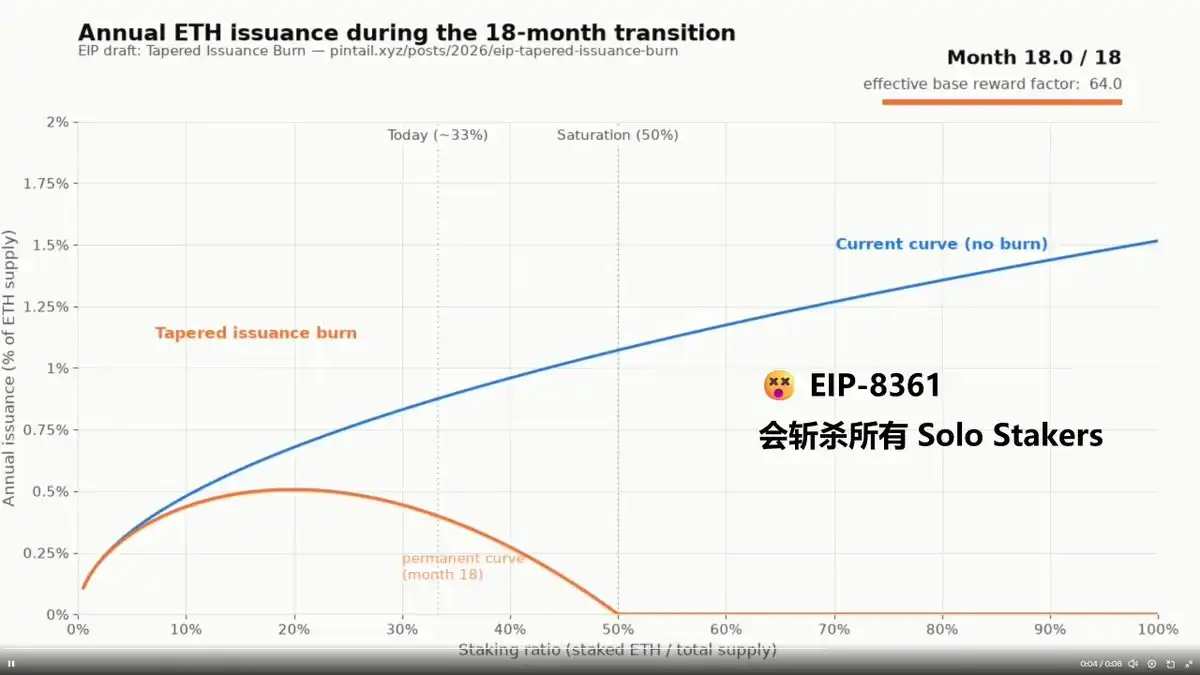
Essentially, this proposal boils down to drastically slashing the APR for $ETH staking.

If the staking ratio exceeds 50%, it would directly cut the yield to 0.

My assessment: A meaningless and counterproductive proposal.

As is well known, if a system is functioning properly, it should not be tinkered with lightly. Ethereum is currently in such a state.

Actually, having been involved in Ethereum staking for so long, I do have a say in this.

According to Ebunker, the current ETH Staking yield is a mere 2.4%, which isn't even half as competitive as U.S. Treasury bonds.

For the average Ethereum retail user, solo staking yields barely break even or even result in a slight loss, with very thin margins. It's the die-hard supporters who run Solo Staking.

If EIP-8361 were to go live, solo stakers would immediately enter the kill zone.

This wouldn't affect institutional stakers as much, given their larger volumes and fixed server costs.

For a protocol like Ethereum, Solo Stakers are crucial; they represent the decentralization of the Ethereum ledger.

As for the entry/exit queue (churn rate) concerns raised by Chairman Tychey, there's even less need to worry.

On one hand, improvements have already been made since the era of larger nodes (2048 ETH); on the other hand, modifying this churn rate requires merely changing a parameter with a flick of the fingers, carrying virtually no risk.

However, slashing Ethereum's yield to this extent also requires a hard fork to implement, as it involves the core interests of $ETH and could even potentially lead to the creation of a new token.

For Ethereum, which is currently in a precarious state, the risk is too high—comparable to childbirth.

This proposal is utterly meaningless.
Trending Cryptos

Related Questions

QAccording to the author, what is the main purpose of the EIP-8361 proposal discussed in the article?

AAccording to the author, the main purpose of the EIP-8361 proposal is to drastically reduce the APR (Annual Percentage Rate) for $ETH staking, potentially cutting the yield to 0% if the staking rate exceeds 50%.

QWhy does the author, 0xTodd, consider the EIP-8361 proposal to be "unhelpful"?

A0xTodd considers the proposal unhelpful because it would severely harm solo stakers, who are crucial for Ethereum's decentralization, by making their operations unprofitable or a loss, while larger institutional stakers with fixed server costs could better withstand the lower yields.

QWhat specific negative consequence does the author predict for solo stakers if EIP-8361 is implemented?

AThe author predicts that if EIP-8361 is implemented, solo stakers would 'directly enter the kill line,' meaning their staking operations would become financially unsustainable, leading to losses or barely breaking even.

QWhat reason does the author give for stating that the concern over 'churn rate' is not a problem needing this proposal?

AThe author states that the concern over churn rate (the rate of validators entering/exiting the network) is not a problem because it was already improved after the 'large node era' (2048 ETH), and adjusting this rate is a low-risk process that only requires changing a parameter.

QAccording to the author, why is implementing EIP-8361 a high-risk action for Ethereum at its current state?

AThe author believes implementing EIP-8361 is high-risk because it would require a hard fork that touches the core economic interests of $ETH staking. This carries significant technical and community coordination risks, potentially even leading to the creation of a new token, which is too dangerous for Ethereum in its currently 'turbulent' state.

Related Reads

Home Furnishing Listed Companies Are Trying to Turn Around with AI and Semiconductors

Chinese home furnishing listed companies are increasingly turning to AI and semiconductor cross-border ventures to revive their fortunes amid declining core businesses. A prominent example is PVC flooring giant **Elegant Home Furnishing**, whose stock price skyrocketed with 10 consecutive trading limits after announcing a plan to acquire a majority stake in **Ou Kang Nuo**, a semiconductor storage testing equipment and services company. Despite Elegant Home's own financial struggles—including recent losses and tight cash flow—the acquisition, funded through asset sales and loans, has dramatically boosted its market value. The deal involves a cross-shareholding structure with Ou Kang Nuo's controlling shareholder. This trend is widespread. Over the past year, numerous home furnishing firms with stagnant main operations have seen their stock prices surge after announcing moves into hot sectors like AI, semiconductors, or computing power. Key cases include: * **Markor Home Furnishings** ("high-end home furnishing first share"), after years of heavy losses, acquired an AI server high-speed copper cable company and later introduced AI computing power investors. * **Zhenai Meijia** ("blanket king") became the first A-listed manufacturer controlled by an AI large model company following a takeover. * **Fasilon** (integrated ceiling) saw its stock soar after establishing an AI subsidiary. * **Jinlong Decoration** experienced multiple trading limits after being linked to "commercial aerospace" and "AI computing," despite clarifying these segments contribute less than 1% of its business. Statistics show over 20 A-share companies announced semiconductor crossovers in 2025, with home furnishing and building materials firms being the most active. This shift is largely driven by pressures from the real estate downturn, shrinking overseas demand, and trade tariffs, pushing companies to seek growth through trendy concepts rather than core business improvement. However, the article warns that such speculative frenzies often end when the hype fades, leaving stock prices to eventually reflect the companies' weak fundamentals, as seen in Jinlong Decoration's subsequent sharp price correction. The repeated attempts to "ride the trend" highlight a desperate struggle for survival in a challenging traditional industry.

marsbit45m ago

Home Furnishing Listed Companies Are Trying to Turn Around with AI and Semiconductors

marsbit45m ago

"Sell America" Trade Resurfaces: Global Funds Reprice Washington Policy Risks, Dollar and Treasuries Bear the Brunt

"Sale of America" Trade Resurges as Global Funds Reprice Washington Policy Risks, Hitting Dollar and Treasuries First Recent policy signals from Washington are prompting global bond and foreign exchange investors to reignite the "Sale of America" debate. Uncertainty stems from Fed Chair Wash's shift towards less policy communication, Treasury Secretary Bessant's approval of joint intervention with Japan to support the Yen (the first such coordinated move in nearly 30 years), expanding fiscal deficits, and trade war fears. These factors are undermining confidence in U.S. assets. The 30-year Treasury yield recently broke above 5%, hitting a high not seen since 2007, while the Bloomberg Dollar Spot Index has fallen about 2% from its June peak. This dollar weakness is unusual given still-high U.S. interest rates. Investors cite policy uncertainty as a key driver, with one manager calling the Fed Chair and Treasury Secretary a "double whammy" creating a "Trump administration premium." While the S&P 500 continues hitting record highs and foreign holdings of U.S. Treasuries remain high, parts of the bond and FX markets are adjusting. A core concern is whether the Fed under Wash can effectively anchor inflation expectations; analysts warn that if the Fed lags the hiking cycle, long-end yields could face further upward pressure. The 30-year term premium has risen sharply. The U.S.-backed Yen intervention has also sparked debate on the dollar's structural outlook. While framed by Bessant as a "reallocation of reserves," market participants caution that if Japan—America's largest foreign creditor—must sell Treasuries to fund interventions, ripple effects could hit the bond market. Strategists predict moderate dollar depreciation ahead. Most experts are not predicting an end to dollar hegemony or the safe-haven status of Treasuries. However, a key underlying risk is highlighted: the pace of foreign buying of U.S. debt may not keep up with the speed of American borrowing, gradually eroding the structural advantages that have long supported "American exceptionalism."

marsbit46m ago

"Sell America" Trade Resurfaces: Global Funds Reprice Washington Policy Risks, Dollar and Treasuries Bear the Brunt

marsbit46m ago

Trading

Spot

Hot Articles

Discussions

Welcome to the HTX Community. Here, you can stay informed about the latest platform developments and gain access to professional market insights. Users' opinions on the price of ETH (ETH) are presented below.

活动图片