Metaplanet and Hut8 Withdraw $125 Million Worth of Bitcoin from Exchanges

cryptonews.ruPublished on 2026-08-12Last updated on 2026-08-12

Abstract

Metaplanet and Hut8 collectively withdrew approximately $125 million worth of Bitcoin from exchanges. Metaplanet moved 1,473 BTC off-exchange, followed by Hut8 transferring 493 BTC about two hours later. While neither company disclosed the specific reason for these transfers—which could be for cold storage, custodian change, or other financial purposes—large withdrawals from exchanges are generally viewed as a bullish signal for Bitcoin's supply. Metaplanet, a Tokyo-listed firm, has built one of the largest corporate Bitcoin treasuries outside the U.S., holding over 43,000 BTC valued at around $4.09 billion as of August 2026. Its strategy focuses on long-term accumulation, consistently buying and then moving coins to secure storage. Hut8, a mining and digital infrastructure provider, holds Bitcoin both as a treasury asset and as collateral for financing. It currently holds 10,278 BTC, ranking among the top 15 public corporate holders. Earlier in 2026, the company refinanced a $200 million Bitcoin-backed loan at a lower interest rate, freeing up collateral. The withdrawals occurred amid ongoing Bitcoin price volatility, with prices trading just below $64,000. The moves by these two significant corporate treasuries are seen as notable within the market context.

Metaplanet withdrew 1,473 $BTC from an exchange, and about two hours later, Hut8 followed suit by withdrawing 493 $BTC. Combined, these two transfers resulted in 1,966 $BTC (approximately $125 million) being removed from exchange control at once—all against the backdrop of Bitcoin's overall price decline this summer, which has pressured both treasury companies and miners.
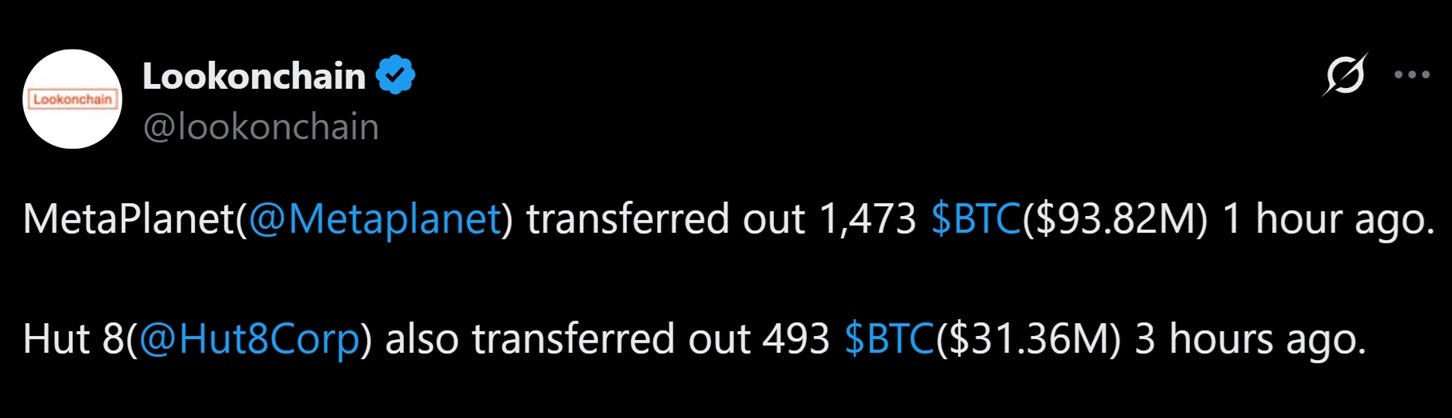
Image Source: X

Neither company has publicly explained the reasons for these specific transfers, and the move could simply indicate a move to cold storage, a custodian change, or a routine financial decision. Nevertheless, it's worth noting that when large holders withdraw Bitcoin from exchanges, it is typically viewed as a 'bullish' supply-side signal.

This information carries particular weight as it comes from known corporate treasuries like Metaplanet and Hut8.

Metaplanet's Broader Bitcoin Strategy

This Tokyo-listed company has built one of the largest corporate Bitcoin treasuries outside the United States. The purchase of 2,823 $BTC in early July increased its total assets to 43,000 $BTC, with the cumulative acquisition cost amounting to about $4.09 billion, making it the third-largest public corporate Bitcoin holder as of August 2026.

Furthermore, as reported by Bitcoin.com News in April, through active purchases in Q1 2026 alone, Metaplanet added 5,075 $BTC to its stockpile, bringing its holdings at that time to over 40,177 $BTC (a pace the company maintained throughout the summer).

However, this accumulation has not been fully reflected in Metaplanet's share price. Publications this month noted that the company's shares have struggled to find buyers, even as its Bitcoin reserves surpassed the 43,000 $BTC mark—this disconnect between asset growth and market reaction has been a recurring theme for Bitcoin-holding stocks in 2026.

Nevertheless, Metaplanet has built its strategy on long-term accumulation rather than trading, so the withdrawal from the exchange fits a pattern the company has repeated throughout the year: purchase first, then move the coins into long-term storage.

Hut8's Balance Between Mining and Holding

Hut8 operates differently from pure accumulation companies because, as a mining company and digital infrastructure provider, it holds $BTC both as a treasury asset and as collateral for financing. According to online treasury asset trackers, Hut8's total assets amount to 10,278 $BTC, placing it among the top 15 public corporate holders and representing approximately 0.065% of the total Bitcoin supply in circulation.
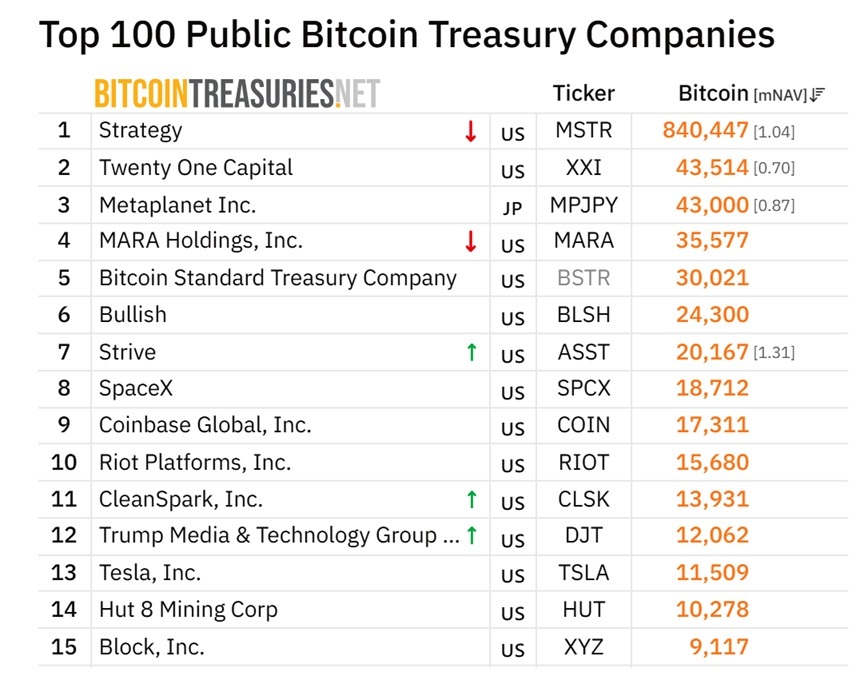
Image Source: Bitcointreasuries.net

Earlier in 2026, Hut8 refinanced a $200 million Bitcoin-backed credit facility in a new deal with FalconX, lowering the interest rate from 9% to 7% and freeing approximately 3,300 $BTC that were pledged as collateral. In its Q2 2026 results report, the company also reported having no debt with full recourse at the parent company level after converting the Coatue note, part of broader efforts to shift to non-dilutive project-level financing for expanding its data centers. This context serves as a reminder that not every movement in Hut8's wallet indicates a direct purchase.

Neither Metaplanet nor Hut8 has confirmed the destination of the withdrawn coins, and blockchain data alone cannot distinguish a transfer to cold storage from a trade being executed. Additionally, these withdrawals occurred during a period of Bitcoin price volatility, with the cryptocurrency trading just below $64,000 after being stuck below the $65,200 level reached earlier in the week.


Trending Cryptos

Related Questions

QHow many Bitcoins were withdrawn from exchanges by Metaplanet and Hut8 combined, and what is their approximate USD value?

AMetaplanet and Hut8 withdrew a combined total of 1,966 BTC, which is worth approximately $125 million.

QWhat are the two primary interpretations for why major holders like Metaplanet and Hut8 would withdraw Bitcoin from exchanges?

AThe withdrawals could represent a move to cold storage, a change in custodian, or routine financial management. However, such large-scale withdrawals from exchanges are typically interpreted as a bullish supply-side signal.

QWhat is Metaplanet's overall Bitcoin accumulation strategy, and how does this recent withdrawal fit into it?

AMetaplanet's strategy is based on long-term accumulation rather than trading. The pattern is to first purchase Bitcoin and then move the coins into long-term storage, which is consistent with this recent withdrawal from an exchange.

QHow does Hut8's relationship with Bitcoin differ from a pure accumulation company like Metaplanet?

AUnlike pure accumulation companies, Hut8 is a mining and digital infrastructure provider. It holds Bitcoin both as a treasury asset and as collateral for financing its operations and expansion.

QWhat significant financial move did Hut8 make earlier in 2026 related to its Bitcoin holdings?

AEarlier in 2026, Hut8 refinanced a $200 million Bitcoin-backed credit facility with FalconX. This deal lowered the interest rate from 9% to 7% and freed up approximately 3,300 BTC that had been used as collateral.

Related Reads

El Salvador’s Bitcoin experiment turns 5: ‘It was for us, not them’

Five years after becoming the first country to adopt Bitcoin as legal tender, El Salvador's national experiment is widely viewed as a failure based on its original stated goals of banking the unbanked, slashing remittance costs, and attracting major foreign investment. Research indicates mass adoption by citizens never occurred; Bitcoin use remained concentrated among young, urban, educated, and already banked males. The government's Chivo wallet failed to address core barriers to financial inclusion, and Bitcoin accounted for barely 1% of remittances by 2024, offering little advantage as most funds arrive in US dollars. Following a 2024 IMF financing deal, El Salvador scaled back its involvement, making Bitcoin acceptance voluntary and limiting state use. However, the experiment undeniably changed the global conversation, turning nation-state Bitcoin adoption from theory into reality and positioning El Salvador at the center of the Bitcoin movement. It provided a proof of concept and a global platform, attracting prominent Bitcoin advocates. Success stories exist in localized economies like Bitcoin Beach, but analysts note the project's symbolic benefits were largely "for" the international Bitcoin community rather than "for" the economic transformation of most Salvadorans. The assessment is further complicated by President Nayib Bukele's popular, yet authoritarian, governance style, which delivered drastically improved security but raised concerns about centralized power and civil liberties. Ultimately, Bitcoin gave Bukele a global stage, and Bukele gave Bitcoin its first national adoption test.

cointelegraph14m ago

El Salvador’s Bitcoin experiment turns 5: ‘It was for us, not them’

cointelegraph14m ago

Trading

Spot

Hot Articles

What is $BITCOIN

DIGITAL GOLD ($BITCOIN): A Comprehensive Analysis Introduction to DIGITAL GOLD ($BITCOIN) DIGITAL GOLD ($BITCOIN) is a blockchain-based project operating on the Solana network, which aims to combine the characteristics of traditional precious metals with the innovation of decentralized technologies. While it shares a name with Bitcoin, often referred to as “digital gold” due to its perception as a store of value, DIGITAL GOLD is a separate token designed to create a unique ecosystem within the Web3 landscape. Its goal is to position itself as a viable alternative digital asset, although specifics regarding its applications and functionalities are still developing. What is DIGITAL GOLD ($BITCOIN)? DIGITAL GOLD ($BITCOIN) is a cryptocurrency token explicitly designed for use on the Solana blockchain. In contrast to Bitcoin, which provides a widely recognized value storage role, this token appears to focus on broader applications and characteristics. Notable aspects include: Blockchain Infrastructure: The token is built on the Solana blockchain, known for its capacity to handle high-speed and low-cost transactions. Supply Dynamics: DIGITAL GOLD has a maximum supply capped at 100 quadrillion tokens (100P $BITCOIN), although details regarding its circulating supply are currently undisclosed. Utility: While precise functionalities are not explicitly outlined, there are indications that the token could be utilized for various applications, potentially involving decentralized applications (dApps) or asset tokenization strategies. Who is the Creator of DIGITAL GOLD ($BITCOIN)? At present, the identity of the creators and development team behind DIGITAL GOLD ($BITCOIN) remains unknown. This situation is typical among many innovative projects within the blockchain space, particularly those aligning with decentralized finance and meme coin phenomena. While such anonymity may foster a community-driven culture, it intensifies concerns about governance and accountability. Who are the Investors of DIGITAL GOLD ($BITCOIN)? The available information indicates that DIGITAL GOLD ($BITCOIN) does not have any known institutional backers or prominent venture capital investments. The project seems to operate on a peer-to-peer model focused on community support and adoption rather than traditional funding routes. Its activity and liquidity are primarily situated on decentralized exchanges (DEXs), such as PumpSwap, rather than established centralized trading platforms, further highlighting its grassroots approach. How DIGITAL GOLD ($BITCOIN) Works The operational mechanics of DIGITAL GOLD ($BITCOIN) can be elaborated on based on its blockchain design and network attributes: Consensus Mechanism: By leveraging Solana’s unique proof-of-history (PoH) combined with a proof-of-stake (PoS) model, the project ensures efficient transaction validation contributing to the network's high performance. Tokenomics: While specific deflationary mechanisms have not been extensively detailed, the vast maximum token supply implies that it may cater to microtransactions or niche use cases that are still to be defined. Interoperability: There exists the potential for integration with Solana’s broader ecosystem, including various decentralized finance (DeFi) platforms. However, the details regarding specific integrations remain unspecified. Timeline of Key Events Here is a timeline that highlights significant milestones concerning DIGITAL GOLD ($BITCOIN): 2023: The initial deployment of the token occurs on the Solana blockchain, marked by its contract address. 2024: DIGITAL GOLD gains visibility as it becomes available for trading on decentralized exchanges like PumpSwap, allowing users to trade it against SOL. 2025: The project witnesses sporadic trading activity and potential interest in community-led engagements, although no noteworthy partnerships or technical advancements have been documented as of yet. Critical Analysis Strengths Scalability: The underlying Solana infrastructure supports high transaction volumes, which could enhance the utility of $BITCOIN in various transaction scenarios. Accessibility: The potential low trading price per token could attract retail investors, facilitating wider participation due to fractional ownership opportunities. Risks Lack of Transparency: The absence of publicly known backers, developers, or an audit process may yield skepticism regarding the project's sustainability and trustworthiness. Market Volatility: The trading activity is heavily reliant on speculative behavior, which can result in significant price volatility and uncertainty for investors. Conclusion DIGITAL GOLD ($BITCOIN) emerges as an intriguing yet ambiguous project within the rapidly evolving Solana ecosystem. While it attempts to leverage the “digital gold” narrative, its departure from Bitcoin's established role as a store of value underscores the need for a clearer differentiation of its intended utility and governance structure. Future acceptance and adoption will likely depend on addressing the current opacity and defining its operational and economic strategies more explicitly. Note: This report encompasses synthesised information available as of October 2023, and developments may have transpired beyond the research period.

1.8k Total ViewsPublished 2025.05.13Updated 2025.05.13

What is $BITCOIN

Discussions

Welcome to the HTX Community. Here, you can stay informed about the latest platform developments and gain access to professional market insights. Users' opinions on the price of BTC (BTC) are presented below.

活动图片