It’s been five years since El Salvador became the first country to adopt Bitcoin as legal tender.
President Nayib Bukele announced the plan at the Bitcoin conference in Miami on June 5, 2021, to the jubilant cries and applause of the Bitcoin community, who hailed the tiny Central American nation as living proof that BTC could be sovereign money.
Bukele sold the experiment as a way to bank the unbanked, slash remittance costs, and attract investment to the impoverished nation.
But five years on, who did the experiment benefit, and what did it actually achieve?
Dr. Tobias Boos, a senior scientist at the University of Vienna who leads a research project examining the political economy of Bitcoin in El Salvador, tells Magazine:
“There is little doubt that the project was a failure if we take seriously the reasons Bukele gave for its adoption. Foreign direct investment in this sector didn’t increase, it did not effectively bank the unbanked, and it is not widely used for remittances.”
Yet El Salvador’s Bitcoin bet undeniably changed the conversation around the world’s number-one cryptocurrency, and turned nation-state adoption from a theoretical possibility into a living, breathing reality. Whether it succeeded or failed depends on what you think El Salvador was trying to achieve.
Five years into El Salvador’s Bitcoin bet
In a video message played at Bitcoin 2021, Bukele said the adoption of Bitcoin would generate jobs in the short term and “help provide financial inclusion to thousands outside the formal economy.”
Today, the evidence for mass adoption is difficult to square with that ambition.
Research by Boos, Grigera and Schmid in 2025 found that the Salvadorans who adopted Bitcoin tended to be young, male, urban, more highly educated, and, perhaps more importantly, already banked. Boos concludes that, “Mass adoption by citizens did not occur.”
El Salvador had one of the region’s lowest levels of banking access at the time, with just 35.9% of people over 15 holding a bank account in 2021, according to World Bank data.
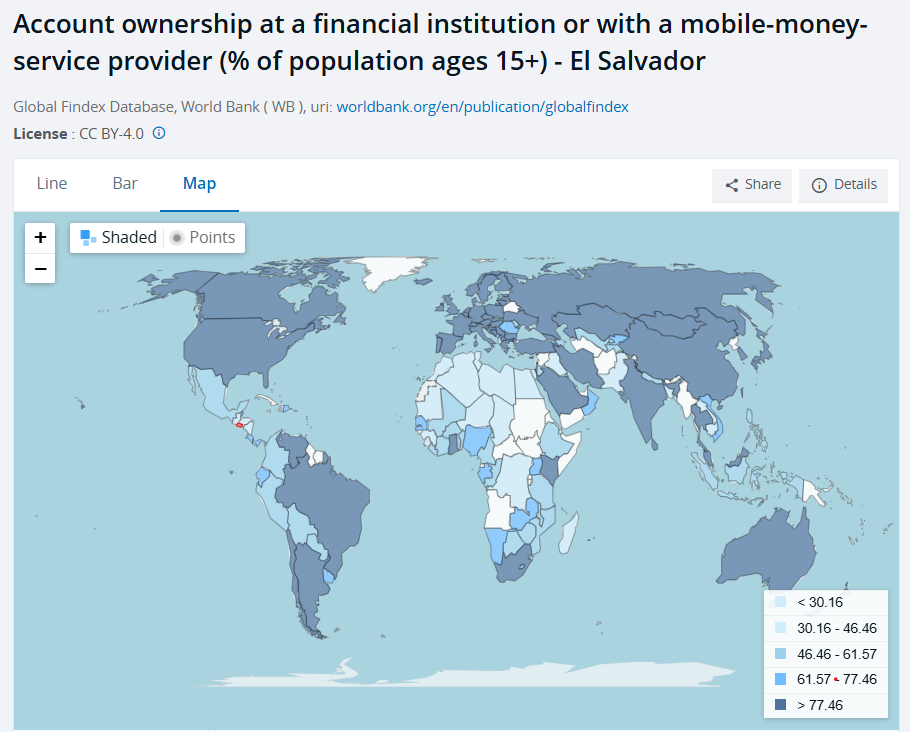
Account ownership at a financial institution (% of population ages 15+) - El Salvador. Source: World Bank
Yet the government’s Chivo Bitcoin wallet did little to solve the problem: it could transfer funds to bank accounts, but didn’t remove the underlying barriers preventing unbanked Salvadorans from accessing the financial system in the first place.
According to Boos and his colleagues, the same problem emerged with remittances, another pillar of Bukele’s pitch. In 2024, remittances accounted for around 24% of El Salvador’s gross domestic product, with the United States providing a full 98% of the total. But El Salvador adopted USD as its official currency more than 20 years ago, and having most remittances arrive from a country with the same currency removed one of the major cost reductions that Bitcoin could theoretically offer: currency conversion.
Related: Bitcoin will never fall below $60K again: Nansen founder
Despite the promise that Bitcoin could make these transfers cheaper, crypto wallets accounted for barely 1% of remittances by 2024, down from a peak of 1.7% in 2020-21.
It suggests the government’s early efforts to stimulate adoption failed to translate into sustained use. Chivo offered users $30 in Bitcoin for signing up, but the National Bureau of Economic Research’s nationally representative research found that more than 60% of early Chivo users never made another transaction after spending their free BTC.
Joe Nakamoto, a Bitcoin-focused journalist who has repeatedly reported from El Salvador, found a similar disconnect on the ground.
In a recent video documenting one of his visits, he said he tested Bitcoin acceptance at 21 shops in a San Salvador mall, and found that only four accepted Bitcoin, and just one did so smoothly. He tells Magazine:
“It’s very, very hard, borderline impossible to genuinely live on Bitcoin in El Salvador. Unless you’re just eating pupusas on the beach in El Zonte, and then going across to the other Bitcoin circular economies and finding workarounds.”
When the IMF pulled the plug
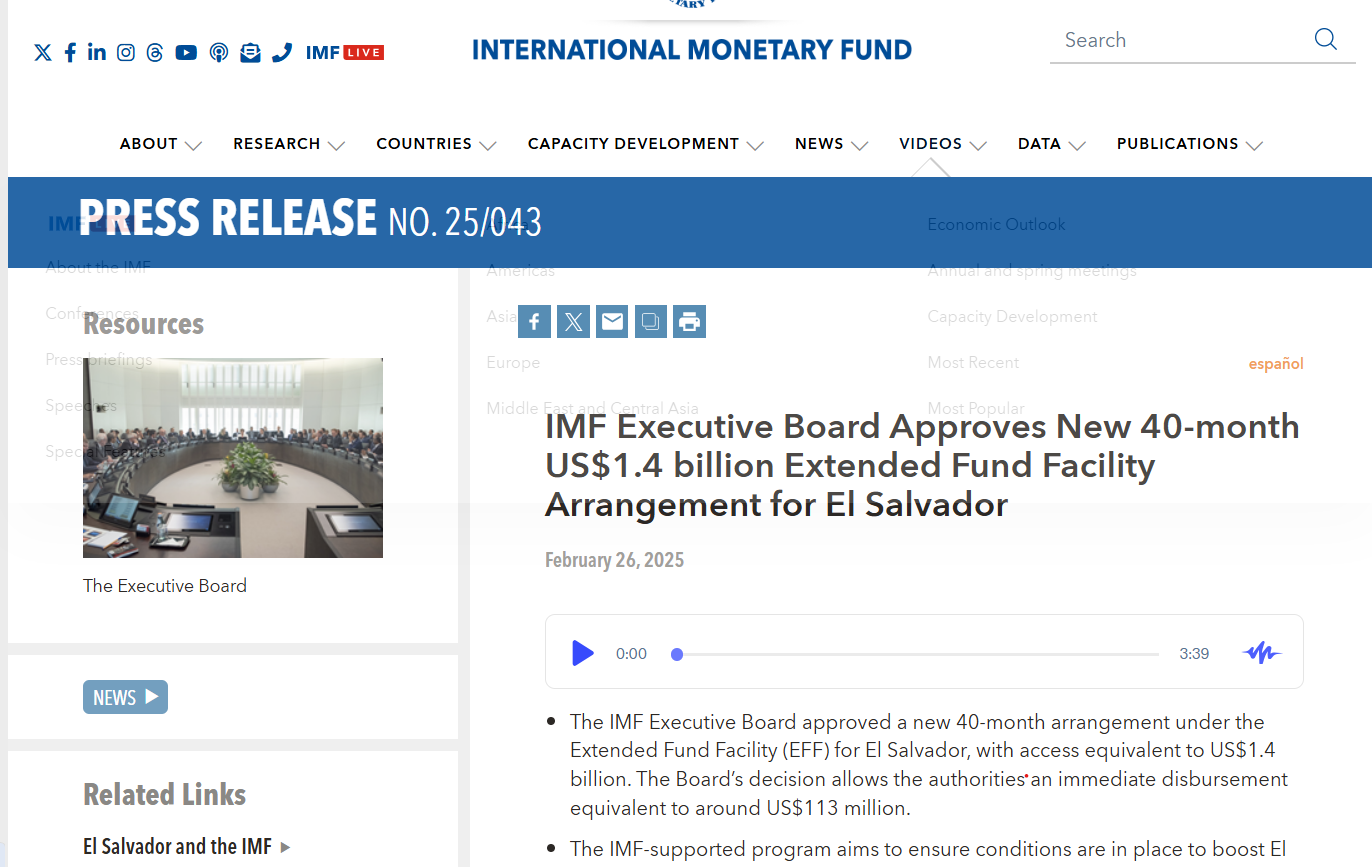
The government has also faced international pressure to retreat from its Bitcoin experiment. In December 2024, it reached a $1.4 billion financing agreement with the International Monetary Fund, under which it agreed to scale back its involvement in Bitcoin.
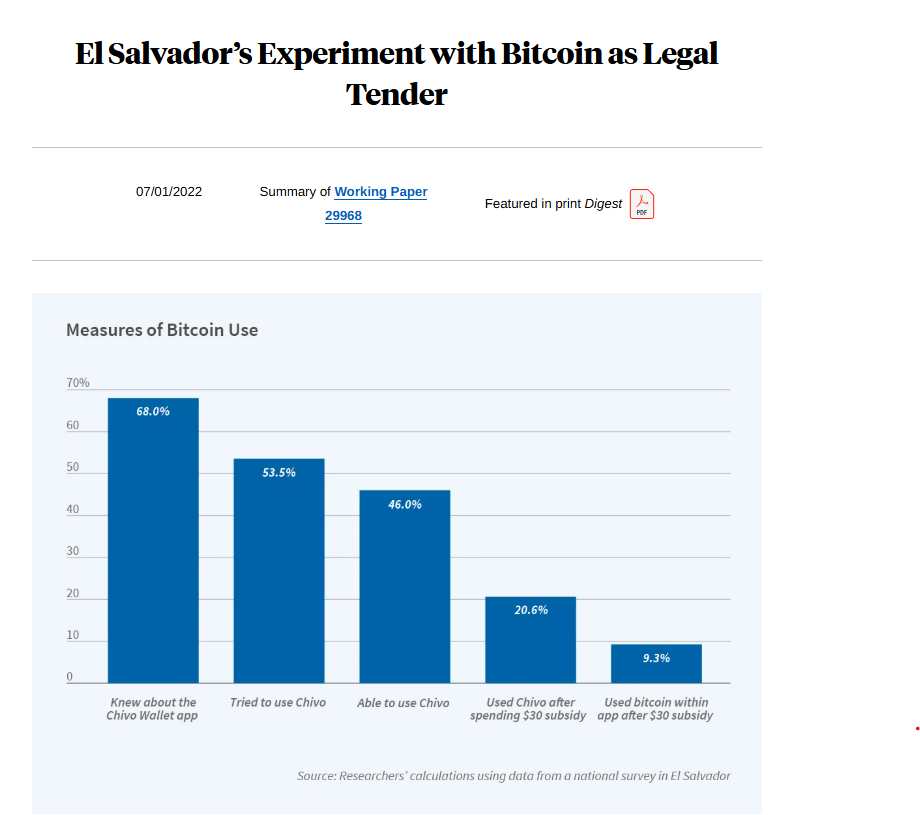
El Salvador’s experiment with Bitcoin as Legal Tender. Source: NBER
The deal was approved in February 2025, and in January, the government amended its Bitcoin law to make acceptance voluntary, require taxes to be paid in US dollars and limit public sector involvement in Bitcoin-related activities, effectively dismantling the most radical parts of Bukele’s experiment.
While Bitcoin could still be used voluntarily, the state no longer compelled businesses to accept it or used it as part of the country’s public financial system.
The IMF later found that Bitcoin had produced “no evidence” of a beneficial use case for the unbanked and had had minimal impact on financial inclusion. Boos says:
“The ‘soft adoption,’ as we refer to it in one of our articles, never led to mass adoption for payments. I am not aware of any instances where tax payments were made using Bitcoin, and the infrastructure has largely remained unused.”
What Bitcoin actually did achieve
If El Salvador failed to turn Bitcoin into everyday money, it still managed something no country had done before: it made nation-state Bitcoin adoption real.
Before 2021, the idea of a government adopting Bitcoin was still largely hypothetical; El Salvador made it real. As Samson Mow, chief executive of Bitcoin infrastructure firm JAN3, tells Magazine:
“The question in front of every president or finance minister shifted from whether a sovereign could hold Bitcoin to why it hadn’t.”
The experiment also thrust El Salvador into the center of the global Bitcoin movement, with many prominent Bitcoiners, including Max Keiser and Stacy Herbert, making Bitcoin country their new home. Herbert later became director of El Salvador’s National Bitcoin Office, showing just how closely intertwined parts of the Bitcoin movement have become with the government.
Related: IMF says tokenization could transform settlement and financial stability
Bitcoin Beach, the grassroots project in El Zonte that predated the national experiment, is still one of the clearest examples of a functioning Bitcoin economy, with local businesses, hotels and tourism operators continuing to accept Bitcoin, even after the government made acceptance voluntary.
Nakamoto’s reporting has also documented several concrete success stories for everyday Salvadorans, including Mama Rosa, who saves Bitcoin from her pupusa stand, and Napo, who expanded from one taxi to a fleet.
Bukele’s government even went further than simply holding BTC on its balance sheet or making it legal tender by promoting plans for Volcano Bonds and Bitcoin City.
After repeated delays, the IMF agreement effectively kneecapped those projects’ progress, but the symbolic impact still matters. Mow explains:
“Bitcoin gained a proof of concept, and El Salvador gained a global platform.”
There’s also an important distinction between what El Salvador achieved for Bitcoin and what Bitcoin achieved for El Salvador.
Boos argues that the symbolic significance has largely been “for” the international Bitcoin community, rather than evidence of economic success “in” El Salvador. Nakamoto says:
“It looks more like a marketing campaign for foreigners than a genuine economic strategy for Salvadorans. It’s beautiful branding, pointed at people with the passports and the capital. Bukele is a razor-sharp operator. He knows exactly who’s watching and who’s clapping. The Bitcoin country strategy, it’s not for them. It breaks my heart to say it, but it’s for us.”
The uncomfortable part: Bitcoin and Bukele
Perhaps the hardest question is what El Salvador’s Bitcoin experiment says about the relationship between Bitcoiners’ ideals of individual freedom and the government that imposed it.
IMF Executive Board approves 40-month fund facility. Source: IMF
Bukele has concentrated power during his time in office, and the state of emergency introduced to combat gang violence in March 2022 remains in place more than four years later.
Human Rights Watch says the government has continued to remove checks on executive power, and local and international human rights groups have documented mass arbitrary detention and due process violations under the state of emergency.
But judging Bukele only through that lens risks missing why he remains so popular at home. El Salvador was once in the grip of powerful gangs, with many Salvadorans living with daily threats of extortion, violence and death. The official homicide rate fell from 53.1 per 100,000 people the year he took office, to just 1.3 per 100,000 in 2025.
Bukele’s crackdown has transformed public security, and many Salvadorans view the trade-off between security and civil liberties very differently from critics abroad. Nakamoto says:
“It’s a country that has serious scars. Bukele has saved the nation in many ways. He kicked out the gangs and also he has done wonderful things for Bitcoin in terms of putting it on the world map.”
While Mow acknowledges the positive impact of Bukele’s gang crackdown, he says the broader implications of normalizing emergency powers cannot be ignored:
“In the hands of someone with restraint, those same powers can accomplish real things, like El Salvador’s crackdown on the gangs. But it’s important to think ahead. What serves a leader with restraint today can just as easily serve one without restraint once there’s a change of guard.”
For Bitcoiners, that leaves an uncomfortable tension. El Salvador’s Bitcoin experiment has become inseparable from the government that made it possible, and from a president whose record is far more complicated than the Bitcoin success story alone suggests.
That may ultimately be the most difficult part of assessing El Salvador five years on: Bitcoin gave Bukele a global platform, and Bukele gave Bitcoin something it had never had before — a nation-state willing to put it at the center of its economic strategy.
Magazine: Strategy became a symbol of the dot-com crash: Could history repeat?