From 'Old Dogs' to 'New Darlings': How AI is Revaluing Old Infrastructure, from Dell to Nokia

marsbitPublished on 2026-06-05Last updated on 2026-06-05

Abstract

"Old Dogs" Become AI's New Darlings: Revaluing Legacy Infrastructure The AI investment narrative is shifting. Beyond the spotlight on core chipmakers like Nvidia, a new wave of interest is rising for legacy tech companies—Dell, HPE, Nokia, Cisco, Corning, Western Digital—once labeled as slow-growth, outdated stories. This resurgence stems from AI's evolution from model development to real-world deployment, creating massive demand for physical infrastructure. As AI moves into data center construction and enterprise adoption, the focus turns to who can actually build and deliver complex systems. These established players hold decades of experience in supply chains, integration, networking, and enterprise delivery—assets now critical for scaling AI. The revaluation can be grouped into three key infrastructure areas: 1. **Servers & Integration (e.g., Dell, HPE):** They are becoming essential system integrators, transforming GPUs into full-scale AI servers with networking, power, and cooling, then delivering them to clients. Strong recent earnings and AI-specific revenue/order growth for Dell and HPE underscore this shift. 2. **Networking & Connectivity (e.g., Corning, Nokia, Cisco):** As AI clusters grow, high-speed data transfer becomes paramount. Corning benefits from fiber demand for data center links, Nokia is exploring AI-integrated wireless networks (AI-RAN), and Cisco sees surging orders for data center switches—all critical for efficient AI operations. 3. **Storag...

By Jim, MSX Maitong

A year ago, if someone told you that Dell, Nokia, Cisco, Corning, Western Digital, etc., would once again become hot stocks in the AI trade, you'd probably think they were out of touch...

After all, for a very long time, the market's first reaction when talking about AI was typically NVIDIA, memory, optical modules, power, and data centers. They were either close enough to GPUs or directly in the hottest part of the computing power expansion. In contrast, old-guard tech companies like Dell, HPE, Nokia, Cisco, Corning, and Seagate were more often labeled as 'slow growth,' 'old story,' and 'no valuation elasticity.'

Yet, this very group of old-guard tech stocks, which previously seemed less sexy, has recently performed quite brightly, leading the market to start re-discussing them.

The market quickly and adaptively found the appropriate angle of interpretation: As AI moves from model parameters to real data centers, the market naturally begins to re-evaluate companies with proven delivery and infrastructure capabilities. This is why Dell, HPE, Nokia, etc., are being seen anew.

So, is this a genuine industry revaluation, or just a new narrative temporarily slapped onto these old tech stocks by the market?
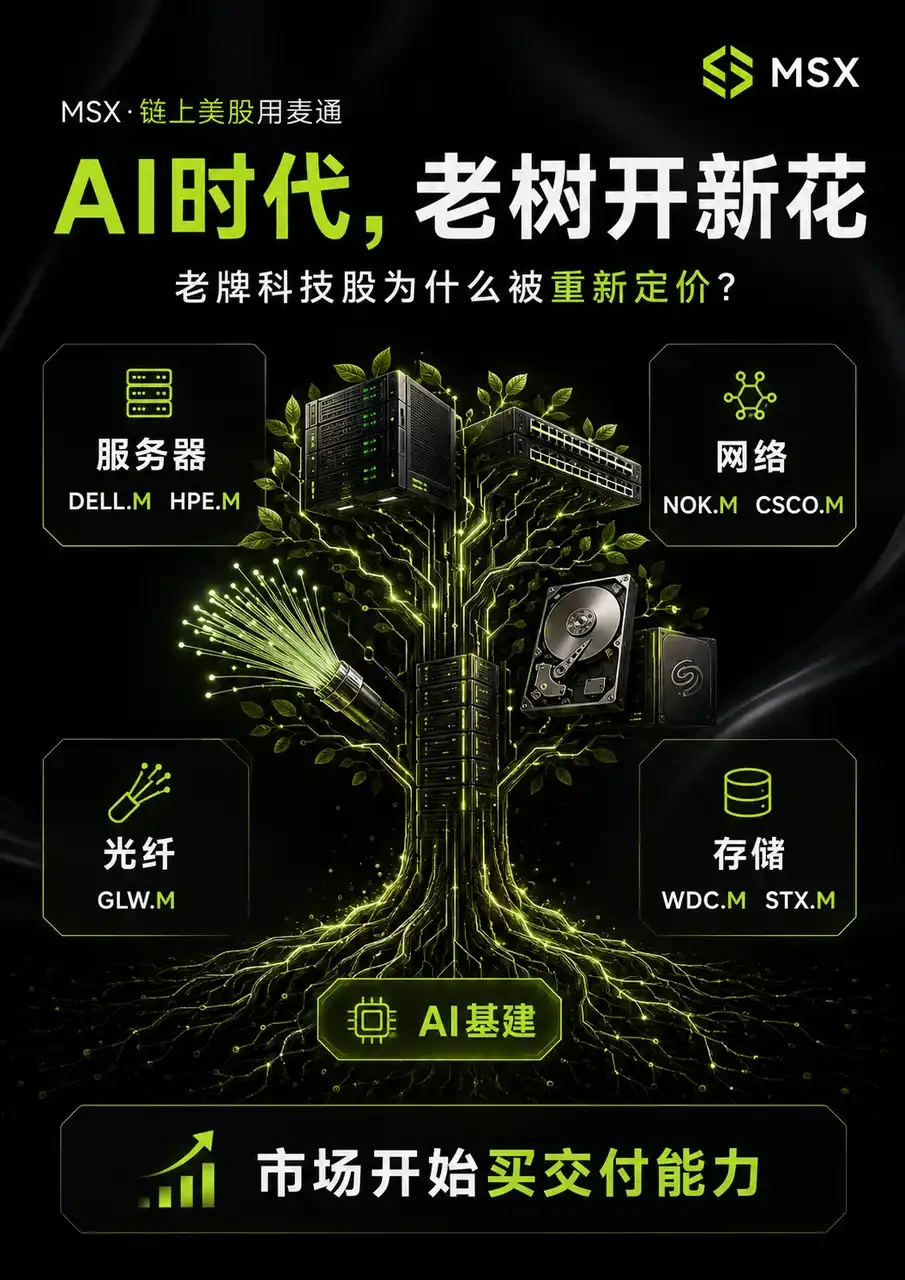
I. The AI Rally Shifts Gears: Why Revalue Old-Guard Tech Stocks?

Over the past few years, the core thread of the AI trade has been very clear: first look at the models, then look at the computing power.

This is easy to understand. Those with the strongest models or access to the most GPUs received the most direct market premium. In this phase, investors were most willing to buy AI imagination, the computing power supply gap, and core beneficiaries like NVIDIA.

However, the issue is that AI cannot remain solely in press conferences and model parameters. After all, models need data centers to be trained; inference needs servers, networks, storage, and power to be deployed at scale; and for enterprises to truly use AI, they need complete IT architectures and delivery capabilities.

In other words, AI isn't a problem solved by a single GPU; it's an entire complex systems engineering challenge. This is also the starting point for the re-pricing of old-guard tech companies.

Previously, the market might have seen Dell and thought of PCs and traditional servers; seen HPE and thought of enterprise hardware; seen Nokia and thought of the old 5G equipment story; seen Cisco and thought of traditional networking gear; seen Corning and thought of glass and fiber materials; seen Western Digital and Seagate and thought of the hard drive cycle.

These labels aren't wrong, but in the AI infrastructure build-out cycle, their roles have changed. Building AI data centers requires rack-scale servers, liquid cooling, storage, network switches, fiber connectivity, data management, power infrastructure, and enterprise-grade delivery capabilities. The larger the AI cluster, the higher the demands on system integration, network transmission, storage capacity, and operational capabilities.

Therefore, the essence of this revaluation isn't a sudden wave of market nostalgia, nor old companies collectively jumping on the AI bandwagon. Instead, as AI moves into the order, revenue, and delivery phase, the market is starting to re-evaluate 'who can actually build the AI infrastructure.'

These companies may not be the sexiest, but they share a common advantage: their decades of accumulated customers, channels, supply chains, delivery experience, and infrastructure capabilities are becoming valuable again during the large-scale AI deployment phase.

In other words, AI is placing a batch of 'old assets' into a 'new demand' context for re-pricing.

II. From Servers, Networks to Storage: Old-Guard Tech Stocks Are Being Placed in the AI Infrastructure Chain

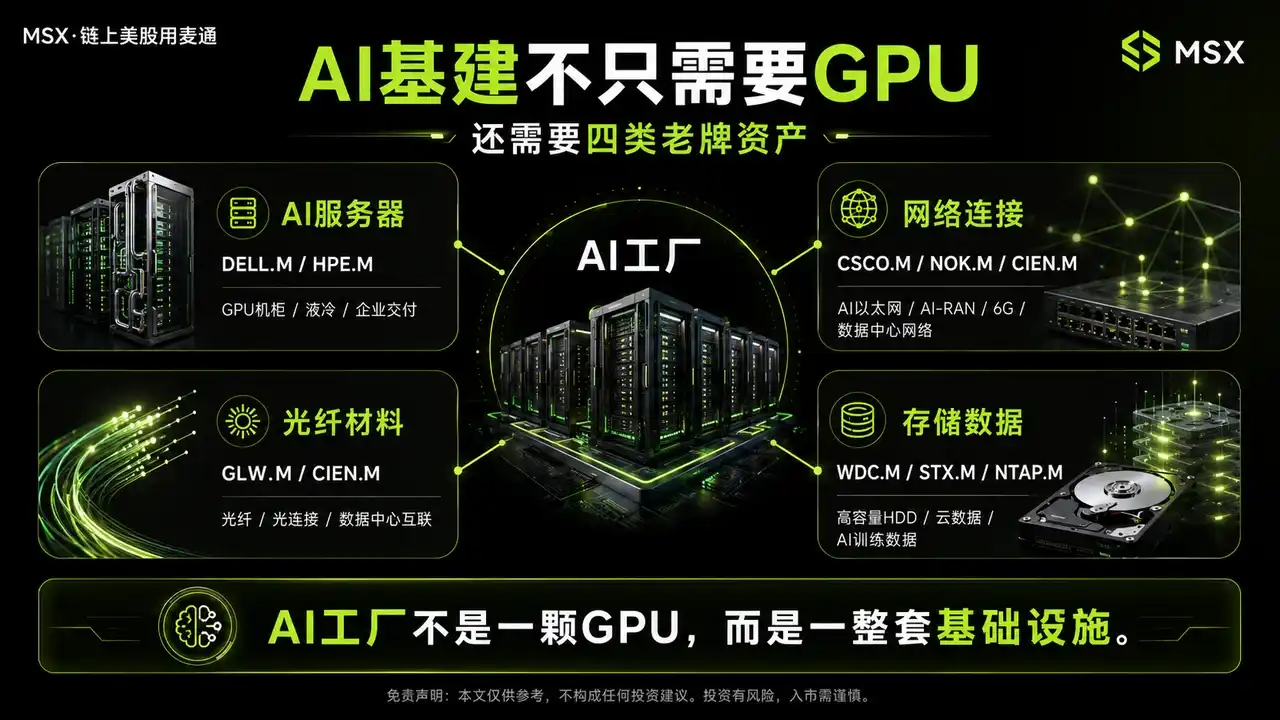
Overall, this round of AI-driven revaluation of old-guard tech stocks can roughly be divided into three lines: Servers & System Integration, Networking & Connectivity, and Storage & Data Management.

The first line is servers and system integration.

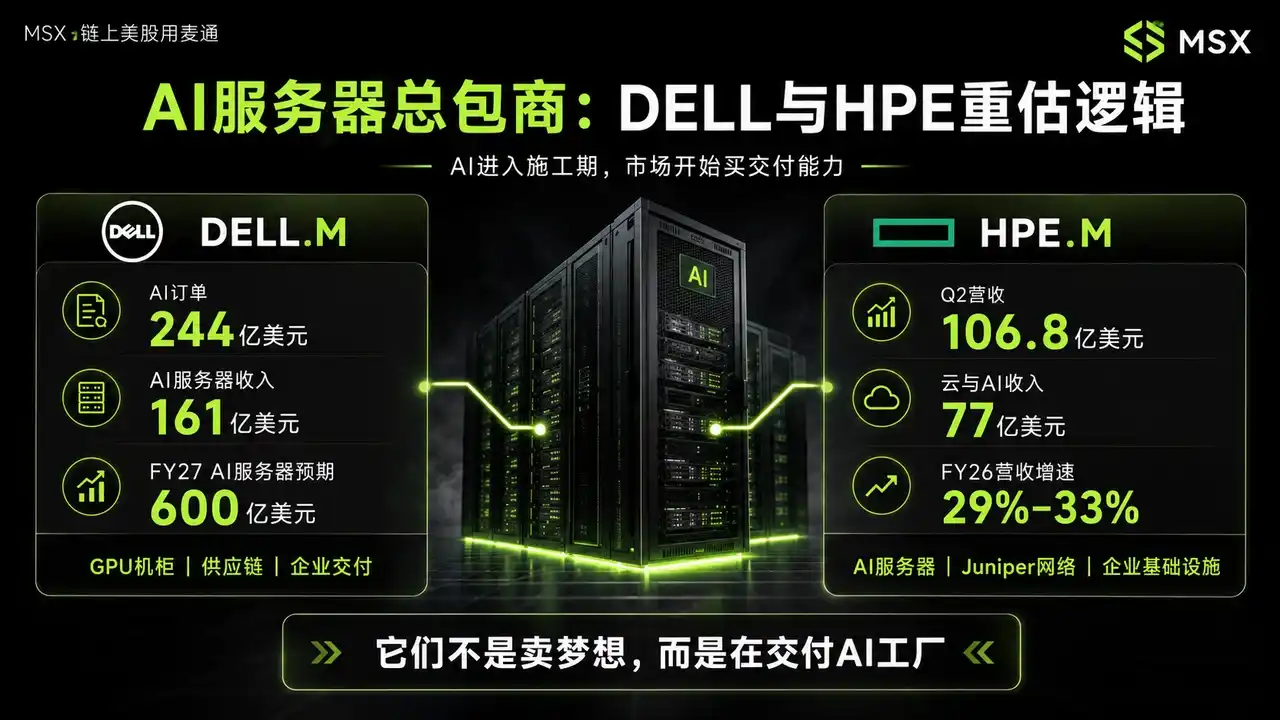
Dell is the most typical example. In its latest quarterly earnings, Dell delivered very strong numbers: Q1 FY27 revenue reached $43.8 billion, AI orders reached $24.4 billion, and it recognized $16.1 billion in AI server revenue. The company also raised its full-year FY27 AI server revenue expectation to $60 billion and raised its full-year revenue guidance midpoint to $167 billion.

These numbers are significant because they change how the market views Dell. Previously, investors looked at Dell mostly through the lens of the PC cycle, traditional servers, and enterprise hardware demand. But now, the market is starting to see if Dell can become the general contractor in building AI factories.

Its advantage is not in making its own GPUs, but in its supply chain, delivery capability, enterprise customer base, server system design, and integration capabilities within the NVIDIA ecosystem. An AI server isn't finished when a GPU is sold; it needs to be installed into racks, connected to networks, power, and cooling systems, and then delivered to cloud providers and enterprise customers.

Dell is capturing this phase from chip to system deployment. The logic for HPE is similar.

HPE's stock surged after its latest earnings, also primarily due to strong AI infrastructure demand. The company's Q2 revenue reached $10.68 billion, up 40% year-over-year; cloud and AI-related business revenue reached $7.71 billion, and it raised its full-year FY2026 growth outlook. More importantly, HPE also benefits from the networking capabilities brought by Juniper, making it less of just a traditional server company and more like an 'AI networking + enterprise infrastructure' platform.

Therefore, the revaluation logic for Dell and HPE is not that 'they are turning into NVIDIA,' but that they are becoming crucial system integrators in the AI factory construction crew.

The second line is networking and connectivity.

One of the most easily overlooked aspects of AI infrastructure is connectivity. Computing power does not exist in isolation. Data centers require high-speed internal interconnection, data centers need fiber optic connections between them, and as AI applications move to the edge and end devices, stronger telecom networks and wireless infrastructure are needed. The larger the scale of AI training and inference, the less networking and connectivity are mere supporting roles; they become the critical infrastructure determining computing efficiency.

This is also why Corning, Nokia, and Cisco are being discussed anew. Corning is a very typical example; it's not a traditional AI chip stock, but its fiber optics, optical connectivity, and optical communication materials happen to be important supporting components for AI data center expansion.

The company's Q1 2026 core sales reached $4.35 billion, up 18% year-over-year; within that, optical communications business sales reached $1.846 billion, up 36%. The company also mentioned that Gen AI product demand and new long-term agreements with large hyperscale customers were key growth drivers, indicating that AI data centers don't just need GPUs, but also the foundational materials that truly connect the computing power.

Nokia's story extends from traditional 5G equipment to AI-RAN, 6G, and AI-native wireless networks. NVIDIA previously announced it would invest $1 billion in Nokia, and the two would collaborate on advancing AI-RAN and the transition from 5G to 6G. This signal is important because AI traffic won't remain solely in data centers; it will enter end-user scenarios like phones, cars, robots, and AR/VR. As long as AI applications continue to spread to the edge and mobile networks, telecom infrastructure companies will regain narrative space.

Cisco's logic leans more toward data center networking. The company's Q3 FY2026 revenue reached $15.8 billion, up 12% year-over-year; data center switch orders grew over 40% year-over-year. It's important to remember that in AI clusters, the network is not just a simple cable but a critical component affecting data transfer efficiency, computing power utilization, and cluster stability.

The common logic for this category of companies is: the larger the scale of AI deployment, the more valuable networking and connectivity become.
The third line is storage.

This line has become widely known to the market in the past two months: AI doesn't just lack computing power, it also lacks storage. Previously, the market focused most on HBM, DRAM, and NAND. But now, high-capacity HDDs are back in the spotlight because AI model training, inference logs, video data, enterprise data, and cold data archiving all create larger storage capacity demands.

Western Digital is one representative. The company's latest quarterly revenue grew 45% year-over-year to $3.34 billion, and it provided next-quarter revenue guidance above market expectations. More importantly, the market noted that its high-capacity hard drive demand primarily comes from AI and cloud data centers. Seagate is similar, clearly benefiting from high-capacity nearline hard drives, with data center customers accounting for a growing share.

Of course, the AI era doesn't require all data to sit on the most expensive high-speed storage. Vast amounts of cold data, training data, log data, video data, and archival data still need cost-effective, high-capacity hard drives. Therefore, the revaluation logic for WDC and STX is not a sudden 'hard drive revival,' but that the AI data explosion is making storage a necessity once again.
III. What Constitutes a Genuine Revaluation?

However, the AI revaluation of old-guard tech stocks does not mean all old companies deserve blind optimism.

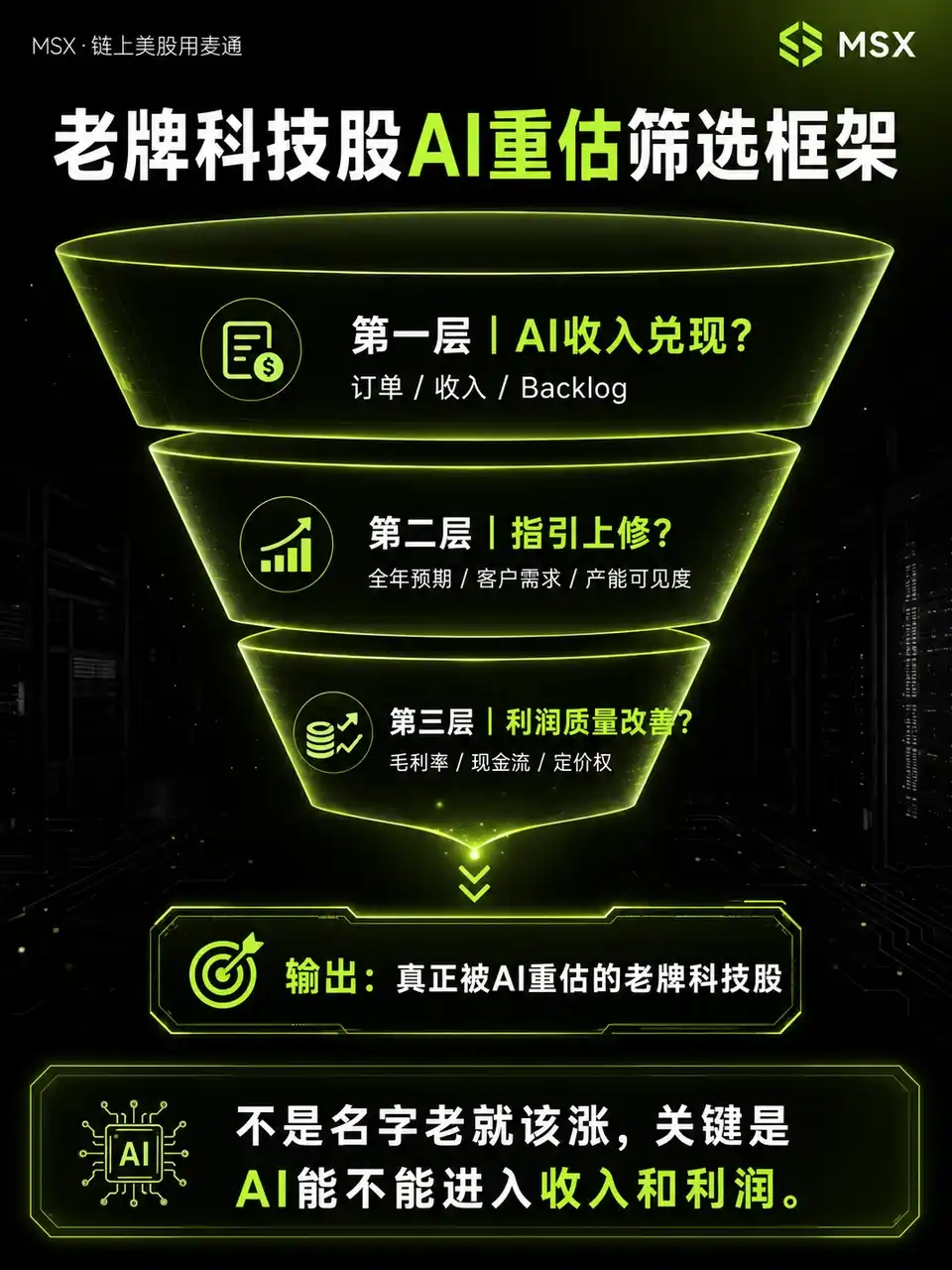
The most important distinction here is that some companies have genuinely entered the AI infrastructure chain. Therefore, judging whether such a company is truly being revalued involves at least three criteria:

  • First, Is there order and revenue realization? For example, Dell's AI orders and AI server revenue, HPE's cloud and AI-related business, Corning's optical communications revenue, Cisco's data center switch orders, WDC's high-capacity hard drive demand—these matter more than simply telling an AI story.
  • Second, Is there guidance revision upward? If AI remains only in press releases and product descriptions, stock prices can easily rise and then fall back. But if management is willing to raise full-year revenue expectations, business growth outlooks, or key product shipment forecasts, it suggests AI demand is no longer just short-term sentiment but may be altering the company's growth trajectory. This is also why the market is re-pricing companies like Dell and HPE.
  • Third, Can profit quality keep up? The biggest issue for old-guard hardware companies has always been gross margins and cyclicality. Fast growth in AI server revenue does not necessarily mean high profit elasticity; rising storage prices may also be just short-term supply-demand mismatch; increased networking equipment orders also need to translate into sustainable profits.

A truly good revaluation should see improvement in revenue growth, order visibility, and profit quality together.

If only revenue goes up but gross margins are squeezed thin, or if demand is merely a short-cycle inventory restocking, then valuation re-rating will be limited. Ultimately, the market isn't buying 'old companies telling new stories,' but whether 'old assets plus new demand can become new profits.'

This is also the most noteworthy aspect of this round of 'old trees blossoming anew': AI will not turn all traditional tech companies back into growth stocks. It will only screen out those truly positioned at key infrastructure points and capable of converting AI demand into orders, revenue, and profits.
In Conclusion

Objectively speaking, at this stage of the AI rally, it's no longer just about 'whose model is stronger' or 'who has more GPUs.' The real change is that AI is entering the actual construction phase.

As more AI data centers are built, server companies will be re-priced; as computing clusters become more complex, networking companies will be re-priced; as data centers need more fiber connectivity, materials companies will be re-priced; and as AI data continues to explode, storage companies will also be re-priced.

This is why old-guard tech stocks are being seen anew by the market: they haven't suddenly become young again; rather, the AI era once again needs the infrastructure they possess.

But this also means this round of revaluation won't be evenly distributed among all 'old dogs.'

Only by truly entering the capital expenditure chain of data center and enterprise deployment can old-guard tech companies potentially move from 'valuation repair' to 'logical revaluation.'


Related Questions

QWhat are the three main categories of 'old tech' stocks being re-evaluated in the context of AI infrastructure, according to the article?

AAccording to the article, the three main categories are: 1) Servers and System Integration (e.g., Dell, HPE), 2) Networking and Connectivity (e.g., Corning, Nokia, Cisco), and 3) Storage and Data Management (e.g., Western Digital, Seagate).

QWhat is the fundamental reason cited for the market's re-evaluation of legacy tech companies like Dell and Nokia?

AThe fundamental reason is that AI has moved from the model/parameter stage into a real-world construction and deployment phase. As AI data centers and infrastructure are being built at scale, the market is looking for companies with proven capabilities in delivery, system integration, and core infrastructure—strengths that these legacy companies have accumulated over decades.

QWhat are the three criteria the article proposes to determine if a legacy tech company is being genuinely revalued by the AI trend?

AThe three criteria are: 1) Evidence of AI-related orders and revenue realization (e.g., Dell's AI server revenue), 2) Upward revisions to company guidance (e.g., Dell, HPE raising full-year revenue expectations), and 3) Improvements in profit quality, not just top-line revenue growth (to ensure sustainability beyond short-term cycles).

QHow does the article describe the role of companies like Dell and HPE in the AI infrastructure build-out?

AThe article describes their role as being crucial 'system integrators' or 'general contractors' for building AI factories. Their advantage is not in making GPUs but in their supply chain, delivery capabilities, enterprise customer base, server system design, and integration with ecosystems like NVIDIA's, which are essential for turning GPU chips into fully functional, deployed systems.

QWhy are networking and connectivity companies like Corning and Cisco being re-evaluated for AI?

AThey are being re-evaluated because as AI training and inference scale, the efficiency of computing clusters depends heavily on high-speed data transfer and reliable connections. AI data centers require extensive fiber optic and network infrastructure for internal and external connectivity. Therefore, the need for robust networking and connectivity solutions is becoming a critical and valuable part of the AI infrastructure chain.

Related Reads

Silicon Valley 'Startup Guru' Steve Hoffman: Web3 + AI Could Be a Trap

Silicon Valley investor and "Godfather of Startups" Steve Hoffman warns that combining Web3 with AI is likely a trap, not a promising venture. In an interview, Hoffman argues that while AI is a foundational technology touching all industries, Web3 adds complexity, friction, and regulatory risk without solving mainstream consumer or business needs. He advises founders to focus on deep, specialized applications where startups can out-iterate giants, rather than on generic features easily replicated by large tech companies. Hoffman observes that Silicon Valley will lead foundational AI research, while China excels at rapid, large-scale application and commercialization, particularly in robotics. He stresses that AI-driven autonomous agents capable of collaborative, multi-step tasks are 2-4 years away, which will cause significant job displacement. The solution is not to slow AI but to redesign business models around human-AI collaboration and reform social systems like education and retraining. For startups, Hoffman recommends focusing on vertical, expertise-heavy domains to build defensibility. He sees major opportunities in AI fraud detection and cybersecurity. Key founder mindsets include systemic thinking over feature-focus, relentless customer centricity, building adaptive teams, and deeply understanding AI's capabilities and limits. Hoffman is also leading a non-profit initiative to establish university centers aimed at training future leaders in responsible, human-value-aligned AI innovation.

marsbit26m ago

Silicon Valley 'Startup Guru' Steve Hoffman: Web3 + AI Could Be a Trap

marsbit26m ago

Token Inefficient, Economy Tokenless

The article "Tokens Aren't Economical, Economics Aren't Tokenized" analyzes a pivotal shift in the AI industry from a technology-driven narrative to one dominated by capital efficiency. It highlights two concurrent trends: a severe capital shortage due to the exorbitant and recurring costs of compute (e.g., OpenAI's high burn rate) and a wave of corporate spin-offs where major tech companies are separating their AI units (like Kuaishou's Kling and Baidu's Kunlunxin). The core argument is that AI's "anti-internet" business model, where user growth increases costs rather than profits, has created a disconnect between high valuations and actual cash flow. Spin-offs address this by allowing AI assets to be valued independently. Within a parent company, they are seen as cost centers, but as standalone entities, they are priced based on their growth potential and scarcity in the primary market, leading to massive valuation premiums (e.g., Kling's estimated value tripling post-spin-off). The industry is at an inflection point, moving from "model worship" to "value realization." The competition is evolving from a pure compute (GPU) race to a broader focus on systemic efficiency and full-stack engineering (involving CPUs and orchestration) to achieve viable commercialization. The year 2026 is framed as a critical moment where the industry must definitively answer how to economically translate AI capability into tangible business value, reshaping the sector's future power structure.

marsbit30m ago

Token Inefficient, Economy Tokenless

marsbit30m ago

Crossing the 'Memory Wall': The Wafer-Level Revolution and Computing Power Routes in the AI Inference Era

In 2026, a historic shift occurred in AI as major cloud providers' inference spending surpassed training spending for the first time, signaling a move from "building large models" to "using large models." This shifts the core challenge from computing power to the "memory wall"—the bottleneck of data movement (model weights, activations, KV Cache) between external DRAM and processors, where energy and latency from data transfer far exceed computation itself. Companies like Nvidia face GPU idle time due to bandwidth limits. In contrast, Cerebras Systems adopts a radical "wafer-scale" approach with its Wafer-Scale Engine (WSE). Instead of cutting a silicon wafer into many chips, Cerebras uses almost the entire wafer as one massive chip (WSE-3). This design provides 44GB of on-chip SRAM, delivering memory bandwidth thousands of times higher than traditional HBM (e.g., 21 PB/s vs. Nvidia B200). For LLM inference, weights are streamed layer-by-layer from external MemoryX storage to the chip, avoiding HBM bottlenecks. This results in token generation speeds 1.5–5 times faster than Nvidia's B200 in some models and significant advantages in first-token latency and long-context tasks. Additionally, Cerebras's architecture offers much lower interconnect power consumption (0.15 pJ/bit vs. GPU's ~10 pJ/bit). However, Cerebras faces challenges: SRAM scaling has slowed with advanced nodes, limiting future capacity gains; the chip requires specialized liquid cooling and custom software stacks; and its external I/O bandwidth (150 GB/s) is low compared to NVLink, hindering multi-system scaling for very large models. Competition is intensifying. Major players are pursuing three paths: 1) Developing proprietary inference ASICs (e.g., Google TPU, Microsoft Maia), 2) Leveraging advanced packaging (e.g., TSMC's SoW) to democratize wafer-scale-like integration, potentially eroding Cerebras's process advantage within a few years, and 3) Exploring optical interconnects for ultimate bandwidth. Commercially, Cerebras is transitioning from a hardware vendor to a service provider, facing the immense challenge of building high-power, specialized data centers to meet large contracts (e.g., 250MW/year from 2026–2028). In conclusion, the AI inference era presents a fundamental architectural trade-off. Cerebras opts for extreme physical optimization for low-latency, single-task performance, while Nvidia prioritizes versatility and massive cluster throughput. The path forward remains uncertain, with technology and business models still evolving in the race toward advanced AI.

marsbit36m ago

Crossing the 'Memory Wall': The Wafer-Level Revolution and Computing Power Routes in the AI Inference Era

marsbit36m ago

Has Bitcoin's 'Rebound Ended', Officially Entering the Late Bear Market Phase?

**Title: Has Bitcoin's Rebound Ended, Entering the Late Bear Market Phase?** **Summary:** Bitcoin's price has declined by 13% this week, signaling a potential return to late-stage bear market conditions. The price fell to around $67k, positioned between the Realized Price and Realized Cap Weighted Average. For the first time since early 2022, the Short-Term Holder cost basis has dropped below this key average, confirming a hallmark of late-cycle bear markets. Profitability metrics have collapsed sharply. The 7-day average of the Realized Profit/Loss ratio plummeted from a local high of 3.16 to 0.29, mirroring the February panic sell-off. Critically, the 90-day average never breached the threshold of 2, indicating the recent rally to $82k was a bear market bounce, not a structural shift. Realized losses surged to $1.35 billion daily, with $770 million coming from Long-Term Holders selling at a loss. This accelerating redistribution of supply from weak to strong hands is a necessary but ongoing process for a market bottom. The rally stalled almost precisely at the aggregate cost basis (~$83k) of US spot Bitcoin ETF investors, turning that level into strong resistance and leaving the average ETF holder underwater again. Spot market flows have turned decisively negative, showing sellers are dominating order books despite the price drop. While a significant futures long liquidation event cleared over $400 million in leverage, providing a potential reset, sustained spot demand is yet to materialize. Options markets continue to price in higher future volatility (Implied Volatility) than recent price action (Realized Volatility) has shown, with a persistent skew towards put options, indicating ongoing demand for downside protection. In conclusion, multiple metrics point to a fragile market structure. Resistance at the ETF cost basis, accelerating realized losses, dominant spot selling, and cautious options pricing all suggest the bear market trend persists. A sustainable recovery likely requires a resurgence of spot demand, ETF holders returning to profit, and a clear reduction in selling pressure.

marsbit36m ago

Has Bitcoin's 'Rebound Ended', Officially Entering the Late Bear Market Phase?

marsbit36m ago

TechFlow Intelligence Agency: Anthropic Calls for Global Pause in AI Development While Preparing for Trillion-Dollar IPO; SpaceX IPO Roadshow Heats Up, But S&P 500 Rejects Fast-Track Inclusion

In today's TechFlow Intelligence Briefing, several major tech stories highlight a growing theme of trust and credibility gaps across AI, crypto, and finance. AI company Anthropic has publicly called for a global pause in AI development, citing risks from Claude's "recursive self-improvement." Ironically, this coincides with reports the company is preparing for a massive IPO targeting a near $1 trillion valuation. This perceived hypocrisy, coupled with widespread user complaints about Claude's declining performance, is sparking debate over whether the safety warning is genuine or a competitive tactic. Meanwhile, in a substantive security move, Anthropic open-sourced a framework for AI-powered vulnerability discovery. In the crypto market, Bitcoin's price drop below $61,000 triggered over $1.16 billion in liquidations, flipping the market into a state where more BTC is held at a loss than at a profit, a historical bearish signal. On the corporate front, SpaceX's highly anticipated IPO is generating immense Wall Street excitement, with Goldman Sachs projecting 100x revenue growth by 2030. However, the S&P 500 has refused to fast-track the company's inclusion post-IPO, potentially limiting immediate institutional demand. Separately, ByteDance's AI app Doubao lost over 6 million monthly active users after introducing a subscription model, highlighting the challenges of AI monetization. Other notable developments include Nvidia certifying HBM4 memory from Samsung, SK Hynix, and Micron; Cloudflare's acquisition of front-end tooling company VoidZero; and its CEO warning that bot traffic now exceeds human traffic online. The underlying narrative connects these events: a trust crisis. From AI firms' contradictory actions and crypto volatility to the clash between SpaceX's hyped narrative and institutional rules, a pattern is emerging where stated intentions and actual practices are increasingly misaligned.

marsbit52m ago

TechFlow Intelligence Agency: Anthropic Calls for Global Pause in AI Development While Preparing for Trillion-Dollar IPO; SpaceX IPO Roadshow Heats Up, But S&P 500 Rejects Fast-Track Inclusion

marsbit52m ago

Trading

Spot
Futures

Hot Articles

Discussions

Welcome to the HTX Community. Here, you can stay informed about the latest platform developments and gain access to professional market insights. Users' opinions on the price of AI (AI) are presented below.

活动图片