Research Report Analysis: Morgan Stanley Details SanDisk SNDK, The Truth About Cloud Data Center Pricing Power and AI Inference Benefits

marsbitPublished on 2026-06-23Last updated on 2026-06-23

Abstract

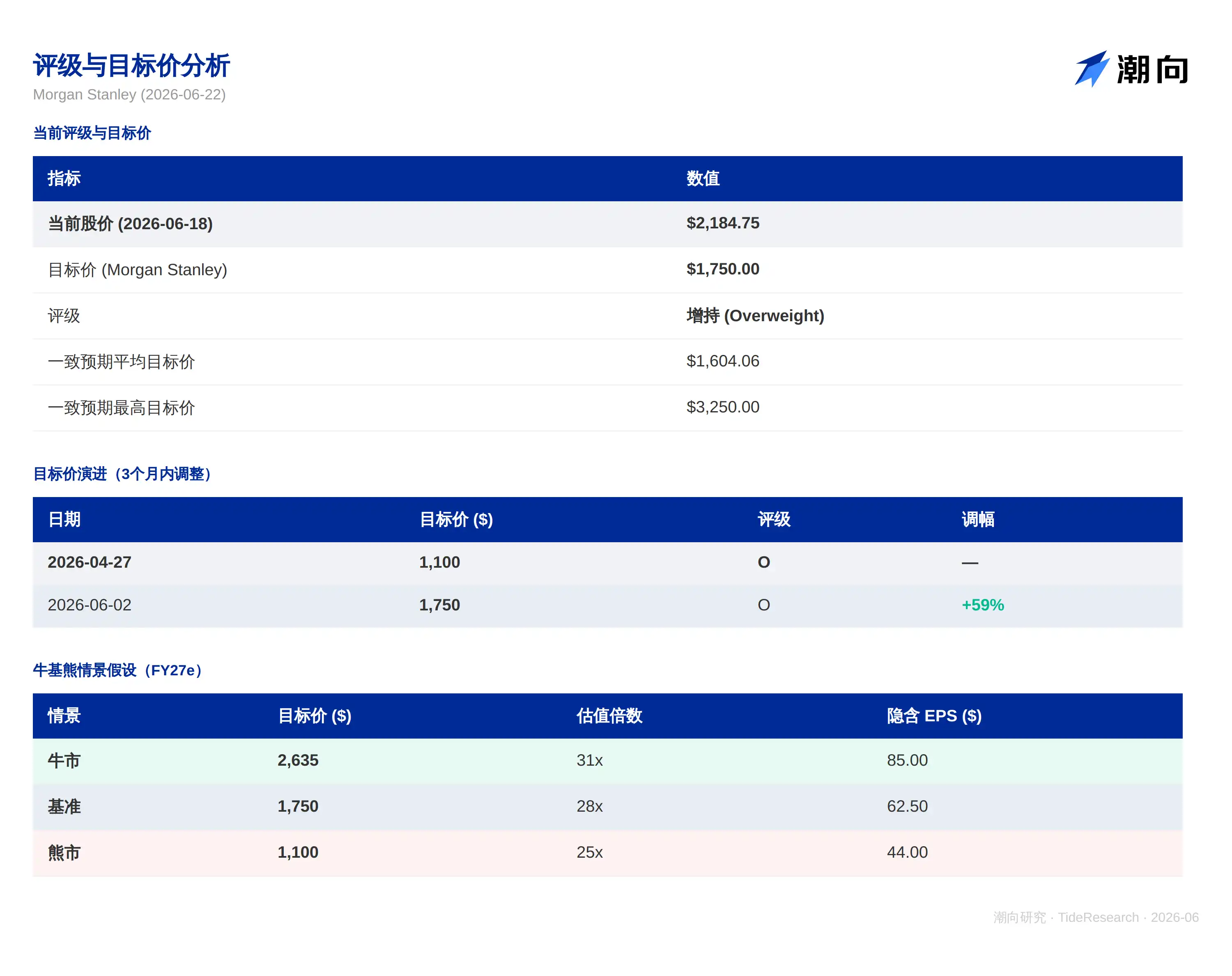
Morgan Stanley raised its price target for SanDisk (SNDK) from $1100 to $1750 on June 22, maintaining an Overweight rating. The upgrade is driven by AI inference demand reshaping the NAND market, particularly for KV Cache and context window storage in cloud data centers. These cloud clients exhibit price inelasticity and sign long-term contracts, granting SanDisk significant pricing power. SanDisk's New Business Model (NBM) agreements, covering over one-third of FY27 bit shipments with 3-5 year terms and fixed price/price collar structures, are crucial. They are projected to sustain gross margins around 80% even at floor prices, providing a buffer against cyclical downturns. Morgan Stanley forecasts gross margins to surge from 30.3% in FY25 to 86.7% in FY27e. With NAND supply expected to remain tight into 2026/2027 and cloud/data centers becoming the largest end-market, SanDisk holds supply-side pricing power. The company targets 15-19% bit growth via technology transitions, not capacity expansion. Revenue is projected to grow ~6.6x from FY25 to FY27, with EPS rising from $2.74 to $14.73, driven by high-margin cloud business. Key upside catalysts include faster enterprise SSD adoption and edge AI growth. Downside risks involve slower industry growth, competitor capex increases, market share loss, and competition from Chinese players like YMTC. The investment thesis rests on AI-driven structural demand, NBM's margin protection, and sustained supply tightness. The $1750 targ...

Author:Rita

TideGuide Introduction

Morgan Stanley updated its research report on SanDisk on June 22, raising the target price from $1,100 to $1,750 and maintaining an Overweight rating. The reasoning is straightforward: AI inference demand is rewriting the rules of the NAND market, and cloud data center customers are price-insensitive, granting SanDisk pricing power. Coupled with new business model agreements locking in gross margins, the company's future profits are largely predictable.

Changing Demand Structure: AI Inference Reshaping the NAND Market

Following 64% quarter-over-quarter growth in Q4, SanDisk's Q1 cloud business growth further accelerated to 233%. This is driven by a change in demand structure. Cloud providers are paying a premium for AI inference's KV Cache (Key-Value Cache) and context window storage. Morgan Stanley's calculations show that cloud business already accounts for a significant portion of SanDisk's Q1 sales, nearly all driven by TLC (Triple-Level Cell) demand, as customers prioritize storage density and performance. These customers don't operate by consumer logic; they sign long-term contracts with locked-in prices, which genuinely supports gross margins.

SanDisk's launched NBM (New Business Model) agreements have already locked in over one-third of its bit shipments for FY27. These are mostly 3- to 5-year agreements with fixed prices or price collar structures. A key point: even at the floor price, these contracts can maintain around 80% gross margin. For comparison, SanDisk's gross margin was only 30.3% in FY25, rising to 69.2% in FY26e, and projected to hit 86.7% in FY27e. This improvement is sustainable. Morgan Stanley believes the company could eventually cover 70% to 80% of its shipments under NBM. Once that ratio is reached, the company's profits have a 'bumper.' Meanwhile, maintaining 80% gross margin at the floor price means high profits can be sustained even in a price war.

Supply-Side Pricing Power and Profit Resilience

The current tight NAND supply may persist for an extended period. During several industry cycles, overcapacity has repeatedly triggered price crashes. This time, with AI data center expansion accelerating, storage demand is far from saturated. By securing long-term contracts during this window, SanDisk can hedge a significant portion of cyclical risk. Morgan Stanley expects ASP (Average Selling Price) to continue rising through calendar year 2026, possibly extending into mid-2027. 40% to 50% of SanDisk's revenue comes from North America, with data centers already becoming the largest end-market. Against the backdrop of tight supply and high customer loyalty, pricing initiative lies with the supplier.
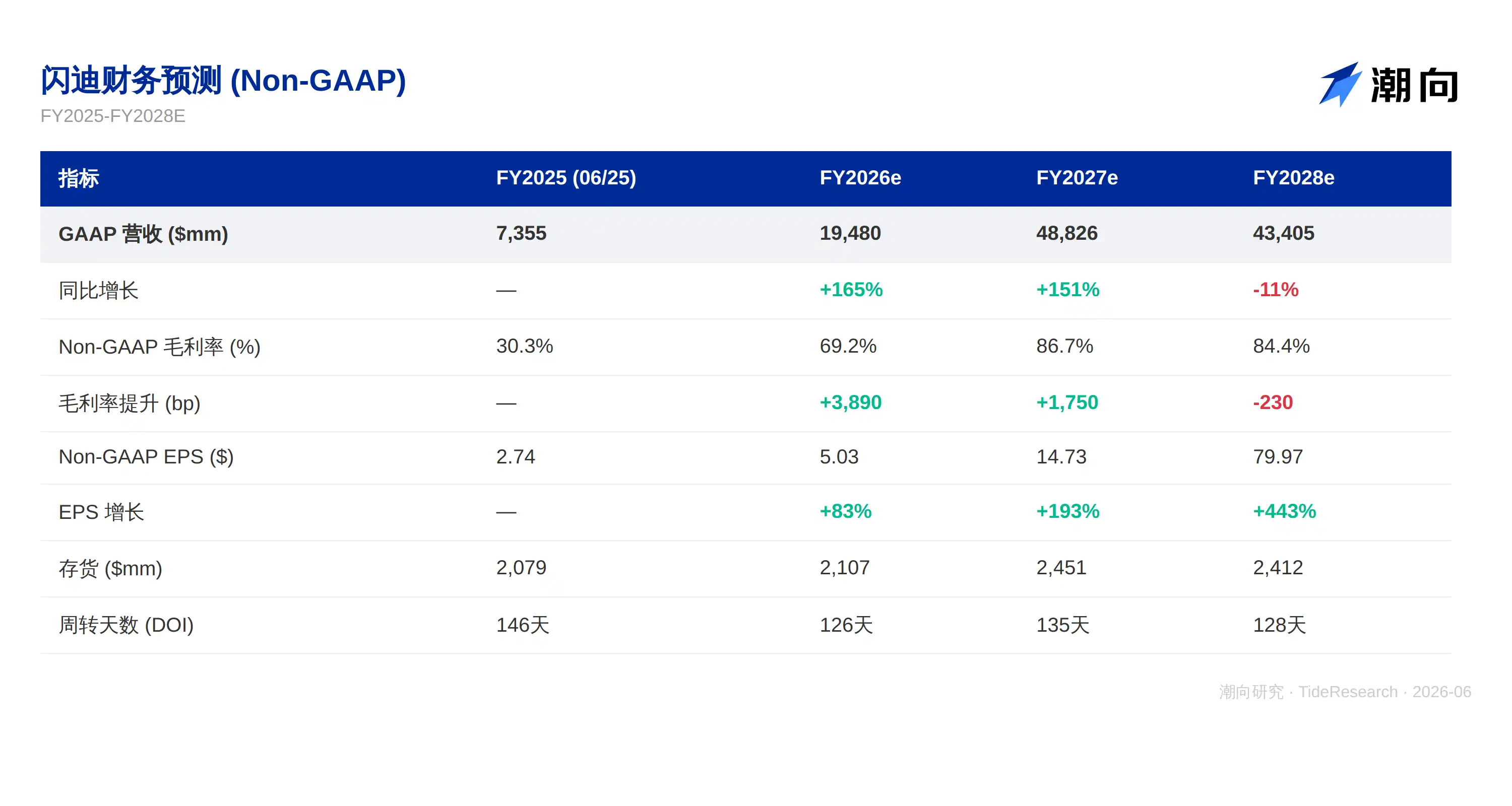
The company's target is 15% to 19% bit growth, achieved mainly through technology transitions (density improvements and process advancements) rather than capacity expansion. From FY25 to FY27, revenue is projected to grow from $7.355 billion to $48.826 billion, an increase of approximately 6.6x, with EPS rising from $2.74 to $14.73. The key behind these numbers is the quality of growth, not the speed. Growth stems from high-margin cloud business, not the low-price, thin-margin consumer market. The company just announced a $6 billion stock buyback plan, with management believing the current stock price is among the lowest valued in the semiconductor sector. Valuation-wise, Morgan Stanley's three scenarios are based on FY27 full-year EPS: 28x P/E for the base case corresponds to $1,750, 31x P/E for the bull case corresponds to $2,635, and 25x P/E for the bear case corresponds to $1,100.
Coexisting Catalysts and Risks

Upside catalysts are worth watching in several directions. Data center eSSD (Enterprise Solid-State Drive) penetration may exceed expectations, edge AI applications could drive NAND content growth, and investments in advanced technologies like HBF (High Bandwidth Flash) might start paying off. Downside risks include industry growth falling short of expectations, competitors increasing capital expenditure, SanDisk losing share in the data center space, and Chinese memory manufacturers like YMTC (Yangtze Memory Technologies Co.) continuing to gain market share.

Morgan Stanley's bullish thesis on SanDisk is built on three pillars: the structural demand shift brought by AI inference, gross margin protection locked in by NBM agreements, and persistent NAND supply tightness. The target price was raised from $1,100 to $1,750, corresponding to approximately 28x FY27e P/E. The forecast itself will be revised with earnings reports and customer feedback, but the logical framework is more valuable as a reference than the specific numbers.
Disclaimer

This article is TideResearch's compilation and interpretation of a third-party brokerage research report. The ratings, target prices, earnings forecasts, and related judgments cited in the article are the views of the respective analysts, representing only the stance of their affiliated institutions. They do not represent the views of TideResearch nor constitute any investment advice.

Please note three points while reading: 1. Target prices are analysts' expectations for the next approximately 12 months; they are forecasts, not promises, and will be repeatedly adjusted based on performance and market conditions. 2. Sell-side research reports are inherently bullish, and some covered companies may have investment banking relationships with the brokerage. 3. The value of a research report lies in its mainline logic and underlying assumptions, not in a single target price. Focus on the logic, not just the price.

There are risks in the market; decisions should be independent. This article should not be used as a basis for trading any securities.

Data Source: Morgan Stanley Research Report (Joseph Moore, June 22, 2026) · Company Financial Reports

TideResearch · TideResearch · June 2026

Trending Cryptos

Related Questions

QWhat are the three main pillars of Morgan Stanley's bullish logic on Sandisk (SNDK) as described in the article?

AThe three main pillars are: 1) The structural demand change driven by AI inference needs; 2) The margin protection locked in by the New Business Model (NBM) agreements; 3) The continued tight supply in the NAND market.

QHow does the New Business Model (NBM) agreement contribute to Sandisk's future profitability and risk mitigation according to the report?

AThe NBM agreements lock in a significant portion of future bit shipments (over one-third by FY27) with fixed prices or price corridors. Crucially, even at the floor price, these contracts can maintain around 80% gross margin. This provides a 'bumper' for profits and helps hedge against cyclical risks in the NAND market.

QWhat key change in demand structure is driving the rapid growth of Sandisk's cloud business, as highlighted by Morgan Stanley?

AThe rapid growth is driven by cloud providers paying a premium for NAND storage related to AI inference, specifically for KV Cache (key-value cache) and context window storage. These customers prioritize storage density and performance and sign long-term contracts, making them less price-sensitive than consumer clients.

QWhat are the potential downside risks mentioned for Sandisk's outlook in the report?

APotential downside risks include: slower-than-expected industry growth; competitors increasing capital expenditure; Sandisk losing market share in the data center segment; and Chinese memory manufacturers like YMTC (Yangtze Memory Technologies Corp.) continuing to gain market share.

QWhat is Morgan Stanley's new price target for Sandisk (SNDK) and the corresponding PE multiple for FY27 in their base case scenario?

AMorgan Stanley's new price target is $1750, which corresponds to a Price-to-Earnings (P/E) multiple of approximately 28x based on the FY27 full-year EPS estimate in their base case scenario.

Related Reads

Programmers Worldwide Are Wasting Money on Anthropic! The Company Can't Stand It Anymore

Anthropic recently published guidelines to help developers using Claude Code reduce unnecessary token costs. The key recommendations include: 1) Clear (/clear) conversations after completing a task to avoid carrying irrelevant file reads and command outputs into the next task. 2) Set the model and reasoning effort level at the start of a session, as switching mid-session invalidates the prompt cache, requiring a full-price recalculation of the entire dialog history. 3) Attach files using @ references instead of typing paths manually to avoid extra tool calls and searches that bloat the context. 4) Add quiet flags to verbose commands (e.g., in CLAUDE.md) to minimize lengthy output in the dialog history. 5) Use /compact while the session cache is still warm (before breaks) to compress the dialog at one-tenth the cost. 6) Offload large-output tasks to a sub-agent, which runs in an isolated context and only returns conclusions, preventing intermediate outputs from polluting the main dialog. The article explains token pricing: input tokens (prefill) are processed in parallel, while output tokens (decode) are generated serially, making output tokens five times more expensive. Caching is crucial for savings—if a request's prefix (system prompt, CLAUDE.md, dialog history) matches the previous one byte-for-byte, reading it costs only 10% of the standard input price. However, cache invalidation occurs when changing models, effort levels, fast mode, compressing dialogs, after cache expiration, or when resuming old sessions. Dialog history also grows quadratically (O(n²)) as file contents and command outputs accumulate, increasing costs per round. Proactive context management—like isolating noisy tasks, using /rewind to trim unproductive turns, and task-based session clearing—is becoming an essential skill for cost-effective AI-assisted development.

marsbit54m ago

Programmers Worldwide Are Wasting Money on Anthropic! The Company Can't Stand It Anymore

marsbit54m ago

Pax Silica vs. WAICO: The US Wants to Prohibit Europe from Using Chinese Artificial Intelligence

The United States is preparing to demand that European and other partners abandon Chinese artificial intelligence initiatives, threatening exclusion from the American-led "Pax Silica" coalition, according to a leaked U.S. State Department document. This ultimatum forces signatories of the "AI Opportunity Statement" to choose between the Western technological ecosystem and alternative frameworks, with China not explicitly named but clearly targeted. Pax Silica is a U.S. strategy for AI and semiconductor hegemony, launched in late 2025. Its European presence expanded significantly in mid-2026. Concurrently, China, Russia, and 27 other nations established the World AI Cooperation Organization (WAICO) in July 2026 as an independent intergovernmental platform promoting AI governance based on UN principles. This situation creates a difficult choice, especially for European nations balancing strategic autonomy with dependence on U.S. tech and security. It also pressures Global South countries with pragmatic ties to both Washington and Beijing. The formation of competing blocks risks fragmenting the global tech landscape, forcing companies to split supply chains, increasing costs, and potentially leading to incompatible standards and protocols. The era of open globalization in AI may be ending, replaced by geopolitical confrontation where technological sovereignty trumps economic efficiency. The decisions made will shape the global digital economy for decades.

cryptonews.ru2h ago

Pax Silica vs. WAICO: The US Wants to Prohibit Europe from Using Chinese Artificial Intelligence

cryptonews.ru2h ago

Robert Kiyosaki Shares His Mentor's Predictions About the Emergence of Bitcoin and AI

American entrepreneur and author of "Rich Dad Poor Dad," Robert Kiyosaki, discussed the influence of futurist R. Buckminster Fuller on his worldview, linking Fuller's past technological predictions to the emergence of Bitcoin and the development of artificial intelligence. In an X post, Kiyosaki also reflected on personal purpose, sharing his journey from the music business—where he worked with bands like The Police and Iron Maiden—to creating the "Cashflow" board game and writing his famous book. He described feeling an inner emptiness despite his success, a turning point that came after meeting Fuller, whom he studied with for three summers. Kiyosaki described Fuller as a "friendly genius" who foresaw world-changing developments like Bitcoin and AI. However, the core of his post focused on Fuller's philosophical impact, particularly a quote about belonging to the universe and finding purpose by dedicating one's life to the maximum benefit of others. The entrepreneur remains a vocal advocate for cryptocurrencies. He regularly advises buying Bitcoin during market panics, viewing it and assets like Ethereum, gold, and silver as hedges against traditional financial system failures. Kiyosaki has predicted a major market crash by 2026, seeing it as an opportunity for prepared investors, with long-term price targets including $750,000 for Bitcoin and $95,000 for Ethereum.

cryptonews.ru4h ago

Robert Kiyosaki Shares His Mentor's Predictions About the Emergence of Bitcoin and AI

cryptonews.ru4h ago

Etherealize CEO Calls Wall Street's Private Blockchains a 'Race to the Bottom'

Etherealize co-founder and CEO Vivek Raman criticized Wall Street's growing interest in private, permissioned blockchains, calling them a "race to the bottom." In an interview with CoinDesk, Raman argued that consortium networks fragment liquidity and return the industry to the siloed systems that blockchain technology was meant to overcome. He stated that closed networks do not interoperate, undermining two key advantages of the technology: system compatibility and liquidity concentration. Etherealize promotes Ethereum as an open, foundational layer for institutional players. Raman insists that privacy and access restrictions should be built on top of public infrastructure—at the application or L2 level—rather than creating separate, closed networks. He compared Ethereum to HTTP as a base layer, with additional permissioned and private layers akin to HTTPS. Examples of this new wave of "closed" solutions mentioned include Canton Network from Digital Asset, Circle's Arc project, and Stripe's Tempo. Raman termed this trend "consortium chains 2.0," recalling earlier initiatives like the R3 interbank consortium and the Hyperledger corporate ecosystem from 2016 that failed to gain significant traction. He reiterated his firm belief that a global, open, permissionless infrastructure is necessary as a foundational base layer. Raman previously noted in June that traditional financial institutions had begun implementing Ethereum-based solutions into real business processes.

cryptonews.ru4h ago

Etherealize CEO Calls Wall Street's Private Blockchains a 'Race to the Bottom'

cryptonews.ru4h ago

Trading

Spot

Hot Articles

Discussions

Welcome to the HTX Community. Here, you can stay informed about the latest platform developments and gain access to professional market insights. Users' opinions on the price of AI (AI) are presented below.

活动图片