Jensen Huang 'Saves' South Korean Stock Market: Locks In SK Hynix Memory, Chip Shortage to Continue

marsbitPublished on 2026-06-08Last updated on 2026-06-08

Abstract

On June 5th, South Korea's stock market experienced a sharp decline, with major chipmakers like Samsung and SK Hynix dropping nearly 10%. Amidst the turmoil, NVIDIA CEO Jensen Huang's visit to Seoul played a dramatic role in boosting market sentiment. Following a dinner meeting with SK Group Chairman Chey Tae-won and SK Hynix CEO Kwak Noh-Jung, Huang confirmed that NVIDIA's new Vera CPU will utilize SK Hynix DRAM. The companies announced a multi-year technical partnership to co-develop next-generation memory for NVIDIA's AI infrastructure, covering products from data centers to personal AI and robotics. This collaboration extends beyond memory supply. SK Hynix is integrating NVIDIA's AI and Omniverse platform into its own semiconductor design and manufacturing processes, including computational lithography and creating digital twins of its fabrication plants for autonomous operation. While strengthening ties with SK Hynix, NVIDIA is diversifying its supply chain for the upcoming HBM4 memory, with Samsung, SK Hynix, and Micron all certified as suppliers for its Vera Rubin platform. Despite this, Huang warned that the global chip shortage, driven by relentless demand from AI factory construction, is expected to persist for several years across the entire supply chain. His visit underscores NVIDIA's systematic effort to deepen integration with South Korea's broader tech industry.

On June 5, the South Korean stock market experienced a 'Black Friday,' with the KOSPI index plummeting 5.54% at the close. When the market opened on June 8, the intraday decline widened to over 8%, triggering the market's circuit breaker mechanism, while Samsung and SK Hynix both fell nearly 10%.

As market jitters intensified, Jensen Huang's visit dramatically played the role of a 'market savior.'

Prior to this, on the evening of Sunday, June 7, local time in South Korea, Jensen Huang held a 'dinner meeting' with SK Group Chairman Choi Tae-won, SK Hynix CEO Kwak Noh-Jung, and others.

After the dinner, Huang confirmed to the media present: NVIDIA's newly launched Vera CPU will utilize SK Hynix DRAM; both sides are preparing for a 'large-scale collaboration' later this year and next year; regarding the current memory chip shortage, he believes it will persist for several years.

Subsequently, NVIDIA and SK Hynix officially announced a multi-year technology cooperation agreement, involving extending AI supercomputing to robotics, digital twins, and semiconductor manufacturing.

Huang even gave a direct sales pitch at the press conference, stating, 'If you are a shareholder of an AI company, you should be happy. Their current prices are very low.'

01 Locking In SK Hynix Memory

Vera is NVIDIA's first dedicated, independent data center CPU. It faces competitors including Intel's Xeon product line, AMD's Epyc chips, and in-house projects from major cloud service providers like Amazon's Graviton.

In this new battleground, NVIDIA has anchored its memory supply to SK Hynix from the outset.

On June 7, NVIDIA and SK Hynix formally announced the establishment of a multi-year technology partnership to jointly develop next-generation memory matching NVIDIA's AI infrastructure roadmap.

It is understood that the collaboration covers a series of NVIDIA product lines for both personal edge devices and the cloud, including the NVIDIA Vera Rubin AI supercomputer, Vera CPU, PCs equipped with RTX Spark, and the Jetson Thor robotics computing platform.

The announcement pointed out that the cooperation aims to secure the supply of advanced memory to cope with the long development cycles, complex manufacturing processes, and high capital investment required for such products, thereby supporting the ongoing construction of global AI factories.

The announcement also listed new markets that SK Hynix will expand into alongside NVIDIA, including AI infrastructure, Personal AI, and Physical AI.

02 AI Feeds Back Into Chip Manufacturing

Beyond supplying memory, SK Hynix is beginning to apply NVIDIA's AI technology to its own chip design and manufacturing processes.

Similar collaborations have previously been implemented at TSMC, most notably in 'computational lithography.'

According to the announcement, SK Hynix is using NVIDIA CUDA-X libraries and AI to accelerate semiconductor simulation, covering areas such as Technology Computer-Aided Design (TCAD) and computational lithography.

The two sides are also working to extend these tools into the semiconductor Electronic Design Automation (EDA) and simulation ecosystem, paving the way for three-way collaboration among chipmakers, NVIDIA, and EDA software vendors.

This means their cooperation is no longer limited to SK Hynix's internal use but is exploring a model that can be promoted to the entire semiconductor industry.

In the manufacturing sector, SK Hynix is advancing the development of digital twin functionality for its wafer fabs, aiming to achieve fully autonomous factory operations. This work is based on the NVIDIA Omniverse platform. Leveraging Omniverse libraries and OpenUSD workflows, SK Hynix can build 3D factory scenes for visualizing, simulating, and optimizing complex semiconductor manufacturing environments.

At the factory operations level, these digital twin functions can also be integrated with NVIDIA's cuOpt decision optimization engine and Metropolis platform to schedule autonomous mobile robots and other assets within the wafer fab.

The announcement also revealed that the two companies are exploring ways to connect the digital twins with existing legacy software and agentic AI workflows, enabling AI systems to reason based on fab data, automatically execute tasks, and improve manufacturing decisions.

03 Laying the Groundwork Half a Year Early

In October 2025, NVIDIA and SK Hynix announced a large-scale infrastructure cooperation.

At that time, the SK Group was building an AI factory equipped with over 50,000 NVIDIA GPUs, with the first phase scheduled for completion by the end of 2027. Upon completion, it is expected to become one of South Korea's largest AI factories.

The factory adopts a 'GPU-as-a-Service' model, opening up to SK Group subsidiaries and external organizations, with the goal of accelerating the digital transformation and industrial innovation of South Korea's industries.

SK Telecom is also involved in the specific deployment.

As an NVIDIA Cloud Partner, SK Telecom plans to build an industrial AI cloud in Asia using NVIDIA RTX PRO 6000 Blackwell server GPUs, with an initial deployment exceeding 2,000 GPUs specifically for running Omniverse workloads, providing computing power to support SK Hynix's semiconductor manufacturing, fab digital twins, and internal AI agents.

During this visit to South Korea, Huang also revealed information: he is in discussions with telecommunications companies because future AI will utilize telecom networks. This aligns with the direction of SK Telecom's involvement in the cooperation.

04 HBM4 Orders Split Among Three Companies

Although NVIDIA signed a multi-year technology cooperation agreement with SK Hynix, for HBM4 supply, NVIDIA has not put all its eggs in one basket.

Upon arriving in Seoul, Huang made a clear statement to reporters: 'All three suppliers are qualified. All three suppliers are in production, and they are all racing to support Vera Rubin.'

These three suppliers correspond to Samsung Electronics, SK Hynix, and Micron Technology.

In his keynote speech at Computex Taipei, Huang confirmed that Vera Rubin is in full production, with plans for delivery in the third quarter of this year. This system is built around NVIDIA's Vera CPU and Rubin graphics core clusters, with each server rack system paired with terabytes of HBM4 memory.

Looking at the actual progress of HBM4, SK Hynix remains in the leading position.

Reuters reported in September last year that SK Hynix had completed internal certification for HBM4 chips at that time and established a production system for customers, aiming to complete mass production preparation for 12-layer HBM4 products in the second half of 2025. Kim Sunwoo, a senior analyst at Meritz Securities, predicted at the time that thanks to early supply to key customers and the resulting first-mover advantage, SK Hynix's HBM market share would remain in the low sixties percent in 2026.

05 Chip Shortage to Last for Years

The situation of spreading HBM4 supply across three companies does not mean supply pressure will ease immediately.

After the Sunday dinner, Huang also gave a rather pessimistic assessment. He told the media on-site that the memory chip shortage will not end soon. 'The entire industry's supply chain—from wafers to packaging to silicon photonics... everything is in short supply because demand is so high. This situation will last for years.'

This statement comes against the backdrop of the near-endless consumption of advanced memory for the construction of global AI factories.

The shortage Huang mentioned is not a lack of a specific component, but supply tightness at almost every link in the industrial chain. NVIDIA launching Vera Rubin, promoting AI factories, and entering the fields of Personal AI and Physical AI are all driving up demand for memory. This is also why he said all three HBM4 suppliers are racing to support Vera Rubin.

No one wants to fall behind in a situation of supply shortage.

While SK Group was the focus of this South Korea trip, it was not Huang's entire schedule. Upon arrival, he revealed that he had meetings scheduled with Hyundai Motor, LG, SK, Samsung, and Naver. He also mentioned that NVIDIA is actively hiring for its new R&D center in South Korea. From these developments, NVIDIA is systematically deepening its ties with the entire South Korean tech industry. The SK Group is a key part, but not the only part.


Related Questions

QWhat was the initial market situation in South Korea that led to Jensen Huang's visit being seen as a 'market rescue'?

AOn June 5th, the South Korean stock market experienced a 'Black Friday' with the KOSPI index plummeting 5.54%. The selling continued on June 8th, with intraday losses expanding beyond 8%, triggering circuit breakers on trading platforms. Major stocks like Samsung and SK hynix fell nearly 10%.

QWhat are the key areas of collaboration between NVIDIA and SK hynix as announced during Jensen Huang's visit?

AThe collaboration includes SK hynix supplying DRAM for NVIDIA's new Vera CPU, working on 'hyper-scale cooperation' for the second half of this year and next, and jointly developing next-generation memory for NVIDIA's AI infrastructure roadmap. Additionally, SK hynix will use NVIDIA's CUDA-X libraries and AI for semiconductor simulation and is developing digital twins for its factories using the NVIDIA Omniverse platform.

QHow is the future HBM4 supply for NVIDIA's products being structured among memory suppliers?

ANVIDIA has not put all its eggs in one basket for HBM4. Jensen Huang stated that three suppliers—Samsung Electronics, SK hynix, and Micron Technology—have all received qualification and are in production, competing to support the upcoming Vera Rubin AI system.

QAccording to Jensen Huang, what is the outlook for the chip shortage, particularly for memory?

AJensen Huang stated that the memory chip shortage is not ending soon. He believes the entire industry supply chain—from wafers and packaging to silicon photonics—is facing shortages due to extremely high demand, and this situation is expected to last for several years.

QBeyond the partnership with SK Group, what other actions did Jensen Huang take or mention during his South Korea trip?

AHis schedule included meetings with Hyundai Motor, LG, SK, Samsung, and Naver. He also mentioned that NVIDIA is actively hiring for its new R&D center in South Korea, indicating a systematic effort to deepen ties with the broader Korean tech industry.

Related Reads

Founder of Baixing.com: My Fourteen Claude Code Usage Experiences

Founder of Baixing.com Shares 14 Personal Tips for Using Claude Code The author outlines his personal, non-universal strategies for maximizing Claude Code. Key points include: focusing deeply on one primary tool (Claude Code) rather than constant comparison; mastering essential shortcuts for the editor and command line; utilizing voice input like HoldSpeak; starting projects with a structured PROJECT.md file; defaulting to Claude agents for most tasks; and leveraging integrations with GitHub and Cloudflare for build, deployment, and infrastructure. He emphasizes a clear separation between human and machine work: manually maintain a core CLAUDE.md file, and understand AI-generated content by asking the AI, not reading its raw code. Efficient communication involves dragging files (screenshots, audio, documents) directly into the interface. For knowledge management, he recommends a centralized, Git-synced memory system based on ~/.claude/CLAUDE.md to ensure permanence and avoid scattered project memories. Other practices include writing and continuously refining "Skills," using the expensive but reliable ultracode for complex dynamic workflows, and employing Git documentation as handoff points between agents. The overarching philosophy is to treat Claude Code like a horse (or a person) with its own pathfinding abilities—setting goals and boundaries rather than micromanaging every turn.

链捕手8m ago

Founder of Baixing.com: My Fourteen Claude Code Usage Experiences

链捕手8m ago

Gary Yang: Agent Economy and AI Submicroeconomics

**Title:** Agent Economy and AI Sub-Microeconomics - Gary Yang **Summary:** Following the AI singularity, the pace of evolution has accelerated rapidly, creating new generational disparities in technological advancement globally. While many regions are still grappling with single-agent bottlenecks, Silicon Valley has moved ahead into the next dimension: the Agent Economy and A2A ecosystems. The article outlines six key areas of this emerging paradigm: 1. **AI Payment Competition & H2A Bottlenecks:** A fierce battle for AI Agent payment protocol standards is underway (e.g., MPP, x402). However, most current efforts remain Human-to-Agent (H2A), essentially grafting AI onto traditional human-centric commerce, which creates a non-AI-native bottleneck. The true potential lies in Agent-to-Agent (A2A) autonomous economies. 2. **Agent Economy & the Inevitable A2A Trend:** The Agent Economy is defined by autonomous AI Agents creating, exchanging, and capitalizing value as independent economic actors. The A2A ecosystem describes their interactions. This represents the next major investment frontier, akin to the early days of e-commerce or DeFi, but with faster iteration and an AI-native, efficiency-first perspective that often diverges from human needs. 3. **AI Protocol vs. Crypto Protocol:** AI Protocols are the foundational rules for Agent interaction in an open network (communication, discovery, collaboration), akin to the governance and economic laws of the AI world. Currently, they focus on communication and weak boundaries, unlike Crypto Protocols which emphasize asset rights and clear ownership. While they appear different due to political-economic factors and legacy system constraints, their eventual convergence into a unified Digital Protocol system is seen as inevitable, driven by first principles. 4. **AI Agent Sub-Microeconomics & Biological Analogy:** AI Agent economics differ fundamentally from human economics: higher frequency/lower value transactions, energy/value direct correlation, efficiency-driven (not emotional) decisions, task-oriented (not consumption-oriented) behavior, and near-zero organizational/communication costs. A powerful analogy frames the Agent economy as a biological system: the LLM is the nucleus, the Agent harness is the cytoplasm, the Agent itself is a cell, its communication protocol is the cell membrane, and external tools (Skills, Prompts) are the extracellular environment. 5. **The Inevitability of AIFi & FinChip:** AIFi (AI Finance) represents the financial system where AI-native value within the Agent economy is tokenized and exchanged. Unlike TradFi/DeFi where value resides *in* finance, in AIFi, value originates *in* AI, and finance becomes its form. This shift is enabled by Agents taking over value discovery. FinChip (Financial Chip) is introduced as a key infrastructure—a fusion of AI autonomy and crypto smart contracts—forming intelligent financial assets to power the future A2A economy. 6. **AI-Native as a Paradigm Shift:** Adopting AI is not akin to "Internet+". It requires AI-Native thinking—designing systems based on first principles, the shortest energy-value path, and maximum efficiency. This abstract, counter-intuitive logic poses a significant, ongoing challenge for all practitioners, as effective, generalized upgrade methodologies will be slow to emerge in this rapidly evolving landscape.

链捕手49m ago

Gary Yang: Agent Economy and AI Submicroeconomics

链捕手49m ago

From 'The Big Short' to San Francisco: The Revelry and Dizziness Within the AI Bubble

From "The Big Short" to San Francisco: The Frenzy and Dizziness in the AI Bubble The article captures the intense, frenetic atmosphere in San Francisco, the epicenter of the current AI boom. Drawing a parallel to the "smell of money" from *The Big Short*, the author observes a city gripped by a singular status game centered entirely on AI and technology. This manifests in a palpable, caffeine-fueled anxiety ("people are shaking"), rampant comparison using vanity metrics like funding rounds, and pervasive "Big Bubble Behavior." The piece explores the city's stark contrasts: its dystopian streets versus beautiful vistas, and the disconnect between the doomsday concerns of some AI researchers and the optimistic, growth-focused "GTM" teams. It critiques the obsession with "math genius" founders as the new ticket to outsized returns, akin to scouting sports prodigies. Referencing economic historian Carlota Perez's "frenzy phase" and Karl Polanyi's "double movement," the author frames the boom as a period where financial speculation detaches from fundamentals, with society potentially becoming subordinate to a new economic force driven by "geniuses in data centers." Ultimately, while acknowledging the unprecedented wealth creation and party-like energy, the article concludes with cautionary advice: when the music is playing, you should dance, but don't get drunk. The core reminder is to stay grounded, avoid distorted judgment, and maintain perspective amidst the euphoria.

marsbit51m ago

From 'The Big Short' to San Francisco: The Revelry and Dizziness Within the AI Bubble

marsbit51m ago

Is AI Creating a New Class of 'Information Poor'?

AI is generating a new kind of "information poverty." The core issue isn't that AI denies answers to the poor; it's that it provides abundant, cheap, and plausible-sounding answers to everyone. This availability shifts the true scarcity from obtaining answers to possessing the **judgment to evaluate them** and the access to turn them into real-world opportunities. New information poverty thus describes those who have AI tools and outputs, but lack the complementary skills, authorization, and contextual experience to critically assess and act on them. Research reveals a multi-layered divide: access to AI is stratified by income and platform design (e.g., premium vs. free, embedded tools). In workplaces, usage heavily favors higher-paid, more experienced, or formally trained employees, with AI often automating entry-level tasks that were traditional stepping stones. Crucially, the heaviest users are often mid-career professionals whose existing expertise allows them to effectively judge and leverage AI outputs, while novices risk over-relying on them without building judgment. While controlled experiments show AI can significantly boost low-skilled workers' performance, real-world adoption and benefit are constrained by unequal social and organizational structures. Historically, general-purpose technologies first reward those with existing complementary capital. AI, by affecting judgment-based work, may accelerate and deepen this initial inequality gap, even if it narrows over decades. The danger lies in the illusion of competence it creates, potentially stunting the very critical thinking needed in an era where judgment is paramount.

marsbit1h ago

Is AI Creating a New Class of 'Information Poor'?

marsbit1h ago

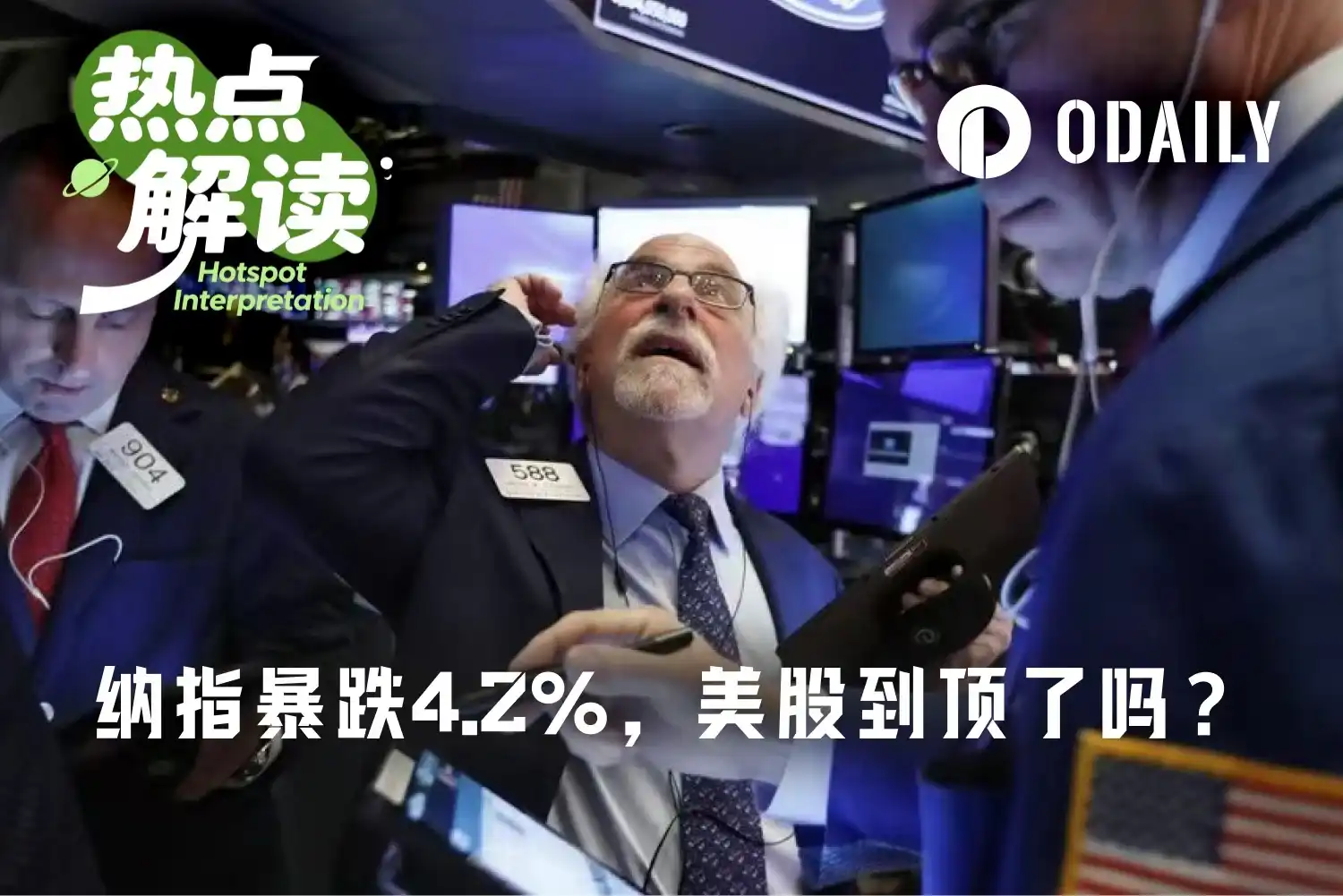
Nasdaq Plunges 4.2% in a Single Day: Does "Black Friday" Burst the U.S. Stock Market Bubble?

The Nasdaq plunged 4.18% on June 5, 2026, its worst single-day drop in over a year, as a much stronger-than-expected US jobs report triggered fears of economic overheating and delayed Federal Reserve interest rate cuts. The selloff, centered on high-valuation tech and AI stocks like Nvidia and Broadcom, spread across major indices. The article examines whether this signals a market top. The strong May non-farm payrolls data, nearly double expectations, pushed bond yields higher, directly hurting rate-sensitive tech stocks. This exposed vulnerabilities in the crowded AI trade, where valuations had soared on narratives of infinite growth, despite emerging signs of slowing order momentum and corporate AI monetization challenges. Prior to the drop, market indicators flashed warning signs: historically high valuations (e.g., Shiller CAPE ratio near 39.5), extreme bullish sentiment, and high levels of leverage. Technical charts showed key support levels being breached. Wall Street is divided on the outlook. Bears, citing risks of "stagflation" and AI bubble comparisons to the dot-com era, warn of a potential significant correction. Bulls view the drop as a healthy correction within a bull market, underpinned by a strong economy and expected corporate earnings growth of around 7% in 2026. The immediate future hinges on upcoming key events: the May CPI inflation data and the mid-June FOMC meeting. Their outcomes will critically shape market expectations for the Fed's rate path. The article concludes that conditions for a major market top are aligning, marking a fragile transition from narrative-driven gains to a phase demanding validation from macroeconomic data and corporate fundamentals. Caution is advised.

marsbit2h ago

Nasdaq Plunges 4.2% in a Single Day: Does "Black Friday" Burst the U.S. Stock Market Bubble?

marsbit2h ago

Trading

Spot
Futures

Hot Articles

How to Buy CHIP

Welcome to HTX.com! We've made purchasing USD.AI (CHIP) simple and convenient. Follow our step-by-step guide to embark on your crypto journey.Step 1: Create Your HTX AccountUse your email or phone number to sign up for a free account on HTX. Experience a hassle-free registration journey and unlock all features.Get My AccountStep 2: Go to Buy Crypto and Choose Your Payment MethodCredit/Debit Card: Use your Visa or Mastercard to buy USD.AI (CHIP) instantly.Balance: Use funds from your HTX account balance to trade seamlessly.Third Parties: We've added popular payment methods such as Google Pay and Apple Pay to enhance convenience.P2P: Trade directly with other users on HTX.Over-the-Counter (OTC): We offer tailor-made services and competitive exchange rates for traders.Step 3: Store Your USD.AI (CHIP)After purchasing your USD.AI (CHIP), store it in your HTX account. Alternatively, you can send it elsewhere via blockchain transfer or use it to trade other cryptocurrencies.Step 4: Trade USD.AI (CHIP)Easily trade USD.AI (CHIP) on HTX's spot market. Simply access your account, select your trading pair, execute your trades, and monitor in real-time. We offer a user-friendly experience for both beginners and seasoned traders.

1.4k Total ViewsPublished 2026.04.21Updated 2026.06.02

How to Buy CHIP

Discussions

Welcome to the HTX Community. Here, you can stay informed about the latest platform developments and gain access to professional market insights. Users' opinions on the price of CHIP (CHIP) are presented below.

活动图片