Founder of Chinese Mining Company: "Don't Be Fooled by Bitcoin's Rise, the Bull Market Has Not Yet Begun"

cryptonews.ruPublished on 2026-08-08Last updated on 2026-08-08

Abstract

Jiang Zhuoer, founder of mining pool B.TOP, states that current capital flows in the cryptocurrency market do not signal the start of a new bull market. He points to a sustained outflow from the stablecoin supply, with the total market capitalization of stablecoins decreasing by approximately $2.23 billion over the past month. Specifically, Tether (USDT) fell from $184.2B to $183.1B, and USD Coin (USDC) dropped from $73.28B to $72.15B. Zhuoer argues this decline in stablecoin supply indicates weak new capital inflow and that current funding conditions are not conducive to a bull market beginning. While he predicts Bitcoin could see a short-term recovery, potentially reaching a peak between $68,000 and $70,000, he warns that following the covering of short positions during this rise, Bitcoin might experience a "final drop."

Jiang Zhuoer, founder of the mining pool B.TOP, stated that the current capital flows in the cryptocurrency market do not signal the start of a new bull market, and pointed out the possibility of a final decline for Bitcoin following short-term growth.

According to data provided by Jiang Zhuoer, the trend of funds outflowing from the stablecoin supply in the cryptocurrency market continues. Over the past month, the total market capitalization of stablecoins has decreased by approximately 2.23 billion dollars.

During this period, the market capitalization of Tether (USDT) dropped from 184.2 billion dollars to 183.1 billion dollars, and the market capitalization of USD Coin (USDC) fell from 73.28 billion dollars to 72.15 billion dollars.

Zhuoer argued that the decrease in stablecoin supply indicates that the influx of new capital into the market remains weak, and that current funding conditions are not conducive to the start of a bull market.

Zhuoer stated that Bitcoin could recover in the short term, predicting that the price might reach a high of 68,000–70,000 dollars. According to the analyst, after short positions are closed during this rise, Bitcoin could experience a "final drop."

*This is not investment advice.

end-content

Trending Cryptos

Related Questions

QAccording to Jiang Zhuoer, what does the trend of declining stablecoin supply indicate about the cryptocurrency market?

AHe indicates that the declining stablecoin supply shows that the influx of new capital into the market is still weak and that current funding conditions are not conducive to the start of a bull market.

QWhat is Jiang Zhuoer's short-term price prediction for Bitcoin?

AHe predicts that the price of Bitcoin could recover to a high range of $68,000 to $70,000 in the short term.

QWhat does Jiang Zhuoer believe might happen to Bitcoin after a potential short-term price rise?

AHe believes that after short positions are closed during this potential rise, Bitcoin could experience a 'final decline' or drop.

QAccording to the data cited in the article, by how much did the total market capitalization of stablecoins decrease in the last month?

AThe total market capitalization of stablecoins decreased by approximately $2.23 billion in the last month.

QWhat are the specific changes in market capitalization mentioned for USDT and USDC over the last month?

AUSDT's market cap decreased from $184.2 billion to $183.1 billion, and USDC's market cap fell from $73.28 billion to $72.15 billion.

Related Reads

Conversation with Blockchain Capital Partners: The Next Bull Market May Be Right in Front of Us

In a recent Bankless podcast, Blockchain Capital partners Aleks Larsen and Spencer Bogart discussed the crypto market's evolution from infrastructure to applications. They noted that widespread stablecoin adoption has built significant on-chain liquidity, boosting revenues for lending and trading protocols. The partners defended the "buyback and burn" token model, explaining its current effectiveness in aligning incentives and establishing credibility with holders, despite past debates on capital efficiency. Addressing the sentiment divide in crypto, they highlighted positive catalysts like regulatory clarity and institutional entry, even during the bear market. Aleks compared the industry's current state to the 2003-2004 internet era—post-"broadband transition" with cheap block space, awaiting mainstream adoption through applications like stablecoins and prediction markets. They observed a shift from "fat protocol" to "fat application," where value now accrues more at the application layer than the base infrastructure, a sign of a maturing ecosystem. Drawing parallels to AI, they noted similarities in early hype cycles but emphasized crypto's transparent, token-driven market corrections versus AI's private market adjustments. On Real World Assets (RWA), Spencer projected stablecoin market cap to reach trillions by 2030, detailing its multiplier effect on on-chain economic activity. For stock tokenization, he outlined two approaches: permissionless but legally indirect models and compliant, direct ownership channels, suggesting they can coexist in "sidecar" models alongside pure DeFi. The conversation concluded that while the industry's ethos evolves with institutional adoption, crypto's core promise of upgrading global financial infrastructure for greater efficiency remains intact and is steadily progressing.

marsbit22m ago

Conversation with Blockchain Capital Partners: The Next Bull Market May Be Right in Front of Us

marsbit22m ago

Bitcoin's ECX Hard Fork to Introduce Three New Versions Throughout October

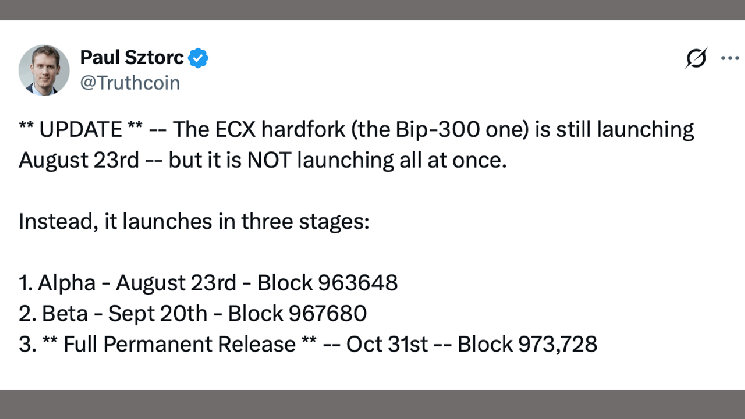
Bitcoin developer Paul Stortz, behind the Drivechain and BIP 300 proposals, has announced a hardfork for a new blockchain called ECX. Scheduled for October 31st (the 18th anniversary of the Bitcoin whitepaper), ECX will copy Bitcoin's full transaction history at a specific block height, crediting nearly all Bitcoin holders with an equal amount of ECX coins without altering the Bitcoin network itself. The launch will be executed in three phases. An "alpha" version is set for August 23rd (block 963,648), followed by a "beta" version on September 20th (block 967,680). The final mainnet launch is planned for October 31st (block 973,728). Coins accumulated during the alpha and beta phases can later be burned or swapped for real ECX. Stortz cites several reasons for the phased rollout: to address potential software bugs (including those possibly found by AI), allow an early market price to form for ECX before mining difficulty stabilizes, and let traders test and speculate. He described it as a "safety net" to manage any major issues and to demonstrate the chain's functionality. A key detail is that replay protection—a mechanism to prevent a transaction from being valid on both the Bitcoin and ECX chains—will remain optional, not automatic. The official ECX wallet software will apply this protection and warn users; Stortz warned that transactions ignoring this warning will be replayed on ECX, effectively tracking a user's spent bitcoins to their new owner unless a deliberate split is made. Stortz has given holders and exchanges 12 weeks from the alpha launch to prepare, during which they must decide on practical matters like running the wallet software to split their BTC and ECX holdings and how exchanges will credit the new asset to clients. The announcement comes as Bitcoin also faces another potential fork related to BIP-110.

cryptonews.ru4h ago

Bitcoin's ECX Hard Fork to Introduce Three New Versions Throughout October

cryptonews.ru4h ago

Trading

Spot

Hot Articles

Discussions

Welcome to the HTX Community. Here, you can stay informed about the latest platform developments and gain access to professional market insights. Users' opinions on the price of S (S) are presented below.

活动图片