Behind HYPE's Repeated Record Highs, the 'Minions' in the Ecosystem Can't Keep Up

Foresight NewsPublished on 2026-06-17Last updated on 2026-06-17

Abstract

While HYPE, the native token of the Hyperliquid ecosystem, surges to new all-time highs above $76 and attracts significant institutional ETF inflows, a starkly different reality unfolds within its HyperEVM application layer. Multiple core DeFi protocols across lending, NFTs, stablecoins, and DEXs have announced shutdowns between May and June. The article argues HYPE functions more like an "application stock" than a traditional ecosystem token. Its value is anchored to the trading fees from Hyperliquid's core perpetual contracts platform (HyperCore), which boasts a diversified revenue stream from crypto, commodities, and indices. Approximately 97% of protocol fees fund buybacks and burns of HYPE. This means HYPE's price is largely decoupled from the health of projects built on HyperEVM. The closures of significant projects like lending protocol HypurrFi (peak TVL >$300M) and NFT marketplace Drip.Trade highlight a structural tension. Hyperliquid's minimalist philosophy offers infrastructure without official grants, liquidity support, or marketing coordination for HyperEVM projects. This forces protocols into a fiercely competitive environment from day one. Furthermore, the success of HyperCore creates a liquidity vacuum, and mechanisms like HIP-3 (allowing direct perpetual market deployment) divert user attention and capital away from application-layer projects. The stronger the core perpetual trading business becomes, the more difficult it is for peripheral "DeFi lego" proje...


Author: Sanqing, Foresight News


On June 16, HYPE reached 76.965 USDT, once again hitting a new all-time high, with a daily increase of about 10%, triggering over $11.5 million in short liquidations. Meanwhile, according to SoSoValue data, three US spot HYPE ETFs have attracted a cumulative net inflow of approximately $180 million in their first month of trading, indicating sustained institutional capital inflow.


However, the scene on the Hyperliquid ecosystem side is completely different. From May to June, several protocols across multiple sectors including lending, NFT, stablecoin, and DEX have successively announced their shutdown.


HYPE is an "Application Stock"


Hyperliquid injects about 97% of protocol fees into the Assistance Fund, continuously buys back HYPE in the open market and permanently burns it. According to buildix data, the current daily buyback is about 34,000 HYPE (approximately $2.57 million), with an annualized buyback scale of about $940 million, annualized protocol revenue of about $976 million, a P/E ratio of about 73x, and a buyback yield of about 5.6%.


According to DefiLlama data, Hyperliquid's trading volume in the last 30 days exceeds $240 billion. This is precisely the fuel driving the buyback machine: the highly diversified revenue structure of the HyperCore perpetual contract trading layer. Crypto perpetual contracts (BTC, ETH, SOL, etc.) contribute about 55% of daily fees, commodities (crude oil, gold, silver) about 22%, stock indices (S&P 500, Nasdaq) about 12%, and spot trading about 6%.
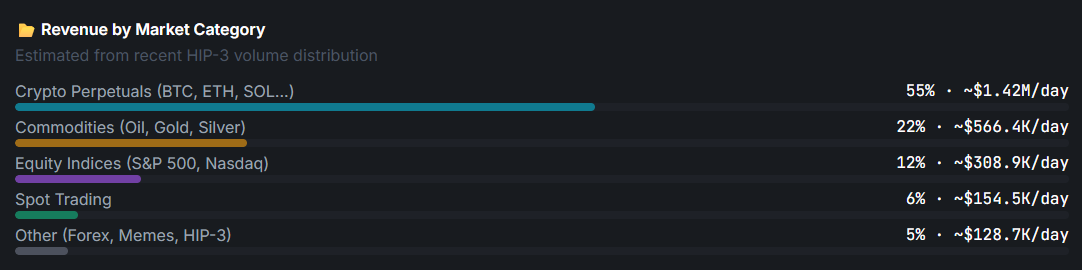


This means HYPE resembles more of an "application-type stock" rather than a traditional "ecosystem token." Its value capture is anchored to HyperCore's trading fees and has almost no direct relationship with HyperEVM's TVL scale or the survival count of DeFi protocols.


This is fundamentally different from ETH's value logic. ETH's pricing premise is that ecosystem prosperity drives Gas consumption, which in turn pulls the token price. Therefore, the death of any ecosystem project is a negative signal for ETH.


But HYPE's fee source is almost unrelated to HyperEVM. Whether HyperEVM projects live or die does not change HyperCore's trading volume, nor does it affect the Assistance Fund's buyback pace. Investors holding HYPE are exposed to the operational risk of "the business of Hyperliquid's perpetual contract trading," not the risk of a particular DeFi protocol.


Five Announcements


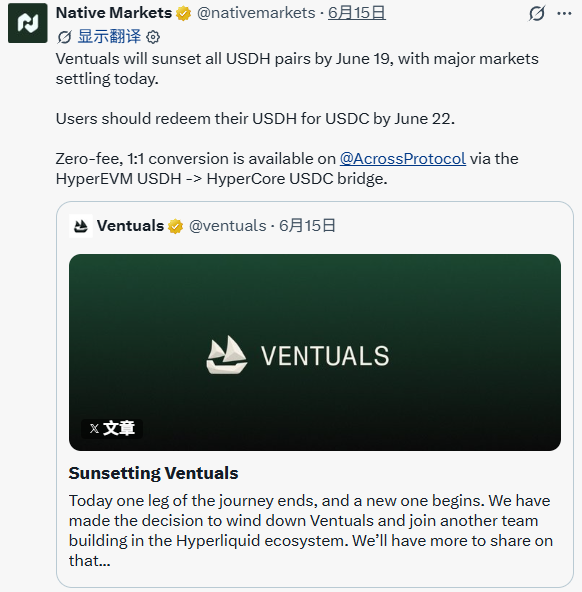
Ventuals (June 15): Cumulative trading volume exceeded $650 million, serving over 11,000 traders, with the announcement receiving 47,000 views. The team wrote: "Today, one segment of the journey ends, and a new one begins." The shutdown process was extremely orderly, listing settlement times and price mechanisms for 11 markets including OpenAI and Anthropic one by one, with user HYPE refunded in full at a 1:1 ratio.


Felix (announced June 8, terminated June 20): Announcement: "In light of the deactivation of USDH, the Felix HIP-3 DEX and all active markets will begin deactivation on June 19 and conclude on June 20."


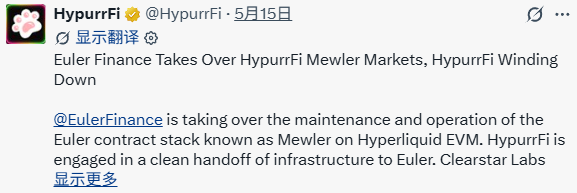
HypurrFi (May 15): Once a top lending protocol on HyperEVM, with a peak TVL exceeding $300 million. The announcement stated: "No security breach. No exploit. No emergency. This is a considered operational decision." The brand is exiting, infrastructure is being handed over to Euler Finance, and Pooled markets will complete final settlement on July 15.


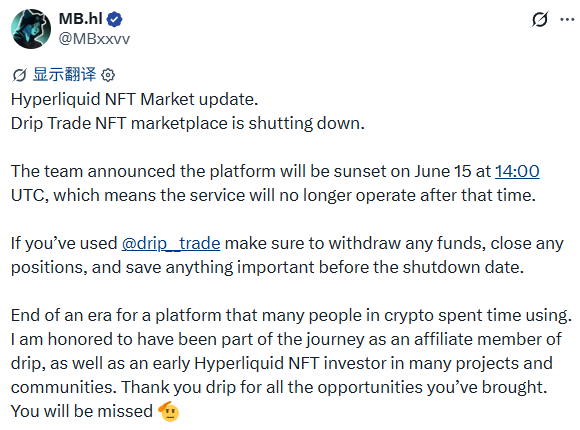
Drip.Trade (June 15): The only NFT marketplace on HyperEVM. Hyperliquid ecosystem KOL @MBxxvv relayed official news: "The platform will go offline at 22:00 on June 15, and services will no longer operate thereafter."


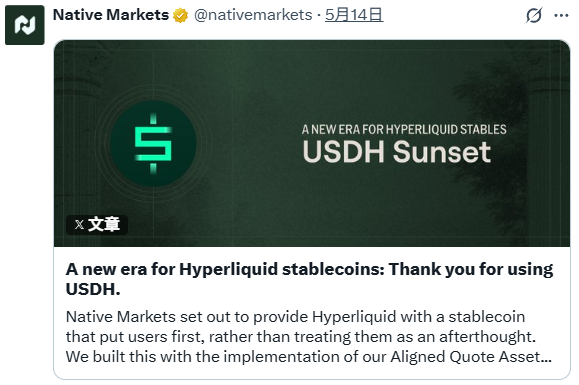
USDH / Native Markets (May 14): Announcement by Native Markets stated it would transfer the stablecoin brand rights of USDH to Coinbase, making Coinbase the official USDC deployer on Hyperliquid.


These five projects cover five sectors: lending, NFT, stablecoin, RWA private markets, and DEX, almost representing the main categories of DeFi infrastructure on HyperEVM. They were not marginal projects but protocols with real users and trading volume within the ecosystem at the time.


The Stronger the Core, the Harder the Ecosystem Lives


If HYPE's rise and the death of ecosystem projects were merely two independent trajectories, then this crisis would just be "the failure of peripheral projects themselves," not worth in-depth examination. But looking closely, these two events are not just happening in parallel.


Hyperliquid's design philosophy is minimalism: provide the chain and infrastructure, do not get involved in operations.


Since its launch in February 2025, HyperEVM has attracted over 170 project deployments, but from the start, there were no official grants, no coordinated market-making arrangements, no launch liquidity support. Projects faced the fully competitive secondary market head-on from day one. The core team hardly publicly participates in collaborative interactions with HyperEVM project parties; protocol projects are expected to be self-sufficient by default.


When on-chain products were scarce, any functioning protocol brought its own traffic. But the market in 2026 is already saturated. The survival of new protocols is not a technical problem; it's a cold start problem. Without official endorsement and liquidity guidance, the vast majority of projects simply cannot survive the cold start phase.


Furthermore, the HIP-3 mechanism allows anyone to directly deploy perpetual contract markets on HyperCore. It was originally an outlet for liquidity overflow, but it simultaneously diverts attention and user traffic away from protocol projects.


The leading project on HIP-3, TradeXYZ, already occupies about 97% of the market share in its category, leaving almost no room for latecomers. This means protocol projects are not only competing with external competitors but also competing with Hyperliquid's own liquidity siphon effect.


The more successful HyperCore is, the more traffic and capital it attracts, the harder it is for projects on HyperEVM to get a share. This is not HyperEVM's technical failure, but Hyperliquid's business model inherently reserves the highest-quality resources for the core layer, structurally compressing the peripheral survival space.


Trending Cryptos

Related Questions

QAccording to the article, why is HYPE considered more like an 'application stock' rather than a traditional 'ecosystem token'?

AHYPE is considered an 'application stock' because its value is primarily tied to the revenue generated by HyperCore's perpetual contract trading business, not to the performance or survival of projects on the HyperEVM. Its buyback and burn mechanism is fueled by HyperCore's transaction fees, which come from a diversified range of assets. The health of HyperEVM DeFi projects does not directly impact HYPE's price, unlike ETH which depends on network activity and gas fees.

QWhat are the two main reasons mentioned in the article for the difficulty HyperEVM projects face in surviving?

AThe two main reasons are: 1) Hyperliquid's minimalist, hands-off philosophy means no official grants, liquidity support, or coordinated market-making for projects, leaving them to fend for themselves in a competitive market. 2) The success of the core HyperCore layer, particularly the HIP-3 mechanism, creates a 'liquidity siphon' effect. It attracts the most capital and user attention, making it extremely difficult for independent projects on HyperEVM to capture user traffic and sustain themselves.

QWhich five major sectors in the HyperEVM ecosystem have seen projects announce shutdowns, as highlighted in the article?

AAccording to the article, projects in five major sectors announced shutdowns: Lending (HypurrFi), NFTs (Drip.Trade), Stablecoins (USDH / Native Markets), RWA Private Markets (Ventuals), and DEXs (Felix).

QWhat is the primary source of transaction fees driving the HYPE buyback mechanism on Hyperliquid?

AThe primary source of transaction fees driving the HYPE buyback is the HyperCore perpetual contract trading layer. The revenue structure is highly diversified, with approximately 55% from crypto perpetuals (BTC, ETH, SOL), 22% from commodities (oil, gold, silver), 12% from stock indices (S&P 500, Nasdaq), and 6% from spot trading.

QHow does the relationship between the core protocol (HyperCore) and the broader ecosystem (HyperEVM) in Hyperliquid differ from that of Ethereum?

AIn Ethereum, the value of ETH is intrinsically linked to the health of its ecosystem. A thriving ecosystem with many successful dApps drives network usage and gas consumption, which benefits ETH's price. In Hyperliquid, the value of HYPE is decoupled from the HyperEVM ecosystem. HyperCore's trading fees, which fund the HYPE buyback, are generated independently of whether HyperEVM projects succeed or fail. A strong HyperCore can even hinder HyperEVM projects by absorbing most of the liquidity and user attention.

Related Reads

My Coding Betting Dashboard is Profiting, but Polymarket is Truly Not a Good Place for 'Arbitrage'

The author built a custom monitoring dashboard for Polymarket, a prediction market platform, and tested it with $1,600, achieving over 30% returns. However, the core argument is that Polymarket is not a good venue for traditional arbitrage. The dashboard has two main sections: a "Portfolio Dashboard" for tracking active positions with key metrics like total capital, P&L, and a risk-control module using a tier system (T1, T2, T3), and an "Opportunity Watchlist" for monitoring markets. The article details a critical structural trap in binary markets: a bet with a high perceived probability of success still carries a 100% loss risk if wrong. The author's T1/T2/T3 system is designed to manage this by limiting position sizes based on conviction and time horizon, emphasizing that high confidence should not equal high concentration. A key insight is the danger of "pseudo-diversification"—betting on different markets driven by the same underlying variable. The author concludes that Polymarket offers few true low-risk, arbitrage opportunities. It is instead a high-risk environment where wins can create a false sense of mastery, leading to large losses. The platform is better viewed as a training ground for honing judgment through disciplined, framework-driven betting rather than a reliable income source. The tools help transform intuition into structured, rule-based decisions to mitigate the risk of catastrophic errors.

marsbit2h ago

My Coding Betting Dashboard is Profiting, but Polymarket is Truly Not a Good Place for 'Arbitrage'

marsbit2h ago

WeChat AI Card Hands-On Guide: Has the AI Shopping Era Arrived?

**"WeChat AI Card" Practical Test Guide: Has the Era of AI Shopping Arrived?** WeChat has officially launched the "AI Exclusive Card," a feature integrated into its Workbuddy AI assistant. This card is designed to handle payments for AI-initiated purchases. Our hands-on test reveals it's not yet a tool for fully autonomous AI shopping, but rather a controlled payment layer for AI agents. The AI Card functions as an isolated sub-wallet within WeChat Pay. Users must bind the card and transfer funds into it from their main wallet. Crucially, every transaction requires explicit user confirmation via smartphone scan; AI cannot spend autonomously. Currently accessible through the Workbuddy agent, the card targets specific digital consumption scenarios: purchasing paid content (reports, data), calling paid APIs/tools, and subscribing to services. Its design prioritizes security and control by separating funds and mandating approval for each payment. We tested a real-world scenario: ordering bubble tea via Workbuddy using a "Meituan Life Assistant" skill. The process encountered multiple hurdles: high "skill" usage costs (exceeding daily free credits), and most importantly, while a payment was successfully initiated, the AI purchased an incorrect product (a mismatched group-buy coupon instead of the desired drink). This highlights the current limitation: the **AI Card only solves the payment step**. The broader challenge lies in the **AI agent's execution chain**—accurately understanding intent, navigating third-party platforms, selecting the right product, and ensuring proper fulfillment. The payment succeeded, but the purchase failed to meet the user's need. In conclusion, the WeChat AI Exclusive Card is a cautious, early-step experiment in AI commerce. It provides a secure, user-controlled payment method for agent interactions but is not yet capable of reliable, end-to-end complex purchases. For now, it's best used for low-value, low-risk digital services with careful user verification at each step. The vision of AI handling complete shopping tasks remains a work in progress.

marsbit5h ago

WeChat AI Card Hands-On Guide: Has the AI Shopping Era Arrived?

marsbit5h ago

Deconstructing Notion's Growth: From a Note-taking Tool to 100 Million Users—How Notion Built a Triple Growth Flywheel Through Product, Templates, and Community

Notion's growth from a niche note-taking tool to a platform with 100 million users is powered by three interconnected flywheels: Product-Led Growth (PLG), a Template Economy, and Community-Driven Growth. First, Notion's PLG strategy relies on a highly flexible, "plastic" product that users can adapt to countless personal and team workflows. Its freemium model lowers the barrier to entry, while features like page sharing and collaboration drive organic, usage-based viral growth as users naturally invite others. Second, the Template Economy solves the "blank page" problem. Templates, created by both Notion and its community, transform abstract product capabilities into concrete, copyable solutions for specific scenarios (e.g., project management, content calendars). This dramatically lowers activation costs for new users and fuels SEO-driven discovery. Third, a vibrant Community acts as a distributed growth engine. Users and official Ambassadors create tutorials, share use cases, and host local events. This community not only educates users but also fosters a sense of identity around pursuing "better ways of working," strengthening loyalty and enabling global, low-cost expansion. Together, these flywheels create a self-reinforcing ecosystem: a great product attracts users who create templates and community content, which in turn attracts more users and deepens engagement. This system allowed Notion to scale from individuals to teams and enterprises through a bottom-up adoption path. Looking ahead, AI integration promises to accelerate these flywheels further by making templates smarter and the platform a potential AI-native work operating system. Ultimately, Notion's defensible advantage is not just its features, but this deeply entrenched network of user assets, creators, and community trust.

marsbit5h ago

Deconstructing Notion's Growth: From a Note-taking Tool to 100 Million Users—How Notion Built a Triple Growth Flywheel Through Product, Templates, and Community

marsbit5h ago

$10 Billion, Qualcomm to Acquire Chip Legend Jim Keller's Company

Global mobile chip giant Qualcomm is in advanced talks to acquire AI chip startup Tenstorrent in a deal valued between $8-10 billion, according to media reports. This potential acquisition would be one of the largest in the AI chip sector in recent years. Tenstorrent, led by legendary chip architect Jim Keller, has gained prominence for its RISC-V architecture and AI accelerator designs. The move highlights Qualcomm's strategic push to diversify beyond its core smartphone chip business. As the smartphone market matures, Qualcomm is aggressively targeting growth in automotive, data center, and cloud AI. Acquiring Tenstorrent would allow Qualcomm to rapidly enter the high-end AI computing market, bypassing lengthy in-house development cycles. Tenstorrent's cost-effective system architecture, which avoids expensive HBM memory and relies on standard Ethernet for clustering, offers a potential alternative to Nvidia's costly solutions. Furthermore, Tenstorrent's high-performance RISC-V CPU technology and its focus on the automotive and edge computing segments align with Qualcomm's strategic goals, including its "Snapdragon Digital Chassis" platform. Despite the strategic rationale, the high valuation has sparked some investor caution. The successful integration of Tenstorrent's open-source culture and independent team into Qualcomm's organization, along with the commercialization of its technology, remains a key challenge.

marsbit6h ago

$10 Billion, Qualcomm to Acquire Chip Legend Jim Keller's Company

marsbit6h ago

Trading

Spot
Futures

Hot Articles

Discussions

Welcome to the HTX Community. Here, you can stay informed about the latest platform developments and gain access to professional market insights. Users' opinions on the price of S (S) are presented below.

活动图片