2026 Crypto Financing Reshuffle: Gaming and DePIN Are Dead, Two Prediction Market Deals Gobble Up 18% of Yearly Funding

marsbitОпубликовано 2026-05-09Обновлено 2026-05-09

Введение

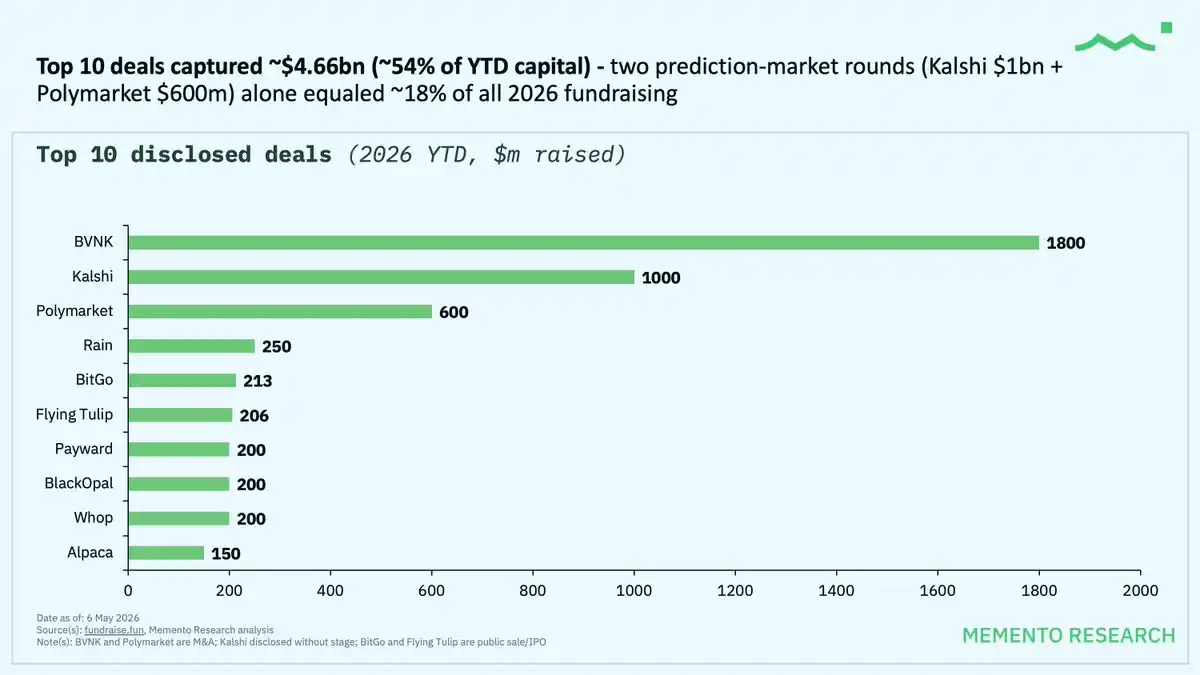
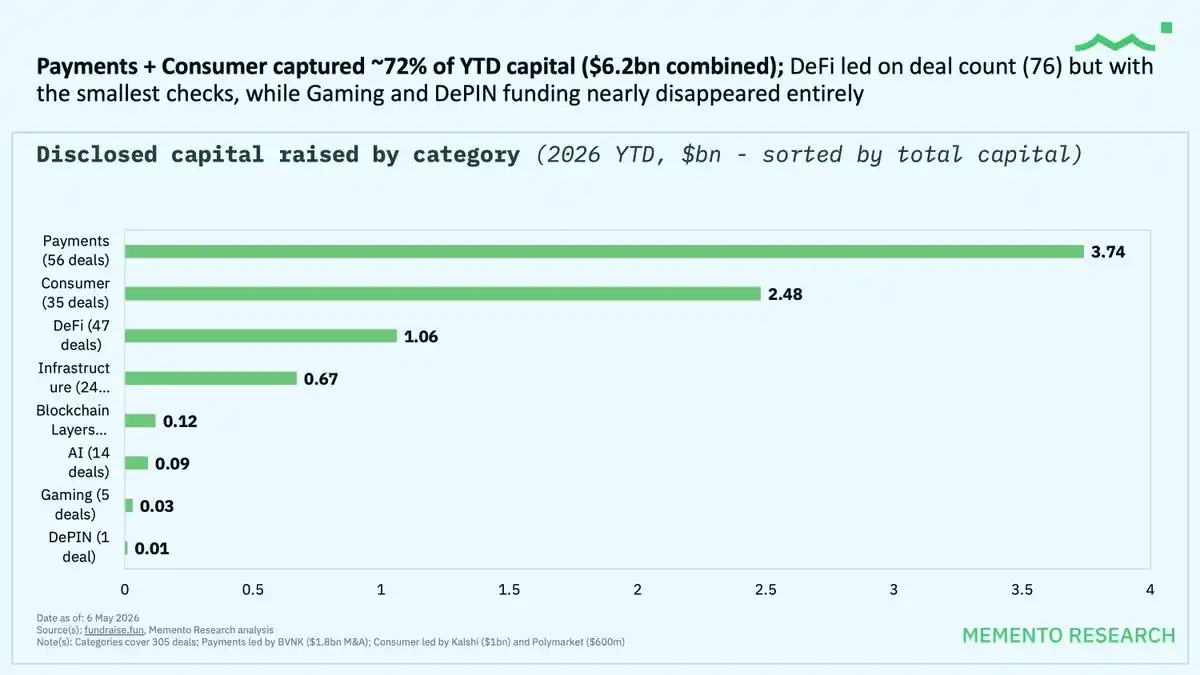
Crypto Funding Shakeup in 2026: Gaming & DePIN Fade, Prediction Markets Dominate Analysis of crypto funding from January 1 to May 6, 2026, reveals a major sectoral shift. The industry raised $8.65 billion across 305 deals. However, a March surge to $4.57 billion was largely due to two mega-deals: BVNK's $1.8 billion acquisition and a $1 billion raise by Kalshi. Excluding these, monthly funding is a sluggish ~$1 billion. Capital concentration is extreme. The Payments ($3.74B) and Consumer ($2.48B) sectors absorbed 72% of all funds. Within Consumer, prediction markets were dominant: Kalshi's $1B and Polymarket's $600M raises together accounted for 18% of the year's total, surpassing all 47 DeFi deals combined ($1.06B). In contrast, Gaming and DePIN sectors saw funding nearly vanish. A strategic pivot is underway. Merger & Acquisition (M&A) activity reached 48 deals, nearly matching the 57 seed-stage rounds. This indicates capital is increasingly flowing toward acquiring established leaders rather than betting on new ideas. The most active investors so far in 2026 are Coinbase Ventures (18 deals), Tether (13 deals), Animoca Brands (11 deals), and GSR (11 deals). Notably, a16z's pace has slowed significantly compared to its 2021-2026 average.

Author: Memento Research

Compilation: TechFlow Deep Tides

Deep Tides Intro: Crypto financing data from the first four months of 2026 reveals a brutal reality: funding for the gaming and DePIN sectors has nearly dried up, while Kalshi and Polymarket, two prediction market companies, have taken more money than all DeFi projects combined for the entire year. More alarmingly, the number of M&A deals has caught up with seed rounds, indicating that capital is shifting from betting on new ideas to acquiring existing industry leaders.

Financing Overview: The March Surge Was Just an Illusion

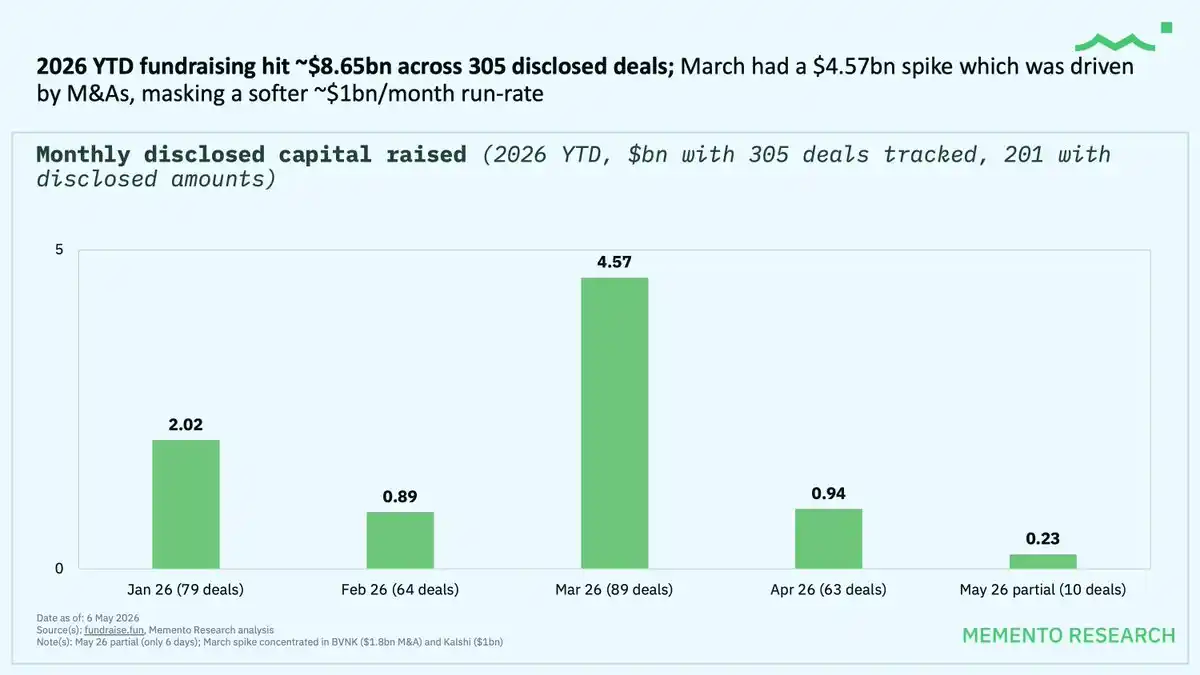
From January 1 to May 6, 2026, the crypto industry completed 305 financing rounds, totaling $8.65 billion. However, the "surge" of $4.57 billion in March was essentially just two mega M&A deals: BVNK's $1.8 billion and Kalshi's $1 billion.

Excluding these two, the real financing pace is about $1 billion per month, which is even weaker than at the end of 2025.

Fund Flow: Payments and Consumer Gobble Up 72%

By sector:

Payments: $3.74 billion (56 deals)

Consumer: $2.48 billion (35 deals)

DeFi: $1.06 billion (47 deals, the highest number of transactions)

The payments and consumer sectors together account for 72% of the year's funding. Financing for gaming and DePIN has almost vanished.

Prediction Markets Dominate the Consumer Sector

The two prediction market companies accounted for 18% of the year's total funding:

Kalshi: $1 billion

Polymarket: $600 million

These two deals total $1.6 billion, exceeding the combined total of all 47 DeFi financing rounds.

M&A Becomes Mainstream

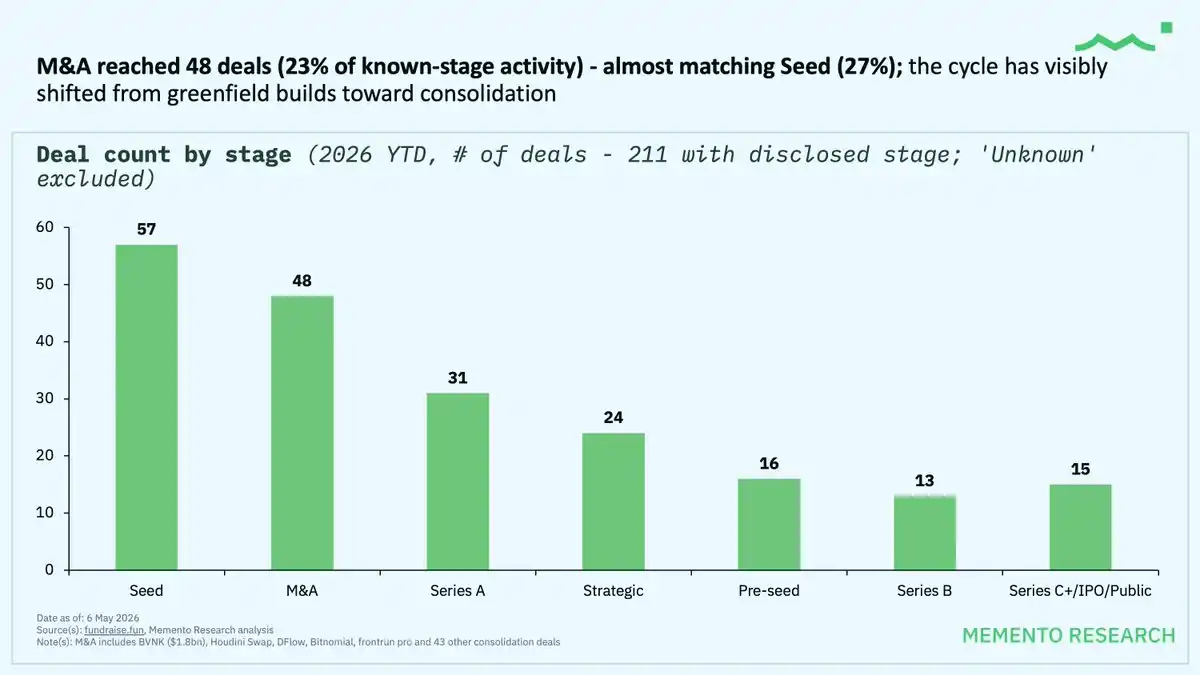
M&A deals reached 48 (23% of known-stage transactions), almost on par with 57 seed rounds (27%). This cycle has shifted from the early stage of investing in new ideas to acquiring industry leaders.
Investor Rankings Reshuffled

Most active funds in 2026:

Coinbase Ventures: 18 deals (Ranked 2nd during 2021-26)

Tether: 13 deals (New top lead investor)

Animoca Brands: 11 deals (Ranked 1st during 2021-26)

GSR: 11 deals

a16z: 7 deals (Significantly down from ~200 deals during 2021-26)

Связанные с этим вопросы

QWhat were the two major M&A deals that dominated the funding figures for March 2026, and what were their values?

AThe two major M&A deals were BVNK, which raised $1.8 billion, and Kalshi, which raised $1 billion.

QWhich two sectors accounted for 72% of total funding in early 2026, and what were the respective funding amounts?

AThe Payments and Consumer sectors accounted for 72% of total funding. Payments raised $3.74 billion across 56 deals, while Consumer raised $2.48 billion across 35 deals.

QHow much funding did the prediction market companies Kalshi and Polymarket receive collectively, and what percentage of the year's total funds does this represent?

AKalshi and Polymarket collectively received $1.6 billion in funding, which represents 18% of the total funds raised in early 2026.

QWhat significant trend is highlighted by the number of M&A transactions (48) nearly matching the number of seed rounds (57) in early 2026?

AThe trend highlights a market shift where capital is moving away from funding new ideas (seed-stage investments) and towards acquiring existing market leaders (M&A).

QAccording to the article, which were the most active investment funds in early 2026 by number of deals?

AThe most active funds were Coinbase Ventures with 18 deals, Tether with 13 deals, and Animoca Brands and GSR with 11 deals each.

Похожее

Smart Money Hoards $40 Billion in Cash, Retail Bets $2.6 Trillion on Calls: The Critical Moment of the US Stock Market's AI Narrative

Title: Smart Money Hoards $40 Billion in Cash, Retail Traders Bet $2.6 Trillion on Call Options: The Tipping Point for the AI Narrative in U.S. Stocks The U.S. stock market is experiencing a striking divergence. While the S&P 500 hits new highs, the financial sector is down 6% year-to-date, underperforming more than during the 2008 and COVID crises. In contrast, a record $2.6 trillion in S&P 500 call options traded in a single day, and the Philadelphia Semiconductor Index RSI is at its highest since 1999. This reflects a clear split: "smart money" is retreating while retail traders chase gains. Key data points highlight this critical juncture in the AI-driven rally: 1. SoftBank had to cut its $10 billion loan target against its OpenAI stake to $6 billion, as lenders questioned the valuation of the private AI giant, signaling primary market skepticism. 2. The explosive $2.6 trillion daily options volume, with 60% being calls, is described by a Goldman Sachs partner as a "semi-irrational chase," drawing parallels to the 1999 tech bubble. 3. The financial sector's severe underperformance relative to the S&P 500 is a classic technical warning signal, indicating potential underlying economic stress. 4. Apollo Global Management, despite strong earnings, is building a $40 billion cash buffer in its insurance business, preparing for what its CEO calls a 30-35% probability of an exogenous shock from geopolitics, inflation, and AI's economic disruption. 5. Consumer behavior mirrors this split: while Whirlpool plunged on a worsening macro outlook for big-ticket items, DoorDash rose on strong demand for small, immediate services. Together, these conflicting signals from primary markets, secondary markets, leading sectors, and top institutions suggest market risk premia have compressed to a precarious level. The current price action may be increasingly reliant on speculative sentiment rather than fundamental support, marking a potential tipping point for the AI investment narrative.

marsbit21 мин. назад

Smart Money Hoards $40 Billion in Cash, Retail Bets $2.6 Trillion on Calls: The Critical Moment of the US Stock Market's AI Narrative

marsbit21 мин. назад

Tiger Research: AI Agents Will Now Need Identity Verification

Tiger Research: AI Agents Now Need "ID Verification" AI agents are increasingly capable of autonomously executing contracts, making payments, and conducting trades. However, a critical issue remains unresolved: how to verify the identity of the agent on the other side of a transaction. This article examines the emerging competition to establish a KYA (Know Your Agent) standard and the current state of regulatory progress. **Core Points:** 1. As AI agents operate independently in A2A (agent-to-agent) scenarios, the focus shifts from KYC (Know Your Customer) to KYA for identity verification. 2. KYA is not universally required; it's essential primarily when independently deployed agents interact with open ecosystems like DEXs, engage in A2A payments, or pay merchants, not within centralized platforms. 3. A standards battle is underway, with four key players approaching KYA from different angles: * **ERC-8004:** A blockchain-native approach, creating agent IDs as NFTs with on-chain registries for identity, reputation, and validation. * **Visa TAP:** Leverages Visa's payment network to issue verified "Agent Intent" credentials, bundling agent identity into its payment rails. * **Trulioo:** Adapts the SSL certificate model to issue dynamic "Digital Agent Passports," verifying both developer (KYB) and user (KYC) credentials. * **Sumsub:** Focuses on real-time risk detection and re-verification of the human behind an agent during suspicious transactions, rather than pre-issuing certificates. 4. Regulatory momentum is building. The EU AI Act, the U.S. NIST, and Singapore's national AI governance framework are prioritizing agent identity management. The rollout of KYA standards is likely to follow a pattern similar to the FATF Travel Rule, becoming a watershed moment for the industry. The market is unlikely to have a single winner. Different approaches will dominate specific niches: ERC-8004 for on-chain autonomous transactions, Visa TAP for payment-bound commerce, Trulioo for regulated finance, and Sumsub for fraud-prone scenarios. The key differentiator will be which players successfully integrate their identity infrastructure earliest as adoption scales.

marsbit1 ч. назад

Tiger Research: AI Agents Will Now Need Identity Verification

marsbit1 ч. назад

Perspective: The current AI supercycle will last 15 years, but most are still buying stocks in the first FOMO stage

This article outlines a 15-year AI supercycle, segmented into four investment stages. It argues that while most investors are still focused on the first stage, smart money is already moving to the third. **Stage 1: The Foundation (2023-2025) - Priced In** The semiconductor layer (e.g., NVIDIA, AMD) is complete. While growth continues, the historic entry opportunity is over as risk/reward has compressed. **Stage 2: The Build-Out (2025-2027) - In Progress** This phase involves building the necessary physical infrastructure: power/utilities (CEG), cooling (VRT), networking (ANET), and nuclear SMRs (OKLO, SMR). Significant upside remains, but obvious names have already moved. **Stage 3: The Asymmetric Bet (2026-2028) - Positioning Window** AI moves into the physical world. Key areas include robotics/autonomy (Tesla Optimus), space/defense/drones (Rocket Lab, LUNR), and critical materials. This stage presents the best asymmetric risk/reward and is where positioning should occur now. **Stage 4: The Endgame (2028+) - Software Dominance** The mega-cap cloud platforms (Microsoft, Alphabet, Amazon, Meta), with their massive capital expenditure, will build the AI software layer and AGI infrastructure, aiming to win the entire cycle. **Core Conclusion:** The cycle is confirmed in Stage 2. Stage 3 (robotics, space, defense, nuclear SMRs) is where capital is currently rotating for maximum opportunity, while the majority of investors are expected to be 12 months behind this shift.

marsbit1 ч. назад

Perspective: The current AI supercycle will last 15 years, but most are still buying stocks in the first FOMO stage

marsbit1 ч. назад

Торговля

Спот
Фьючерсы
活动图片