The Most Successful CTO in Web3, The Community's Self-Rescue of Pudgy

marsbitPublished on 2026-06-23Last updated on 2026-06-23

Abstract

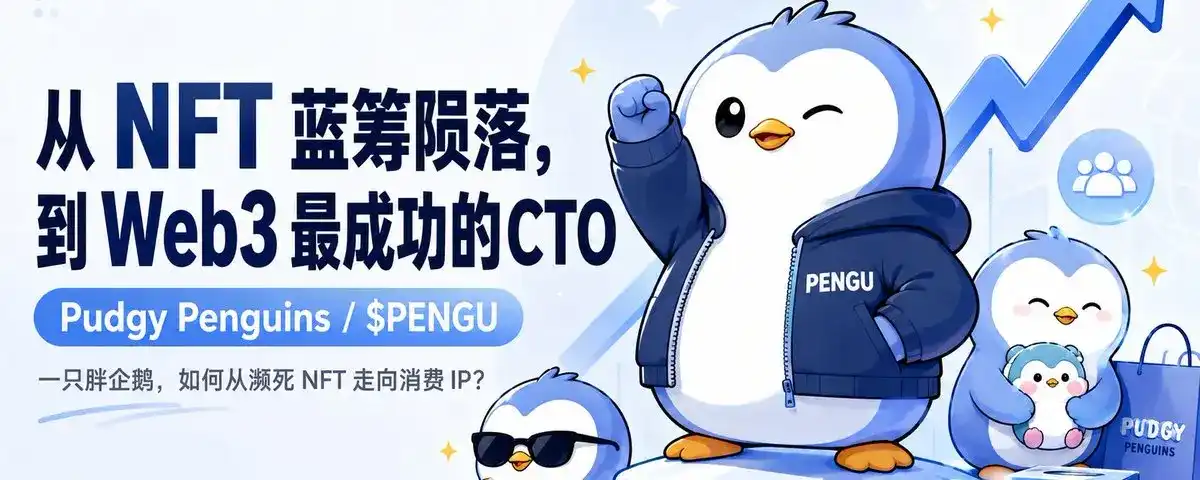
"Web3's Most Successful CTO: The Community Rescue of Pudgy Penguins" Pudgy Penguins, once a flagship NFT project in 2021, faced near-collapse by 2022 with its floor price plummeting to ~0.5 ETH, a disgruntled community voting out its founders, and depleted funds. Its revival, termed a "Community Takeover," began when @LucaNetz acquired the IP for 750 ETH. The turnaround strategy shifted focus from speculative NFT prices to building a genuine consumer brand. In 2023, "Pudgy Toys" launched in major retailers like Walmart, featuring QR codes that bridge physical buyers to the digital "Pudgy World." NFT holders earn IP royalties from these toys. By 2026, Pudgy evolved far beyond a typical NFT project: partnerships with the NHL and Manchester City, the launch of a Visa-integrated "Pengu Card" payment product, a free web game, and a popular trading card game. The $PENGU token airdrop in 2024 further expanded the community. The core lesson was moving beyond selling JPEGs to answer a critical question: can this penguin become a beloved, usable brand? With a 2026 revenue target of $120 million and IPO ambitions, Pudgy's story is one of community-led resilience and successful Web3 brand-building.

A few days ago, I tweeted that I was planning to acquire a Pudgy Penguin NFT, and many friends asked why? NFTs are already outdated, why spend so much money on one now?

Most Chinese users probably first learned about Pudgy Penguins because of the 2024 $PENGU airdrop. That airdrop was quite generous, even bordering on "universal benefit." Even if you didn't own a Pudgy Penguin NFT, but had been trading on Solana relatively early, you might have received hundreds of dollars worth of $PENGU.

What was truly staggering was the NFT holders. Just before the airdrop, the Pudgy Penguin NFT floor price skyrocketed to over 30 ETH. Each Pudgy Penguin NFT could claim roughly 1.7 million $PENGU, and each Lil Pudgy could claim about 188,000. Calculated at the token price then, a large penguin was worth tens of thousands of USD, at its peak even exceeding $100,000. A Lil Pudgy at its peak was also worth over $10,000. For someone like the on-chain expert @wenxue600 who held many, based on his holdings, receiving a million-dollar airdrop wouldn't be an exaggeration.

But many buddies claimed their airdrops without understanding the story behind it.

$PENGU is not a Meme Token that suddenly appeared out of nowhere. The Pudgy Penguins behind it almost died during the craziest era of NFTs.

In 2022, the Pudgy Penguins floor price once dropped to about 0.5 ETH, and the community even voted to oust the founder themselves. 4 years later, it's in 3,100 Walmart stores across the US, doing collaborations with Manchester City and the NHL, launching a payment card integrated with the Visa network, and even setting a 2026 revenue target of $120 million.

This is probably the most incredible resurrection story in Web3.

How exactly did Pudgy Penguins survive? The story begins in 2021, when 8,888 Pudgy Penguins were minted at 0.03 ETH each, selling out in under 20 minutes. Less than a month after launch, The New York Times even published a feature. At that time, almost no one doubted it would become the next blue-chip NFT.

But what truly made Pudgy special wasn't how it took off, but how it later crashed and climbed back up.

By the end of 2021, promised games, tokens, and ecosystem developments remained unfulfilled. The mysterious egg finally hatched... a fishing rod, which the community mockingly called "Rogs," a pun on "Rug" (rug pull).

A more severe trust crisis emerged, with the original team being questioned for draining the treasury and wanting to sell the project and walk away. In January 2022, holders directly initiated a vote on Discord to remove founder Cole. For the first time, an NFT community acted like shareholders, voting the founder out with their own hands.

But voting out the founder didn't guarantee the project's survival. At that time, Pudgy's floor price hit a low of about 0.5 ETH, the community was fractured, the project treasury was nearly empty, and some holders even used Wrapped Penguins to bypass the original team's royalties. That penguin wasn't just "facing difficulties"; it was truly on the brink of dying.

The turning point came in April 2022, when @LucaNetz bought the Pudgy Penguins IP and operating rights for 750 ETH, worth about $2.5 million at the time. This deal was later called by many the most successful CTO (Community Takeover) in Web3.

But the reality after the takeover wasn't as ideal as a fairy tale; it was even harsh. Luca later recalled: the team took over with almost no money in the account, immediately followed by the NFT bubble bursting, with trading volume plummeting 95%, ETH falling about 80%, and the royalty model collapsing; at its most difficult point, 80% of the team went without pay for 11 consecutive months.

Pudgy's comeback wasn't about just changing owners and pumping the NFT floor price again. What it truly did right was to stop treating the NFT price as the product and start treating the character behind the NFT as a genuine consumer IP.

In 2023, Pudgy Toys began entering Amazon and Walmart marketplaces. Within a year, products were on shelves in 3,100 Walmart stores across the US. Each toy also has a QR code that leads consumers who know nothing about wallets or NFTs into Pudgy World. Interestingly, these physical toys use penguin images owned by community holders, and qualifying NFT holders also receive IP licensing revenue.

This means NFT holders aren't just buying a picture; they can participate in creating and sharing the brand's value. This was the most crucial step for Pudgy moving from OpenSea into Walmart.

Looking at 2026, Pudgy's roadmap looks less and less like a traditional NFT project:

  • Partnered with the NHL, hosting offline events at the 2026 Winter Classic;
  • Launched collaborative merchandise with Manchester City, expanding after the initial phase;
  • Launched Pengu Card, integrated with the Visa payment network, supporting Apple Pay and Google Pay, covering about 150 million merchants globally; the virtual card quickly gained 100,000 registrations;
  • The free web game Pudgy World officially launched, and the digital content obtained by scanning QR codes on purchased physical toys finally started having real use cases;
  • Vibes TCG collectible card game cumulative sales exceeded 4 million packs.

The CEO set a 2026 revenue target of $120 million and has publicly expressed hope to push for an IPO before 2027. Looking at all the plans together, a clear picture emerges. NFTs brought it its first batch of owners and promoters; toys brought it into ordinary households; social media and memes kept the penguin image spreading; games, cards, and payment products continuously add use cases; $PENGU lowered the participation barrier from an expensive NFT to a larger internet community.

The NFT bubble burst because most NFT projects ultimately died after "selling the pictures." Pudgy almost died there too, but it ultimately survived. Because it stopped relying on the next batch of people buying at higher prices and started answering a more important question: Can this penguin become a brand that people genuinely like, buy, and use?

So, the reason I want to buy a Pudgy Penguin NFT isn't just because NFTs have risen in price recently. Back then, although I didn't hold a Pudgy Penguin NFT, just by using Solana for a relatively long time, I received thousands of dollars worth of $PENGU airdrop. Now, looking back, buying an NFT to serve as an identity token for this IP and community also seems like a good choice for me.

Recently, I've also noticed the Pudgy Penguins Chinese community @PudgyChina is restarting. During bull markets, everyone talks about price; it's actually bear markets that are more suitable for seriously building a community. Those interested can also follow: @PudgyChina @pudgypenguins @LucaNetz

Trending Cryptos

Related Reads

A Threefold Performance Leap! NEAR Achieves 200ms Physical Block Time Limit with SPICE

NEAR's core development team, Near One, has announced its next major protocol evolution: SPICE (Separation of Consensus and Execution). Currently in development, SPICE represents the most significant upgrade before the full implementation of Nightshade 3.0. Its core innovation is decoupling the consensus layer, responsible for ordering transactions, from the execution layer, which processes them. This allows the consensus layer to run at full speed without waiting for transaction execution to complete. Once deployed, SPICE is projected to triple NEAR's block production speed, achieving a 200ms block time, which is considered the physical limit due to the speed of light and network latency. This leap will dramatically reduce transaction latency and finality, with transactions confirming in roughly 0.4 seconds—faster than a typical card payment. The upgrade also enables more complex, long-running transactions and significantly improves user experience for applications like NEAR Intents and near.com. Beyond raw speed, SPICE enhances network scalability and security. It enables deeper parallelism, efficiently distributing workload across shards and improving resource utilization. The simpler block structure and lighter contracts also facilitate formal verification and security auditing. Furthermore, SPICE lays the critical groundwork for future Nightshade 3.0 features, most notably atomic cross-shard transactions, which would simplify complex contract logic and eliminate development hurdles caused by asynchronous execution. The Near One team is actively developing SPICE, targeting deployment in the coming months.

Foresight News1h ago

A Threefold Performance Leap! NEAR Achieves 200ms Physical Block Time Limit with SPICE

Foresight News1h ago

Deep Insight: Decentralized Inference is Not Hype, but a Key Track for AI to Break Through Centralized Monopoly

Decentralized Reasoning: Beyond the Hype, a Key to Breaking AI's Centralized Monopoly A future scenario where a powerful AI model is banned by a major government illustrates the core value proposition of decentralized AI: resistance to censorship. The core bet of decentralized inference networks is mitigating this risk, with other benefits like cost being secondary. The path is extremely difficult, involving four key challenges: 1. **Running Massive Models:** Distributing a single model across a decentralized GPU swarm requires sophisticated techniques like pipeline and speculative decoding to overcome crippling network latency, aiming for usable speeds (e.g., 30-40 tokens/second). 2. **Proving Model Integrity:** Verifying that a node runs the correct model is critical. Solutions range from cryptographically secure but slow ZKML to faster, economically-secure methods like statistical fingerprints, deterministic re-execution, or live-weight proofs, each involving trade-offs between integrity, latency, and cost. 3. **Ensuring Prompt Privacy:** Simply sharding a model does not protect user inputs from nodes. Robust solutions currently require trusted hardware (TEEs) or advanced cryptography (FHE), which are not yet widely deployed in consumer swarms. 4. **Building a Real Market:** Identifying the ideal customer is tough. Beyond speculative AI agents, the viable market currently consists of startups embedding AI and projects needing batch processing (e.g., synthetic data generation), where decentralized aggregation can be an advantage over low-latency needs. The article analyzes several projects tackling these problems, such as Dolphin Network (live-weight proofs), Inference.net (statistical verification), Morpheus (TEE-based), and Darkbloom (Apple Secure Enclave). It provides a framework: decentralization is a "tax" for latency-sensitive applications (e.g., chat) but a potential supply-side advantage for throughput-oriented tasks (e.g., batch processing). The long-term vision is a closed data loop where decentralized inference generates valuable data (traces, preferences) to feed decentralized training networks, which in turn produce better open-weight models for the inference networks. A due diligence checklist advises focusing on projects that: are truly decentralized at specific layers; have a credible integrity method; offer real cost benefits; ensure genuine privacy; handle node reliability; have paying users; and are built by teams with deep AI expertise. The ultimate goal should be products that appeal beyond the crypto-native audience, using crypto mechanisms invisibly to deliver better cost, performance, or privacy.

Foresight News1h ago

Deep Insight: Decentralized Inference is Not Hype, but a Key Track for AI to Break Through Centralized Monopoly

Foresight News1h ago

Trading

Spot
Futures

Hot Articles

How to Buy NFT

Welcome to HTX.com! We've made purchasing AINFT (NFT) simple and convenient. Follow our step-by-step guide to embark on your crypto journey.Step 1: Create Your HTX AccountUse your email or phone number to sign up for a free account on HTX. Experience a hassle-free registration journey and unlock all features.Get My AccountStep 2: Go to Buy Crypto and Choose Your Payment MethodCredit/Debit Card: Use your Visa or Mastercard to buy AINFT (NFT) instantly.Balance: Use funds from your HTX account balance to trade seamlessly.Third Parties: We've added popular payment methods such as Google Pay and Apple Pay to enhance convenience.P2P: Trade directly with other users on HTX.Over-the-Counter (OTC): We offer tailor-made services and competitive exchange rates for traders.Step 3: Store Your AINFT (NFT)After purchasing your AINFT (NFT), store it in your HTX account. Alternatively, you can send it elsewhere via blockchain transfer or use it to trade other cryptocurrencies.Step 4: Trade AINFT (NFT)Easily trade AINFT (NFT) on HTX's spot market. Simply access your account, select your trading pair, execute your trades, and monitor in real-time. We offer a user-friendly experience for both beginners and seasoned traders.

7.1k Total ViewsPublished 2024.03.29Updated 2026.06.02

How to Buy NFT

What is Altura NFT?

Altura: Providing One-Stop NFT Solutions for Game Developers

56.0k Total ViewsPublished 2024.06.12Updated 2024.06.12

What is Altura NFT?

What is AINFT

EternaFi Agents and $AINFT: A Comprehensive Analysis of AI-Powered NFT Infrastructure in the Web3 Ecosystem The intersection of artificial intelligence (AI) and blockchain technology is rapidly evolving, establishing innovative platforms that redefine ownership models and economic participation. EternaFi Agents, along with its native token $AINFT, exemplifies a groundbreaking approach to the tokenization of AI infrastructures through the means of non-fungible tokens (NFTs). Launched in July 2025 by the development team at Nova Club, EternaFi merges the advancements of AI with the decentralized financial mechanisms of blockchain, presenting a unique investment opportunity for participants within the web3 ecosystem. This article aims to provide an in-depth assessment of EternaFi Agents, covering its core components, functionality, and significance within the crypto landscape. Introduction and Project Overview EternaFi Agents stands as a salient example of how blockchain technology can democratize access to advanced AI capabilities. The project endeavors to reshape the paradigm of AI ownership by diversifying economic participation, making sophisticated AI systems accessible to a larger pool of stakeholders. At its core, the project tokenizes a proprietary large language model (LLM) developed by Nova Club, allowing NFT holders to gain fractional exposure to the model's economic performance. By utilizing NFTs representing stakes in the LLM, EternaFi Agents fosters a model wherein stakeholders not only participate in AI service consumption but also enjoy sharing in the economic rewards generated by the platform. This transformative approach enables the development of sustainable revenue models for AI services, all the while promoting broad community engagement and facilitating transparent governance. What is EternaFi Agents? EternaFi Agents represents an AI-NFT infrastructure project that aims to blend the capabilities of AI with blockchain technology in a coherent ecosystem. The essential feature of this project is the creation of NFTs that serve as financial instruments, representing fractions of ownership in Nova Club's proprietary AI infrastructure. Each NFT symbolizes direct exposure to the economic performance of the underlying AI system, providing a lucrative opportunity for investors. The project operates on the Base blockchain, known for its scalability and efficiency, thus ensuring manageable transaction costs while facilitating a seamless operational experience. One of the notable features includes a revenue-sharing mechanism, wherein NFT holders can receive portions of subscription income generated by the AI services provided on the platform. This innovative approach establishes a connection between the success of the AI services and the economic dividends distributed among the holders, thus ensuring an alignment of interests across the community. Who is the Creator of EternaFi Agents? The creative force behind EternaFi Agents is Nova Club, a development team based in Singapore proficient in the amalgamation of AI and blockchain technology. Their prior experience in AI development and cryptocurrency analysis gives credence to the project, contributing a breadth of expertise to the creation of EternaFi Agents. Nova Club’s mission centers on democratizing access to cutting-edge AI technologies while building sustainable economic models that benefit users alongside developers. Their commitment to transparency, community governance, and innovation is reflected in the design and implementation of the EternaFi platform, aiming to establish a unique ecosystem that fosters positive engagement and long-term value creation. Who are the Investors of EternaFi Agents? The specific details concerning investors or investment organizations backing EternaFi Agents are not publicly available. However, EternaFi has adopted an inclusive approach to funding its development through the sale of NFTs to the public, allowing a wide array of participants to invest in the ecosystem. The project’s architecture ensures that core infrastructure is funded responsibly while allowing community members to partake in the ownership and economic returns generated from the AI services. This model emphasizes community engagement by aligning the interests of investors and project developers, creating a collaborative environment where long-term participation is incentivized. How Does EternaFi Agents Work? EternaFi Agents operates through a multifaceted ecosystem where NFTs serve as a primary means of ownership representation within the project. Each NFT holder is entitled to a share of the monthly subscription income produced by the underlying AI-powered platform, thereby positioning NFT ownership as a lucrative investment vehicle. Revenue Generation Mechanism The primary source of revenue generation for the EternaFi platform stems from subscription fees related to the AI services provided. Users can access various tiered services, ranging from basic market analysis tools to comprehensive AI-assisted trading solutions. These services are monetized and form the basis for the revenue-sharing framework, which distributes profits to NFT holders through automated smart contracts. An innovative feature of the EternaFi ecosystem is the revenue-sharing mechanism that operates transparently, ensuring that rewards are allocated based on verifiable metrics from the AI platform's operations. This creates a direct link between the performance of AI services and the returns available to community investors, establishing a sustainable economic model. Staking and Vesting Mechanisms Participants within EternaFi can engage in staking their NFTs to unlock additional economic benefits. The vesting schedule is designed to promote long-term commitment among participants, rewarding those who exhibit ongoing support for the project. This ensures a robust alignment of interests and fosters a sense of community engagement essential for achieving the project's long-term goals. Transparent Governance EternaFi Agents embraces decentralized governance, allowing NFT holders to play an active role in decision-making regarding the platform's development and future directions. The governing structure includes community voting mechanisms, providing NFT holders with the opportunity to influence significant decisions and contributing to a collaborative approach to project growth. Timeline of EternaFi Agents The development trajectory of EternaFi Agents showcases a systematic approach toward building a sustainable AI infrastructure while meeting the needs of community participants. Below is a timeline of important milestones in the project’s history: July 2025: Launch of EternaFi Agents, including the public sale of NFTs and deployment of the $AINFT token on the Base blockchain. Q4 2025: Establishment of market infrastructure including liquidity pools and launch of staking dashboards for NFT holders. 2026: Initiation of community engagement programs, expanding AI capabilities, and integration with cross-chain technologies. Q4 2026: Implementation of the dividend distribution system, allowing NFT holders to reap economic benefits from their investments. These milestones signify the focus on establishing a functional and participative ecosystem while ensuring continuous evolution to meet market demands. Technological Infrastructure and Blockchain Integration EternaFi Agents is anchored in an advanced technological framework combining AI systems with blockchain capabilities. Operating on the Base blockchain, the project leverages the advantages of scalability and low transaction costs. The underlying smart contract architecture governs the NFT ownership, revenue sharing, and community management features, ensuring efficiency and transparency. AI System Development The proprietary large language model underpinning EternaFi Agents has been independently developed and designed to cater to revenue-generating applications without reliance on proprietary external frameworks. This endeavor reflects a commitment to creating a versatile and adaptable AI infrastructure capable of delivering meaningful services to users, thus generating economic value for investors. Security Measures The robustness of EternaFi’s security infrastructure is paramount. Regular audits and stringent security measures ensure the integrity of the AI systems and blockchain mechanisms, safeguarding against potential vulnerabilities while fostering confidence among participants. Conclusion EternaFi Agents signifies a landmark innovation within the realm of artificial intelligence and blockchain technology, opening avenues for community ownership and economic participation in advanced AI capabilities. The project’s comprehensive strategy to tokenize AI infrastructure via NFTs establishes a precedent for future decentralized ecosystems. By harmonizing technical sophistication with user-centric economic models, EternaFi not only fosters engagement but also generates a sustainable revenue-sharing framework for community participants. The significance of EternaFi extends well beyond its operational success as it exemplifies how blockchain can democratize cutting-edge AI technologies, paving the way for future ventures in this intersectional space. The evolution of EternaFi Agents may herald a new era of AI development characterized by participant-driven governance, sustainable economic models, and transparent verification, ultimately contributing to the broader democratization of AI and technology accessibility across industries.

4.1k Total ViewsPublished 2025.08.14Updated 2025.08.14

What is AINFT

Discussions

Welcome to the HTX Community. Here, you can stay informed about the latest platform developments and gain access to professional market insights. Users' opinions on the price of NFT (NFT) are presented below.

活动图片