Behind HYPE's Repeated Record Highs, the 'Minions' in the Ecosystem Can't Keep Up

Foresight NewsPublished on 2026-06-17Last updated on 2026-06-17

Abstract

While HYPE, the native token of the Hyperliquid ecosystem, surges to new all-time highs above $76 and attracts significant institutional ETF inflows, a starkly different reality unfolds within its HyperEVM application layer. Multiple core DeFi protocols across lending, NFTs, stablecoins, and DEXs have announced shutdowns between May and June. The article argues HYPE functions more like an "application stock" than a traditional ecosystem token. Its value is anchored to the trading fees from Hyperliquid's core perpetual contracts platform (HyperCore), which boasts a diversified revenue stream from crypto, commodities, and indices. Approximately 97% of protocol fees fund buybacks and burns of HYPE. This means HYPE's price is largely decoupled from the health of projects built on HyperEVM. The closures of significant projects like lending protocol HypurrFi (peak TVL >$300M) and NFT marketplace Drip.Trade highlight a structural tension. Hyperliquid's minimalist philosophy offers infrastructure without official grants, liquidity support, or marketing coordination for HyperEVM projects. This forces protocols into a fiercely competitive environment from day one. Furthermore, the success of HyperCore creates a liquidity vacuum, and mechanisms like HIP-3 (allowing direct perpetual market deployment) divert user attention and capital away from application-layer projects. The stronger the core perpetual trading business becomes, the more difficult it is for peripheral "DeFi lego" proje...


Author: Sanqing, Foresight News


On June 16, HYPE reached 76.965 USDT, once again hitting a new all-time high, with a daily increase of about 10%, triggering over $11.5 million in short liquidations. Meanwhile, according to SoSoValue data, three US spot HYPE ETFs have attracted a cumulative net inflow of approximately $180 million in their first month of trading, indicating sustained institutional capital inflow.


However, the scene on the Hyperliquid ecosystem side is completely different. From May to June, several protocols across multiple sectors including lending, NFT, stablecoin, and DEX have successively announced their shutdown.


HYPE is an "Application Stock"


Hyperliquid injects about 97% of protocol fees into the Assistance Fund, continuously buys back HYPE in the open market and permanently burns it. According to buildix data, the current daily buyback is about 34,000 HYPE (approximately $2.57 million), with an annualized buyback scale of about $940 million, annualized protocol revenue of about $976 million, a P/E ratio of about 73x, and a buyback yield of about 5.6%.


According to DefiLlama data, Hyperliquid's trading volume in the last 30 days exceeds $240 billion. This is precisely the fuel driving the buyback machine: the highly diversified revenue structure of the HyperCore perpetual contract trading layer. Crypto perpetual contracts (BTC, ETH, SOL, etc.) contribute about 55% of daily fees, commodities (crude oil, gold, silver) about 22%, stock indices (S&P 500, Nasdaq) about 12%, and spot trading about 6%.
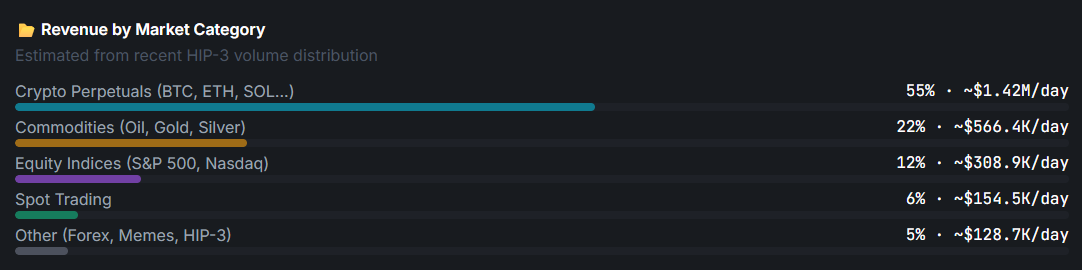


This means HYPE resembles more of an "application-type stock" rather than a traditional "ecosystem token." Its value capture is anchored to HyperCore's trading fees and has almost no direct relationship with HyperEVM's TVL scale or the survival count of DeFi protocols.


This is fundamentally different from ETH's value logic. ETH's pricing premise is that ecosystem prosperity drives Gas consumption, which in turn pulls the token price. Therefore, the death of any ecosystem project is a negative signal for ETH.


But HYPE's fee source is almost unrelated to HyperEVM. Whether HyperEVM projects live or die does not change HyperCore's trading volume, nor does it affect the Assistance Fund's buyback pace. Investors holding HYPE are exposed to the operational risk of "the business of Hyperliquid's perpetual contract trading," not the risk of a particular DeFi protocol.


Five Announcements


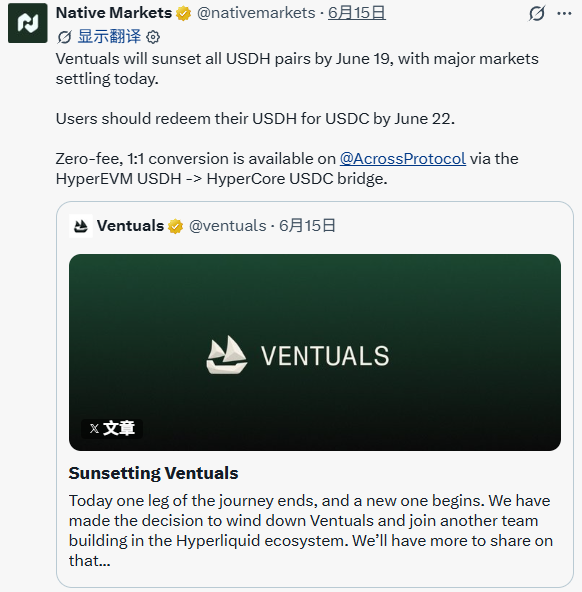
Ventuals (June 15): Cumulative trading volume exceeded $650 million, serving over 11,000 traders, with the announcement receiving 47,000 views. The team wrote: "Today, one segment of the journey ends, and a new one begins." The shutdown process was extremely orderly, listing settlement times and price mechanisms for 11 markets including OpenAI and Anthropic one by one, with user HYPE refunded in full at a 1:1 ratio.


Felix (announced June 8, terminated June 20): Announcement: "In light of the deactivation of USDH, the Felix HIP-3 DEX and all active markets will begin deactivation on June 19 and conclude on June 20."


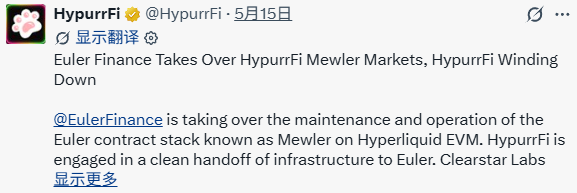
HypurrFi (May 15): Once a top lending protocol on HyperEVM, with a peak TVL exceeding $300 million. The announcement stated: "No security breach. No exploit. No emergency. This is a considered operational decision." The brand is exiting, infrastructure is being handed over to Euler Finance, and Pooled markets will complete final settlement on July 15.


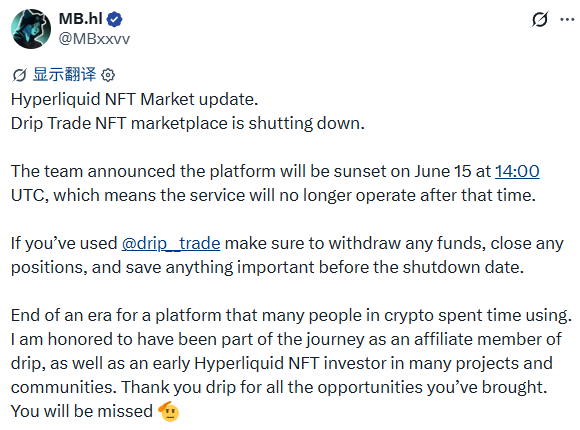
Drip.Trade (June 15): The only NFT marketplace on HyperEVM. Hyperliquid ecosystem KOL @MBxxvv relayed official news: "The platform will go offline at 22:00 on June 15, and services will no longer operate thereafter."


USDH / Native Markets (May 14): Announcement by Native Markets stated it would transfer the stablecoin brand rights of USDH to Coinbase, making Coinbase the official USDC deployer on Hyperliquid.
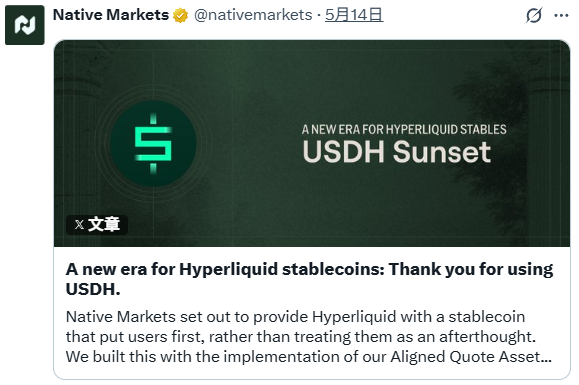


These five projects cover five sectors: lending, NFT, stablecoin, RWA private markets, and DEX, almost representing the main categories of DeFi infrastructure on HyperEVM. They were not marginal projects but protocols with real users and trading volume within the ecosystem at the time.


The Stronger the Core, the Harder the Ecosystem Lives


If HYPE's rise and the death of ecosystem projects were merely two independent trajectories, then this crisis would just be "the failure of peripheral projects themselves," not worth in-depth examination. But looking closely, these two events are not just happening in parallel.


Hyperliquid's design philosophy is minimalism: provide the chain and infrastructure, do not get involved in operations.


Since its launch in February 2025, HyperEVM has attracted over 170 project deployments, but from the start, there were no official grants, no coordinated market-making arrangements, no launch liquidity support. Projects faced the fully competitive secondary market head-on from day one. The core team hardly publicly participates in collaborative interactions with HyperEVM project parties; protocol projects are expected to be self-sufficient by default.


When on-chain products were scarce, any functioning protocol brought its own traffic. But the market in 2026 is already saturated. The survival of new protocols is not a technical problem; it's a cold start problem. Without official endorsement and liquidity guidance, the vast majority of projects simply cannot survive the cold start phase.


Furthermore, the HIP-3 mechanism allows anyone to directly deploy perpetual contract markets on HyperCore. It was originally an outlet for liquidity overflow, but it simultaneously diverts attention and user traffic away from protocol projects.


The leading project on HIP-3, TradeXYZ, already occupies about 97% of the market share in its category, leaving almost no room for latecomers. This means protocol projects are not only competing with external competitors but also competing with Hyperliquid's own liquidity siphon effect.


The more successful HyperCore is, the more traffic and capital it attracts, the harder it is for projects on HyperEVM to get a share. This is not HyperEVM's technical failure, but Hyperliquid's business model inherently reserves the highest-quality resources for the core layer, structurally compressing the peripheral survival space.


Trending Cryptos

Related Questions

QAccording to the article, why is HYPE considered more like an 'application stock' rather than a traditional 'ecosystem token'?

AHYPE is considered an 'application stock' because its value is primarily tied to the revenue generated by HyperCore's perpetual contract trading business, not to the performance or survival of projects on the HyperEVM. Its buyback and burn mechanism is fueled by HyperCore's transaction fees, which come from a diversified range of assets. The health of HyperEVM DeFi projects does not directly impact HYPE's price, unlike ETH which depends on network activity and gas fees.

QWhat are the two main reasons mentioned in the article for the difficulty HyperEVM projects face in surviving?

AThe two main reasons are: 1) Hyperliquid's minimalist, hands-off philosophy means no official grants, liquidity support, or coordinated market-making for projects, leaving them to fend for themselves in a competitive market. 2) The success of the core HyperCore layer, particularly the HIP-3 mechanism, creates a 'liquidity siphon' effect. It attracts the most capital and user attention, making it extremely difficult for independent projects on HyperEVM to capture user traffic and sustain themselves.

QWhich five major sectors in the HyperEVM ecosystem have seen projects announce shutdowns, as highlighted in the article?

AAccording to the article, projects in five major sectors announced shutdowns: Lending (HypurrFi), NFTs (Drip.Trade), Stablecoins (USDH / Native Markets), RWA Private Markets (Ventuals), and DEXs (Felix).

QWhat is the primary source of transaction fees driving the HYPE buyback mechanism on Hyperliquid?

AThe primary source of transaction fees driving the HYPE buyback is the HyperCore perpetual contract trading layer. The revenue structure is highly diversified, with approximately 55% from crypto perpetuals (BTC, ETH, SOL), 22% from commodities (oil, gold, silver), 12% from stock indices (S&P 500, Nasdaq), and 6% from spot trading.

QHow does the relationship between the core protocol (HyperCore) and the broader ecosystem (HyperEVM) in Hyperliquid differ from that of Ethereum?

AIn Ethereum, the value of ETH is intrinsically linked to the health of its ecosystem. A thriving ecosystem with many successful dApps drives network usage and gas consumption, which benefits ETH's price. In Hyperliquid, the value of HYPE is decoupled from the HyperEVM ecosystem. HyperCore's trading fees, which fund the HYPE buyback, are generated independently of whether HyperEVM projects succeed or fail. A strong HyperCore can even hinder HyperEVM projects by absorbing most of the liquidity and user attention.

Related Reads

Research Report Analysis: MRVL's Optical AI Booming, Why High Valuation Keeps Morgan Stanley's Star Analyst Sidelined?

Report Recap: MRVL Optical AI Boom - Why High Valuation Led Morgan Stanley's Star Analyst to Stay Neutral? Morgan Stanley analyst Joseph Moore maintained an "Equal-weight" (Neutral) rating on Marvell Technology (MRVL) on May 28, raising the price target from $172 to $195, below the trading price. This stance comes despite Marvell reporting a record quarter and significantly raising its full-year outlook (FY27 revenue ~$11.5B, up ~40%). Moore's neutral view is based on valuation. The $195 target implies ~40x CY2027 P/E. He contrasts MRVL with NVDA: both trade near ~$200, but Nvidia's forward EPS is more than double Marvell's. For MRVL's valuation to hold, it needs consistent earnings upgrades, proof of networking market share gains, or certainty on large-scale custom AI chip shipments—none of which are confirmed yet. Growth is driven by two pillars: **1) Optical Interconnect** (the faster runner): Moore raised FY27 growth expectations to >70%, with the optical module product line nearing a $1B annualized run rate. **2) Custom AI Chips** (the climber): Confidence in FY28 is growing, but a major new customer project only ramps in FY28, with no current revenue visibility. Key risks are the underperforming Storage, Enterprise, and legacy Networking segments. Moore acknowledges the real AI opportunity but believes the current price already reflects it. For the stock to work from here, investors need to see the optical business hit its targets, custom chips ramp as planned, and a recovery in the weaker business units.

marsbit44m ago

Research Report Analysis: MRVL's Optical AI Booming, Why High Valuation Keeps Morgan Stanley's Star Analyst Sidelined?

marsbit44m ago

qinbaFrank: Review and Outlook of the AI Computing Power Wave — From the Three Debates on NVIDIA to Optical Interconnect and SpaceX IPO, How is Capital Rotating?

**Summary: Retrospective and Outlook on the AI Computing Wave - A Framework for Capital Rotation** Based on a presentation by investor qinbaFrank, this analysis reviews the AI computing market trajectory since 2023 and outlines a forward-looking framework. **Key Phases and Market Debates:** The AI bull market progressed through three major debates: 1) The necessity of massive capital expenditure (late 2023). 2) The sustainability of tech giants' spending (early 2024-early 2025). 3) Potential overestimation of compute needs (early 2025). Consensus solidified in late 2025 as model capabilities and utility demonstrably improved. **Core Thesis: Penetration Rate Drives Commercialization.** Unlike the 2000 dot-com bubble, the current AI wave benefits from mature digital infrastructure, enabling faster adoption. The critical threshold is 10% penetration; surpassing it (with recent enterprise intent surveys showing ~18%) indicates entry into a rapid growth "golden period" where user scale and willingness to pay increase simultaneously. **AI vs. Internet: A Fundamental Difference.** While the internet enhanced connection efficiency, AI directly substitutes human cognition and labor. Once AI performance exceeds the "societal average" human level, its commercial value scales exponentially as payment shifts from human labor costs to AI service fees. **Investment Logic Evolution in the Compute Chain.** The focus has expanded from GPUs to a systemic re-rating of the entire hardware stack: storage/HBM, CPUs, interconnects, power, and advanced packaging. The framework is: **short-term "scarcity pricing," mid-term "upgrade pricing" (e.g., optical interconnects, power networks), and long-term "Physical AI" pricing** (edge computing, robotics). **Market Focus Shift and Adjustment Framework.** The market is transitioning from "hardware scarcity" to "commercialization validation." The ultimate anchor for the narrative is sustained high growth in model providers' Annual Recurring Revenue (ARR) and cloud business revenue, which justifies continued capital expenditure. Adjustments are categorized into three levels: * **L1 (Minor):** Driven by valuation compression or macro noise (e.g., single CPI print). Fundamentals intact. * **L2 (Moderate):** Triggered by significant macro events requiring risk repricing. Requires new data for confidence restoration. * **L3 (Major):** Involves a reset of the core industrial narrative or macro regime (e.g., AI commercialization growth stalling). The **crucial dividing line** is whether AI commercialization growth slows. Without a slowdown, pullbacks are likely L1/L2 "repricing" events. A genuine growth deceleration would signal an L2/L3 narrative reset. **Conclusion: A Foundational Civilizational Leap.** AI represents a foundational upgrade to "intelligence" itself—akin to humanity mastering fire—rather than a single-point industrial revolution. This底层能力跃迁 (underlying capability leap) will spawn successive waves of innovation (Agent, robotics, industry workflow重构). The journey will be波浪式的 (wavelike), driven by cycles of scarcity, technological upgrades, and远期兑现 (long-term realization).

marsbit55m ago

qinbaFrank: Review and Outlook of the AI Computing Power Wave — From the Three Debates on NVIDIA to Optical Interconnect and SpaceX IPO, How is Capital Rotating?

marsbit55m ago

A Country That Mined Bitcoin for 8 Years Has Built Its Own Dedicated Crypto Bank

A country that has been mining Bitcoin for eight years has established its own dedicated crypto bank. DK Bank, located in Bhutan's newly developed GMC special administrative zone, aims to fill the significant banking service gap for the cryptocurrency industry. Its CEO, Zheng YD, explained that most banks avoid crypto businesses due to a lack of risk management frameworks for decentralized and anonymous protocols. Operating under a unique "one country, two systems" governance model separate from mainland Bhutan, GMC aspires to become a financial hub for South Asia. DK Bank differentiates itself by offering integrated multi-currency accounts where users can manage both fiat currencies and stablecoins like USDT and USDC in one place, alongside services like Bitcoin-backed loans. The bank faces technical challenges in merging traditional banking systems with 24/7 crypto markets and implements rigorous on-chain and off-chain transaction monitoring for risk control. GMC's regulatory framework draws from Singaporean common law and Abu Dhabi's ADGM rules, offering a fast-track licensing process for already licensed firms while maintaining high standards. The initiative is part of Bhutan's longer-term crypto strategy, which includes Bitcoin mining since 2018. The focus, however, is on building a diversified institutional-grade crypto ecosystem—including custody and asset management—rather than retail speculative tokens. Proponents argue such sovereign crypto infrastructure is necessary, and Bhutan's early, measured approach exemplifies the thoughtful integration needed in global finance.

Foresight News1h ago

A Country That Mined Bitcoin for 8 Years Has Built Its Own Dedicated Crypto Bank

Foresight News1h ago

Trading

Spot
Futures

Hot Articles

Discussions

Welcome to the HTX Community. Here, you can stay informed about the latest platform developments and gain access to professional market insights. Users' opinions on the price of S (S) are presented below.

活动图片