US-Based Bitcoin ETFs Post Roughly $1B Inflows In Past Week: Report

bitcoinistPublished on 2026-04-20Last updated on 2026-04-20

Abstract

US-based spot Bitcoin ETFs recorded significant inflows of approximately $1 billion over the past week, driven by improved market sentiment amid easing geopolitical tensions in the Middle East. On April 17 alone, net inflows reached $663.9 million, marking the fourth consecutive day of positive movement. BlackRock’s IBIT led with $283 million, followed by Fidelity’s FBTC with $163.42 million and Ark 21Shares’ ARKB with $117.9 million. This brings the two-week total net inflows to over $1.78 billion. Despite the increased institutional interest, Bitcoin’s price declined over 2% in 24 hours, trading around $75,664, while ETF holders remain at a loss with an average cost basis of $82,247.

The price of Bitcoin saw a rise in bullish momentum over the past week, as the initially improving situation in the Middle East served as a significant catalyst. This optimism seems to have spread across the digital asset market, as fresh capital also flowed into the US-based spot Bitcoin ETFs (exchange-traded funds).

According to the latest market data, the spot BTC exchange-traded products saw the addition of nearly $1 billion in value over the past trading week. This fresh capital influx reflects an uptick in investor sentiment and demand over the past few weeks.

US Bitcoin ETFs Register $664M Net Inflows

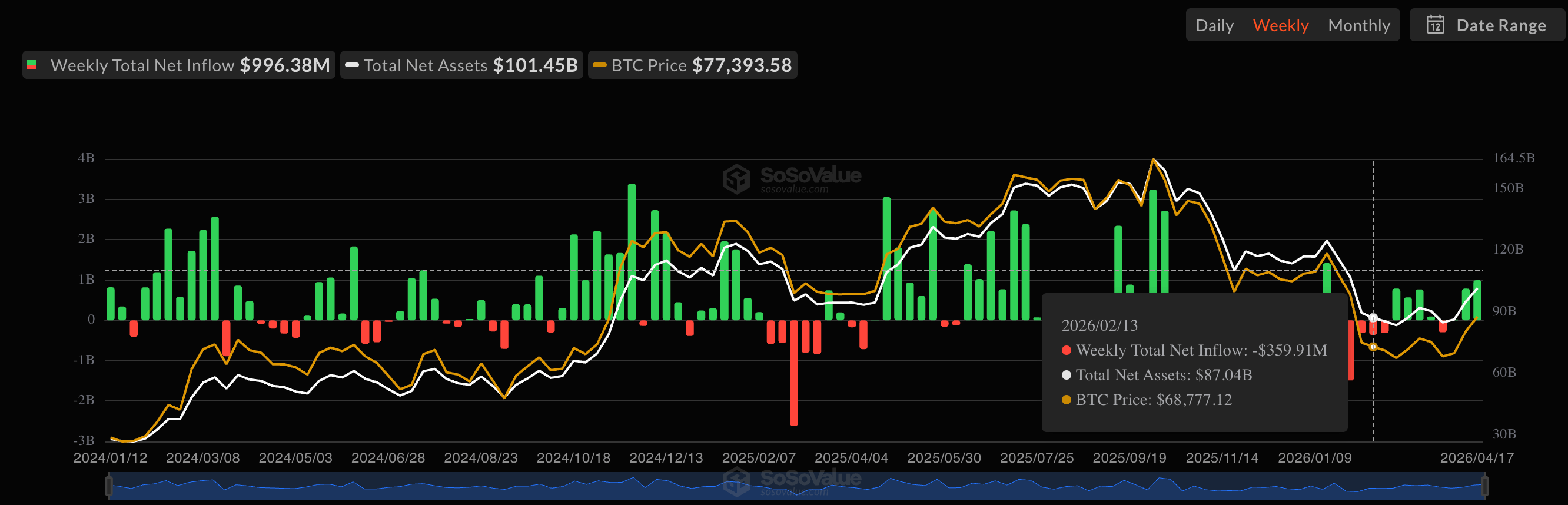
On Friday, April 17th, the US-based Bitcoin ETFs recorded a total net inflow of $663.9 million, reflecting a return of investor demand into the market in recent weeks. This single-day performance marked the fourth consecutive day of inflows for the crypto-linked investment products.

Data from SoSoValue shows that BlackRock’s iShares Bitcoin Trust (IBIT) led the day’s activity, with a total net inflow of $283 million on Friday. This was followed by the Fidelity Wise Origin Bitcoin Fund (FBTC), which posted a $163.42 million net inflow on the day.

The Ark 21Shares Bitcoin ETF (ARKB) also registered a significant $117.9 million total net inflow on Friday. The other issuers with positive net inflows on the day included Grayscale Bitcoin Trust (GBTC), Grayscale Bitcoin Mini Trust (BTC), VanEck Bitcoin Trust (HODL), and Invesco Galaxy Bitcoin ETF (BTCO).

Their performances brought the weekly record of spot Bitcoin ETFs to around $996.38 million in net inflows, with the other weekly gains coming on Tuesday ($411.5 million) and on Wednesday ($186 million). Meanwhile, the past week’s activity represents the second-straight week of capital inflows, with $786.31 million net influx in the previous week.
Source: SoSoValue

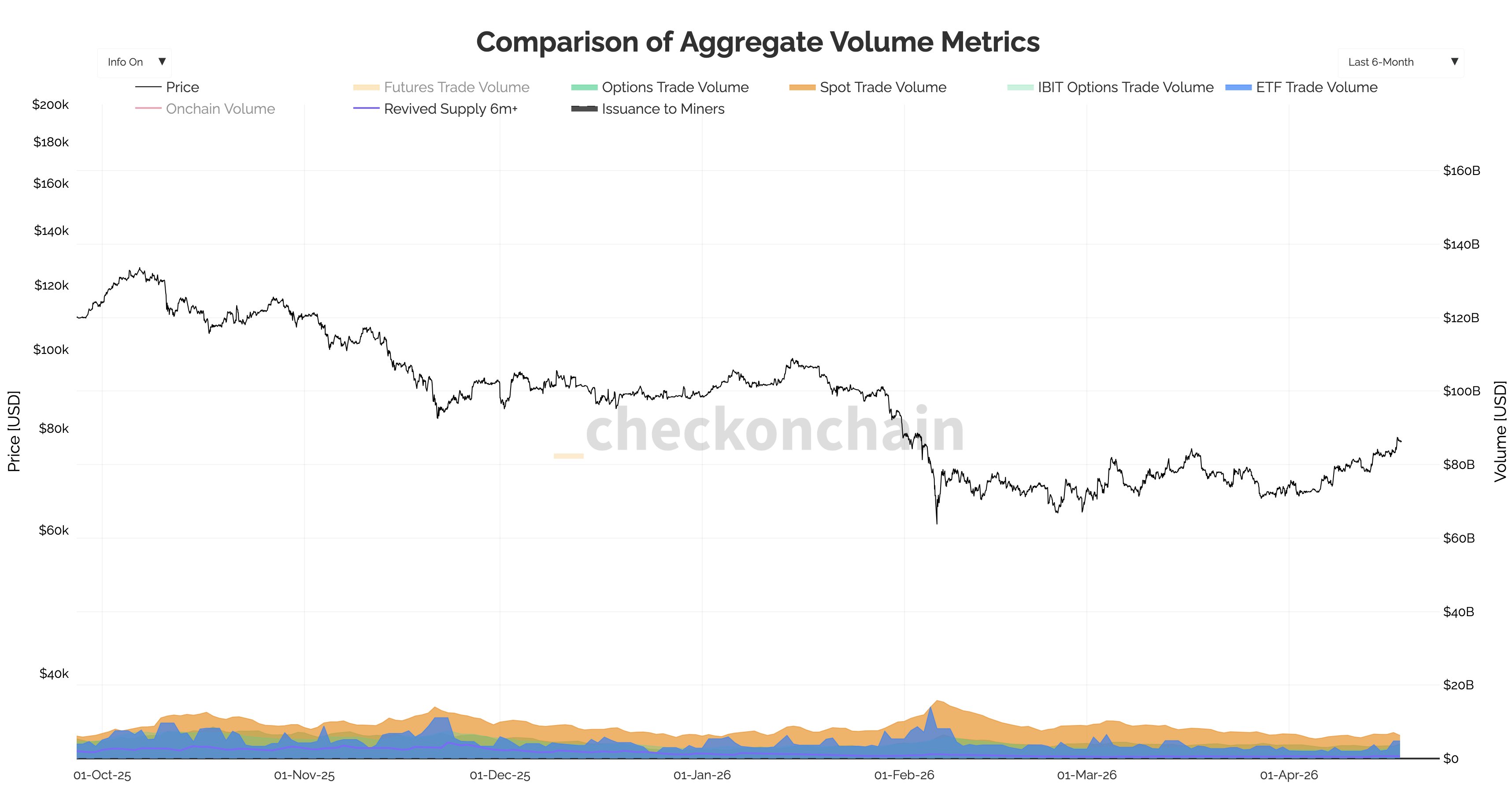
This upturn in capital inflows is reflective of the easing tensions in the Middle East, with what seems like a return of positive sentiment into the market. According to data highlighted by on-chain analyst Darkfost, the BTC exchange-traded fund trading volumes are on the rise and currently stand at $4.7 billion, inching closer to spot market volumes, totaling at around $6.2 billion.

However, Darkfost noted that the average cost basis of the BTC ETF is around $82,247, with holders still at a loss. “Since March, the trend has shifted notably in a positive direction for ETFs, with inflows largely dominating,” the crypto analyst added.
Source: @Darkfost_Coc on X

Bitcoin Price At A Glance

As of this writing, the price of BTC stands at around $75,664, reflecting an over 2% decline in the past 24 hours.

The price of BTC on the daily timeframe | Source: BTCUSDT chart on TradingView


Related Questions

QWhat was the total net inflow for US-based Bitcoin ETFs over the past trading week?

AThe total net inflow for US-based Bitcoin ETFs over the past trading week was approximately $996.38 million.

QWhich two Bitcoin ETFs led the day's activity with the highest net inflows on Friday, April 17th?

ABlackRock’s iShares Bitcoin Trust (IBIT) led with a $283 million net inflow, followed by the Fidelity Wise Origin Bitcoin Fund (FBTC) with a $163.42 million net inflow.

QWhat was cited as a significant catalyst for the rise in Bitcoin's bullish momentum and the influx of capital into ETFs?

AThe initially improving situation in the Middle East was cited as a significant catalyst.

QWhat is the average cost basis of the BTC ETF, according to on-chain analyst Darkfost?

AThe average cost basis of the BTC ETF is around $82,247.

QWhat was the price of Bitcoin at the time of writing, and how much did it change in the last 24 hours?

AThe price of Bitcoin was around $75,664, reflecting an over 2% decline in the past 24 hours.

Related Reads

Bitcoin's Bull-Bear Range Battle Continues, HYPE Faces Critical Test of Wave V Support | Exclusive Analysis

This market analysis covers Bitcoin (BTC) and HYPE, highlighting key levels and trading strategies for the week. HYPE is currently testing a critical support level at $40.17. A hold above this level could lead to consolidation between $40.17–$45.76, while a break below it may signal the end of its current V-wave uptrend from the April 2 low. The short-term strategy is to look for long entries near $40.17 if support holds, using 30% leverage and strict stop-loss discipline. Bitcoin is interpreted to be in a larger D-wave rebound from the February 6 low of $60,000, currently trading within a $73,500–$79,000 range. Key resistance lies at $79,000–$80,600 and $83,500–$84,500, with supports at $73,500, $69,500, and $65,000–$66,000. The medium-term strategy maintains a 60% short position from $89,000. Short-term tactics include selling into rallies near $76,500–$79,000 (Scenario A) or breaking below $73,500 (Scenario B), using 30% leverage. Last week, a 1x leveraged long trade in HYPE yielded a 6.80% gain, and the BTC short from $89,000 is currently up approximately 17.08%. Risk management is emphasized: set stop-losses at entry, move to breakeven at +1% profit, and trail stops to lock in gains thereafter. All views are based on technical analysis and are not investment advice. Traders are urged to exercise caution and adapt to market changes.

marsbit9m ago

Bitcoin's Bull-Bear Range Battle Continues, HYPE Faces Critical Test of Wave V Support | Exclusive Analysis

marsbit9m ago

Bitcoin's Bull-Bear Range Battle Continues, HYPE Faces Critical Test of Wave V Support | Invited Analysis

The market is experiencing directional uncertainty with both opportunities and risks. HYPE's daily V-wave structure is at a critical juncture, with the $40.17 support level being pivotal for its future trajectory. A break below this level, followed by an inability to surpass the recent high of $45.76, could signal the end of the current upward structure. The short-term strategy for HYPE is to "follow the trend and buy on dips," using a 30% position size and a 30/60-minute trading cycle, entering long upon confirmed support holds with model signals. Bitcoin's market structure is reinterpreted, with the rally from the $60,000 low now considered a larger D-wave rebound within a medium-term correction, facing a key test between $73,500 and $79,000. A break above the upper bound may lead to limited upside, while a drop below could see a decline toward $69,500. Core resistance lies at $79,000–$80,600 and $83,500–$84,500, with support at $73,500, $69,500, and $65,000–$66,000. The medium-term strategy maintains a 60% short position from $89,000, to be exited if price stabilizes above the multi-empty band. Short-term tactics involve 30% positions for "spread" opportunities, with two scenarios: selling on rallies near $76,500–$79,000 (Scheme A) or shorting on a breakdown below $73,500 (Scheme B), both with strict stop-losses. A复盘 of HYPE's recent short trade showed a 6.80% gain from a long entry at $41.59 (based on model buy signals) and exit at $44.42 (triggered by top signals). Key reminders include setting initial stops at entry, moving to breakeven at +1% profit, and trailing stops thereafter. All views are for reference only; market conditions change rapidly, and caution is advised.

Odaily星球日报16m ago

Bitcoin's Bull-Bear Range Battle Continues, HYPE Faces Critical Test of Wave V Support | Invited Analysis

Odaily星球日报16m ago

Strategy's 'Money Printer': Is STRC Bitcoin's Savior or Destroyer?

Bitcoin's recent price movement is being heavily influenced by Michael Saylor and his company, MicroStrategy, through a new financial instrument: STRC (Variable Rate Series A Perpetual Stretch Preferred Stock). This Nasdaq-listed perpetual preferred stock offers an 11.5% annual dividend, attracting significant capital. Crucially, funds raised from STRC are used to purchase Bitcoin, with a 3x leverage effect—for every $1 from STRC, MicroStrategy adds $2 from MSTR equity to buy $3 worth of BTC. This creates a powerful "flywheel": more STRC sales fuel massive BTC buying, supporting its price and improving MicroStrategy's credit, which in turn makes STRC more attractive to investors. However, this mechanism introduces risks. A significant "ex-dividend arbitrage" pattern has emerged, where traders buy STRC before its monthly dividend, collect the payout, and quickly sell, causing price volatility and potentially driving up Bitcoin's cost basis for MicroStrategy. In response, Saylor has proposed shifting STRC to a semi-monthly dividend to smooth out these effects. Furthermore, STRC's high yield is being integrated into DeFi protocols like Apyx Protocol and Saturn Credit, offering new on-chain yield opportunities. The central concern remains: as MicroStrategy aggressively accumulates over 3.5% of all BTC, it challenges Bitcoin's foundational principle of decentralization, creating a system where a single public company significantly influences the market.

marsbit24m ago

Strategy's 'Money Printer': Is STRC Bitcoin's Savior or Destroyer?

marsbit24m ago

Trading

Spot
Futures

Hot Articles

What is $BITCOIN

DIGITAL GOLD ($BITCOIN): A Comprehensive Analysis Introduction to DIGITAL GOLD ($BITCOIN) DIGITAL GOLD ($BITCOIN) is a blockchain-based project operating on the Solana network, which aims to combine the characteristics of traditional precious metals with the innovation of decentralized technologies. While it shares a name with Bitcoin, often referred to as “digital gold” due to its perception as a store of value, DIGITAL GOLD is a separate token designed to create a unique ecosystem within the Web3 landscape. Its goal is to position itself as a viable alternative digital asset, although specifics regarding its applications and functionalities are still developing. What is DIGITAL GOLD ($BITCOIN)? DIGITAL GOLD ($BITCOIN) is a cryptocurrency token explicitly designed for use on the Solana blockchain. In contrast to Bitcoin, which provides a widely recognized value storage role, this token appears to focus on broader applications and characteristics. Notable aspects include: Blockchain Infrastructure: The token is built on the Solana blockchain, known for its capacity to handle high-speed and low-cost transactions. Supply Dynamics: DIGITAL GOLD has a maximum supply capped at 100 quadrillion tokens (100P $BITCOIN), although details regarding its circulating supply are currently undisclosed. Utility: While precise functionalities are not explicitly outlined, there are indications that the token could be utilized for various applications, potentially involving decentralized applications (dApps) or asset tokenization strategies. Who is the Creator of DIGITAL GOLD ($BITCOIN)? At present, the identity of the creators and development team behind DIGITAL GOLD ($BITCOIN) remains unknown. This situation is typical among many innovative projects within the blockchain space, particularly those aligning with decentralized finance and meme coin phenomena. While such anonymity may foster a community-driven culture, it intensifies concerns about governance and accountability. Who are the Investors of DIGITAL GOLD ($BITCOIN)? The available information indicates that DIGITAL GOLD ($BITCOIN) does not have any known institutional backers or prominent venture capital investments. The project seems to operate on a peer-to-peer model focused on community support and adoption rather than traditional funding routes. Its activity and liquidity are primarily situated on decentralized exchanges (DEXs), such as PumpSwap, rather than established centralized trading platforms, further highlighting its grassroots approach. How DIGITAL GOLD ($BITCOIN) Works The operational mechanics of DIGITAL GOLD ($BITCOIN) can be elaborated on based on its blockchain design and network attributes: Consensus Mechanism: By leveraging Solana’s unique proof-of-history (PoH) combined with a proof-of-stake (PoS) model, the project ensures efficient transaction validation contributing to the network's high performance. Tokenomics: While specific deflationary mechanisms have not been extensively detailed, the vast maximum token supply implies that it may cater to microtransactions or niche use cases that are still to be defined. Interoperability: There exists the potential for integration with Solana’s broader ecosystem, including various decentralized finance (DeFi) platforms. However, the details regarding specific integrations remain unspecified. Timeline of Key Events Here is a timeline that highlights significant milestones concerning DIGITAL GOLD ($BITCOIN): 2023: The initial deployment of the token occurs on the Solana blockchain, marked by its contract address. 2024: DIGITAL GOLD gains visibility as it becomes available for trading on decentralized exchanges like PumpSwap, allowing users to trade it against SOL. 2025: The project witnesses sporadic trading activity and potential interest in community-led engagements, although no noteworthy partnerships or technical advancements have been documented as of yet. Critical Analysis Strengths Scalability: The underlying Solana infrastructure supports high transaction volumes, which could enhance the utility of $BITCOIN in various transaction scenarios. Accessibility: The potential low trading price per token could attract retail investors, facilitating wider participation due to fractional ownership opportunities. Risks Lack of Transparency: The absence of publicly known backers, developers, or an audit process may yield skepticism regarding the project's sustainability and trustworthiness. Market Volatility: The trading activity is heavily reliant on speculative behavior, which can result in significant price volatility and uncertainty for investors. Conclusion DIGITAL GOLD ($BITCOIN) emerges as an intriguing yet ambiguous project within the rapidly evolving Solana ecosystem. While it attempts to leverage the “digital gold” narrative, its departure from Bitcoin's established role as a store of value underscores the need for a clearer differentiation of its intended utility and governance structure. Future acceptance and adoption will likely depend on addressing the current opacity and defining its operational and economic strategies more explicitly. Note: This report encompasses synthesised information available as of October 2023, and developments may have transpired beyond the research period.

363 Total ViewsPublished 2025.05.13Updated 2025.05.13

What is $BITCOIN

Discussions

Welcome to the HTX Community. Here, you can stay informed about the latest platform developments and gain access to professional market insights. Users' opinions on the price of BTC (BTC) are presented below.

活动图片