Article Compiled: Block unicorn
Preface
If different wallets are consolidated into a single entity, Satoshi Nakamoto, the anonymous creator of Bitcoin, is the largest holder, possessing 1.096 million BTC (approximately $77 billion). Arkham's labeling originates from a known mining pattern called the "Patoshi Pattern" and includes the only (known) address where Satoshi spent Bitcoin. Research indicates he obtained this Bitcoin as a reward for mining 22,000 blocks.
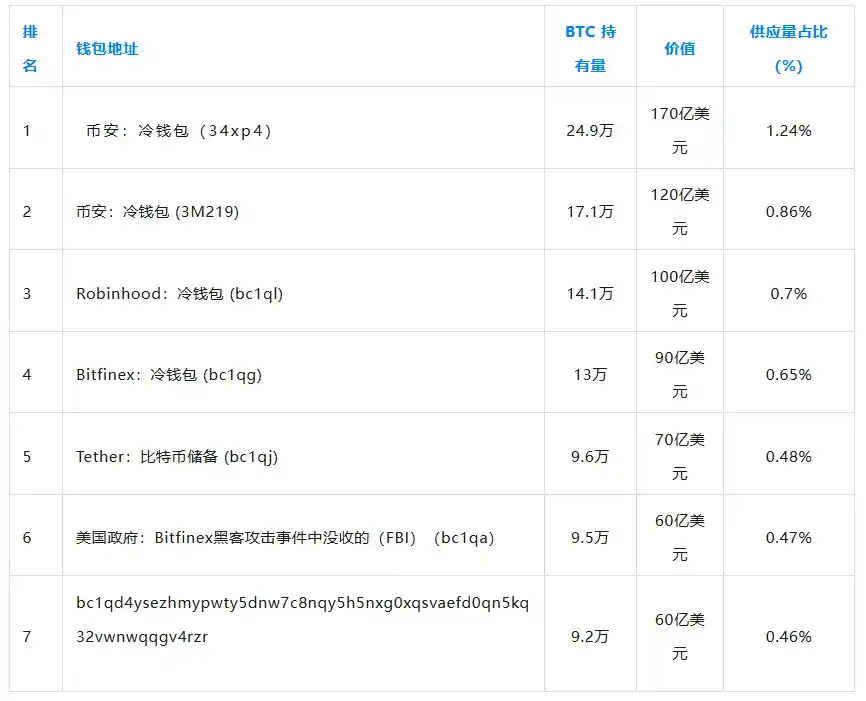
In terms of individual addresses, the wallet holding the most Bitcoin is Binance exchange's cold wallet, holding nearly 250,000 BTC.You can also view the entities holding the most Bitcoin. An entity refers to a confirmed collection of crypto addresses controlled by the same person or institution (e.g., an exchange, DeFi protocol, or company).
Bitcoin is a decentralized digital currency operating on a blockchain (a peer-to-peer network). Due to these characteristics, no one truly owns the entire Bitcoin network, but individuals can access and own Bitcoin through their private keys.
Bitcoin's price has risen significantly, reaching approximately $126,000 in October 2025, with a peak market capitalization of $2.48 trillion, creating multiple Bitcoin billionaires and other wealthy holders. In this article, we will examine some individuals, companies, and wallets that have become crypto whales based on on-chain data and their own public statements, and investigate the amount of Bitcoin they hold.
Summary
-
Satoshi Nakamoto is the largest Bitcoin holder, with approximately 1.1 million BTC, worth about $77 billion at current prices.
-
Coinbase is the second-largest entity, holding 982,000 BTC.BlackRock holds 775,000,Binance holds 655,000,Fidelity Custody holds 460,000, and Strategy holds 443,000 (although Strategy controls 738,000 BTC, due to its consolidated custody approach, some of this is attributed on-chain toFidelity Custody).
-
The U.S. government holds 328,000 BTC. These Bitcoins come from asset seizures from criminal organizations.
-
There are also multiple unidentified Bitcoin billionaires. There are numerous wallets, most of which have been inactive since the first inflows.
Largest Bitcoin Wallets
We group wallets associated with individuals or organizations into "entities." Entities are useful because, for security and operational reasons, large holders rarely keep all their assets in one wallet. By grouping all associated wallets into one entity, we can more accurately and completely represent that entity's total holdings and influence in the cryptocurrency market.
However, it is also possible to view individual wallets without categorizing them into their corresponding entities. The table below lists the largest individual wallets. The top four are all cold wallets controlled by the world's largest exchanges.
The fifth-largest wallet is controlled by the U.S. government,from seizures in the Bitfinex hack incident. The sixth-largest wallet is controlled by Tether for managing its Bitcoin reserves.
Top Holders by Category
Below are the top Bitcoin holders from various major entity categories (individuals, exchanges, ETF issuers, government agencies, publicly listed companies, and private companies).
Strategy's full holdings are listed in parentheses next to its on-chain confirmed positions.

Exchanges
Coinbase has the largest exchange holdings of Bitcoin, with its own and its customers' Bitcoin custodied at Coinbase. Coinbase also invests some of its net income in crypto assets and holds a certain amount of Bitcoin for operations, such as meeting customer withdrawal needs at any time.
Binance, Robinhood, and Upbit are also large exchange holders of Bitcoin. The cold wallets controlled by exchanges custody customer deposits and typically do not represent ownership by the exchange.
At the time of writing, Coinbase holds 5% of the total Bitcoin supply, while Binance holds 3.3%.
ETF Issuers
Since the launch of U.S. spot Bitcoin ETFs in January 2024, Arkham was the first to identify all ETF positions on-chain.
These include the following companies:
-
BlackRock
- <极p>Fidelity
-
Grayscale
-
Bitwise
-
ARK Invest
Grayscale is an asset management company offering a range of products for the public markets. The company is a subsidiary of Digital Currency Group. All digital assets for Grayscale's financial products are also custodied at Coinbase. While Grayscale publicly discloses its Bitcoin balance, they declined to reveal the trust's on-chain addresses—we successfully found these addresses on-chain, distributed across over 1,750 different addresses, each holding no more than 1,000 BTC.
Governments
Many of the world's largest countries have confirmed holdings of Bitcoin or have held it in the past.
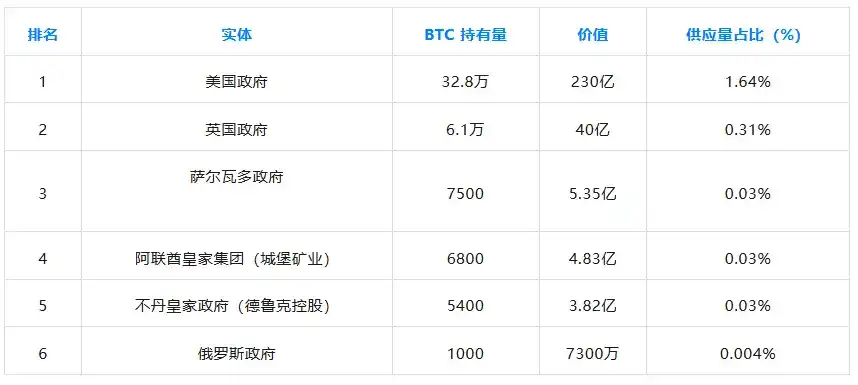
Data from our sources shows the following are the five governments with the most Bitcoin holdings verified on-chain. There may be more governments holding Bitcoin, but their holdings have not been verified.
Asset Seizures
The United States tops the list with a wallet size of 328,000 BTC. This Bitcoin was recovered by the U.S. Federal Bureau of Investigation (FBI) from the Bitfinex hack and seized from the Silk Road market and its hacker James Zhong. Recently, the U.S. government also obtained 127,000 BTC from the LuBian Hacker's address.
The United Kingdom holds 61,245 BTC. The UK's Metropolitan Police seized 61,000 BTC from Jian Wen and Zhimin Qian in 2018 and gained access to these seized Bitcoins in July 2021.
In November 2020, Chinese authorities confiscated 194,775 BTC from the operators of the PlusToken Ponzi scheme. These tokens were confiscated for local governments, but it is unclear whether China still holds them or has sold them.
Since the Russo-Ukrainian War, Ukraine has also received Bitcoin donations worth $22.8 million. According to data released by the Ukrainian government in April 2021, over 700,000 Ukrainian public officials declared holdings of Bitcoin, with some holding up to 18,000 BTC. Allegedly, Ukrainian public officials collectively hold 46,351 BTC. While officials' Bitcoin holdings are not strictly government assets, the large-scale public holding of Bitcoin by civil servants is still significant and unusual.
In January 2024, the German government seized 50,000 BTC from a movie piracy website called Movie2k. However, these Bitcoins were all sold in July 2024.
Sovereign Adoption
Unlike most countries that confiscate and hold Bitcoin through criminal arrests, El Salvador boldly recognizes Bitcoin as legal tender. El Salvador famously spent $108 million to purchase 2,546 BTC. Additionally, in November 2022, Salvadoran President Nayib Bukele announced that the country would also buy 1 Bitcoin daily.
Bhutan has been mining Bitcoin since 2019. In May 2023, Bhutan's sovereign wealth fund, Druk Holding & Investments, announced a $500 million partnership with Bitdeer to expand its Bitcoin mining operations. Given Bhutan's geographical advantages, the country has built numerous hydropower plants along its glacial rivers. Today, Bhutan will use its cheap and abundant hydropower for Bitcoin mining and invest the proceeds in national development.
The United Arab Emirates (UAE) is actively positioning itself as a global cryptocurrency hub. Recently, we discovered large-scale mining activity in the UAE. The UAE holds 6,800 BTC. This Bitcoin comes from Citadel's mining operations. Citadel is a listed mining company controlled by the UAE's Royal Group through IHC (International Holding Company).
Publicly Listed Companies
As Bitcoin's value as a digital asset becomes increasingly recognized and accepted, publicly listed companies are incorporating Bitcoin into their investment strategies or diversifying their corporate reserves.
Led by Michael Saylor, Strategy (formerly MicroStrategy) holds more Bitcoin than any other publicly listed company. The company has been accumulating Bitcoin since August 2020, making purchases of varying sizes every few weeks. Its total holdings are 739,000 BTC.
MARA is a listed Bitcoin mining company in North America and another company holding a significant amount of Bitcoin. The company operates 9 mining farms, with an average daily production of 22.7 BTC in September 2025. According to our data, MARA's on-chain wallets hold 13,000 BTC (worth $864 million). However, it is reported that the company also holds a treasury reserve of 53,200 BTC.
Tokyo-listed Metaplanet is hailed as "Japan's MicroStrategy." The company is acquiring Bitcoin as its primary reserve asset, citing it as a key hedge against the long-term depreciation of the yen and broader economic uncertainty. Metaplanet currently holds 35,100 BTC (approximately $2.4 billion).
Private Companies
According to verified on-chain data, the two private companies holding the most Bitcoin are Tether (96,300) and SpaceX (8,300).
SpaceX first purchased Bitcoin in 2021 and once held 28,000. However, its holdings have since significantly decreased. In August this year, SpaceX's Bitcoin was worth $1 billion.
According to the Bitcoin Treasuries website, Block.one is currently the private company holding the most Bitcoin, with 164,000. Block.one is a private technology and investment company known for developing the open-source blockchain software EOSIO. Its massive holdings cannot be verified on-chain.
Unattributed Wallets
To further explore these unattributed wallets, you can copy the addresses yourself and paste them into a data platform for search.

Conclusion
Bitcoin, which started as a niche project for cryptography enthusiasts, has evolved into a financial asset of global importance, held by numerous companies, individuals, and government agencies. Bitcoin's great appeal to users stems from its decentralized nature. This characteristic ensures that the Bitcoin network is not completely controlled by anyone; even the most determined attacker would find it almost impossible to control the entire network due to the extremely high cost.
Bitcoin's maximum supply of 21 million is a fundamental element of the project's design, ensuring it remains scarce and is not inflated to drive up its value. Considering that approximately 3.7 million BTC are permanently stuck in inaccessible wallets, the actual total supply of Bitcoin is even lower.