Bitcoin Enters the Public Bond Market, Moody's Issues World's First Rating for Crypto-Collateralized Bond

marsbitPublished on 2026-04-01Last updated on 2026-04-01

Abstract

Moody's Ratings has assigned a Ba2 provisional credit rating to a $100 million Bitcoin-backed municipal bond issued by the New Hampshire Business Finance Authority, marking the first time a major rating agency has assessed a cryptocurrency-collateralized public bond. The bond, structured by Wave Digital Assets, is fully collateralized by Bitcoin held in regulated cold storage and requires 160% over-collateralization. It includes automatic liquidation triggers if the collateral value falls below 140% of the debt exposure. Moody's conservative assessment incorporated a 72% advance rate and short liquidation windows, simulating a 28% Bitcoin price drop. The Ba2 rating reflects the structure's risk mitigation measures rather than a dismissal of Bitcoin itself. This issuance represents a new phase in institutional crypto adoption—using Bitcoin as rated collateral in public debt markets—potentially paving the way for more regulated, large-scale institutional crypto financing.

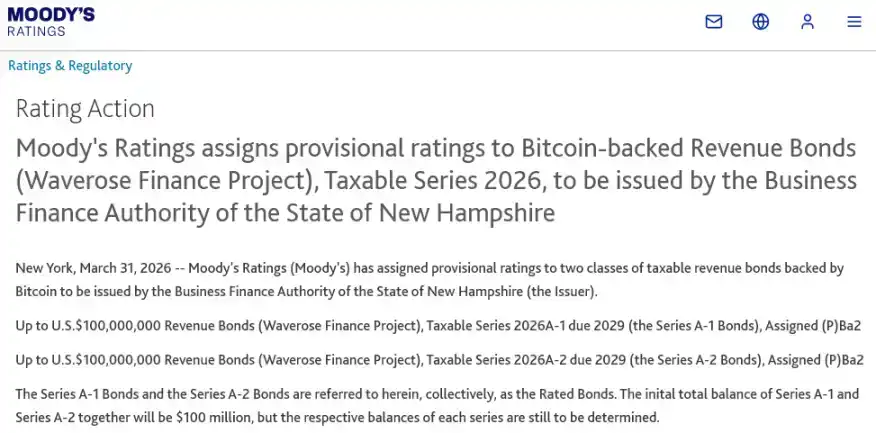
On March 31, Moody's Ratings assigned a provisional credit rating of Ba2 to a Bitcoin-collateralized bond issued by the New Hampshire Business Finance Authority (BFA). This marks the first time in history that a traditional rating agency has conducted a credit assessment for a Bitcoin-collateralized municipal bond.
What is This Bond

This is a $100 million Bitcoin-backed taxable revenue bond linked to the Waverose Finance Project, divided into two series, 2026A-1 and 2026A-2, both maturing in 2029.

The bond was structured by Wave Digital Assets, with Rosemawr Management serving as the investment manager and Orrick providing legal services. The fees BFA receives from the transaction will be used to create a "Bitcoin Economic Development Fund."

The core of the bond structure lies in its independence from any entity's cash flow, relying directly on Bitcoin as collateral for repayment. The Bitcoin collateral is custodied by BitGo Trust Company, Inc. and held in regulated cold storage.

When the borrower needs to pay interest or repay principal, the collateral will be liquidated to cover the expenses. The bond also includes a clause relatively favorable to holders. Series A-2 holders are entitled to receive an additional share of BTC profits after full repayment of principal and interest if the price of Bitcoin is higher than the pricing date at maturity.

Compared to Bitcoin lending tools on platforms like Coinbase, the most significant aspect of this bond is that it provides cryptocurrencies with their first opportunity to enter the public bond market for financing. Borrowers no longer rely on private loans from centralized platforms but instead, through publicly rated bonds with traditional credit ratings, leverage institutional funds on a large scale and at low cost within a compliant framework.

How Institutions Assess Bitcoin's Risks

Moody's stated in its report that the provisional rating primarily reflects risks related to collateral, structure, and operations, with Bitcoin's high volatility being the primary consideration.

To hedge against price fluctuations, the issuance structure introduced a 1.6x over-collateralization requirement, meaning the value of BTC collateral must always remain at least 160% of the debt exposure.

If the collateral ratio falls to the 1.4x trigger line (i.e., LTV deteriorates to approximately 71%), a mandatory full redemption mechanism will be triggered, causing the bond to mature early and the Bitcoin to be liquidated for repayment.

In other words, for every $100 borrowed, at least $160 worth of Bitcoin must be collateralized. If the collateral value shrinks to below $140, the system triggers forced repayment, the bond matures early, and the Bitcoin is sold to repay the debt.

To assess conservatism, Moody's used a 72% advance rate and a shorter liquidation window in its rating report, simulating an extreme scenario where Bitcoin's price drops approximately 28% from the pricing date. Tests showed that the 1.6x initial over-collateralization and 1.4x trigger mechanism still provide sufficient protection, supporting the Ba2 rating outcome.

This parameter design is quite conservative, but for an asset with historical drawdowns often exceeding 50%, this conservatism may also be a prerequisite for Moody's willingness to issue a rating.

Another noteworthy detail is that although this bond bears the name of the New Hampshire Business Finance Authority, it has no connection to the state's public credit. Moody's explicitly stated in its report that no public funds from the state can be used to repay this bond.

The issuer acts as a "conduit issuer" in the structure, providing issuance channels and nominal endorsement but assuming no credit guarantee responsibility.

This structure is not uncommon in the traditional municipal bond field and is often used for financing special projects such as healthcare and education.

Why This Transaction is Important

To understand the historical significance of this bond, it must be viewed in a broader context.

Over the past few years, institutional attitudes toward Bitcoin have gone through three stages: from exclusion, to holding it as an asset (BTC reserves on corporate balance sheets), to using it as collateral for financing (pledging BTC for fiat loans). This bond represents the beginning of the fourth stage: Bitcoin, as the underlying collateral for publicly rated debt instruments, has entered the track of traditional public financial markets.

This track signifies three things: opening a window for institutional investors to indirectly gain Bitcoin exposure through compliant channels; prompting Moody's to begin establishing a rating methodology for crypto collateral, attracting more rating agencies to follow suit; proving that Bitcoin can, under certain conditions, serve as the underlying logic for "interest-bearing assets," not just zero-interest holdings.

This bond is not an isolated event. Concurrently, the U.S. Department of Labor, pursuant to President Trump's executive order, released a proposal to expand the availability of digital assets in retirement investment portfolios; multiple states are considering "Bitcoin strategic reserve" legislation; New Hampshire is also the first state in the U.S. to pass a cryptocurrency reserve law.

The Ba2 rating, frankly, is "junk bond" level, but this label itself can be misleading. In Moody's rating sequence, Ba2 is the second tier of speculative grade, still quite distant from the bottom (C/D).

Tesla did not receive investment-grade ratings from S&P and Moody's until between 2022 and 2023; Ford still maintains a speculative grade (Ba1) in Moody's system and barely holds the lowest investment grade with a negative outlook in S&P's system. This does not prevent them from being important allocation targets for institutional investors.

Secondly, the fact that this bond received Ba2 rather than a lower rating itself indicates that the 1.6x over-collateralization plus the forced liquidation mechanism passed the relevant scenario simulations in Moody's stress tests. Thus, Ba2 reflects the conservatism of the structural design, not a simple dismissal of the Bitcoin asset itself.

Looking at historical precedents, the first MBS (mortgage-backed security) and the first green bond similarly started at similar points when entering the rating system. As pricing experience accumulated and structures matured, ratings often improved accordingly. In this sense, Ba2 is merely a starting point.


Trending Cryptos

Related Questions

QWhat is the significance of Moody's assigning a Ba2 rating to the Bitcoin-backed bond issued by New Hampshire BFA?

AIt is the first time a traditional rating agency has provided a credit assessment for a Bitcoin-collateralized municipal bond, marking Bitcoin's entry into the public debt market with institutional recognition.

QHow does the bond structure mitigate the risk associated with Bitcoin's price volatility?

AThe bond requires 160% over-collateralization, with a forced full redemption triggered if the collateral value drops to 140% of the debt exposure, ensuring repayment even if Bitcoin's price declines significantly.

QWhat role does the New Hampshire Business Finance Authority play in this bond issuance?

AIt acts as a conduit issuer, providing the issuance channel and nominal endorsement but assuming no credit guarantee responsibility; no public funds from the state are used for bond repayment.

QWhat additional benefit do Series A-2 bondholders receive under certain conditions?

AIf Bitcoin's price is higher than the pricing date at maturity, Series A-2 holders are entitled to an additional BTC profit share after full principal and interest payments.

QWhy is the Ba2 rating considered a starting point rather than a final assessment for such bonds?

ASimilar to historical precedents like the first MBS or green bonds, ratings often improve as pricing experience accumulates and structures mature; Ba2 reflects conservative design rather than outright rejection of Bitcoin.

Related Reads

Must-Watch Events Next Week|CLARITY Act Could Face Senate Vote; SpaceX, Circle to Report Earnings (8.3-8.9)

**Summary: Key Events and Developments to Watch (August 3-9)** The upcoming week is marked by significant financial disclosures, key legislative deadlines, and notable product updates. **Major Financial Events:** Several companies are scheduled to release their Q2 2026 earnings. American Bitcoin (ABTC) will report on August 3, followed by SpaceX and Hut 8 Mining Corp. on August 4, and Circle on August 5. Notably, a significant portion of SpaceX shares (up to 12% of total shares) will be unlocked on August 6 following their earnings release. **Key Legislative Deadline:** The U.S. Senate faces an August 7 deadline to secure 60 votes for the CLARITY Act, a bipartisan bill aiming to establish a federal regulatory framework for cryptocurrencies. The Senate may hold a full vote on the bill during the week. **Economic Data:** The U.S. July Non-Farm Payrolls report will be released on August 7, providing crucial labor market data. **Technology & Product Updates:** * **Shutdowns:** DeFi portfolio tracker Zapper and wallet app Ctrl Wallet will cease operations on August 3. * **Upgrades:** LayerZero will deprecate its v1 relayers on August 3. XRP Ledger's new version 3.3.0, featuring five new functions, is expected next week. * **AI:** Elon Musk announced that the advanced Grok 4.6 AI model is set for release around August 7. * **Bitcoin:** The BIP-110 forced signaling for a potential Bitcoin network change is scheduled to begin around August 8. **Other Notable Events:** Chinese robotics firm Unitree Tech has set its preliminary price inquiry for its IPO for August 5. South Korean exchange Upbit will delist AQT and AERGO tokens on August 3.

marsbit30m ago

Must-Watch Events Next Week|CLARITY Act Could Face Senate Vote; SpaceX, Circle to Report Earnings (8.3-8.9)

marsbit30m ago

Stocks Are Plummeting More Sharply Than Cryptocurrencies. Where Has the Money Gone?

Stock Markets Plunge Deeper Than Cryptocurrencies: Where Did the Money Go? In late July, Seoul's Kospi index triggered circuit breakers for two consecutive days, plummeting over 40% from its June high. The collapse was led by heavyweight stocks like SK Hynix, whose record profits still disappointed investors, and devastating leveraged ETFs, with one major product losing over 83% of its value. This signaled a global, forced deleveraging targeting the most crowded trades. Interestingly, while stocks exhibited extreme volatility akin to crypto markets, Bitcoin rose nearly 15% in July after a prior steep drop. Analysis shows the money fleeing equities did not flow into Bitcoin. Instead, Bitcoin had already absorbed its sell-off in May-June, when U.S. spot Bitcoin ETFs saw historic outflows. The true safe-haven beneficiary was gold, whose price rose over 20% year-on-year, highlighting a decoupling between Bitcoin and gold as "digital gold." The sell-off was a targeted unwinding of leveraged positions in tech and semiconductors, accelerated by broker-dealer risk management and shifts in the AI narrative, including new competition from Chinese memory chipmakers. The retreat path was clear: from high-valuation tech stocks to cash and U.S. Treasuries, then to gold. For Bitcoin to attract sustained institutional inflows, conditions like eased global liquidity pressure, a "soft-landing" Fed rate cut, and U.S. regulatory clarity via legislation like the stalled CLARITY Act are needed. Currently, Bitcoin is not a safe haven but an already-cleared asset. Its low correlation with tech stocks, however, makes it a potential diversification play for institutional portfolios once the storm passes. The money isn't here yet, but the positioning is underway.

marsbit30m ago

Stocks Are Plummeting More Sharply Than Cryptocurrencies. Where Has the Money Gone?

marsbit30m ago

In Conversation with Ray Dalio: We Are Currently in an AI Bubble, with 1% of My Portfolio in Bitcoin

Ray Dalio, founder of Bridgewater Associates, warns in an interview that the current AI boom shows classic bubble characteristics, which could lead to significant economic downturns as seen in past cycles like 1929 or 2000. He explains that speculative enthusiasm, fueled by debt and overvaluation, often precedes a crash when rising rates or taxation force asset sales, causing widespread losses and recession. Dalio also outlines his "Big Cycle" theory, describing an approximate 80-year pattern where widening wealth gaps, massive government deficits, and shifting geopolitical power (like China's rise) create internal conflict and global instability. He emphasizes that we are in a late-cycle, transitional phase where traditional powers like the US and UK face decline. For personal wealth protection, Dalio advises diversification beyond cash into assets like stocks, bonds, real estate, and particularly gold, which he prefers over Bitcoin. While he holds about 1% of his portfolio in Bitcoin as a non-printable hard asset, he views gold as more secure from technological or governmental threats. Regarding AI's impact, Dalio believes it will disproportionately benefit capital owners, worsening inequality by replacing both physical and cognitive labor. He suggests that human intuition and emotional intelligence, combined with AI, will be key for future workers. On taxation, Dalio argues that wealth taxes are impractical and risk triggering asset sell-offs, reducing productive investment. He points to the UK as a cautionary example of debt, low productivity, and political strife. Geopolitically, Dalio foresees a more regionalized world, with the US showing weakness in prolonged conflicts like with Iran, akin to past imperial declines. The ideal outcome, he suggests, is coexisting powerful blocs (e.g., Americas, China-Asia Pacific) without major war.

marsbit4h ago

In Conversation with Ray Dalio: We Are Currently in an AI Bubble, with 1% of My Portfolio in Bitcoin

marsbit4h ago

Daily 7.2 Trillion KRW: Foreign Capital's Record Net Buying on Friday! Wall Street Says Headwinds for Korean Stock Fund Flows Have Subsided

South Korean stock market sees a dramatic shift in fund flows. On July 31, foreign investors made a record net purchase of approximately KRW 7.2 trillion in KOSPI stocks, marking a fundamental reversal from the persistent large-scale net outflows seen in previous months. This contributed to a significant narrowing of foreign net selling in July to KRW 9.8 trillion, down sharply from KRW 48.4 trillion in June and KRW 44.5 trillion in May. Simultaneously, domestic institutional pressure eased. South Korean pension funds and asset managers turned to a net buying position in July, purchasing KRW 1.0 trillion worth of KOSPI shares, contrasting with net sales in May and June. Market volatility is expected to be dampened by new financial regulations. Effective July 31, the Financial Services Commission tightened access for retail investors to single-stock leveraged ETFs by raising the minimum cash deposit requirement. Trading volumes for these products subsequently dropped to about 50% of their monthly average. Citigroup Research maintains its year-end KOSPI target of 10,000 points. The firm cites several supportive factors: the substantial easing of headwinds from capital outflows, a robust fundamental outlook for the semiconductor sector, historically low market valuations, strong economic fundamentals, and the potential for policy support from financial authorities if needed.

marsbit4h ago

Daily 7.2 Trillion KRW: Foreign Capital's Record Net Buying on Friday! Wall Street Says Headwinds for Korean Stock Fund Flows Have Subsided

marsbit4h ago

Trading

Spot

Hot Articles

Discussions

Welcome to the HTX Community. Here, you can stay informed about the latest platform developments and gain access to professional market insights. Users' opinions on the price of S (S) are presented below.

活动图片













