Has Bhutan Stopped Mining Bitcoin? New BTC Moves Fuel Fresh Questions

bitcoinistОпубликовано 2026-03-19Обновлено 2026-03-19

Введение

Bhutan's recent Bitcoin transfers, totaling $72.3 million over 24 hours, have raised questions about whether the country has stopped mining BTC. Blockchain analytics firm Arkham noted that the last significant inflow to known Bhutan-linked wallets was over a year ago, suggesting the state-backed mining operation may have slowed or halted. However, alternative explanations exist, such as seasonal hydropower limitations or the use of unidentified wallets for mining rewards. Bhutan has historically framed its Bitcoin strategy as a long-term national commitment rather than speculative trading. The ongoing outflows indicate distribution rather than accumulation, but the true status of Bhutan's mining activities remains uncertain.

Bhutan’s latest Bitcoin transfers have revived one of the market’s more unusual sovereign-BTC questions: is the kingdom still mining, or is it now mainly selling from an older reserve? Arkham said wallets tied to Bhutan moved another $44.44 million in BTC, bringing total transfers from those addresses to $72.3 million over 24 hours, while noting that the last Bhutan-linked inflow above $100,000 was seen more than a year ago.

That detail is what turned a routine wallet movement into a bigger story. If the identified wallets are no longer receiving fresh mining rewards, the obvious interpretation is that Bhutan’s state-backed mining operation may have slowed or stopped. Arkham pushed that line directly, asking whether Bhutan had halted mining after highlighting repeated outbound transfers and the long gap in visible inflows.

The selling pattern itself is not new. Arkham had already flagged another $27.8 million BTC transfer a day earlier and said Bhutan had also moved $11 million last week, with roughly that same amount sent to an address previously used in similar transactions. According to Arkham, Bhutan has periodically sold portions of its Bitcoin in clips of roughly $5 million to $10 million, with a particularly active phase around mid-to-late September 2025.

Has Bhutan Really Stopped Bitcoin Mining?

Still, the on-chain evidence does not settle the question on its own. Bhutan kept its mining activity secret for years. It only became public through investigations tied to the bankruptcies of Celsius and BlockFi. That history leaves open a more cautious interpretation: DHI may still be operating under the radar and routing fresh mining rewards to new, as-yet unidentified wallets. In other words, the absence of inflows to the known addresses does not necessarily prove the mining has ended.

Another possible explanation is seasonality. Bhutan’s mining model is tightly linked to hydropower, and the country’s electricity production is highly dependent on weather patterns and the time of year. During the winter months, lower rainfall and reduced water levels can lead to a marked decline in power generation. In the summer, by contrast, Bhutan produces large energy surpluses. In that case, the absence of fresh inflows could reflect a seasonal drop in the amount of surplus electricity available for mining.

That distinction matters because Bhutan has never presented Bitcoin as a short-term trade. In a public statement tied to Gelephu Mindfulness City, the country said, “Bitcoin is not being held as an object of speculation. It is being set aside with purpose. This is not an experiment. It is a commitment.” Those lines suggested a strategic, state-level view of Bitcoin tied to Bhutan’s broader economic and energy model rather than opportunistic treasury management.

Even so, the recent flows raise legitimate questions about what that strategy now looks like in practice. If Bhutan is still mining, it may simply be doing so through wallets that are no longer publicly linked to the operation. If it is not, then the current transfers look less like portfolio rotation and more like continued reserve monetization from a stockpile accumulated over earlier years of hydro-powered mining.

The deeper point is not just whether Bhutan sold another tranche of BTC. It is that one of the world’s most closely watched sovereign Bitcoin holders has become harder to read at exactly the moment its visible wallets show distribution, not accumulation. Until new inflows appear or new wallet infrastructure is identified, the question Arkham raised will remain open: not whether Bhutan is moving Bitcoin, but whether it is still producing it.

At press time, BTC traded at $70,394.
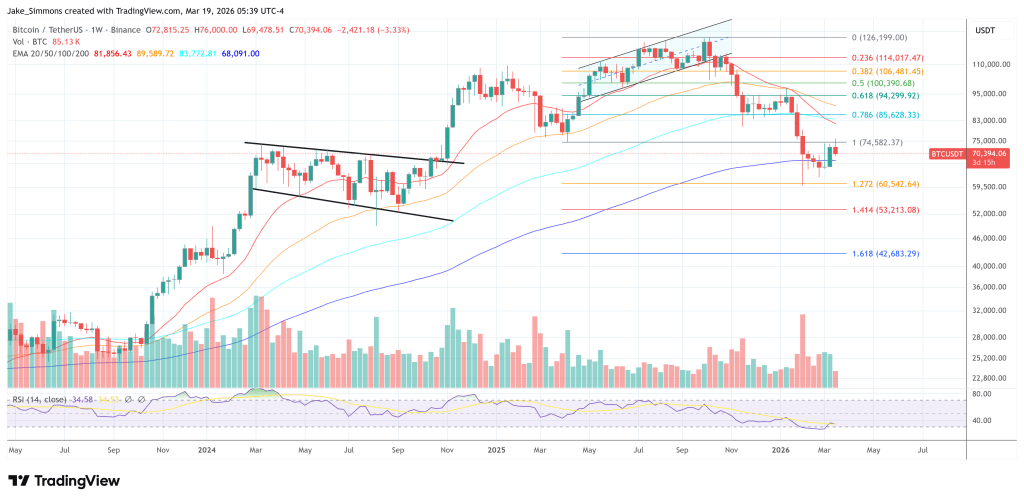
Bitcoin must break above the 1.0 Fib level, 1-week chart | Source: BTCUSDT on TradingView.com

Связанные с этим вопросы

QWhat recent Bitcoin transfers by Bhutan have raised questions about its mining activities?

ABhutan moved $44.44 million in BTC, bringing total transfers to $72.3 million over 24 hours, with no significant inflows to known wallets in over a year.

QAccording to Arkham analysis, what does the absence of recent inflows to Bhutan's known wallets suggest?

AIt suggests that Bhutan's state-backed Bitcoin mining operation may have slowed or stopped, as the wallets are no longer receiving fresh mining rewards.

QWhat are two possible explanations for the lack of visible Bitcoin mining inflows in Bhutan?

A1) Mining may continue through new, unidentified wallets. 2) Seasonal hydropower variations may reduce electricity surplus available for mining during dry winter months.

QHow did Bhutan characterize its Bitcoin strategy in relation to the Gelephu Mindfulness City project?

ABhutan stated Bitcoin is 'not being held as an object of speculation' but is 'being set aside with purpose,' indicating a strategic, long-term commitment rather than short-term trading.

QWhy is the timing of Bhutan's Bitcoin movements particularly significant to observers?

ABecause one of the world's most watched sovereign Bitcoin holders shows distribution patterns rather than accumulation, making its strategy harder to interpret at this moment.

Похожее

Understanding x402 and MPP: Two Approaches to Agent Payments

Stripe's MPP and x402 represent two competing approaches to enabling machine-to-machine payments, both leveraging the long-dormant HTTP 402 status code ("Payment Required"). x402, led by Coinbase, is a minimalist protocol that embeds payment directly into HTTP requests. It requires no accounts, API keys, or intermediaries. A server returns a 402 response with payment details; the client pays on-chain and resubmits the request with a proof. It's open-source, chain-agnostic (currently supporting Base, Polygon, Solana), and designed for open, permissionless systems. However, current usage is low, with small microtransactions. MPP, developed by Stripe and Tempo, is a full-stack solution built for high-frequency agent transactions. Its core innovation is sessions, allowing an agent to pre-authorize a spending limit and make numerous micro-payments within it without repeated on-chain transactions. It runs on the Tempo blockchain, optimized for high throughput and sub-second confirmations. Crucially, it integrates with Stripe's existing compliance, risk, and fiat infrastructure, including support for credit cards via Shared Payment Tokens (SPTs). While x402 offers simplicity and decentralization, MPP provides scalability and enterprise-grade features. Stripe supports both, aiming to capture agent payment flows regardless of the underlying protocol. The ecosystem is still experimental, but major players like Google, Visa, and Anthropic are involved. The choice depends on the use case: x402 for open, long-tail applications, and MPP for commercial, high-volume scenarios.

marsbit1 мин. назад

Understanding x402 and MPP: Two Approaches to Agent Payments

marsbit1 мин. назад

The Use of Humans: Agentic Wallet and the Next Decade of Wallets

The article "The Use of Humans: Agentic Wallet and the Next Decade of Wallets" discusses the evolution of digital wallets in the age of AI agents. It argues that as software users shift from humans to autonomous agents, traditional wallet security models—relying on human confirmation, signatures, and private key management—become inadequate. The core proposition is that Agentic Wallets must serve two masters: humans, who set rules and retain ultimate control, and agents, which require constrained autonomy to execute transactions efficiently. The wallet thus evolves from a simple asset container into a permission and execution system that allows agents to operate within predefined boundaries (e.g., budget limits, approved assets, whitelisted addresses). The article identifies key challenges: current wallets are designed for human interaction, not agentic speed and scale. It outlines four tiers of agent autonomy—from human-controlled to fully autonomous—and emphasizes "bounded autonomy" as the pragmatic near-term solution. A four-layer architecture is proposed: account isolation, permission rules, execution primitives for agents, and governance tools (logging, alerts, veto mechanisms). Critical enabling technologies include standardized Skills (for链上 operations), policy engines, session keys for limited delegation, and audit trails. Current solutions from players like Coinbase, Safe, Privy, and Polygon are noted, but face gaps in portable identity/reputation, unified policy standards, adversarial security (e.g., prompt injection), and cross-chain functionality. The future direction involves a "Wallet Policy Plane" that sits between agent intent and on-chain execution, performing real-time policy checks, risk scoring, and identity verification—akin to Stripe's payment infrastructure. Ultimately, the wallet's role shifts from a front-end gatekeeper to an embedded control layer enabling secure, scalable agentic economies.

marsbit24 мин. назад

The Use of Humans: Agentic Wallet and the Next Decade of Wallets

marsbit24 мин. назад

Must-Follow Next Week|Polymarket to Announce Major News Next Monday; Backpack TGE on March 23 (3.23-3.29)

The following is a summary of key events scheduled for the week of March 23-29, 2026. **March 23:** * **Polymarket** is set to announce major news, speculated to be related to a token launch or funding round. * **Backpack** will conduct its Token Generation Event (TGE). * The U.S. SEC may begin processing **Morgan Stanley's Bitcoin ETF** application. * Cboe plans to launch the **BITVX** volatility index, based on iShares Bitcoin Trust (IBIT) options. * **NilChain** will cease operations; NIL token holders must migrate to Ethereum. * **Binance** will list the PAYPUSDT stock perpetual contract. **March 25:** * The U.S. House Financial Services Committee will hold a hearing on **tokenization**. * **Metaplanet** will hold its annual shareholders meeting. **March 26:** * A proposal to distribute ~70 million **USDS** to Sky Agents may be executed. * U.S. weekly initial jobless claims data will be released. **March 27:** * Federal Reserve Vice Chair **Jefferson** is scheduled to speak. * **Bithumb** will delist Neiro (NEIRO). **March 28:** * **Linea** will update its Terms of Service to prepare for the launch of its Yield Boost feature. **Other Events (Date TBD):** * Elon Musk announced that **X Platform** will release a major open-source update to its AI algorithm next week. * **Starknet** will launch the **STRK20** testnet next week, with a mainnet release planned for late April. STRK20 aims to provide token-level privacy for assets on the network.

marsbit47 мин. назад

Must-Follow Next Week|Polymarket to Announce Major News Next Monday; Backpack TGE on March 23 (3.23-3.29)

marsbit47 мин. назад

Торговля

Спот
Фьючерсы

Популярные статьи

Тест по Bitcoin Биткоина

HTX Learn: Изучите Bitcoin halving и Заработаете Токены USDT

2.8k просмотров всегоОпубликовано 2024.04.16Обновлено 2024.04.16

Тест по Bitcoin  Биткоина

Что такое $BITCOIN

ЦИФРОВОЕ ЗОЛОТО ($BITCOIN): Комплексный анализ Введение в ЦИФРОВОЕ ЗОЛОТО ($BITCOIN) ЦИФРОВОЕ ЗОЛОТО ($BITCOIN) — это проект на основе блокчейна, работающий в сети Solana, который стремится объединить характеристики традиционных драгоценных металлов с инновациями децентрализованных технологий. Хотя он носит имя Биткойн, часто называемого “цифровым золотом” из-за его восприятия как средства хранения ценности, ЦИФРОВОЕ ЗОЛОТО является отдельным токеном, предназначенным для создания уникальной экосистемы в ландшафте Web3. Его цель — позиционировать себя как жизнеспособный альтернативный цифровой актив, хотя детали его применения и функциональности все еще развиваются. Что такое ЦИФРОВОЕ ЗОЛОТО ($BITCOIN)? ЦИФРОВОЕ ЗОЛОТО ($BITCOIN) — это токен криптовалюты, специально разработанный для использования в блокчейне Solana. В отличие от Биткойна, который выполняет широко признанную роль хранения ценности, этот токен, похоже, сосредоточен на более широких приложениях и характеристиках. Примечательные аспекты включают: Инфраструктура блокчейна: Токен построен на блокчейне Solana, известном своей способностью обрабатывать высокоскоростные и недорогие транзакции. Динамика предложения: ЦИФРОВОЕ ЗОЛОТО имеет максимальное предложение, ограниченное 100 квадриллионами токенов (100P $BITCOIN), хотя детали о его обращающемся предложении в настоящее время не раскрыты. Утилита: Хотя точные функциональные возможности не описаны, есть указания на то, что токен может быть использован для различных приложений, потенциально связанных с децентрализованными приложениями (dApps) или стратегиями токенизации активов. Кто создатель ЦИФРОВОГО ЗОЛОТА ($BITCOIN)? На данный момент личность создателей и команды разработчиков, стоящих за ЦИФРОВЫМ ЗОЛОТОМ ($BITCOIN), остается неизвестной. Эта ситуация типична для многих инновационных проектов в области блокчейна, особенно тех, которые связаны с децентрализованными финансами и феноменом мем-криптовалют. Хотя такая анонимность может способствовать культуре, ориентированной на сообщество, она усиливает опасения по поводу управления и ответственности. Кто инвесторы ЦИФРОВОГО ЗОЛОТА ($BITCOIN)? Доступная информация указывает на то, что у ЦИФРОВОГО ЗОЛОТА ($BITCOIN) нет известных институциональных спонсоров или значительных венчурных капиталовложений. Проект, похоже, функционирует по модели пирингового взаимодействия, сосредоточенной на поддержке и принятии сообществом, а не на традиционных путях финансирования. Его активность и ликвидность в основном сосредоточены на децентрализованных биржах (DEX), таких как PumpSwap, а не на устоявшихся централизованных торговых платформах, что еще больше подчеркивает его подход, ориентированный на grassroots. Как работает ЦИФРОВОЕ ЗОЛОТО ($BITCOIN) Операционные механизмы ЦИФРОВОГО ЗОЛОТА ($BITCOIN) можно подробно описать на основе его дизайна блокчейна и характеристик сети: Механизм консенсуса: Используя уникальный механизм доказательства истории (PoH) Solana в сочетании с моделью доказательства доли (PoS), проект обеспечивает эффективную валидацию транзакций, что способствует высокой производительности сети. Токеномика: Хотя конкретные дефляционные механизмы не были подробно описаны, большое максимальное предложение токенов подразумевает, что оно может быть предназначено для микротранзакций или нишевых случаев использования, которые еще предстоит определить. Интероперабельность: Существует потенциал для интеграции с более широкой экосистемой Solana, включая различные платформы децентрализованных финансов (DeFi). Однако детали относительно конкретных интеграций остаются неуточненными. Хронология ключевых событий Вот хронология, которая подчеркивает значимые вехи, касающиеся ЦИФРОВОГО ЗОЛОТА ($BITCOIN): 2023: Первоначальное развертывание токена происходит в блокчейне Solana, отмеченное его адресом контракта. 2024: ЦИФРОВОЕ ЗОЛОТО приобретает видимость, когда оно становится доступным для торговли на децентрализованных биржах, таких как PumpSwap, позволяя пользователям обменивать его на SOL. 2025: Проект наблюдает спорадическую торговую активность и потенциальный интерес к инициативам, возглавляемым сообществом, хотя на данный момент не зафиксировано никаких значительных партнерств или технических достижений. Критический анализ Сильные стороны Масштабируемость: Основная инфраструктура Solana поддерживает высокие объемы транзакций, что может повысить полезность $BITCOIN в различных сценариях транзакций. Доступность: Потенциально низкая цена торговли за токен может привлечь розничных инвесторов, способствуя более широкому участию благодаря возможностям дробного владения. Риски Отсутствие прозрачности: Отсутствие публично известных спонсоров, разработчиков или процесса аудита может вызвать скептицизм относительно устойчивости и надежности проекта. Волатильность рынка: Торговая активность сильно зависит от спекулятивного поведения, что может привести к значительной волатильности цен и неопределенности для инвесторов. Заключение ЦИФРОВОЕ ЗОЛОТО ($BITCOIN) является интригующим, но неоднозначным проектом в быстро развивающейся экосистеме Solana. Хотя он пытается использовать нарратив “цифрового золота”, его отход от установленной роли Биткойна как средства хранения ценности подчеркивает необходимость более четкого различения его предполагаемой утилиты и структуры управления. Будущее принятие и усвоение, вероятно, будут зависеть от решения текущей непрозрачности и более четкого определения его операционных и экономических стратегий. Примечание: Этот отчет охватывает синтезированную информацию, доступную на октябрь 2023 года, и с тех пор могут произойти события.

99 просмотров всегоОпубликовано 2025.05.13Обновлено 2025.05.13

Что такое $BITCOIN

Fractal Bitcoin: масштабирование Биткоина с помощью рекурсивной системы

Fractal Bitcoin — масштабное Layer-1-решнение, созданное на базе кода Биткоина, позволяющего достигать бесконечного масштабирования с помощью рекурсивного подхода.

2.1k просмотров всегоОпубликовано 2025.06.30Обновлено 2025.06.30

Fractal Bitcoin: масштабирование Биткоина с помощью рекурсивной системы

Обсуждения

Добро пожаловать в Сообщество HTX. Здесь вы сможете быть в курсе последних новостей о развитии платформы и получить доступ к профессиональной аналитической информации о рынке. Мнения пользователей о цене на BTC (BTC) представлены ниже.

活动图片