The Chip Frenzy Cools Down? Morgan Stanley's Wilson: Funds Are Flowing Toward AI Hyperscale Giants Like Microsoft and Amazon

链捕手Published on 2026-07-06Last updated on 2026-07-06

Abstract

Chip stock momentum is fading, with funds rotating from previously high-flying semiconductors toward AI hyperscale cloud giants like Microsoft, Amazon, and Meta, according to Morgan Stanley's chief equity strategist Michael Wilson. He notes this rotation is occurring against a backdrop of overall market weakness, with major indices facing continued pressure. The Philadelphia Semiconductor Index has retreated nearly 14% from its recent peak, raising valuation concerns despite its massive gains since last September. Wilson now favors hyperscalers, seeing them as more attractive within the AI ecosystem due to their strong core businesses providing a solid foundation. This group has significantly underperformed semiconductors, suggesting potential catch-up opportunity. However, he cautions these companies might soon lower capital expenditure forecasts in response to market concerns over excessive AI spending. The strategist also expects the rotation to broaden beyond tech, benefiting sectors like consumer discretionary, transportation, and biotech. This view aligns with JPMorgan's Mislav Matejka, who anticipates market leadership widening in the second half of the year. Wilson maintains a year-end S&P 500 target of 8000, implying roughly 7% upside from current levels, though near-term volatility is expected.

Author: Bu Shuqing, Wall Street News

The U.S. stock market may struggle to reach new highs in the short term, with capital flowing out of semiconductor stocks, which have seen the biggest gains this year, and shifting toward AI hyperscale cloud computing providers (hyperscalers).

Michael Wilson, chief U.S. equity strategist at Morgan Stanley, noted in a recent report that momentum in the semiconductor sector is fading, and investors are beginning to turn to AI hyperscale giants, including Microsoft, Amazon, and Meta, which have underperformed this year.

He believes this rotation is occurring against a backdrop of overall market weakness and volatility, with major indices likely to remain under pressure. Wilson maintains his year-end S&P 500 target of 8000 points, suggesting about 7% potential upside from current levels.

The direct market implication of this view is that chip stocks, which previously led the AI rally, face valuation pressure, while hyperscale giants, with their robust core businesses, are poised to become the new landing spot for capital. Concurrently, JPMorgan strategist Mislav Matejka shares a similar view, expecting market gains to broaden beyond the tech sector in the second half of the year.

Semiconductor Momentum Fades, Valuation Pressure Emerges

The Philadelphia Semiconductor Index has fallen nearly 14% since hitting a record high last month, as concerns over a valuation bubble persist. Nevertheless, the index is still up 123% since September last year, highlighting the magnitude of its prior gains.
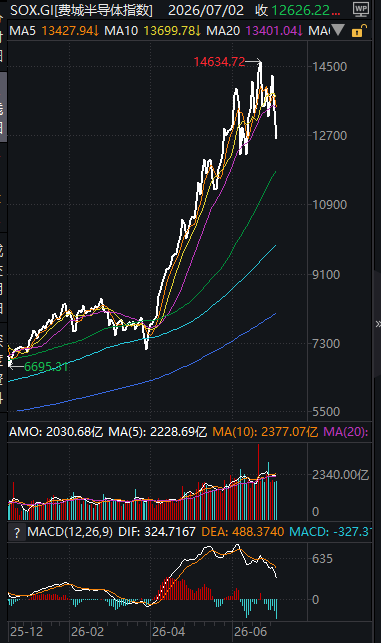
Micron Technology's better-than-expected sales forecast last month failed to sustain a rally in chip stocks, further confirming the sector's fading momentum. Investors are now awaiting insights from companies like Nvidia for more clues on AI chip demand.

Wilson points out that momentum is breaking down among the larger, heavily weighted companies within the index, which will likely keep major U.S. benchmarks under pressure in the near term. The S&P 500 Index has been gradually retreating since peaking in early June.

Hyperscale Giants: Value Picks in the AI Ecosystem

Wilson stated a recent preference for hyperscale giants over semiconductor-related stocks. He finds companies like Microsoft, Amazon, and Meta attractive within the AI ecosystem, citing their strong underlying core businesses as a solid foundation.

In contrast, according to Bloomberg data, a basket of hyperscale giants compiled by UBS Group has fallen 2% since last September, presenting a stark contrast to the gains in the semiconductor sector and suggesting relative catch-up potential for this group.

However, Wilson also anticipates that hyperscale giants may begin to temper expectations for their capital expenditure plans in response to recent market concerns over excessive AI investment. Capital expenditure outlooks are set to become a core focus for investors in the next phase.

Rotation Broadens, Opportunities Beyond Tech Emerge

Wilson's rotation thesis is not limited to the hyperscale sector. He also sees potential beneficiaries from the outflow of chip capital in consumer discretionary, transportation, and biotech sectors.

JPMorgan strategist Mislav Matejka agrees with Wilson, expecting market gains to extend beyond the technology sector in the second half of the year. "AI is unlikely to be the only story in the market," Matejka wrote in a research note.

It is worth noting that Wilson previously correctly predicted that U.S. equities would remain resilient amid geopolitical risks, supported by strong corporate earnings, which adds a degree of reference value to his current assessment. His year-end S&P 500 target of 8000 points implies roughly 7% potential upside from current levels, but short-term volatility risks should not be ignored.


Trending Cryptos

Related Questions

QAccording to Morgan Stanley's Michael Wilson, where are investors shifting their funds from the semiconductor sector to?

AInvestors are shifting funds from the semiconductor sector to AI hyperscale cloud computing giants, specifically naming Microsoft, Amazon, and Meta.

QWhat does the recent performance of the Philadelphia Semiconductor Index suggest about the chip sector, according to the article?

AThe Philadelphia Semiconductor Index has fallen nearly 14% since hitting a record high last month, indicating that the momentum in the semiconductor sector is fading and concerns about valuation bubbles are rising.

QWhy does Wilson find hyperscale AI giants like Microsoft, Amazon, and Meta attractive now?

AWilson finds them attractive because they are positioned well within the AI ecosystem and, crucially, their strong core businesses provide a solid foundation for support.

QBesides hyperscale giants, which other sectors does Michael Wilson believe could benefit from the rotation away from chip stocks?

AWilson believes the consumer discretionary, transportation, and biotechnology sectors could benefit from the funds rotating out of chip stocks.

QWhat is Michael Wilson's year-end target for the S&P 500 and what does it imply for potential gains?

AMichael Wilson maintains a year-end target of 8000 for the S&P 500, which implies a potential gain of approximately 7% from the current level.

Related Reads

Q-Day Countdown: Will Quantum Computing End Cryptocurrencies?

Quantum Computing's Threat to Cryptocurrency: A Countdown to Q-Day Quantum computing, specifically Shor's algorithm, poses a fundamental threat to the public-key cryptography (e.g., ECDSA, RSA) that secures blockchain networks like Bitcoin and Ethereum. This critical juncture, known as Q-Day, is estimated to occur potentially within the next 5-15 years. The core vulnerability stems from the public and immutable nature of blockchains. Assets in addresses where the public key is already exposed on-chain (e.g., spent outputs) are at direct risk, as a sufficiently powerful quantum computer could derive the private key. This threatens the very trust model of cryptocurrencies. The response lies in Post-Quantum Cryptography (PQC)—algorithms like lattice-based ML-DSA and hash-based SLH-DSA, which are resistant to quantum attacks. NIST has standardized key PQC algorithms (FIPS 203, 204, 205), providing a migration path. However, the primary challenge is not technical but socio-economic and involves complex governance: * **Bitcoin's** path is constrained by its conservative ethos. Migrating requires a soft-fork to new address types, facing hurdles like significantly larger signature sizes and, most critically, the divisive governance question of how to handle at-risk legacy UTXOs without violating core principles. * **Ethereum** is pursuing a "cryptographic agility" strategy, with a multi-layered roadmap. It leverages account abstraction for user accounts and is developing compressed hash-based signatures (e.g., leanXMSS) for its consensus layer, aiming for a full-stack upgrade over time. In conclusion, quantum computing does not spell an instant end for cryptocurrency but initiates a critical countdown. The industry has a limited "engineering comfort window" to orchestrate a coordinated, ecosystem-wide migration to PQC. The ultimate bottlenecks are the immense coordination efforts and governance decisions required for this foundational transition.

marsbit15m ago

Q-Day Countdown: Will Quantum Computing End Cryptocurrencies?

marsbit15m ago

Trump, the President Who Knows Best How to 'Trade Stocks'

Former US President Donald Trump reported a record-breaking $2.2 billion in personal income for 2025, the highest annual income ever disclosed by a sitting president. This figure, from a 927-page government ethics filing, represented a 3.5-fold increase from his $600 million income in 2024 and boosted his net worth to $6.5 billion. The primary drivers were cryptocurrency (64% of income, approximately $1.4 billion) and real estate (26%, approximately $575 million). His crypto earnings stemmed largely from the launch of his personal meme coin, $TRUMP, generating over $600 million in licensing fees, and substantial profits from the WLFI token and its parent company. Despite a sluggish property market, his Mar-a-Lago resort and associated golf clubs saw revenue surges of 50% and 27%, respectively, attributed to their use as venues for presidential events. Trump's financial disclosure also revealed an unprecedented level of stock market activity, with over 22,000 trades executed in 2025, averaging 87 trades per market day. Media analyses noted several instances where significant trading coincided with major policy announcements, such as proposed tariffs, raising questions about potential conflicts of interest. While the White House stated these trades were handled by a family-managed trust fund and not Trump directly, critics highlighted this as a departure from the blind trusts traditionally used by presidents post-Watergate. The report has intensified debate over the commercialization of the presidency. Supporters view it as a success story of a businessman-president, while critics argue it demonstrates an unprecedented conversion of public influence into private wealth, with policy decisions potentially linked to personal financial gains. The controversy centers on whether Trump's earnings represent innovative entrepreneurship or a fundamental conflict of interest, sparking renewed calls for stricter ethics reforms in US governance.

marsbit24m ago

Trump, the President Who Knows Best How to 'Trade Stocks'

marsbit24m ago

Countdown to Q-Day: Will Quantum Computing End Cryptocurrencies?

The article explores the existential threat quantum computing poses to cryptocurrencies and the urgent need for "post-quantum" migration. It outlines that quantum computers, through Shor's algorithm, could break the elliptic-curve cryptography (ECC) underlying blockchain security, potentially allowing private keys to be derived from public keys. The core challenge is not a lack of post-quantum cryptography (PQC) standards—like NIST's ML-KEM and ML-DSA—but the immense complexity of upgrading entire ecosystems before "Q-Day" (when quantum computers become capable of such attacks, estimated around 2035-2045). Key points include: * **Bitcoin's** risk is concentrated in legacy UTXOs with exposed public keys (e.g., early P2PK outputs). Migration faces massive hurdles: PQC signatures are much larger, increasing transaction size and cost, and the governance dilemma of handling un-migrated assets threatens its "code is law" ethos. * **Ethereum's** strategy focuses on "cryptographic agility," using Account Abstraction for user accounts and developing compressed hash-based signatures (like leanXMSS with SNARK aggregation) for consensus. Its migration is a complex, full-stack overhaul of execution, consensus, and data layers. * The "security debt" is enormous. The comfortable engineering window for a coordinated, ecosystem-wide upgrade is only 5-8 years. High-value infrastructure (exchanges, bridges) may face pressure before mainnet protocols. In conclusion, quantum computing is not an instant "doomsday" event but a forcing function for systemic change. Bitcoin's ultimate test is social consensus and property rights governance, while Ethereum's is technical complexity. Failure to migrate in time could lead to a fundamental re-pricing of crypto assets.

链捕手28m ago

Countdown to Q-Day: Will Quantum Computing End Cryptocurrencies?

链捕手28m ago

Losing $55 Million to Sell Bitcoin, MicroStrategy's Faith Reaches Its Interest Payment Day

On July 6th, Michael Saylor's MicroStrategy announced the sale of 3,588 BTC for approximately $216 million, incurring a realized loss of around $55.45 million compared to its average cost basis. This move, contradicting Saylor's long-standing "never sell" Bitcoin philosophy, was executed to pay dividends on its digital credit securities. The article traces this shift from a small "desensitization test" sale of 32 BTC in late May to the board's authorization on June 30th to sell up to $1.25 billion in Bitcoin for corporate purposes like dividends and buybacks. Analysis reveals that MicroStrategy's previous growth "flywheel"—using stock premiums to fund more Bitcoin purchases—has stalled. With its stock trading near a critical threshold (1.22x its Bitcoin NAV), issuing new shares would dilute value. Simultaneously, its financing channels (preferred stock, common stock ATM, convertible notes) are constrained while facing rigid annual dividend/interest obligations of roughly $1.76 billion. Consequently, selling Bitcoin became the calculated "optimal solution" under its own financial model. This transforms MicroStrategy from crypto's most prominent steady buyer into a predictable seller, creating a potential overhead of ~2,400 BTC in monthly selling pressure if obligations are fully covered by sales. This shift challenges the valuation models of the entire Digital Asset Treasury (DAT) sector that emulated MicroStrategy. The company's path forward now hinges on Bitcoin's price recovery, which would allow its preferred stock to trade at par and reopen its financing flywheel, creating a cyclical dependency between the firm's financial model and the asset it holds.

链捕手57m ago

Losing $55 Million to Sell Bitcoin, MicroStrategy's Faith Reaches Its Interest Payment Day

链捕手57m ago

Trading

Spot

Hot Articles

Discussions

Welcome to the HTX Community. Here, you can stay informed about the latest platform developments and gain access to professional market insights. Users' opinions on the price of S (S) are presented below.

活动图片