UK’s tokenization roadmap aims to generate $44.15B annually by 2035

ambcryptoPublished on 2026-07-15Last updated on 2026-07-15

Abstract

The UK government has unveiled a roadmap for tokenized finance, projecting an annual economic output of $44.15 billion from the sector by 2035. A key initiative is the planned issuance of a government bond in Q1 2027. A task force of approximately 54 major firms, including BlackRock, Goldman Sachs, JPMorgan, Coinbase, and Ripple, has been established to develop live use cases. However, some institutions like Barclays and PwC offer a more cautious projection of around $29.45 billion for the same period. In related developments, Airbnb CEO Brian Chesky hinted at the potential for tokenizing real-world assets, acknowledging the transformative potential for liquid ownership, faster settlements, and 24/7 global markets. However, he expressed skepticism, emphasizing that widespread trust, not just advanced technology, will determine the success of any tokenization model. The broader tokenization sector is experiencing significant growth. Data from Token Terminal shows the total tokenized asset market cap has reached a new peak of approximately $340 billion, led by stablecoins. The involvement of major governments, financial institutions, and global companies is making ambitious market projections appear increasingly feasible.

The tokenization sector is gaining pace, with the UK government being the latest to announce its entry.

The UK has released a tokenized finance roadmap with the first government bond issuance set for the first quarter (Q1) of 2027. They projected $44.15 billion in annual economic output by 2035.

In line with this roadmap, about 54 firms, including BlackRock, Goldman Sachs, JP Morgan, Morgan Stanley, Coinbase, Ripple, and Circle, have joined the UK government’s tokenization task force to develop live use cases.

However, Barclays and PwC were cautious, projecting about $29.45 billion for the same period. This is assuming the UK becomes the leading hub as the U.S. and the rest of Europe adopt in parallel.

Airbnb CEO hints at tokenization but remains skeptical

Notably, global companies like Airbnb appear to be embracing the same. This development is after CEO Vlad Tenev confirmed Robinhood’s long-term focus for its chain was tokenizing real-world assets (RWAs).

The CEO of Airbnb hinted at tokenizing the business but was skeptical in his words. Brian Chesky said,

I’ve been quietly keeping an eye on real-world asset tokenization for a while now. Most of it is noise. But underneath the noise, something real is happening.

He stressed that the tokens and the chains were not the interesting part but the ownership bit. Chesky also pointed out the speeds in settlement, 24/7 markets, and access with no boundaries. Brian added,

The internet made information liquid. This makes ownership liquid. This is just the beginning.

However, he remained skeptical of the technology, citing trust issues. He argued that the winning token won’t be the most advanced but the one trusted by the majority.

That said, how will all these affect the tokenization sector?

What does it mean for the tokenization sector?

As per Token Terminal, the total tokenized asset market cap had reached a new peak of about $340 billion. Stablecoins led with $295.9 billion, followed by tokenized funds at $34.6 billion.

The number of holders of tokenized assets was also rising, at 283.1 million at press time across 47 blockchains. The total number of assets was 5,143 from 319 issuers.
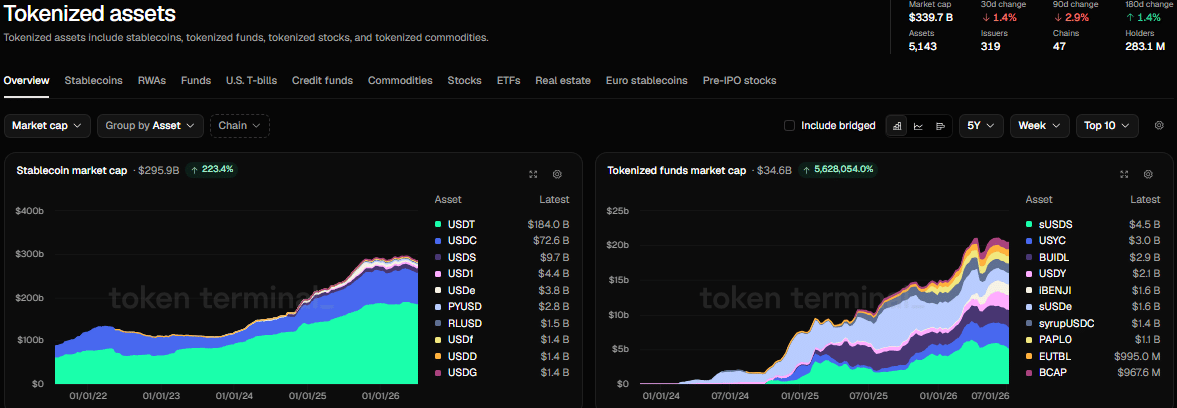
Source: Token Terminal

Securitize was leading this race among issuers with a total RWA value surpassing $5 billion, the first tokenization platform to reach this milestone.

Altogether, the involvement of the UK government alongside major banking institutions, crypto firms like Robinhood and Coinbase, and businesses like Airbnb makes the projections more feasible.


Final Summary

  • The UK government released a tokenized finance roadmap with about 54 firms joining the task force to actualize it.
  • Airbnb CEO hints at tokenizing but remains skeptical even as the total tokenized market cap continues to grow.


Trending Cryptos

Related Questions

QWhat is the UK government's annual economic output projection from tokenization by 2035, as per its roadmap?

AThe UK government projects $44.15 billion in annual economic output from tokenization by 2035.

QWhich two firms gave a more cautious projection for the UK tokenization market by 2035, and what was their figure?

ABarclays and PwC gave a more cautious projection of about $29.45 billion for the UK tokenization market by 2035.

QWhat did Airbnb CEO Brian Chesky identify as the truly interesting part of asset tokenization, beyond the tokens and chains?

ABrian Chesky identified the ownership aspect as the truly interesting part of asset tokenization, highlighting the potential for liquid ownership, faster settlement, 24/7 markets, and borderless access.

QAccording to Token Terminal data, what was the total market cap of tokenized assets and which category led it?

AAccording to Token Terminal, the total market cap of tokenized assets reached about $340 billion, with stablecoins leading at $295.9 billion.

QWhich tokenization platform was the first to reach a total RWA value surpassing $5 billion?

ASecuritize was the first tokenization platform to reach a total Real-World Asset (RWA) value surpassing $5 billion.

Related Reads

Nobel Laureate Hassabis Shocks with Statement: AGI Impact Will Be 10 Times That of the Industrial Revolution

Nobel laureate and DeepMind CEO Demis Hassabis declares that Artificial General Intelligence (AGI), matching human cognitive abilities, is likely just a few years away. He states its impact could be ten times greater than the Industrial Revolution and unfold ten times faster, heralding an age of unprecedented abundance where resource scarcity may end. AGI promises transformative benefits, accelerating breakthroughs in medicine, clean energy, and advanced materials. However, its rapid development, driven by intense commercial and geopolitical competition, outpaces our understanding and increases risks in cybersecurity, bio-threats, and controlling autonomous, self-improving systems. To manage this, Hassabis proposes a U.S.-led framework: a new "Frontier AI Standards Body," modeled after organizations like FINRA. It would define "frontier-class" models through dynamic benchmarks. Labs creating such models would voluntarily submit them for a 30-day pre-release review, later formalized into mandatory assessments. This body would conduct rigorous evaluations on security and safety, update tests regularly, and, if necessary, coordinate a global slowdown in development. While technical challenges are surmountable, Hassabis emphasizes that profound economic and philosophical questions about post-scarcity societies, human values, and purpose remain. He concludes that responsibly navigating AGI's arrival is our defining task, offering a chance to shape a future of immense scientific progress and human flourishing.

marsbit19m ago

Nobel Laureate Hassabis Shocks with Statement: AGI Impact Will Be 10 Times That of the Industrial Revolution

marsbit19m ago

GPT-5.6 Sol Suddenly Gets Dumber Overnight? Thinking Budget Slashed from 960 to 128, No More Fixed-Intelligence Models?

The article discusses widespread user reports that OpenAI's GPT-5.6 Sol model, specifically its "Max" reasoning tier, has become less capable at complex, deep reasoning tasks. Users noted faster but shallower responses. Community investigation revealed an unpublicized internal parameter called "juice value," representing computational budget for reasoning. Observations indicated this value for the Max tier dropped dramatically from 960 to 128. In response, OpenAI's Thibault Sottiaux stated there was no intentional reduction in model capability ("nerf"). He explained the changes were part of an experiment to investigate unexpected high token usage following GPT-5.6's launch, which introduced features like longer reasoning and larger context windows. The experiment temporarily adjusted the "juice" parameter and rolled back the context window from 372k to 272k tokens to diagnose the usage spike. Sottiaux asserted these settings have been reverted and highlighted ongoing optimizations. The controversy highlights a tension between AI as a reliable, fixed-capability tool and its reality as a cloud service where providers can adjust performance parameters. The article argues that for AI to be trusted enterprise infrastructure, providers need clearer, transparent guarantees about the specific performance boundaries associated with service tiers.

marsbit24m ago

GPT-5.6 Sol Suddenly Gets Dumber Overnight? Thinking Budget Slashed from 960 to 128, No More Fixed-Intelligence Models?

marsbit24m ago

Trading

Spot

Hot Articles

Discussions

Welcome to the HTX Community. Here, you can stay informed about the latest platform developments and gain access to professional market insights. Users' opinions on the price of S (S) are presented below.

活动图片