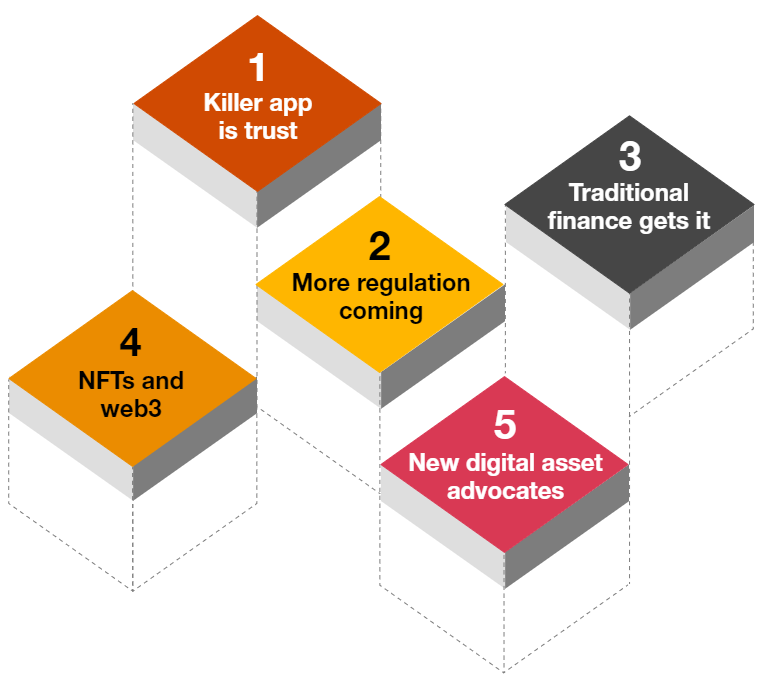
What’s next for cryptocurrency, non-fungible tokens (NFTs) and digital assets more broadly? In light of the turbulence that has hammered markets and the scandals that have humbled once well-regarded companies, it’s more critical than ever for business leaders to have insight into opportunities and risks. To help provide this insight, we offer five business predictions, based on our experience with clients, our alliances with industry leaders and the innovation in our own labs.
The big takeaway is: We have been here before. Disruptive new technologies often pass through a cycle of speculative excess — but after the dust settles, businesses will likely transform and world-beating companies will emerge. Similarly, we expect digital assets (which we define as any asset minted and exchanged on a blockchain) to eventually reinvent much of the digital and physical economy. But much uncertainty remains. Our predictions are designed to help business leaders craft the strategy that this promising but volatile space requires — one that matches innovation with trust.
2023 digital asset predictions

1. Trust will be the new killer app
Crypto winter’s hit to asset prices and the fall of certain large crypto natives (due to both fraud and unsound business models) have undermined what every financial system depends on: trust. Until trust is re-established, digital assets will likely fail to reach their full potential and won’t offer value to most businesses. After all, if every few years a major supporting institution fails, most companies and consumers won’t choose to use digital assets at scale or the underlying technology.
In these more sober times, we predict that market success will likely come to those companies that build trust in digital assets. They may, for example, make “self-custody” both convenient and safe by offering users the demonstrable, verified ability to secure their own digital assets and keys. Or they may simply offer safe, secure, quality “hosted” custody. Other companies may help build trust by providing third-party validation of service providers. Even though many institutions are starting to show proof of reserves and making other basic disclosures, trust may require companies to go further by providing third-party validation of solvency, assets and liabilities, and controls.
What to do next
Trust in digital assets starts with risk management, both for your own operations and those of vendors and counterparties. If your company is a digital asset native, you may wish to take some guidance from the traditional (non blockchain-based) financial world: apply leading practices that cover controls, security, governance and transparency. If you’re a traditional company, it’s important to understand and mitigate digital assets’ specific risks. These range from new kinds of fraud to challenges posed by complex and sometimes opaque technology. Crypto natives and traditional companies both may wish to consider whether an independent audit can help confirm assets and liquidity, as well as the adequacy of risk management controls and procedures.

2. We’ll see more regulation — but not a complete framework
Digital assets need thoughtful regulations — after the recent turbulence, there’s little doubt about that. But policymakers should get the balance of regulations right. That will require carefully assessing the technology’s inadequacies: what actually went wrong and where regulations fell short. Policymakers can then consider where and how existing rules could be applied more effectively and understand those highly specific areas where new rules can enhance trust without overcompensating and halting innovation in its tracks.
We expect to see advances in regulations this year, especially around definitions such as which digital assets are commodities and which are securities. With these definitions in place, it can help become more straightforward to apply existing regulations and reduce some of the necessity for new ones. We also expect to see regulatory progress around stablecoins, since both domestic and global regulators have been studying stablecoins closely. We may also see regulators move aggressively to limit certain risky lending practices (such as taking out loans on collateral received) that helped cause the collapse of several major digital asset companies.
Since digital assets have increasingly become a bipartisan issue in the US, we may see legislation advance on these areas, as well as on disclosures and updates on tax guidance. Various jurisdictions in Europe and the OECD (among others) are also making progress. But given the complexity, we expect most legislation and agency rulemaking to likely remain incomplete for some time to come. Given the borderless nature of digital assets, it will also be important (and complicated) for multiple jurisdictions and government agencies to collaborate. We expect that we’ll get there, eventually, with a clear, comprehensive and global regulatory framework for digital assets. But this process isn't expected to be complete by the end of 2023.
What to do next
In the face of regulatory uncertainty — and piecemeal regulations from various agencies and territories — both digital asset service natives and traditional companies should keep a close eye on developments. Know which regulators (including regulators in foreign countries) may be supervising current or future activities. Pay attention to how rule-making is evolving in theory and how enforcement is occurring in practice. Given how many rules are currently under discussions, you may also want to engage with authorities to help shape future regulations. Finally, include regulatory uncertainty in your risk management framework, both for ongoing and potential digital asset initiatives.

3. Traditional finance will get it right
One common dream among early crypto maximalists was to make traditional financial institutions (FIs) obsolete. We believe that is an unrealistic dream. While there will be a set of highly successful startups, we also predict that a few forward-looking legacy financial institutions will likely be among the real winners of the digital asset space. They’ll both master the underlying technology and complement it with their risk management skills, client relationships and powerful brands. Many customers, discouraged by recent market conditions, may even demand the presence of these trusted, blue-chip names before entering the digital asset space.
This prediction may seem surprising, given the pessimism right now. But many legacy FIs understand that the underlying technology is powerful and that some digital asset natives managed to make many financial services speedier and more cost-effective. Many understand too that crypto winter didn’t result from technology flaws, but from human failures such as fraud and they have deep experience in preventing and minimizing such failures. With crypto winter leading to a wave of consolidation, many established institutions will likely find opportunities to snap up technologies, talent or whole companies as they build out independent digital asset capabilities.
What to do next
For traditional FIs initiating or accelerating digital asset activities, the foundation is a digital asset strategy, which starts with custody. Consider carefully choosing your target exposure and risk tolerance in this space, then establishing guardrails (including controls and oversight, with a special focus on liquidity) to help keep within those limits. Remember too that crypto natives often have real advantages not just in technology, but in speedy, cost-effective processes — which you can learn from even as you add controls, governance and other risk management procedures.
For crypto natives, now may be the time to learn from the competition: Many legacy FIs have the tools and processes to help innovation scale safely. These tools include counterparty and concentration measurement and risk management, both at the legal entity level as well as the enterprise level.

4. NFTs and web3 will increasingly be everywhere — and invisible
Both the highs and lows that NFTs have recently experienced had the same root cause: too much focus on the asset value, which led to rampant speculation. There was too little focus on how these tokens, which can securely represent unique physical or digital objects (including intellectual property), have the potential to provide real business utility. NFTs can, for example, drive revenue, deepen customer engagement and improve business processes. We predict that this imbalance can be corrected. NFTs will likely become seamless, invisible parts of business processes.
The spread of NFTs will be linked, we believe, to the growth of web3. Web3 is about ownership of one's assets, facilitated by blockchain, which can ensure that digital items (such as NFTs) are authentic and easily transferable. Web3 also introduces ways to compensate individuals for their time, data and input while permitting them to keep control of their data and assets. Your customers may be able, for example, to choose how much data to share with you, in exchange for clear, sustainable compensation. They’ll be able to take that data and compensation elsewhere if they choose. With web3, you can not only buy and sell digital assets (such as NFTs) much as you do physical ones (more easily and with fewer intermediaries). You can also better connect the digital and physical worlds. It becomes easier to sell, for example, NFTs that also give ownership over physical products.
As web3 advances, we expect that it can help NFTs become (somewhat like internet protocols) both everywhere and invisible. Your company and customers will increasingly be using and exchanging data and digital assets as part of everyday operations and transactions. But most of the people involved will likely never need to stop and think that it’s web3 tech and NFTs that are helping ensure authenticity, security and intellectual property rights.
What to do next
A sustainable strategy for both NFTs and web3 starts with identifying concrete, measurable business outcomes that these technologies can support. These outcomes can either be part of a larger organizational strategy, or nearer-term deliverables, such as sales or customer engagement. You may also wish to consider how governance, cybersecurity, compliance and oversight will work, both for digital assets and your operations more broadly, in web3’s more decentralized digital world. It will likely lack, for example, many of the gatekeepers that create a certain level of control today.

5. Meet the new digital asset advocates: merchants, social media and telcos
We expect the next wave of digital asset adoption to be driven by actors with their feet firmly on the ground. Examples include merchants looking to cut their transaction costs, social media companies looking for new lines of business and new ways to maintain interest in their platforms, and other consumer-facing companies seeking to drive consumer engagement and play larger roles in digital identity and the digital economy more broadly.
Some social media companies, for example, could be well placed to become payment platforms that process cryptocurrency and serve as an “on-ramp” for digital assets more broadly. That could help them establish their importance for years to come and boost growth among younger consumers. A social media platform that offers its users, for example, a secure identity token — helping people fully own their digital identity as a kind of asset — could become central to the digital asset ecosystem, and to the metaverse and web3 more broadly. Other companies may make similar calculations. We have also seen, for example, telecom companies explore (and sometimes already launch) blockchain wallets for cryptocurrency and NFTs.
It will be such companies, we expect, who will likely drive digital assets’ eventual recovery — and this recovery will likely not come from speculation on asset values, but from the rise of practical use cases and carefully constructed business plans. Yet, the pace of this recovery will likely depend on the overall health of the global economy. Many companies may choose to wait until the economic outlook is rosier before investing in new consumer-facing lines of business.
What to do next
If your company is in a consumer-facing sector, you may consider how digital assets can support your business model by driving engagement or revenue. If you are a digital assets service provider, it may be a good time to broaden your perspectives about the companies you could be providing services to or partnering with. All companies may need to reconsider data and digital identity strategies. The eventual spread of digital assets — which can provide owners greater control over identities and data — may make existing strategies for gathering and monetizing data obsolete.