The collapse of the now-bankrupt cryptocurrency exchange FTX has raised many concerns over unregulated centralized platforms.
Investors are now coming to question how safe it is to keep one’s funds on these exchanges and have voiced grave concerns about centralized decision-making without any checks.
FTX held one billion in a customer’s fund and was found to be using the customer-deposited crypto assets to mitigate its own business losses.
Furthermore, a recent report suggests that the downfall of numerous crypto exchanges over the last decade has permanently taken 1.2 million Bitcoin (BTC) — almost 6% of all Bitcoin — out of circulation.
The revelation of unethical practices by FTX in its bankruptcy filing has set a panic among investors who are already losing trust in these centralized trading firms. Exchange outflows hit historic highs of 106,000 BTC per month in the wake of the FTX fiasco and the loss of trust in centralized exchanges (CEXs) has pushed investors toward self-custody and decentralized finance (DeFi) platforms.
Users have pulled money from crypto exchanges and turned to noncustodial options to trade funds. Uniswap, one of the largest decentralized exchanges (DEX) in the ecosystem registered a significant spike in trading volume on Nov. 11, the day FTX filed for bankruptcy.

With FTX’s implosion acting as a catalyst, DEX trading has seen a notable increase in volume. Just last week, Uniswap registered over a billion dollars in 24-hour trading volume, much higher than many centralized exchanges in the same time frame.
Aishwary Gupta, DeFi chief of staff at Polygon, told Cointelegraph that the failure of centralized entities like FTX has definitely reminded users about the importance of DeFi:
“DeFi-centric platforms simply cannot fall victim to shady business practices because ‘code is law’ for them. Clearly, users realize it as well. In the wake of the FTX implosion, Uniswap flipped Coinbase to become the second-largest platform for trading Ethereum after Binance. As decentralized platforms are run by auditable and transparent smart contracts instead of people, there is simply no way for corruption or mismanagement to enter the equation.”
According to data from Token Terminal, the daily trading volume of perpetual exchanges reached $5 billion, which is the highest daily trading volume since the Terra meltdown in May 2022.
Cointelegraph reached out to PalmSwap, a decentralized perpetual exchange, to understand investor behavior in the wake of the FTX crisis and how it has impacted their platform in particular. Bernd Stöckl, chief product officer and co-founder of Palmswap, told Cointelegraph that the exchange has seen a significant bump in trading volumes.
“The usage of DeFi will surely rise thanks to the FTX downfall. It is said that Crypto.com, Gate.io, Gemini and some other centralized exchanges are in hot waters,” he said, adding, “With so many CEXs falling, trust in custodial wallets is very low and the advantages of DeFi will surely be adopted by more users.”
Elie Azzi, co-founder and DeFi infrastructure provider VALK, believes the increase in DEX volumes could be the beginning of a longer-term trend, given a general reluctance from traders to trust CEXs with their assets. He told Cointelegraph:
“DEXs are innovating at a much faster rate than their counterparts, with execution and settlement times becoming almost instantaneous on certain chains. The trend is that DEXs are developing the usability and UI of CEXs, whilst improving on the logic in the back end. Combined with the unique features that DEXs bring, including self-custody, the ability to trade from one’s own wallet and retain control of private keys.”
He added that CEX platforms might see more stringent controls and transparency initiatives, but this “transparency would exist prima facie in full DeFi. Rather, no one would need to trust CEXs with assets, and any activity, be it trading, liquidity provision or else would be recorded in real-time on-chain.”
DeFi’s struggle with targeted hacks
While DeFi protocols have seen a significant bump in the aftermath of centralized exchange failures, the nascent ecosystem itself has been a prime target for hackers in 2022.
According to data from crypto analytics group Chainalysis, nearly 97% of all cryptocurrency stolen in the first three months of 2022 has been taken from DeFi protocols, up from 72% in 2021 and just 30% in 2020.
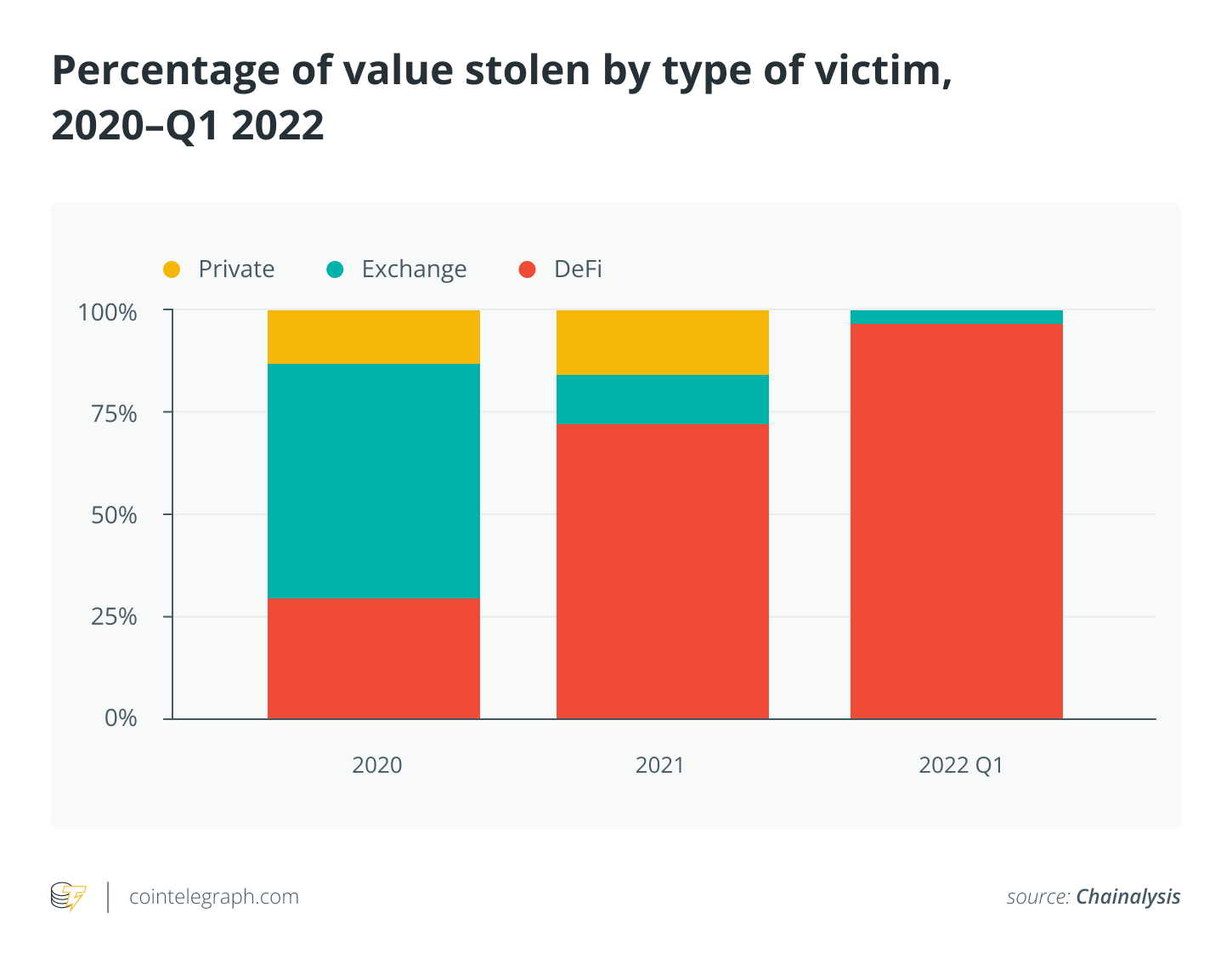
Some of the biggest DeFi exploits of 2022 include the Ronin network exploit in March that resulted in a loss of $620 million worth of funds. The Wormhole bridge hack lost $320 million and the Nomad bridge was compromised for $190 million. In October alone, $718 million worth of crypto assets were stolen from 11 different DeFi protocols.
A majority of the hacks in the DeFi ecosystem have occurred on cross-chain bridges, which Jordan Kruger, CEO and co-founder at DeFi staking protocol Vesper Finance, believes shouldn’t be considered as DeFi exploits.
“A substantial proportion of those exploits (approx. $3 billion this year) have been bridge attacks. Bridges aren’t ‘DeFi’ so much as infrastructure. CEX losses dwarf this number by an order of magnitude. That said, DeFi will improve and become more secure faster than its centralized counterparts because of its ability to iterate faster. This is similar to the way Linux greatly benefitted from an open-source approach and has achieved a strong reputation for security and phenomenal adoption,” she told Cointelegraph.
DeFi is built on the ethos of true decentralization and the decision-making process is often automated via the use of smart contracts. While DeFi does try to eliminate human intervention, vulnerabilities still crop up via different mediums, be it poor coding of smart contracts or breaches of sensitive data.
Lang Mei, CEO of AirDAO, told Cointelegraph that nascent DeFi tech is prone to some bugs and issues but one must remember that the majority of hacks “have been related to either lending or cross-chain bridging, it can be immensely challenging to prevent vulnerabilities in technology which is both radically new and often has a highly-accelerated development schedule due to competition.”
He suggested additional measures that can be taken by developers to minimize the likelihood of exploitable code in their decentralized apps such as “White hat hacking, bug bounty programs, and testnet incentivization are all valuable tools to help identify and correct mistakes. They can also be used to attract and engage users, so it’s essentially a win-win from a team perspective. Decentralization of governance power is also important through the distribution of token supply and safeguards such as multi-signature wallets.”
Till Wendler, co-founder of community-owned DApp ecosystem Peaq, told Cointelegraph that it’s hard to eliminate human-related flaws in smart contacts and design.
“Most thorough smart contract security audit only gets you so far — some exploits result from the way smart contracts interact between themselves in the wider ecosystem, not just from their intrinsic design flaws,” he said, stating, “That said, the DeFi space is definitely now in a better shape than it used to be, and it’s working out its own best security practices on the go, growing more and more reliable by the hour."
Mitchell Amador, CEO at bug bounty protocol Immunefi, told Cointelegraph that DeFi can take help from progression in the security department:
“There’s a huge explosion of security tech being quietly built in the background to tackle the security problem from all angles.”
“Over time, given innovations in UX and security as well as DeFi’s inherent features of transparency, DeFi could permanently overtake centralized platforms, but this dynamic also depends on the wild card of regulations," Amador added.
The collapse of centralized platforms in 2022 and the subsequent rise of noncustodial and DeFi services in its wake is surely a sign of changing times. However, according to many in the crypto space, the most crucial factor in the FTX saga was a lack of understanding and due diligence from the crypto investors.
Myriad crypto pundits have been advocating for self-custody and the use of the decentralized platform for quite some time now. Barney Chambers, the co-founder of the Umbria Network, told Cointelegraph:
“The cryptocurrency space continues to be the wild, wild west of finance. Here are a few pointers to ensure funds are safe: Never connect your wallet to a website you don’t trust, hold your keys in a trusted place such as a hardware wallet, never trust anonymous strangers on the internet when asking for help, and always [do your own research]!”
At present, the only way investors can ensure that their funds are protected is to demand the parties they are investing in to provide transparent and clear information on all accounting and rely on noncustodial solutions in terms of both wallets and trading venues.
Darren Mayberry, ecosystem head at decentralized operating protocol dappOS, told Cointelegraph that noncustodial services should be the way forward for investors.
“Accountability and audits should be standard procedures for all investors, due diligence is a natural part of business, as is fact-checking and investigation. As for non-custodial wallets — they are the most reliable form of storage that transfers liability solely onto their owner and thus negates the possibility of counterparty risks,” he explained.
DeFi platforms might have their own set of vulnerabilities and risks, but industry observers believe that proper due diligence and reducing human error could make the nascent ecosystem of DEX platforms a go-to option over CEX platforms.