Bitcoin Price Recovery Remains Capped, Why 100 SMA Is The Key

newsbtcPublished on 2022-11-23Last updated on 2022-11-23

Abstract

Bitcoin price started an upside correction from $15,500. BTC is now facing a strong resistance near the $16,300 zone and the 100 hourly SMA.

Bitcoin price started an upside correction from $15,500. BTC is now facing a strong resistance near the $16,300 zone and the 100 hourly SMA.

Bitcoin found support near $15,500 and started an upside correction.

The price is trading below $16,300 and the 100 hourly simple moving average.

There is a crucial bearish trend line forming with resistance near $16,200 on the hourly chart of the BTC/USD pair (data feed from Kraken).

The pair could continue to rise if it clears the $16,300 level and the 100 hourly SMA.

Bitcoin Price Eyes Recovery

Bitcoin price extended its decline below the $16,000 support level. BTC even spiked below the $15,800 support level, but the bulls were active near the $15,500 level.

A low was formed near $15,470 and the price started an upside correction. There was a move above the $15,800 and $16,000 resistance levels. The bulls were able to push the price above the 50% Fib retracement level of the key decline from the $16,795 swing high to $15,470 low.

Bitcoin price is now trading below $16,300 and the 100 hourly simple moving average. There is also a crucial bearish trend line forming with resistance near $16,200 on the hourly chart of the BTC/USD pair.

On the upside, an immediate resistance is near the $16,200 level. The first major resistance is near the $16,300 zone and the 100 hourly simple moving average. It is close to the 61.8% Fib retracement level of the key decline from the $16,795 swing high to $15,470 low.
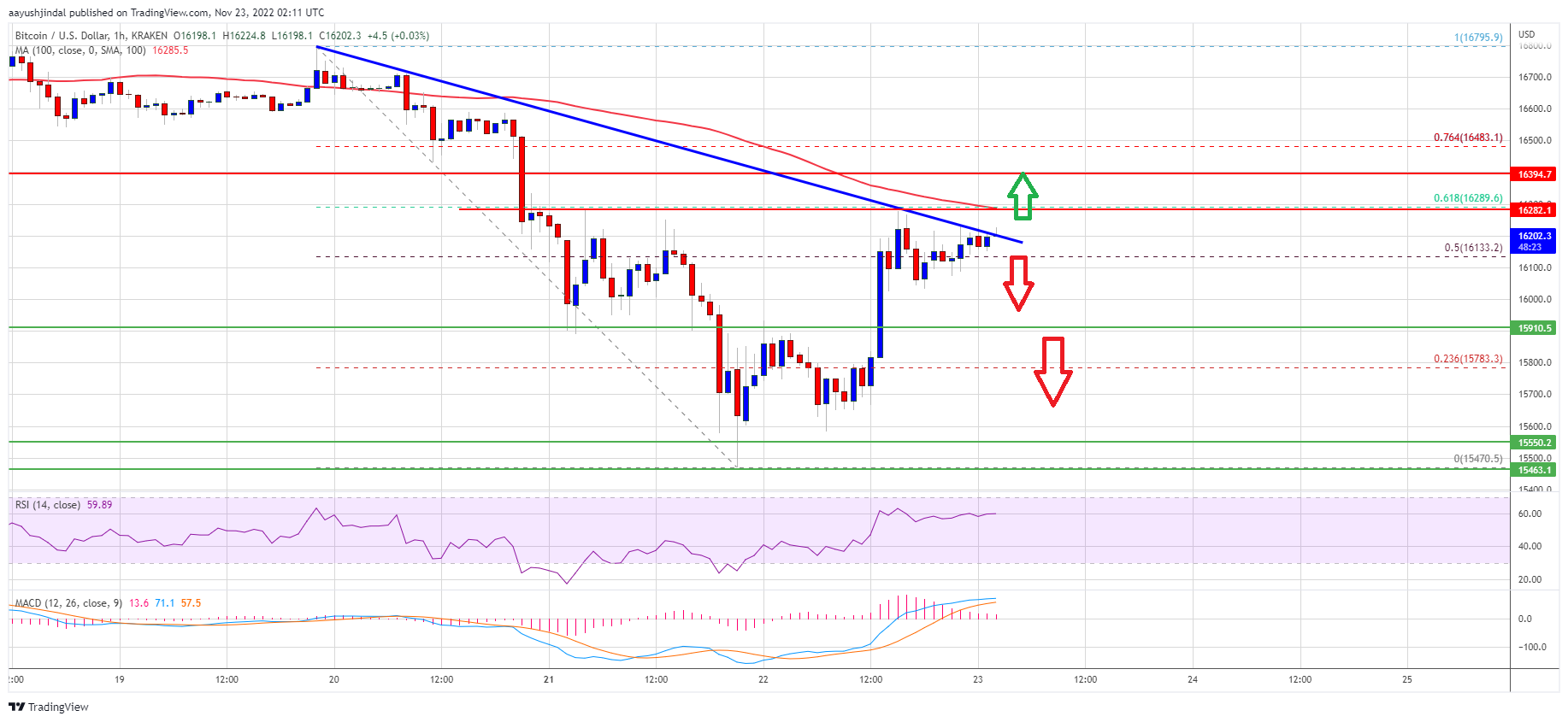
The price must clear the trend line resistance and then $16,300 to start a decent recovery wave. The next major resistance is near $16,500, above which the price could gain pace for a move towards the $17,000 zone.

Fresh Decline in BTC?

If bitcoin fails to recover above the $16,300 resistance zone, it could start another decline. An immediate support on the downside is near the $15,900 level.

The next major support is near the $15,550 zone, below which the price might even struggle to stay above $15,500. A clear move below the $15,500 support might send the price towards the $14,000 support zone.

Technical indicators:

Hourly MACD – The MACD is now losing pace in the bullish zone.

Hourly RSI (Relative Strength Index) – The RSI for BTC/USD is now above the 50 level.

Major Support Levels – $15,900, followed by $15,500.

Major Resistance Levels – $16,200, $16,300 and $17,000.

Trending Cryptos

Related Reads

When 8 Million ETH Start 'Moving': The Post-Pectra Era Ushers in a Structural Transformation for Staking?

A major shift is underway in Ethereum staking, as Lido begins migrating over 8 million ETH (worth ~$16B) from traditional validators to a new architecture enabled by the Pectra upgrade. This migration involves consolidating over 265,000 legacy validators (using 0x01 withdrawal credentials) into a smaller number of higher-balance "0x02" validators, potentially reducing the total validator count on Ethereum by nearly a third. The core driver is EIP-7251 from the Pectra upgrade, which introduced "compounding validators." These allow a single validator's effective balance to grow up to 2048 ETH, with staking rewards automatically reinvested to compound earnings. This contrasts with the old model, where rewards exceeding 32 ETH were automatically sent to a withdrawal address, creating idle funds and operational complexity for reinvestment. While the direct APR boost from compounding is modest—estimated at a ~4.7% relative improvement for smaller validators—the structural benefits are significant. For large operators like Lido, the primary value is operational efficiency: managing fewer validators reduces node, key management, and network message overhead. For smaller individual stakers, the upgrade lowers the barrier to reinvestment by eliminating the need to manually accumulate 32 ETH for new validators. The migration signifies a deeper change in Ethereum's staking landscape. Competition is evolving beyond simple yield, focusing instead on capital efficiency, liquidity management, risk distribution, and infrastructure optimization. Lido's parallel move to require node operator security deposits further highlights this shift towards more robust, capital-backed services. Ultimately, Pectra's compounding validators represent a key step in maturing Ethereum's staking lifecycle, moving the ecosystem from standardized yield products towards more sophisticated capital management and infrastructure solutions.

marsbit8m ago

When 8 Million ETH Start 'Moving': The Post-Pectra Era Ushers in a Structural Transformation for Staking?

marsbit8m ago

Double Long Hynix ETF Plummets, Halved and Halved Again

On July 29th, shares of South Korean semiconductor firm SK Hynix plummeted over 19% intraday, marking its largest single-day drop on record. The Hong Kong-listed "CSOP SK Hynix Daily Leveraged (2x) Product" (Stock Code: 07709) tumbled more than 28% intraday before closing 13.99% lower at HK$32.70. This leveraged product, designed to deliver twice the daily return of SK Hynix, has seen a catastrophic decline of over 80% from its June 25th high of HK$193.65, far exceeding the underlying stock's roughly 50% drop from its peak. Its assets under management have shrunk dramatically, falling over 70% from a high of HKD 130 billion in June to approximately HKD 31.9 billion. This steep sell-off occurred despite SK Hynix reporting stellar Q2 2026 earnings, with revenue and operating profit surging 257% and 557% year-over-year, respectively. However, the results fell short of market expectations. Analysts cited concerns about potential oversupply from expansion and noted that long-term supply agreements for its high-bandwidth memory (HBM) chips might limit near-term price increases. In response to heightened volatility and regulatory changes, the product's issuer, CSOP Asset Management, announced a transition to a "flexible leverage mechanism" starting August 3rd. Under new Hong Kong SFC rules, the fund's daily leverage multiplier can now be dynamically adjusted between 1.1x and 2x (or -1.1x to -2x for inverse products) based on market conditions, moving away from a fixed 2x target. The fund's name will also be changed to clarify its nature as a daily trading tool unsuitable for long-term holding. Experts warn that this change means investors can no longer assume constant 2x returns and must check the disclosed leverage ratio daily.

marsbit24m ago

Double Long Hynix ETF Plummets, Halved and Halved Again

marsbit24m ago

A7 Discusses Accumulated Experience in Using Stablecoins

The Russian State Duma and Federation Council have passed the "Law on Digital Currencies and Digital Rights," which is set to expand the use of stablecoins in cross-border trade settlements starting September 1, 2026. According to the Bank of Russia, exporters and importers will be able to use cryptocurrency in international payments, both directly and through intermediaries, while domestic crypto payments will remain largely prohibited. Company A7, which facilitates operations with the A7A5 stablecoin—Russia's first ruble-pegged stablecoin classified as a Digital Financial Asset (DFA)—commented on the development. Oleg Ogienko, Director of Government Relations and International Affairs for the A7A5 project, stated that while digital asset settlements are still a new practice for many firms, A7 has already accumulated significant expertise in legal documentation, compliance, currency control, and working with infrastructure participants. He added that A7 will continue to apply this expertise for client operations after the law takes effect and will adapt its business processes as the Central Bank issues further regulations. A7 is a Russian international settlement system established in 2024 with participation from PSB Bank. It facilitates cross-border payments and supports foreign trade operations for Russian businesses. Its key instrument, the A7A5 stablecoin, operates on the Tron and Ethereum networks with a market capitalization exceeding $567 million and is circulated in Russia as a DFA via the "Token" platform.

cryptonews.ru38m ago

A7 Discusses Accumulated Experience in Using Stablecoins

cryptonews.ru38m ago

Trading

Spot

Hot Articles

What is $BITCOIN

DIGITAL GOLD ($BITCOIN): A Comprehensive Analysis Introduction to DIGITAL GOLD ($BITCOIN) DIGITAL GOLD ($BITCOIN) is a blockchain-based project operating on the Solana network, which aims to combine the characteristics of traditional precious metals with the innovation of decentralized technologies. While it shares a name with Bitcoin, often referred to as “digital gold” due to its perception as a store of value, DIGITAL GOLD is a separate token designed to create a unique ecosystem within the Web3 landscape. Its goal is to position itself as a viable alternative digital asset, although specifics regarding its applications and functionalities are still developing. What is DIGITAL GOLD ($BITCOIN)? DIGITAL GOLD ($BITCOIN) is a cryptocurrency token explicitly designed for use on the Solana blockchain. In contrast to Bitcoin, which provides a widely recognized value storage role, this token appears to focus on broader applications and characteristics. Notable aspects include: Blockchain Infrastructure: The token is built on the Solana blockchain, known for its capacity to handle high-speed and low-cost transactions. Supply Dynamics: DIGITAL GOLD has a maximum supply capped at 100 quadrillion tokens (100P $BITCOIN), although details regarding its circulating supply are currently undisclosed. Utility: While precise functionalities are not explicitly outlined, there are indications that the token could be utilized for various applications, potentially involving decentralized applications (dApps) or asset tokenization strategies. Who is the Creator of DIGITAL GOLD ($BITCOIN)? At present, the identity of the creators and development team behind DIGITAL GOLD ($BITCOIN) remains unknown. This situation is typical among many innovative projects within the blockchain space, particularly those aligning with decentralized finance and meme coin phenomena. While such anonymity may foster a community-driven culture, it intensifies concerns about governance and accountability. Who are the Investors of DIGITAL GOLD ($BITCOIN)? The available information indicates that DIGITAL GOLD ($BITCOIN) does not have any known institutional backers or prominent venture capital investments. The project seems to operate on a peer-to-peer model focused on community support and adoption rather than traditional funding routes. Its activity and liquidity are primarily situated on decentralized exchanges (DEXs), such as PumpSwap, rather than established centralized trading platforms, further highlighting its grassroots approach. How DIGITAL GOLD ($BITCOIN) Works The operational mechanics of DIGITAL GOLD ($BITCOIN) can be elaborated on based on its blockchain design and network attributes: Consensus Mechanism: By leveraging Solana’s unique proof-of-history (PoH) combined with a proof-of-stake (PoS) model, the project ensures efficient transaction validation contributing to the network's high performance. Tokenomics: While specific deflationary mechanisms have not been extensively detailed, the vast maximum token supply implies that it may cater to microtransactions or niche use cases that are still to be defined. Interoperability: There exists the potential for integration with Solana’s broader ecosystem, including various decentralized finance (DeFi) platforms. However, the details regarding specific integrations remain unspecified. Timeline of Key Events Here is a timeline that highlights significant milestones concerning DIGITAL GOLD ($BITCOIN): 2023: The initial deployment of the token occurs on the Solana blockchain, marked by its contract address. 2024: DIGITAL GOLD gains visibility as it becomes available for trading on decentralized exchanges like PumpSwap, allowing users to trade it against SOL. 2025: The project witnesses sporadic trading activity and potential interest in community-led engagements, although no noteworthy partnerships or technical advancements have been documented as of yet. Critical Analysis Strengths Scalability: The underlying Solana infrastructure supports high transaction volumes, which could enhance the utility of $BITCOIN in various transaction scenarios. Accessibility: The potential low trading price per token could attract retail investors, facilitating wider participation due to fractional ownership opportunities. Risks Lack of Transparency: The absence of publicly known backers, developers, or an audit process may yield skepticism regarding the project's sustainability and trustworthiness. Market Volatility: The trading activity is heavily reliant on speculative behavior, which can result in significant price volatility and uncertainty for investors. Conclusion DIGITAL GOLD ($BITCOIN) emerges as an intriguing yet ambiguous project within the rapidly evolving Solana ecosystem. While it attempts to leverage the “digital gold” narrative, its departure from Bitcoin's established role as a store of value underscores the need for a clearer differentiation of its intended utility and governance structure. Future acceptance and adoption will likely depend on addressing the current opacity and defining its operational and economic strategies more explicitly. Note: This report encompasses synthesised information available as of October 2023, and developments may have transpired beyond the research period.

1.1k Total ViewsPublished 2025.05.13Updated 2025.05.13

What is $BITCOIN

Discussions

Welcome to the HTX Community. Here, you can stay informed about the latest platform developments and gain access to professional market insights. Users' opinions on the price of BTC (BTC) are presented below.

活动图片